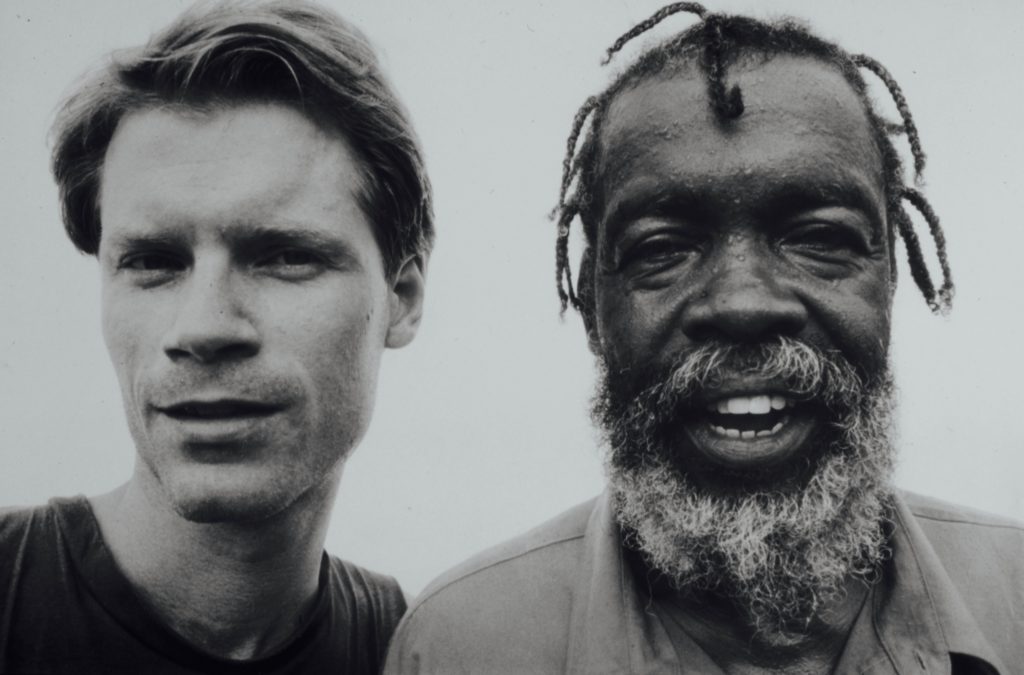
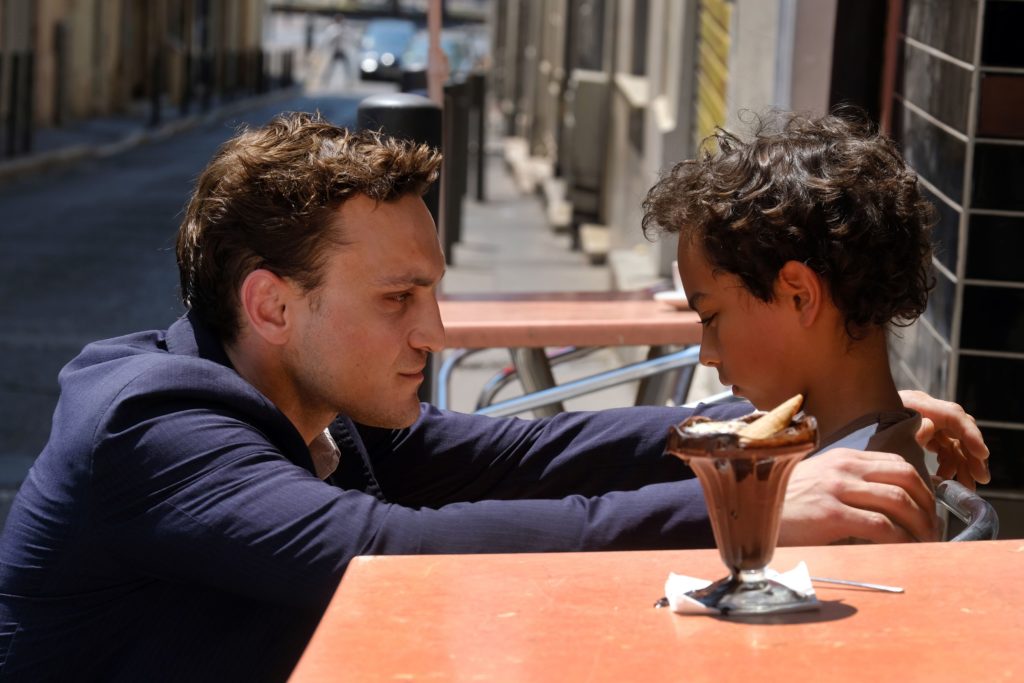
From L:R – Subjects Adam Gussow and Sterling “Mr. Satan” Magee in a still from SATAN & ADAM. Photo courtesy JFI
In the engaging documentary Satan & Adam, Adam, a young white Ivy Leaguer, takes a stroll through Harlem and encounters an older African-American street guitarist, who calls himself Mr. Satan. Adam, a talented amateur blues harmonica player sits in, and soon the odd couple are a busking team, a popular attraction at their regular sidewalk venue in Harlem.
“Mr. Satan” is an alias for an artist of note. Mr. Satan’s talent and the odd couple novelty allows the act to soar to totally unexpected heights. But Satan has emotional and medical issues, and Adam might be a better fit for a career in academia, so this is a story with plenty of unexpected twists and turns. Let’s just say that, over the past 23 years, there have been some significant detours on this journey.
The core of the film is about this unusual relationship and the peculiarities of these two guys, but it also traces the evolving race relations in NYC.
Satan & Adam is told primarily from Adam’s point of view, which is understandable because of Mr. Satan’s periodic unavailability and, when we see him unfiltered, his oft puzzling inscrutability.
I saw Satan & Adam at the San Francisco Jewish Film Festival (SFJFF), a fest noted or its especially rich documentaries. It has finally been released in at least one Bay Area theater.
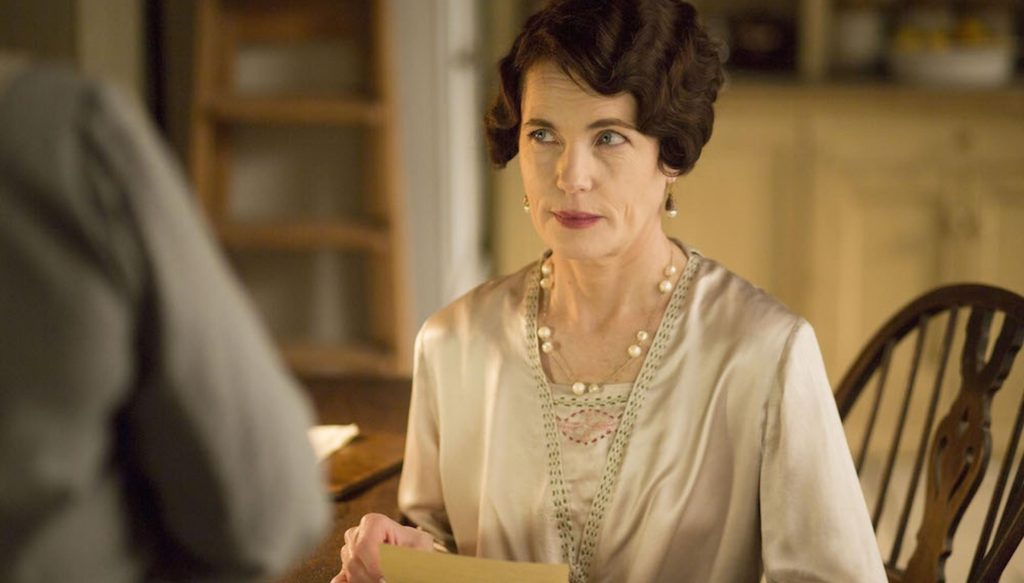
The Chaperone is a pleasing period tale of self-discovery in 1921 America. Louise Brooks (Haley Lu Richardson) is not yet the silent movie sex symbol that she would become; she’s a 15-year-old from Wichita who has a wonderful opportunity – she can attend a cutting edge NYC dance school, if only she can get a chaperone. Local Wichita matron Norma (Elizabeth McGovern) volunteers to be that chaperone. Highly spirited and supremely confident, Louise is a Wild Child who can shock Norma’s sensibilities. But we learn that Norma has a secret reason for leaving Wichita and another secret reason to visit New York City…
This could have been a standard Odd Couple-type romp, but it’s surprisingly deeper. That’s because it centers on the adult character of Norma and benefits from McGovern’s performance. She has a sense of decorum, but she’s not a garden-variety prude. She doesn’t really appreciate her own inner strength and what that strength has helped her survive already. Now, for the first time, she reflects on what it would take to achieve happiness for herself.
Of course, adoptees longing to find out about their biological parents, child sexual abuse, closeted homosexuality and passionless marriages all existed in 1921, but American society was ill-equipped to deal with (or even acknowledge) them. Those are the pivot points in this screenplay written by Downton Abbey’s Julian Fellowes.
Richardson’s persona as Louise does not resemble the sensuous adult Brooks, but she captures the youthful exuberance and confidence of the role. This is only the second American film for Hungarian actor Géza Röhri (from the brilliant but impossibly grim Son of Saul). Röhri is able to project a fundamental decency that is very appealing.
The Chaperone is a satisfying and easy watch, which I would expect to end up on PBS after its theatrical run. The Chaperone played at Cinequest in March.
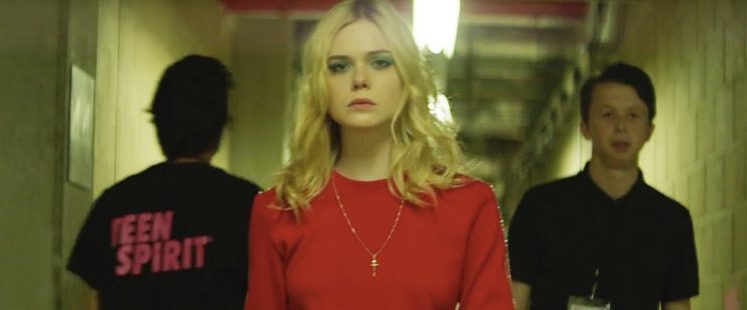
In the appealing Teen Spirit, Elle Fanning plays a Polish working class girl on the Isle of Wight who competes in a fictional British version of American Idol. Even though she is immensely talented, she is not one of the popular kids. And, recognizable as a teenager – she is bored and she resents being bored. Seemingly a hopeless underdog, she finds a mentor in the local barfly Vlad (Zlatko Buric), a former opera singer fallen on hard times.
Yes, Teen Spirit is firmly in the underdog competition genre – and we know that the story will climax in the Big Game, the Big Match or – as here – the Big Sing-off. As with any genre, one of these movies can be an empty, cliche-ridden formula or a masterpiece (Rocky) or something in between. Teen Spirit may not be a Rocky, but, thanks to writer-director Max Minghella, it is well-crafted and has a heart.
It should be noted that Elle Fanning actually does the singing in Teen Spirit – and sings very well. Given that Rami Malek just won an Oscar for lip-syncing, we should bestow a Nobel upon Fanning. She has an ethereal voice and has shown herself to be a fine actress who can carry a more challenging story than this. Both she and Buric are excellent.
First time director Minghella paces the film very well and delivers some flashy movie making, with fast cuts and pounding soundtrack, sometimes giving the effect of being inside a disco ball. All for the good. To his credit, Minghella also follows Billy Wilder’s screenwriting advice – when your story is finished, don’t hang around.
I saw Teen Spirit at Cinequest, and Elle Fanning appeared for a post-screening interview. Teen Spirit opens this weekend in the Bay Area.
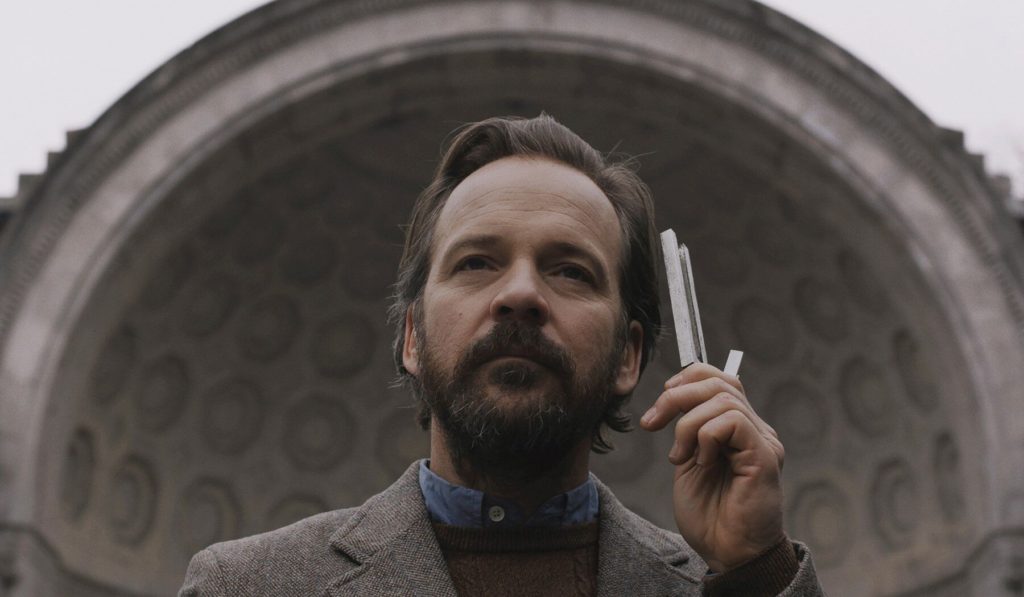
Peter Sarsgaard in Michael Tyburski’s THE SOUND OF SILENCE, playing at the San Francisco International Film Festival April 10-23. Courtesy of SFFILM
In the engrossing character study The Sound of Silence, Peter Lucian (Peter Sarsgaard) is obsessed with the musical tonality of the built environment. Having assigned each area of Manhattan its own distinct musical key, Lucian prowls the city, tuning forks in hand, to map its sounds.
Lucian pays the bills as a house tuner, bringing well-heeled apartment-owners a kind of auditory feng shui. Lucian is sought after to isolate the hum of a problem refrigerator or toaster that can make a living space depression-inducing. He’s even been profiled in The New Yorker.
But we sense that Peter Lucian is a little too confident in his expertise. He is disdainful of the corporate suits trying to monetize his discoveries. “This is about universal constance, not commerce.” In a mistake of hubris, Lucian takes on a research assistant (Tony Revolori – Zero the bell boy in The Grand Budapest Hotel). Lucian is jarred by corporate espionage, and starts to unravel when a respected scientist views him as a crank. Can he recover?
Peter Sarsgaard is a marvelous choice to play a cool obsessive who seems, at time, both blissfully above validation and desperate for it. In spite of his handsome, regular features, Sargaard’s gift for uncanny stillness helps him play creepy. Sarsgaard’s Lucian has the unintended capacity of reassuring other characters, but making then even more uncomfortable.
Rashida Jones plays Ellen, a Lucian client who is not just garden-variety neurotic, but has been so rocked by a tragedy that she remains profoundly unsettled. Jones is so talented as a comic actress, a voice artist, a documentarian and the writer of that rarest of things, a smart romantic comedy (Celeste and Jess Forever). Here, she shows her dramatic chops with a character who starts the movie adrift, but grows able to offer emotional safe harbor.
There’s even a welcome appearance by Austin Pendleton as a Lucian mentor of uncertain reliability. I’ve loved Pendleton since his turn in 1972’s What’s Up, Doc?. (Come to think of it, that movie had a musicologist obsessed with the inherent tonal qualities of igneous rocks.)
The Sound of Silence is the first feature for director and co-writer Michael Tyburski, and it’s a promising debut. Despite using an understated color palette, Tyburski delivers some stirring cinema with his use of sound. As Lucian looks over the city early in the morning, we hear a few musical notes, and then a full orchestra tuning up as the city awakens into its workday. When Lucian takes Ellen for a drink, it is to the quietest possible venue – a club with a decibel level somewhere between a library and a morgue; afterwards, Lucian emerges into urban cacophony. When an academic treats him like a crackpot, we all hear ringing, not just Lucian.
As one would hope, the sound design of The Sound of Silence is remarkable, and the score works very well. The April 14 San Francisco International Film Festival (SFFILM Festival) screening is at the Dolby Cinema, which should be a real treat.
The Sound of Silence premiered at Sundance, has distribution through Sony Pictures, and screens twice at the 2019 SFFILM.
Steve Bannon in THE BRINK, a Magnolia Pictures release. Photo courtesy of Magnolia Pictures.
The Brinkis documentarian Alison Klayman’s up-close-and-personal portrait of Steve Bannon, the outsized personality who founded Breitbart as a “platform for the alt right” and who encouraged Donald Trump’s race-baiting right into the White House.
But even Trump is not shameless enough to keep Bannon around – as The Brink opens, Bannon has just been fired from the Trump Administration in the wake of the wake of the Charlottesville disgrace (“very fine people on both sides“). Bannon is now embarking on a campaign of uniting the European populist Right around a common racist/ white supremicist/anti-immigration message.
Bannon, of course, is a genius at political messaging, and his major outcome was the once unthinkable re-emergence of public white supremicism – voicing those who lived under the dark, damp underside of rocks and logs with the other creepy-crawlies, and making them feel like they can walk the earth erect like other vertebrates.
Bannon is a major ham, and all too happy to let the world watch him in action. Bannon, of all people, is savvy enough to understand that Klayman is hostile to his beliefs and career,yet he granted her intimate access. His ego must not have allowed him to resist a movie about himself – or he learned from Trump that no publicity is bad publicity.
For her part, Alison Klayman (Ai Wei-wei: Never Sorry) is clever enough to let Bannon himself reveal his flaws. As he thinks he is showing us his skills, he is also showing himself to be an attention-craving blowhard. The horror isn’t that Bannon is some invincible evil mastermind but it’s in the masses (only glimpsed) that are so consumed by the fear and hatred that he peddles.
In the riveting opening sequence, Bannon describes how German technocrats designed the Birkenau death camp to be masterfully efficient. The banality of evil is not an original thought, but Bannon’s insights are more than a little scary (and his appreciation of Nazi efficiency is uncomfortable).
I found The Brink to be irresistible and watched with fascination. To those who have had their fill of the propagandists of the Right in Divide and Conquer: The Story of Roger Ailes and Get Me Roger Stone(with Paul Manafort as bonus, I say that The Brink still offers insights – and more satisfaction. Bannon wants his political skill to be validated, but The Brink reveals how pathetically he craves relevance.
Right: Juli Jakab as Írisz in SUNSET. Courtesy of Sony Pictures Classics
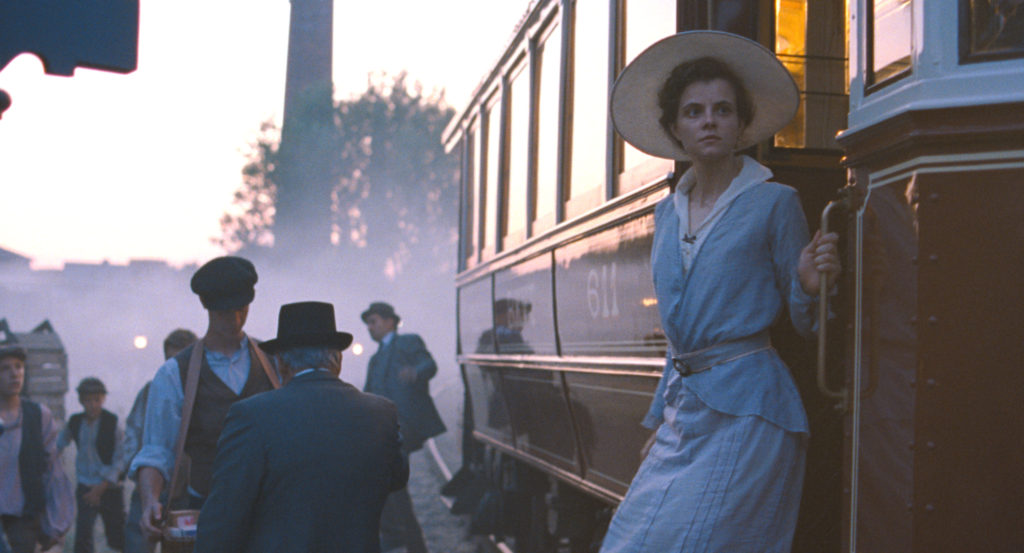
For the first hour-and-a-half of Sunset, I was convinced that I was watching the best movie of the year. Sunset is a visual masterpiece but the story’s coherence and pacing slips away in the final act.
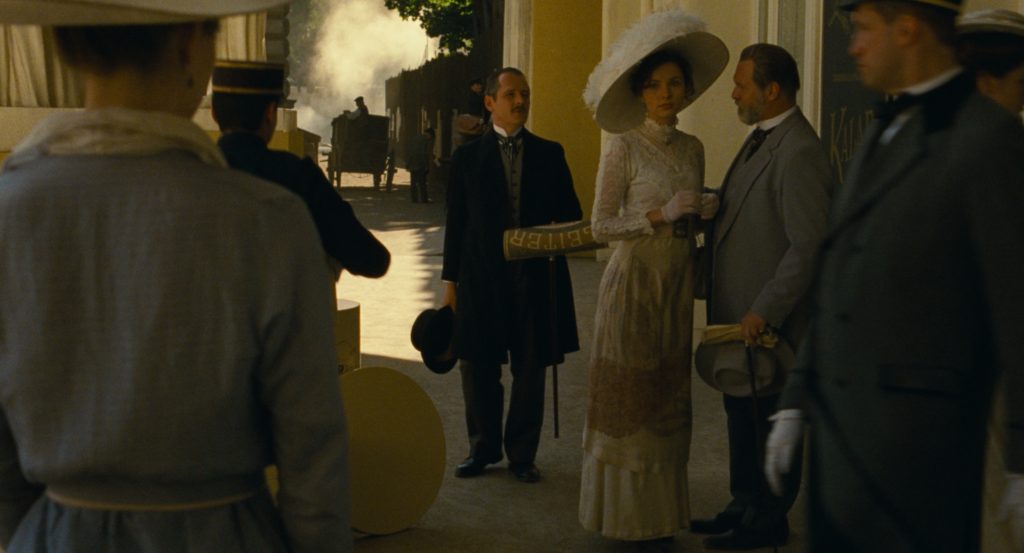
Set only months before the outbreak of World War I, anarchy is erupting as a response to corrupt, senile empires. The young woman Írisz Leiter (Juli Jakab), who was sent to Trieste at age two when her parents died, returns to Budapest and to her parents’ prestigious millinery store. That store – still hatmaker to the elite of the Austro-Hungarian Empire – is now owned by Oszkár Brill (Vlad Ivanov), who is threatened by her reappearance.
Írisz is determined to find out more about what happened to her parents, but she becomes entangled by one more mystery after another. She encounters a former family retainer who is mad, and an aristocratic widow who may be mad; they and some sympathetic milliners leak the shocking snippets. Soon she is surprised to learn that she has a sibling – but can she find him? Then she finds out about a notorious murder – but what really happened and why? She stumbles upon an anarchist plot – but against whom and when? And an upcoming royal visit has a decidedly sinister side.
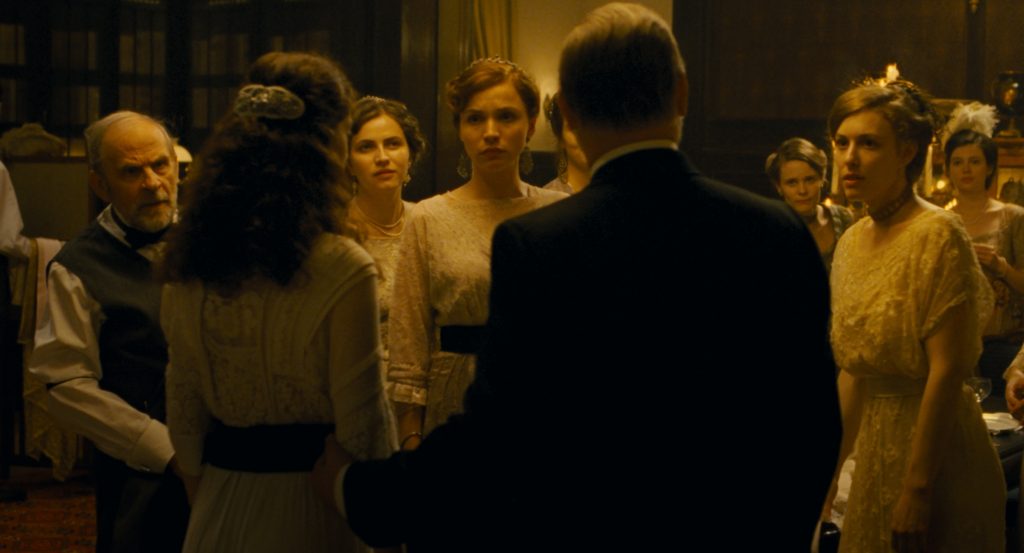
As Írisz insinuates herself in Brill’s squad of young female milliners, she plays detective, unspooling the web of mysteries. While the story is focused on Írisz’ family secrets, Sunset is gripping. When the story grows wider, into a royal perversion and an anarchist upheaval it gets less coherent and less compelling.
Sunset was written and directed by László Nemes, who burst into world cinema with the gripping, innovative and impossibly grim Son of Saul. That film won the Best Foreign Language Picture Oscar. Sunset’s cinematographer Mátyás Erdély won the American Society of Cinematographers Spotlight Award for Son of Saul.
From the painting of Budapest in the opening titles. Sunset is a feast for the eyes. I haven’t seen a film since Ida in which every frame is composed to be a stand alone piece of art. The color palette of the daytime scenes conjures a time that we know from sepia-tinged photos. The chiaroscuro in the nighttime scenes lit by early electricity and open flames is magnificent.
Right: Juli Jakab as Irisz Leiter in SUNSET. Courtesy of Sony Pictures ClassicsCenter: Evelin Dobos as Zelma, Vlad Ivanov as Oszkar Brill in SUNSET. Courtesy of Sony Pictures ClassicsCenter: Evelin Dobos as Zelma in SUN.SET. Courtesy of Sony Pictures Classics
Some have noted that the part of the always intense Írisz doesn’t offer much range for Juli Jakab. But Jakab is able to carry this film in which she’s in every scene, and I admired her performance.
Ivanov is best known for the Romanian masterpiece 4 Days, 3 Weeks and 2 Days, in which he played one of cinema’s most repellent characters, Mr. Bebe, the sexually harrassing abortionist. American audiences have also seen Ivanov’s performances in Police, Adjective and Snowpiercer. Hopefully, Ivanov’s star turn in Hier, which I reviewed for Cinequest, will get an American release.
Nemes, in partnership with his cinematographer Erdély is a peerless filmmaker, but he is not yet a peerless storyteller. I still recommend Sunset, even with its flaws, for its uncommon artistry.
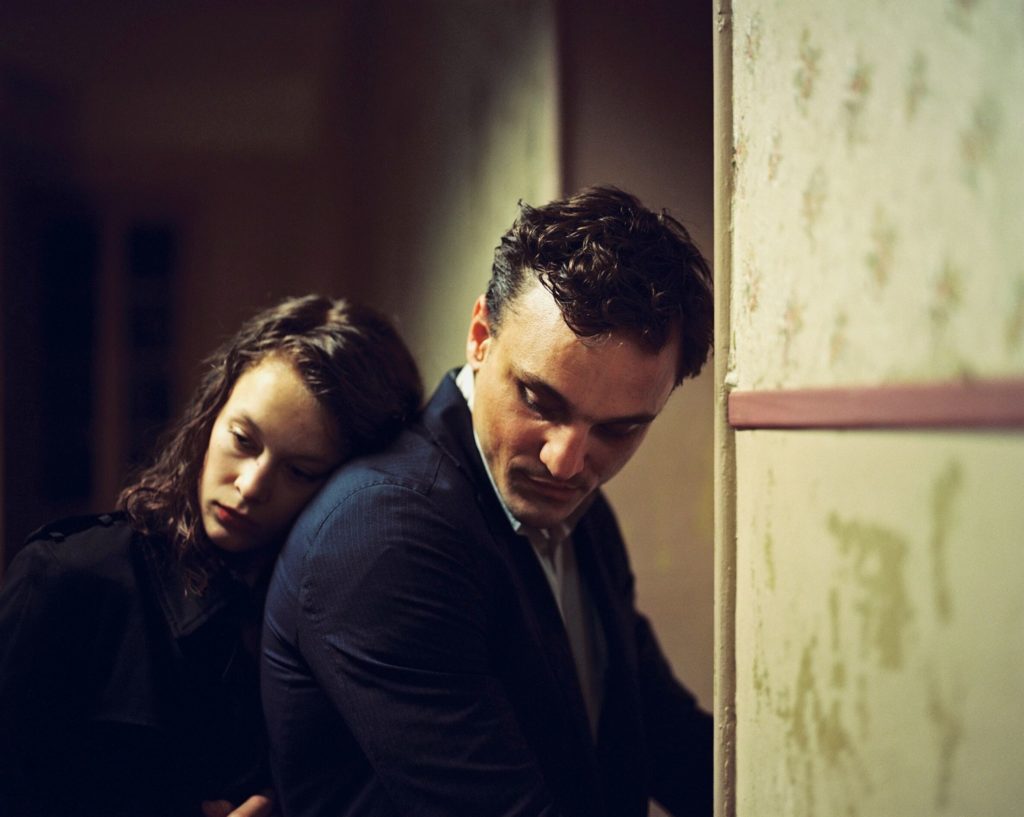
. Paula Beer and Franz Rogowski in TRANSIT. Courtesy of Music Box Films
In Christian Petzold’s puzzling thriller Transit, George (Franz Rogowski) flees Paris for his life, just ahead of the invading Nazis. He assumes the identity of a dead author, which comes with a ticket from Marseilles to the safety of the Western Hemisphere. Trouble is, the ship won’t leave for weeks, so he must wait it out in Marseilles as the Nazis get closer and closer. He finds himself in a community of other refugees – all forlornly hoping for a ticket, a visa, a letter of transit so they can get out, too. Completely at the disposal of impenetrable bureaucracies, their situation is Kafkaesque. It’s a puddle of human desperation, and the clock is ticking.
Georg glimpses a mysterious beauty, Marie (Paula Beer). She turns out to be the widow of the man that Georg is impersonating, but she doesn’t know that her husband is dead. What Georg knows is that he also has papers for her to join him on the escape ship. While waiting for her husband to appear in Marseilles, she has taken up with the altruistic doctor Richard (Godehard Giese).
So, we have European refugees holed up, trying to get letters of transit to escape the Nazis. Our protagonist is in love with a woman, who is with a selfless idealist. Yes, this story does have its similarities to Casablanca – there’s even a dramatic sacrifice at the end. But the impeccably plotted Casablanca is easy to follow, and Transit has its surreal aspects. Casablanca is of its time – when individuals subsumed their interests to a great, global cause: “I’m no good at being noble, but it doesn’t take much to see that the problems of three little people don’t amount to a hill of beans in this crazy world.” Set in the same wartime period, Transit is of our time – focused on the micro-plight of individuals.
I’m trying to think how to explain this – it’s a period story shot in modern times. So, the characters wear 1940s clothes and use 1940s typewriters. But the environs are modern Paris and Marseilles, so the storm troopers are modern French SWAT teams and the police vehicles are modern French cop cars with their Euro sirens. It may sound weird, but it worked for me. I just became absorbed in figuring out what was going on.
Franz Rogowski and Lilien Batman in TRANSIT. Courtesy of Music Box Films
There is a sweet and effective subplot involving Georg and a boy with a disability. Their relationship is the most relatable part of Transit.
Franz Rogowski (so good as Boxer in Victoria) has an intensity that pays off in his portrayal of Georg, who is either escaping or, when he has a moment, seeking. Beer captures Marie’s unreliability and fragility; she makes us understand why Georg’s would be so attracted to Marie – and why that might not work out for him.
At some point in Marseilles, Transit lost me. I still was engaged in the intellectual execise of figuring out the puzzles, but I stopped caring about Georg and Marie. Christian Petzold’s previous films Barbara and Phoenix prove that he is an exceptional filmmaker. Transit, for all its originality just isn’t Petzold’s best.
Salma Hayek and Jesse Eisenberg in THE HUMMINGBIRD PROJECT
In The Hummingbird Project, two brothers take on Wall Street power in a race to build a fiber-optic cable network from Kansas City to New York City. They plan to take advantage of getting financial data several nanoseconds before everyone else and to become zillionaires. Vincent (Jesse Eisenberg) is the wheeler-dealer and Anton (Alexander Skarsgård) is the technical whiz. It’s a ridiculously audacious bet, and the movie is about whether they can pull it off.
Their ruthless Wall Street competition is personalized in the character played by Salma Hayek. Hayek is okay, but she appears to be performing in a different (and better) movie than the other leads.
The Hummingbird Project doesn’t quite work. Eisenberg is not a stranger to jittery, fast-talking roles. But here, he accelerates into auctioneer-pacing, and he speaks so quickly that it’s hard to follow. There’s too much film footage invested in the cable-laying procedural. And why the hell does Vincent return a THIRD time to visit the Amish farmers in the rainstorm?
There are two good scenes in The Hummingbird Project, both involving Anton. In one, he decides to physically run away from the FBI and, in the other, he exacts some hacking revenge on the Wall Street baddies.
I saw The Hummingbird Project at Cinequest, and it is now playing in Bay Area theaters.
A scene from Denali Tiller’s TRE MAISON DASAN, playing at the 2018 San Francisco International Film Festival, April 4 – 17, 2018. Courtesy of SFFILM.
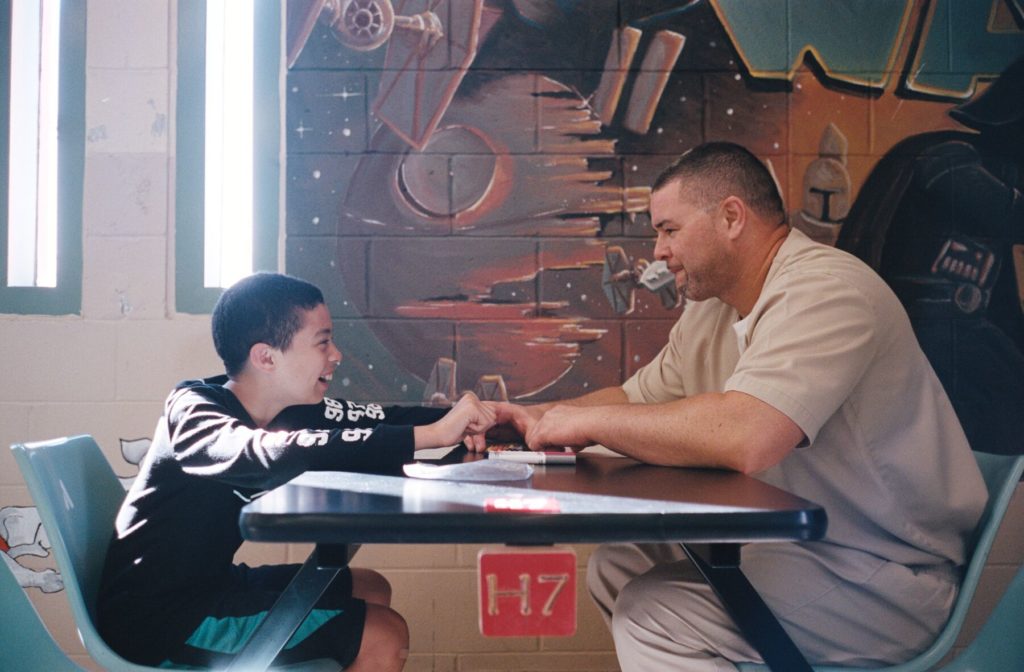
The unwavering and emotionally powerful documentary Tre Maison Dasan was my top pick from the World Premieres at the 2018 San Francisco International Film Festival (SFFILM) – and you can finally watch on TV this weekend. The title reflects the names of three Rhode Island boys with incarcerated parents. Unfettered by talking heads, Tre Maison Dasan invites us along with these kids as they interact with their families – both on the outside and the inside. It’s all about the kids, all of the time – an effective choice by writer-director Denali Tiller In her feature debut.
One of the parents is released from prison early in the film; the other two are going to stay there during critical developmental periods in their children’s lives. Tre, Maison and Dasan are each taking different paths. One kid is getting wonderful nurturing and guidance from a released parent, and lots of support from the community; we sense that he’s going to be OK. That’s not the case with all of the kids.
Tiller doesn’t get academic or partisan. By simply showing the impact on these children of having a parent incarcerated, she gets our attention and sympathy. Tre Maison Dasan may not be a call to action in itself, but it’s an essential predicate. PBS is airing Tre Maison Dasan on its Independent Lens series on April 1; you’ll also be able to stream it on PBS.
Rich Kids has topicality going for it, as it explores our society’s disparity of wealth. Matias (Gerardo Velasquez), his brainy crush Vanessa (Michelle Magallon) and their pals are dirt poor teens. There’s a nearby vacant luxury home, and the kids hop the fence for a dip in the pool. The pool party moves inside, and the kids get to experience what to them is fantasy opulence. Drama ensues.
Unfortunately, Rich Kids wears its social message on its sleeve. The dialogue is too obvious and heavy-handed. Rich Kids becomes a predictable screed. Most of the actors playing the kids are too old to pass for high school students, and they just aren’t able to elevate the dialogue.
On the other hand, the opening scene pulses with verisimilitude, and the actors who play Matias’ parents (who I believe are Ricky Catter and Amelia Rico) are really good.