THE LAST DUEL: power, gender, superstition and knights in armor

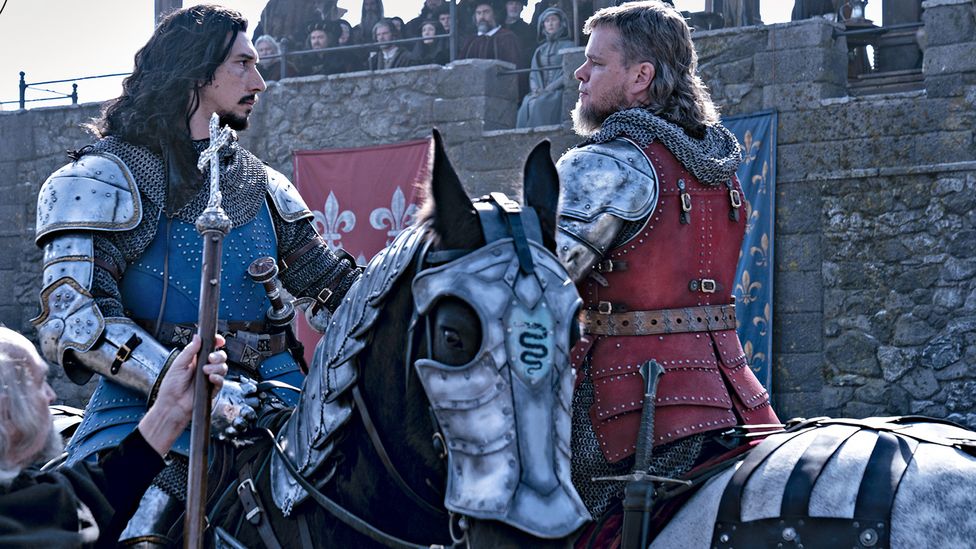
Photo caption: Adam Driver and Matt Damon in THE LAST DUEL. Courtesy 20th Century Studios.

Based on accounts of the last medieval trial by combat, The Last Duel is both a thriller and a thinker. Director Ridley Scott (Alien, Blade Runner, Thelma & Louise, Gladiator, The Martian) brings alive medieval superstition and savagery, and embeds an exploration of the power dynamics within feudal society, especially for women.

The setting is France in the 1380s. Jean (Matt Damon) and Jacques (Adam Driver) have been born into the nobility as squires, which means that they serve as mounted, armored warriors and can own land and castles supported by their very own peasants. Jean is later promoted to the higher title of knight. That puts Jean and Jacques in the elite one percent, but they are totally subservient to the region’s count, Pierre (Ben Affleck), who in turn owes the same absolute fealty to King Charles VI (check him out on Wikipedia).

Jean is an impressive fighter, but not very strategic. He’s a dunderhead, devoid of any social or political skill. Jean has married the beautiful and intelligent aristocrat Marguerite (Jodie Comer), whose father had fallen out of royal favor. Try as she might, Marguerite is only moderately successful in helping Jean from bulling his way through life’s china shop.

Jacques is a canny smoothy, with a rare business sense and charm that melts the ladies. Those financial smarts, along with his appreciation for culture, makes Jacques a protege of Pierre, the count. Pierre favors favors Jacques over Jean, who resents it.

Finding Marguerite alone at home, Jacques rapes her. When Marguerite accuses him, Jacques denies it. Jean presses the case, which culminates in the film’s titular trial by combat.

Ridley Scott tells the story first from Jean’s point of view, then from Jacques’ and, finally, from Margeurite’s. Unlike in Rashomon, the three versions of what occurred don’t diverge much from each other. Instead, we see how Jean and Jacques, who both adhere to the code of their class, see themselves. Jean really thinks that he is a good husband. Jacques, although he has forced himself on Marguerite without her consent, really doesn’t think he has committed rape. (They have their Code of Chivalry, but it sure isn’t very chivalrous.)

Jodie Comer in THE LAST DUEL. Courtesy 20th Century Studios.

We learn that, in 1300s European legality, rape wasn’t even a violent crime against the woman, but was a property crime against her guardian; (she was essentially the property of her father or husband). Ridley Scott slyly emphasizes this when he shows Jean’s reaction to an equine assault on his favorite breeding mare.

Margeurite’s insistence on bringing the rape charge publicly is a major problem for both Jean and for Jacques. It’s also an annoying inconvenience for the count, the king and the Church, who would sweep it under the rug. Jean thinks that he cleverly found away around the cover-up, but he overlooks one disturbing factor – if he dies in the duel, Marguerite will be immediately burned at the stake.

The performances by Comer, Driver, Damon and Affleck are all excellent. Harriet Walker is very good as Jean’s mother, a role which seems at first like a stereotypical stereotypical shrewish mother-in-law, until we learn of her own complicated journey navigating a world where men are unaccountable.

Scott shows us some savage medieval battles to prepare us for the final duel. Warfare at the time was desperate and brutal hand-to-hand butchery, within a sword’s length, like fighting in a phone booth. To stab, slash or impale an opponent, a combatant needed to find an unarmored body part. The jousting in The Last Duel seems especially authentic.

The Wife didn’t want to accompany me when I described it as the “medieval rape movie”; I should have said it’s the “trial by combat movie”.

I was late to The Last Duel, catching up with it several months after its summer 2021 release. Due to the distributor’s blustery publicity campaign, I had underestimated it; it’s one of the Best Movies of 2021, The Last Duel is streaming from Amazon, AppleTV, Vudu, YouTube, HBO and redbox.

A SONG FOR CESAR: the arts embedded in activism

Photo caption: A SONG FOR CESAR. Courtesy of Juno Films.

A Song for Cesar is a rich documentary on the role of music and the arts in the critical years of Cesar Chavez’s United Farm Worker movement – so rich that it’s much more than that. There’s a time capsule of the turbulent 1960s, the story of emerging Chicano identity and a meditation on the role of arts in political activism – all embedded in a compelling history lesson.

A Song for Cesar shows us how music and the UFW uplifted each other. Anthems were used in mobilizing, and benefit concerts were a major pillar of UFW fundraising. In the other direction, Cesar Chavez and the movement inspired a generation of Chicano musical artists. We hear directly from a veritable Who’s Who of Chicano musicians from Malo, El Chicano, Tower of Power, War, Santana and Los Lobos through Ozomotli. The memories of UFW allies like Taj Mahal and Joan Baez are also central to A Song for Cesar.

It’s not just only about music, either – the importance of murals and theater are highlighted. We hear from Luis Valdez, founder of Teatro Campesino, about the beginnings of Teatro and its place in the movement.

A Song for Cesar captures the zeitgeist of the time. The UFW’s organizing campaign coincided with (as well as inspiring) new Chicano identity and pride. As Tower of Power’s Emilio Castillo says, “People were ready to protest for social change.They weren’t going for the old okey-doke no more.” 

A Song for Cesar reminds us of the mass casualty tragedies that galvanized the Farm Worker movement, along with the low pay, wage theft, horrid working conditions and exploitation. (A personal reflection: when I think of the cruelty, disrespect and social control embodied in the short handled hoe, I still get pissed off.) Exceptionally well-sourced, A Song for Cesar presents first-hand recollections of Chavez family members, UFW leader Dolores Huerta and other participants. The UFW history is deep enough to acknowledge the overlooked role of Filipinos in the UFW, with Larry Itliong as a co-founder of the union.

The Farm Workers had to face goon violence from the growers and infiltration by racist law enforcement. It becomes all the more relatable when Luis Valdez describes facing the violence with non-violence in very personal terms. A Song for Cesar is solid history and an important document of the times.

A Song for Cesar is filled with cool tidbits, like how Cesar Chavez was himself a big jazz fan, who would comb record store bins whenever he had the chance. Who knew?

A Song for Cesar opens this weekend, and will have March 18-24 runs at the Opera Plaza and the Smith San Rafael.

ADVENTURES IN SUCCESS: sending up seekers

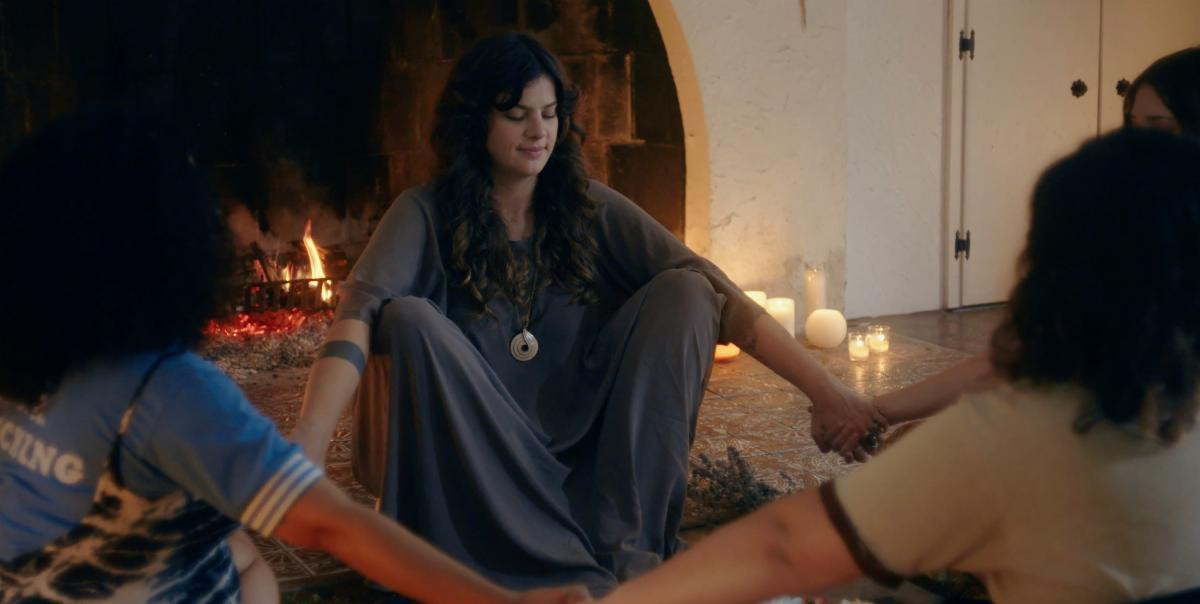
Photo caption: Lexie Mountain in ADVENTURES IN SUCCESS. Photo courtesy of Nashville Film Festival.

The broadly comic Adventures in Success traces the misadventures of a self-help retreat center led by Peggy (Lexie Mountain), a self-described energy transformationist. Peggy claims to have experienced a 12-hour orgasm. Her movement is centered on the female orgasm, the mantra is Jilling Off, and the sessions are essentially orgies where men are not allowed to ejaculate.

Of course, Adventures in Success sends up self-help movements, New Age affectations, and, especially, would-be cult leaders. As Peggy, Lexie Mountain projects a demented self-assurance.

The comic tone is set early – the opening shot is an impressive 28-second performance of urination art.

ADVENTURES IN SUCCESS. Photo courtesy of Nashville Film Festival.

There some inspired LOL moments, but Adventures in Success is not a laugh-a-minute. It runs out of energy when the group takes a final, doomed bus trip to Vegas.

Cinequest hosted the world premiere of Adventures in Success; I screened it for the Nashville Film Festival. Adventures in Success is streaming from Amazon and AppleTV.

THE WORST PERSON IN THE WORLD: funny, poignant, original and profoundly authentic

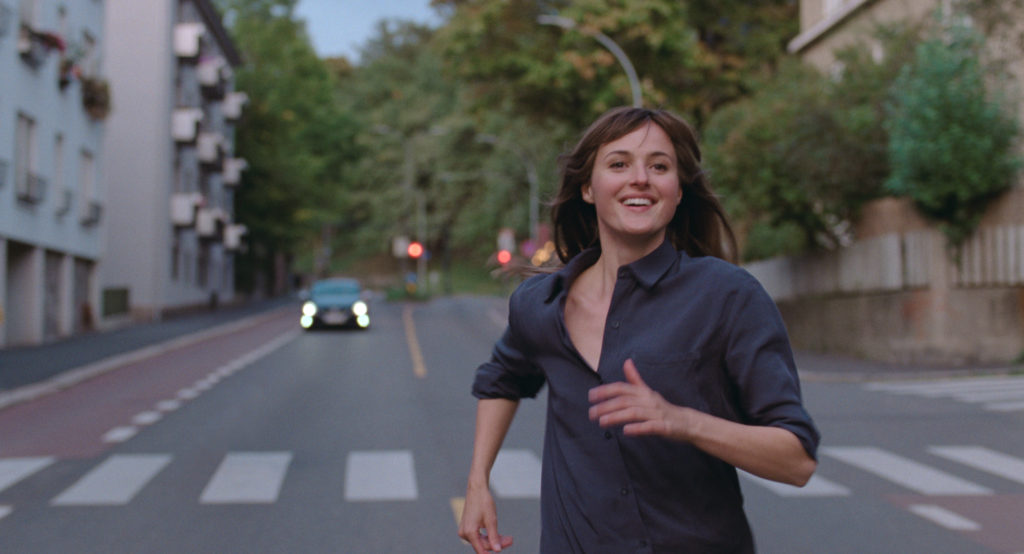
Photo caption: Renate Reinsve in THE WORST PERSON IN THE WORLD. Courtesy of NEON.

In writer-director Joachim Trier’s masterpiece The Worst Person in the World, Julie (Renate Reinsve) is roaring through her life like a locomotive in search of tracks. She’s a medical student until she isn’t, having decided that her passion is psychology instead. Then, she’s convinced her avocation is photography. Each career plunge is accompanied by a new hairstyle and a new boyfriend. She’s charming and talented – and completely restless and unreliable. Surely she can’t keep up this pace of self-invention forever, can she?

Julie falls in love with Aksel (Anders Danielsen Lie) a graphic novelist in his forties, and settles into a dead end retail job in a bookstore and a role as the young companion of a literary figure. Rocking a black cocktail dress for an event celebrating Aksel, she sneaks out and crashes another party. There, she meets the barista Eivind (Herbert Nordrum), and they flirt, after deciding not to cheat on their partners.

Is Julie going to dump Aksel and break up Eivind’s relationship? Real life is more complicated than that, and so is The Worst Person in the World, which maintains a profound authenticity through its moments of silliness, sexiness and poignancy.

I’ve been a huge fan of Trier, since his first feature Reprise, which I named the 4th best movie of 2005. I didn’t care for his well-crafted follow-up Oslo, August 31. But I’ve been strongly recommending his under appreciated Louder Than Bombs. Reprise is available to stream on Amazon, and you can find the other two on many streaming platforms.

Famed director Howard Hawks said that a great movie has “three great scenes and no bad scenes.” There are no bad scenes in The Worst Person in the World, and Trier hits Hawk’s mark with the moments when:

  • Julie, on her 30th birthday, reflects on what her mother, grandmother and other female ancestors were doing when they were 30.
  • Julie and Eivind meet and share nonsexual intimacies – which is smolderingly sexy.
  • Time stands still for the rest of Oslo when Julie has the impulse to find Eivind again.

The title of the film does not refer to Julie; it’s a self-deprecating joke by another character, who is a good person himself.

Renate Reinsve is relentlessly appealing as Julie; Reinsve won the best actress award at Cannes. Lie (who starred in Reprise and Oslo, August 31) and Nordrum are also superb.

Technically, The Worst Person in the World is a romantic comedy, but it’s so smart, so authentic and so original, I can’t bring myself to describe it as such. This is one of the best movies of 2022. The Worst Person in the World is Oscar-nominated both for Trier’s screenplay and for best international feature film.

PIG: he may LOOK deranged, but…

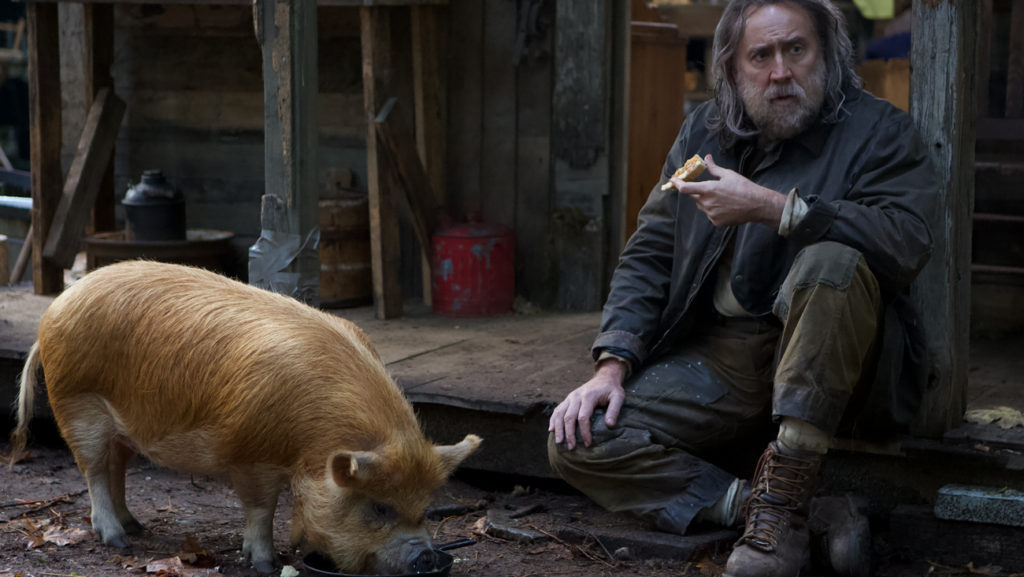
Photo caption: Nicolas Cage (right) in PIG. Courtesy of NEON.

When we first meet Pig’s protagonist Rob (Nicolas Cage), he is living off the grid deep in a Pacific Northwest forest. Rob hunts truffles with his beloved pig. Once a week, Amir (Alex Wolff), a hustler from Portland, arrives to buy the week’s harvest. That is Rob’s only interaction with the human race, and he prefers not to converse with Amir. Rob is filthy, even in comparison to the pig.

When the pig is kidnapped (or pignapped?), Rob forces Amir to drive him into and around Portland on a quest to rescue the pig. As the quest continues, we learn some surprising things about Rob.

Initially, we would assume that Rob, with his crazy homeless guy look, is a broken man, withdrawing from society because a trauma, a failure, a mental breakdown or an addiction has sapped him of his abilities. It turns out that Rob has suffered a loss, but we’re surprised to learn that Rob is revered by an entire community within Portland. In personal grief, and motivated by his assessment of a coming environmental apocalypse, he has chosen to withdraw. He may LOOK like a deranged derelict, but, when he chooses to be, he is very functional.

Pig is the first feature for writer-director Michael Sarnoski, and it’s pretty entertaining.

Sarnoski has created an extreme character in Rob, and who is better at extreme characters than Nicolas Cage? This is Cage’s best performance in years. Rob is a man with a firm beliefs and a rigid code – and he takes them to their logical extremes, however uncomfortable they seem, and Cage credibly shows us a character with resolute self-assurance and impressive skills.

Alex Wolff is suitably annoying as the callow and loquacious Amir, who fashions himself more of a player than he really is. Amir is smart enough to know that he is no match for his father Darius – a very serious guy. Adam Arkin plays Darius’ ruthlessness (and his one vulnerability) convincingly.

Pig is streaming on Amazon, AppleTV, Vudu, YouTube, Hulu and redbox.

MY BEST PART: growing up, with a boost from mom

Photo caption: Nicolas Maury in MY BEST PART. Courtesy of Altered Innocence.

In the French coming of age dramedy My Best Part, the young actor Jérémie (Nicolas Maury) is teetering on the verge of a breakdown. Not that Jérémie is generally a stable person – he is so needy and dramatic that he attends Jealous Anonymous.  But he loses a gig that he was counting on, his credit card is declined, and worst of all, Jérémie’s smothering jealousy sabotages his relationship with his veterinarian boyfriend (Arnaud Valois), Jérémie’s neurotic fit having disrupted ferret surgery.

With his tail between his legs, Jérémie Paris retreats to hos boyhood home in rural Limousin (the area around Limoges) and the arms of his mother (Nathalie Baye). Jérémie is open to infantilization, but the matter-of-fact Mom is anything but neurotic. With prodding from his mom, will he start behaving like a sane, stable grownup and get his life back on the rails?

Nathalie Baye and Nicolas Maury in MY BEST PART. Courtesy of Altered Innocence.

I’ll watch ten-time César Award nominee Nathalie Baye in anything. Here, in an unchallenging role, she brightens every scene with the sniveling son.

One of the world’s funniest actors, Laure Calamy gets to play a hilarious meltdown in a brief turn as a narcissistic film director.

My Best Part is the feature directing debut for Maury, who also co-wrote the screenplay. My Best Part was nominated for the César for Best First Film.

Parts of My Best Part drag, especially a slooooooow nighttime poolside scene. The final scene, in which Jérémie sings lyrics that explicitly detail his character’s growth, is off-putting and self-indulgent.

My Best Part opens Feb 25 on VOD and at the Glendale Laemmle.

SUNDOWN: checked out, really checked out

Photo capon: Tim Roth in SUNDOWN. Courtesy of Bleecker Street.

In Sundown, Neil Bennett (Tim Roth) and the hard-charging CEO Alice Bennett (Charlotte Gainsbourg) are vacationing with two college age kids at a luxurious Acapulco resort. Their family matriarch unexpectedly dies and – of course! – they immediately head to the airport to organize the funeral in the UK. But Neil fakes an excuse and avoids getting on the plane, vowing to come along soon. Instead, he does the unthinkable and essentially hides out from the family.

Instead of returning to the resort, Neil moves into a downscale hotel near Acapulco’s public beach. Other than wandering to the beach to commandeer a plastic chair and an ice bucket of cerveza, Neil doesn’t do much for the rest of Sundown. Notably, he does make the acquaintance of a friendly local woman, Berenice (Iazua Larios). Berenice speaks very little English, and Neil speaks essentially no Spanish.

Iazua Larios in SUNDOWN. Courtesy of Bleecker Street.

Writer-director Michel Franco gradually unspins his tale, and we learn how the Bennetts are related and how wealthy they are. But Franco leaves it to us to figure out why Neil is behaving in this way. Is it just awful behavior – irresponsible and selfish? Is he suffering from a psychiatric or neurological disorder?

From the very beginning of Sundown, Neil’s affect is oddly detached and passive. Is he blissed out on vacation? Is he stoned? Bur he soon becomes bizarrely avoidant. And Neil is firmly purposeful in his detachment. A much better director than writer, Michel gives us so little back story, that we really don’t know how divergent Neil’s behavior is. The critic Mick LaSalle observes, “He consistently seems calmer than he should be, so we wonder what he knows.“.

In any case, Sundown is a portrait of a man who is checked out – for an unknown reason and to an explicable extent. We are curious and decidedly not empathetic; his withdrawal from normal obligations causes harm to others – others who at least deserve an explanation.

Sundown’s 82 minutes is hypnotic. Franco is a Mexico City native and brings verisimilitude to the contrasting tiers of Acapulco beach life.

Tim Roth is excellent as a man who is determined to get what he wants, even though what he wants is essentially nothing. Franco and Roth worked together on Chronic.

Iazua Larios is extraordinarily compelling as Berenice, who seems, well, very casual at first, and becomes more complicated. The character of Berenice starts out as an adornment, but she will become the ultimate test of whether there is any limit to Neil’s detachment.

Sundown is a paradox – an unenjoyable observation of an unsympathetic character doing nothing, yet an engaging portrait of an extreme and puzzling personality.

THE LOST DAUGHTER: maddening mothering

Photo caption: Olivia Colman in THE LOST DAUGHTER. Courtesy of Netflix.

The Lost Daughter is a dark thinkpiece about the impact of maternal obligation to a talented and ambitious woman. We meet Leda (Olivia Colman), a middle-aged comparative literature professor as she arrives for a vacation at a Greek beach. Leda is comfortable traveling alone, and decidedly not sociable.

Leda’s tranquility is harshly disrupted when a large, rambunctious family spills onto the beach from a nearby rental villa, shepherded by their force of nature alpha female Callie (Dagmara Dominczyk). This crowd is a course, vulgar and shady family of Greek-Americans from Queens. Leda is resentful, but she is also intrigued by Nina (Dakota Johnson), a young mother who is unhappily exhausted by parenting her little girl.

When Callie makes neighborly chitchat, Leda pointedly says to Nina, “Kids are a crushing responsibility“. When Leda takes an action that is inexplicable and troubling, we start wondering, “what is going on with her?”. Thereby launches a slow burn exploration of how custodial parents, trapped by their responsibility to always be “on the job” without respite or support, can become drained, depressed, even maddened.

We see flashbacks of a young Leda (Jessie Buckley), a promising scholar on the verge of emerging as a major thought leader, getting whipsawed by her two young daughters, who are adorable yet relentlessly needy.

The young Leda meets a backpacker, who gives her an insight into obligation: “Attention is the rarest and purest form of generosity”. Then, young Leda makes a decision that has major ramifications for her career, her family and which still molds the person who is on the Greek beach today.

The Lost Daughter does not take a Hallmark card, children are such a joy view of motherhood. Parenting is complicated, and it challenges different people differently.

The actress Maggie Gyllenhaal directed (this is her debut) and adapted the screenplay from the novel by Elena Ferrante.

Olivia Colman in THE LOST DAUGHTER. Courtesy of Netflix.

Olivia Colman is brilliant as Leda – so contained and self-confident yet utterly unpredictable. You just gotta keep watching this seemingly staid woman and see how she is going to surprise us next. Colman has earned a best actress Oscar nomination for this performance..

Olivia Colman is now 48, but I didn’t appreciate her until the 2013-17 series Broadchurch. Since 2018, she’s compiled an astonishing body of work – winning the Best Actress Oscar for The Favourite, being Oscar-nominated for The Father, and wining the best actress Emmy for playing Queen Elizabeth II in The Crown.

Jessie Buckley in THE LOST DAUGHTER. Courtesy of Netflix.

Jessie Buckley, one of my favorites since her debut in the psychological thriller Beast, has earned a best supporting actress nomination.

Ed Harris and Peter Sarsgaard (Gyllenhaal’s real-life hubbie) are excellent in minor supporting roles.

The Lost Daughter is a thinker with two superb performances, but it may be too dark and unsettling for many audiences. The Lost Daughter is streaming on Netflix.

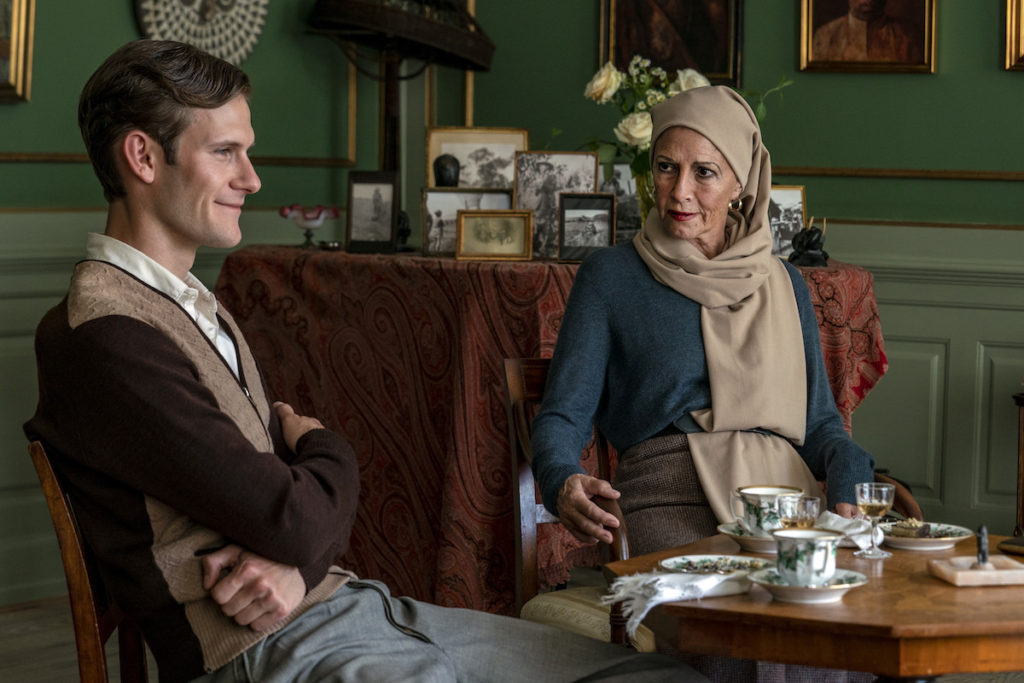
THE PACT: a pawn in someone else’s story

Simon Bennebjerg and Birthe Neumann in THE PACT. Photo by Rolf Konow courtesy of Juno Films.

The Pact is the story of a real life Faustian bargain. In 1948, Karen Blixen (Birthe Neumann) was the rock star of Danish literature, having written Out of Africa under the pen name Isak Dinesen. Blixen was also a baroness, and from her seafront country estate near Copenhagen, she presided over a salon of leading Danish intellectuals and artists.

Thorkild Bjørnvig (Simon Bennebjerg) was an unknown poet whose promise intrigued Blixen. Blixen offered Bjørnvig the titular pact – she would help him achieve his artistic potential, but only if he followed all her guidance. She is transparent – she only cares about elevating his writing, not about his family or his personal happiness. Driven by ambition and entranced by her magnetism, he takes the deal.

She immediately finds him a financial patron and moves him into her estate to write without the distractions of his wife and their adorable but chirpy toddler. His writing starts to blossom, but then her direction becomes more and more intrusive. Soon she dictates his daily schedule, where he lives and even who he sleeps with.

She isolates him from his family, and he doesn’t know what, if any, power he still has.

Does a real life Faustian bargain sound farfetched? This really happened. Director Bille August (the Oscar winning Pelle the Conqueror) adapted the screenplay from Bjørnvig’s memoir.

Simon Bennebjerg and Birthe Neumann in THE PACT. Photo by Rolf Konow courtesy of Juno Films.

Although the story is told from Bjørnvig’s point of view, it’s really about what makes the singular Blixen tick. The Pact works because of Birthe Neumann’s exquisite performance as a woman who masks her neediness with a steely willfulness. Neumann had a key role in the 1998 classic Festen.

Tellingly, Blixen says, “It’s you who need to understand that we’re all playing a role in the story.” Not A story, but THE story. Blixen’s story.

Bennebjerg ably portrays Bjørnvig, a character difficult to sympathize with because of his submissiveness and his willingness to expose others to Blixen’s cruelty.

Naturally, Bjørnvig’s wife finds herself whipsawed as he follows Blixen’s whims. Nanna Skaarup Voss is very good in a role that seems doomed to passive victimhood until she delivers a definitive insight near the end of the story.

Asta Kamma August is also excellent as a sweet innocent whose life is upended by Blixen’s manipulation.

Throughout the film, other characters address Bjørnvig as magister, an unfamiliar word for me. Magister is a medieval term for scholar still in use in 1940s Denmark.

The Pact is opening in theaters, including at the Bay Area’s Opera Plaza and the Rafael on February 18.

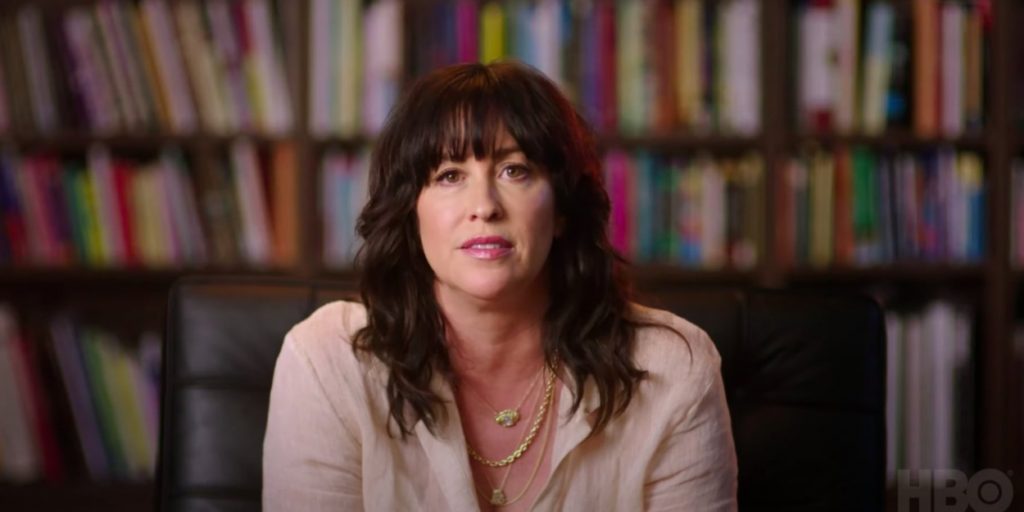
JAGGED: clear-eyed, but not that angry after all

Photo caption: Alanis Morissette in JAGGED. Courtesy of HBO.

Jagged is a surprisingly addictive biodoc of singer-songwriter Alanis Morissette, packed with Morissette’s own reflections. Jagged traces Morissette’s beginnings as a child prodigy and teen pop princess (big hair and all) to the point where she matured into an innovative songwriter and groundbreaking stadium act.

The deepest dive is appropriately on Morissette’s debut album Jagged Little Pill and the 18-month concert tour to support it. With sales of over 33 million, Jagged Little Pill is still the number one selling album by a woman. It’s amazing to reflect that Morissette was only 19-20 when writing the songs and only 20-21 on the tour.

Alanis Morissette in JAGGED. Courtesy of HBO.

Of course, Morissette’s breakthrough came with one of the bitterest of all breakup songs, You Oughta Know, raising the question of just how angry is she? Not at all, says Morissette, who notes that she released her anger in the writing of You Oughta Know and moved on.

Director Alison Klayman (Ai Weiwei: Never Sorry) takes us back to the 1994 media coverage, by male music writers, of Morissette as Angry Young Woman. Jagged takes advantage of lots of candid backstage/tour bus footage from the tour; and that Morissette is an even-tempered and playful person, not even temperamental, let alone raging.

In her years a teen pop singer, Morissette was allowed to tour the world without parental protection, which predictably made her vulnerable to exploitation by older men. It’s really worth watching Jagged to hear Morissette’s framing of how women publicly discuss sexual abuse years afterwards: “They weren’t silent. The culture wasn’t listening.”

Oddly, Morissette herself is unhappy with the documentary, calling it “salacious”. I thought that Klayton handled Morissette’s own words about her sexual abuse in a way that was the opposite of salacious. Klayton has Morissette present herself as insightful and well-grounded, which adds up to a flattering impression.

Jagged is streaming on HBO.