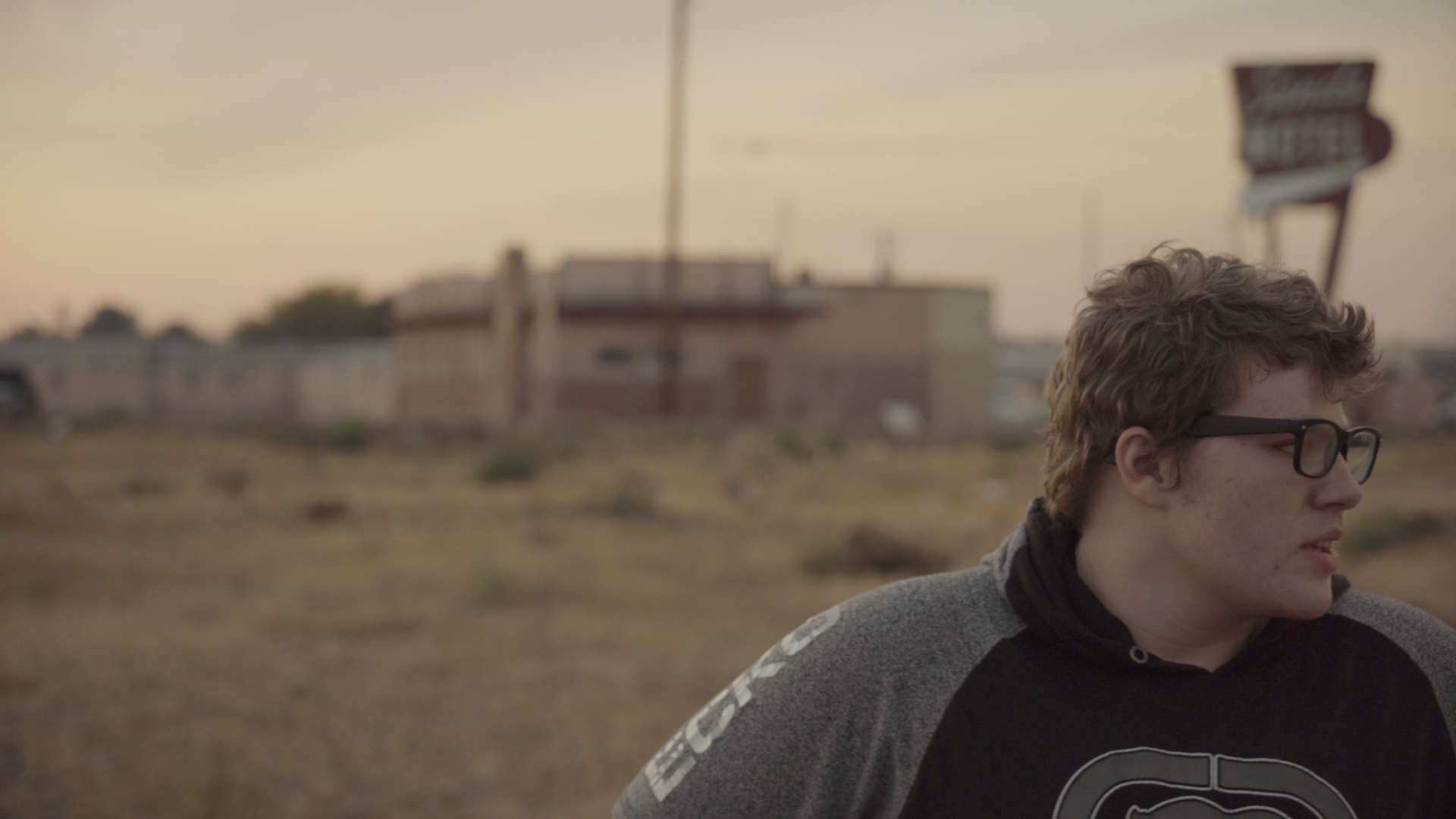
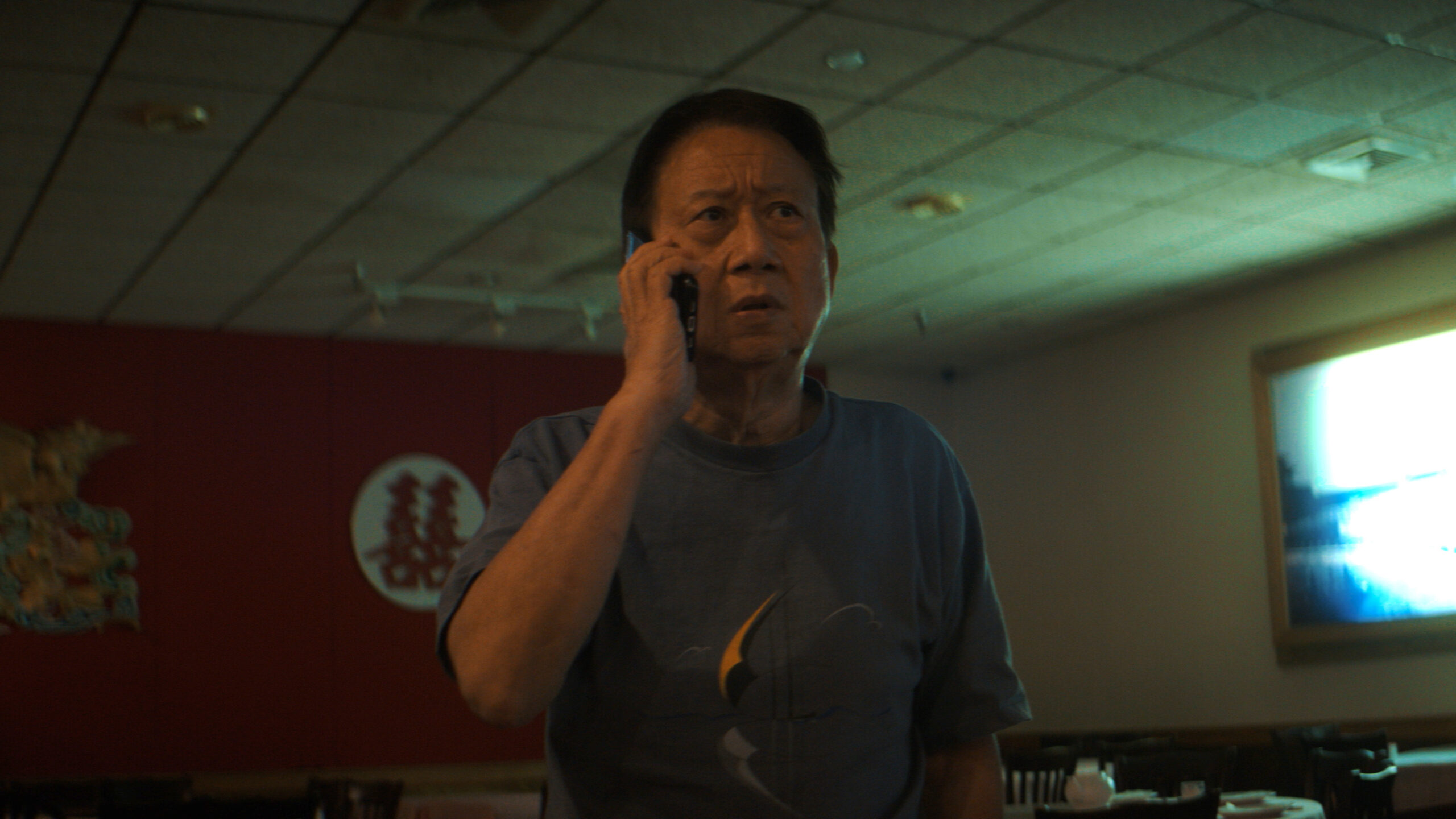
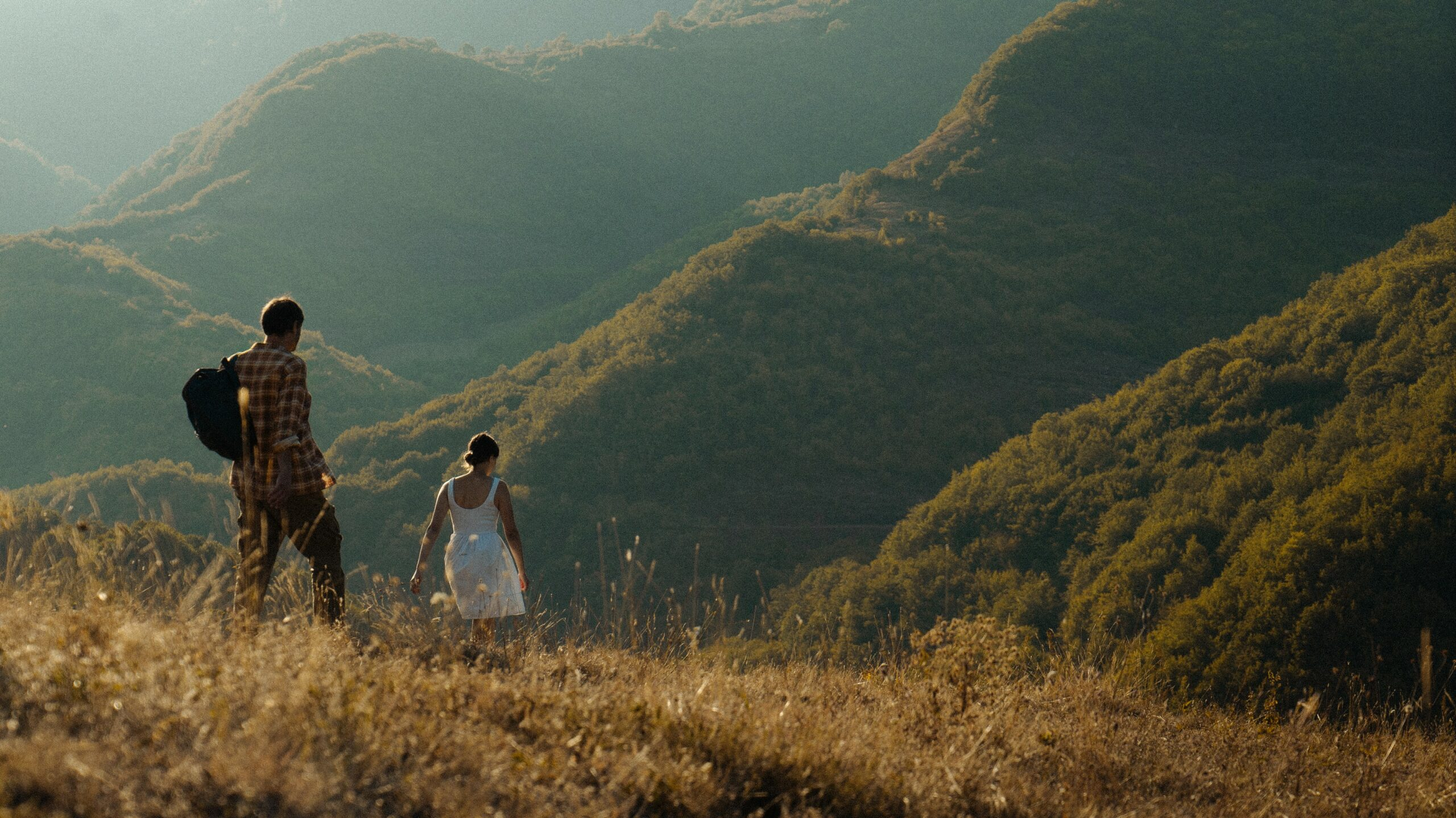
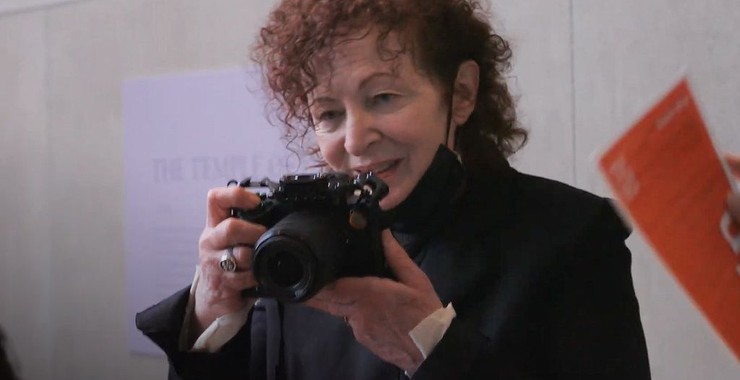
A scene in Brendan Geraghty’s MOTEL DRIVE. Courtesy of Slamdance.
The searing documentary Motel Drive is set in a place none of us would want to be – a clump of three downtrodden motels on a single block in Fresno. The motels have become de facto brothels, emporiums of drug sales and housing-of-last-resort for the otherwise homeless. Registered sex offenders, who are barred from living elsewhere, have been placed in one of the motels. Early in Motel Drive, we learn that over 150 children live there, too, with their mostly meth-addicted parents.
Documentarian Brendan Geraghty has spent seven years following the area’s residents, especially focusing on the Shaw family and their son Justin. The Shaws’ journey is a compelling story, a roller coaster ride of poverty, recovery and relapse with a major stroke of good luck and a shocking consequence to relapse. Addiction is a family disease, and we get a closeup look at the impact on Justin of his parents’ addiction and persistent homelessness.
Justin Shaw in MOTEL DRIVE. Courtesy of Slamdance.
The neighborhood itself is another character in the film, with its own arc driven by neglect and underinvestment, the California High Speed Rail project and changes in government programs on homelessness. We meet saintly do-gooders along with the prostitutes, druggies and the impoverished human flotsam.
Motel Drive is Geraghty’s first feature as a director, and it’s a promising debut; he’s clearly mastered cinéma vérité. Slamdance hosts Motel Drive’s world premiere. As I said in my festival preview, Slamdance: discovering new filmmakers, Justin Shaw was slated to appear on the Slamdance red carpet for Motel Drive’s world premiere, and I couldn’t be happier that this young man could have this experience.
In the documentary Starring Jerry as Himself, a Florida senior sees himself recruited as an operative by Chinese police. The story is told in a re-enactment with the subject playing himself. We later learn why the filmmakers chose re-enactment, and what could have been a conventional true crime exposé or a weeper, is illuminated by the subject family’s humanity.
Starring Jerry as Himself is the first feature for director Law Chen, who also edited, co-produced and shot some of the footage. Law Chen and his co-producer and subject Jonathan Hsu were responsible for the decision on how to structure the film. That decision turned what could have been a heartbreaking downer into an engaging and satisfying family story, albeit a cautionary one.
I highlighted Starring Jerry as Himself as a MUST SEE in my Slamdance: discovering new filmmakers, and it won Slamdance’s Documentary Feature Grand Jury Prize.
The Dutch documentary Sexual Healing traces the experience of Evelien, a 53-year-old woman, afflicted from birth with spasticity, who needs substantial assistance to live independently. Evelien has never enjoyed sexual fulfillment, and now she’s curious. Sexual Healing follows her quest with sensitivity, gentle naughty humor and taste.
Evelien has supportive friends and the good fortune to live in the Netherlands, where there’s an agency established to fill this need for the disabled, essentially a therapeutic escort service. If you’re like me, you’ll be surprised at the age of Evelien’s sex therapist.
Sexual Healing is the second 50+ minute feature for writer-director Elsbeth Fraanje.
[Note: I advisedly used the word ”spasticity” to describe the subject’s disability, to avoid the term that the film uses, “spastic”; in researching the appropriate language, I got no useful guidance from the various sources wagging their fingers at the use of “spastic” but offering no alternatives more specific than “disabled” or “differently abled”.]
Slamdance hosted its US premiere, which I highlighted as a MUST SEE in my Slamdance: discovering new filmmakers. Sexual Healing was programmed in Slamdance’s Unstoppable category, a “showcase of films made by filmmakers with visible and non-visible disabilities”.
Jana Bjelica in WHERE THE ROAD LEADS. Courtesy of Slamdance.
The Serbian feature Where the Road Leads opens with a single shot of very long duration – the protagonist Jana (Jana Bjelica) is running, in and out and all around a remote Serbian village. Is she running away from something or toward something? It turns out that she is racing to prevent something, but this is a film about escape.
The village is so secluded and devoid of commerce and culture, that there is no reaon to visit it – or to live there, which is Jana’s conclusion, too. Whenever an outsider drifts through, it is a major occasion – and, for some, an occasion for suspicion. In Where the Road Leads, when a stranger wanders through, everyone calls him “the new guy”, but Jana fixates on whether he can become her ticket out of town.
Technically, the story is a tragedy, but Ognjanović lightens its telling with wry deadpan humor, showing why Jana finds village life so stifling. There are bickering old marrieds, two determinedly stupid drunks, and the one veteran government official who is weary of dealing with the villagers’ foibles.
Jana Bjelica in WHERE THE ROAD LEADS. Courtesy of Slamdance.
What makes Where the Road Leads powerful is its construction, with the pivotal beginning of the story placed at the end of the film. Ognjanović explains, “From the start, I knew I wanted the film to end with that scene – even though, chronologically, it is the beginning of the story. It is the one moment in our protagonist’s story where she could have changed the course of the events that followed.”
The opening shot of Jana running and running and running ain’t Touch of Evil or Goodfellas, but it’s impressive filmmaking, especially for a film of this budget.
Where the Road Leads is a promising debut feature for writer-director Nina Ognjanović. World premiere on January 22. Slamdance narrative feature competition.
UPDATE: Where the Roads Leads won an Honorable Mention (essentially second place) for Narrative Feature Grand Jury Prize at Slamdance.
Photo caption: Nan Goldin in ALL THE BEAUTY AND THE BLOODSHED. Courtesy of NEON.
All the Beauty and the Bloodshed is a profile of photographer Nan Goldin and her leadership of Prescription Addiction Intervention Now (PAIN), the advocacy group seeking to punish the Sackler family for profiting on the addiction and overdose carnage from oxycontin. Purdue Pharma, a privately held company owned by the Sacklers, intentionally oversold oxycontin to doctors and misled the public on its addictive qualities. The saga ended up in bankruptcy court because the Sacklers drained the profits from Purdue Pharma before it could be forced to reimburse its victims.
It’s unusual to have a public controversy so without nuance – the Sacklers are clearly bad people who acted badly and irreparably injured thousands of others. As a result, we aren’t bothered when Nan Goldin, an addict in recovery herself, evenly says, “It’s personal. I hate these people.”
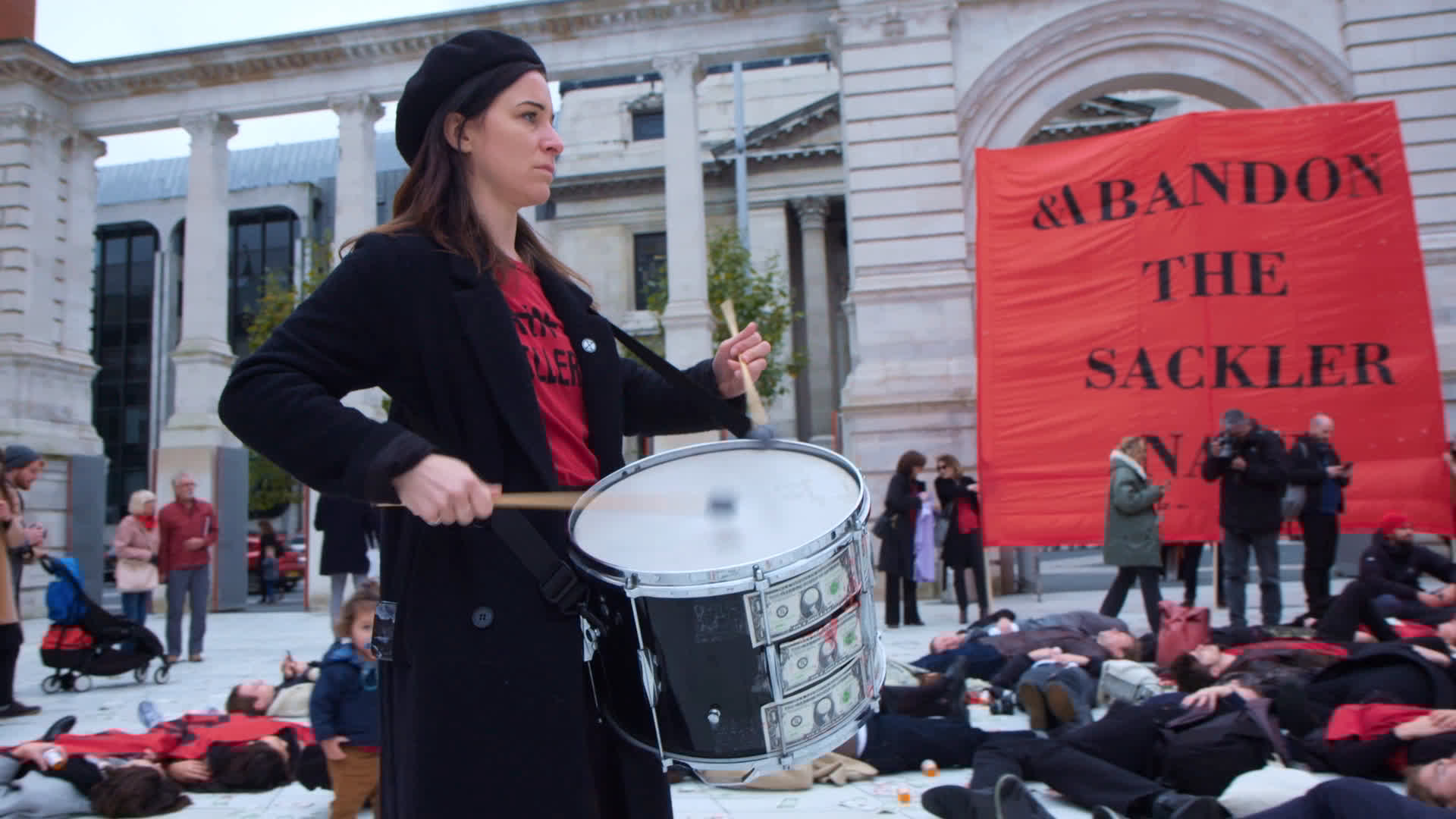
Up against a malevolent, heavily-resourced corporation, PAIN inflicted pain on the Sackler family by turning their own philanthropy against them, shaming major art museums into refusing gifts from the Sacklers and even removing the Sackler name from the buildings and galleries they had sponsored. The museums were the institutions with the very highest profiles: the Guggenheim, Metropolitan Museum of Art, [British] National Portrait Gallery and even the Louvre. To make things even more uncomfortable for the museums, Goldin’s own work is in the permanent collections of some of these museums.
A PAIN action in ALL THE BEAUTY AND THE BLOODSHED. Courtesy of NEON.
PAIN’s actions were themselves works of performance art, often involving PAIN members feigning death en masse, surrounded by prescription bottle. To reflect Richard Sackler’s self-damning email that greedily rejoiced at the “blizzard of prescriptions”, PAIN members created a confetti blizzard of prescription slips in a major museum atrium.
The beginning and end of All the Beauty and the Bloodshed, about a third of the film, follows Goldin and PAIN’s campaign against the Sacklers. The rest of the film is the self-narrated life story of Nan Goldin, much of it illustrated by slide shows of her photos. Goldin became a key figure of the New York avant garde of the 70s, 80s and 90s, and she has led a colorful and oft turbulent life. There’s a major focus on the story of her older sister Barbara, and how the two reacted to their family by rebelling against conformity.
The bottom line is that I found the shaming of the Sacklers much more engaging that the Nan and Barbara Goldin story.
In the highlight of All the Beauty and the Bloodshed, the Sacklers on Purdue Pharma’s corporate board must themselves sit for two hours and listen via Zoom to the testimony of their victims, including one harrowing 911 call.
All the Beauty and the Bloodshed was directed by noted documentarian Laura Poitras, Oscar winner for Citizenfour. The film has been included in various critics’ top ten lists and is a contender for the Best Documentary Oscar. It’s good, but I’ve seen better docs this year.
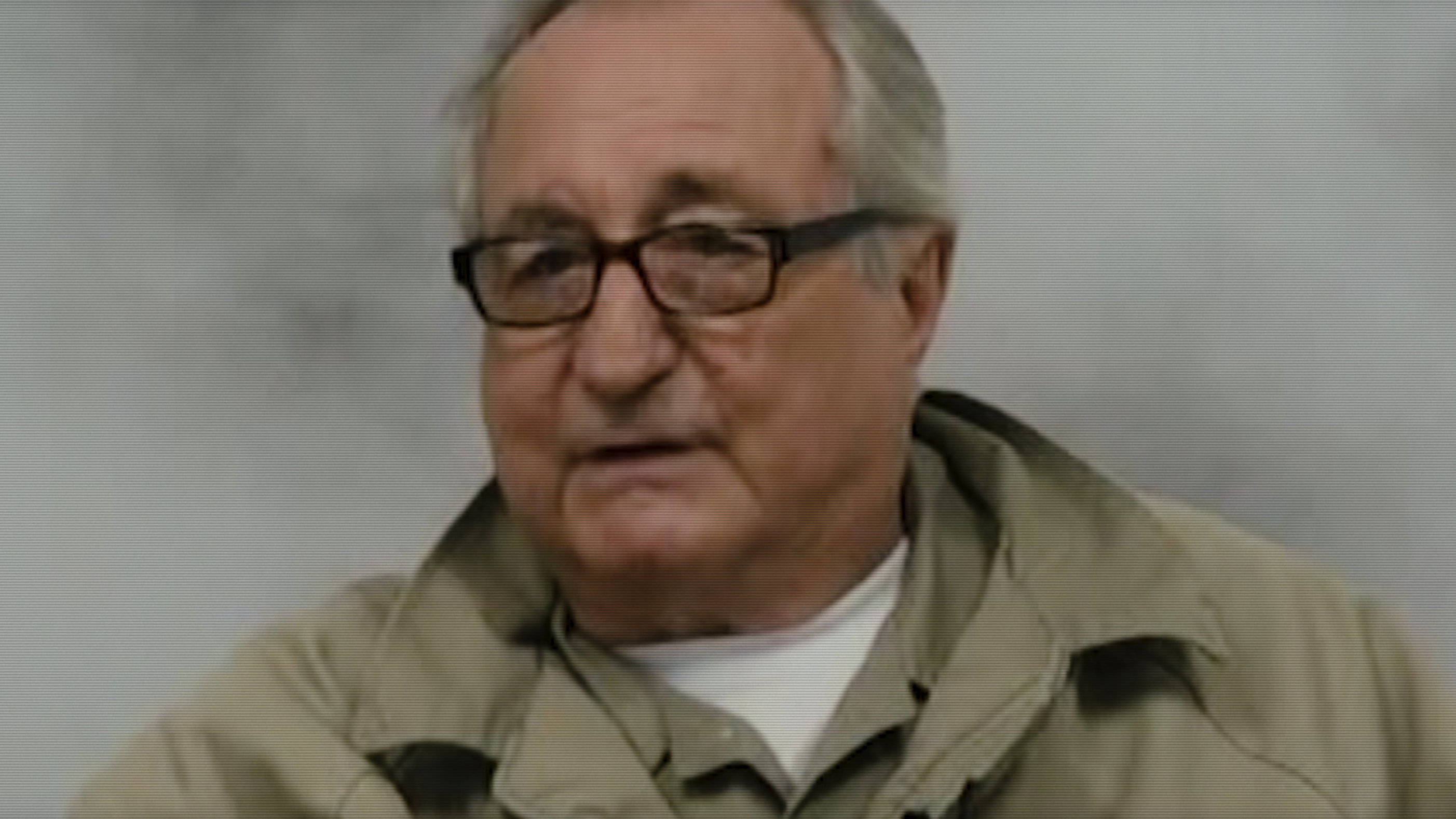
Photo caption: Bernie Madoff in MADOFF: THE MONSTER OF WALL STREET. Courtesy of Netflix.
Netflix’s documentary Madoff: The Monster of Wall Street is a pretty good watch. Most folks, like me, thought they understood the now 15-year-old story of Madoff’s house of cards collapsing at the same time as the 2008 mortgage meltdown, ruining hundred of investors, including pensioners and non-profits. But Madoff: The Monster of Wall Street contributes a comprehensive perspective and some jaw-dropping nuggets, to wit:
How the SEC whiffed MULTIPLE TIMES, even when the case was giftwrapped for them by a credible Wall Street expert;
The moment when the SEC and FBI learned that the fraud was not in the millions, but in the TENS OF BILLIONS;
How Bernie Madoff banned his own sons from the separate office in which the fraud was committed;
How Madoff concealed the fraud in plain sight with brazenness alone;
The one zillionaire investor who must have known about the Ponzi scheme and kept bailing Madoff out; and
What happened to the main characters in the saga, including Madoff’s family and confidantes – it is operatic.
We benefit from Madoff: The Monster of Wall Street‘s comprehensive look at the scandal because our knowledge of it come from the news coverage at time of his arrest, which focused on the plight of Madoff’s victims. That’s a key part of the story, but it helps to (in my case) learn that Madoff’s stature was earned by his building two entirely legitimate Wall Street businesses, co-founding the NASDAQ and becoming a sage adviser to the SEC. It also helps to revisit the scale of his fraud (the largest Ponzi scheme in world history) and how it differed from other Ponzi schemes – NONE of his victims’ money was ever invested.
One of the key themes is the contrast between the two suites of Madoff offices – with only Madoff himself having access to both. His sleek 19th floor suite housed the two legitimate businesses, was immaculately decorated in black and silver, and primarily staffed with well-educated Jews. The 17th floor, which housed the fraud, was staffed by high-school-educated Italian-Americans, and was a messy warren of cardboard boxes and a DOT MATRIX PRINTER.
Madoff: The Monster of Wall Street is well-sourced with the federal agents who arrested Madoff, his personal secretary and employees of both his legitimate and his fraudulent businesses, and clips of Bernie himself in prison garb, ‘fessing up, We also meet the guy who proved as early as 2000 that Madoff had to running a Ponzi scheme, only to be rebuffed by the SEC five times between 20000 and 2008.
Madoff: The Monster of Wall Street was directed by Joe Berlinger, who has directed some of the 21st century’s very best documentaries – the Paradise Lostseries and Metallica: Some Kind of Monster. This time, I did not care for his odd technique of using look-alike “actors” in “re-creations”, obviously to fill in for a scarcity of file footage, but it ultimately did not detract from telling a great story. Anyway, hopefully, Netflix will keep hiring Berlinger to make films, which is a great thing.
Madoff: The Monster of Wall Street is streaming on Netflix.
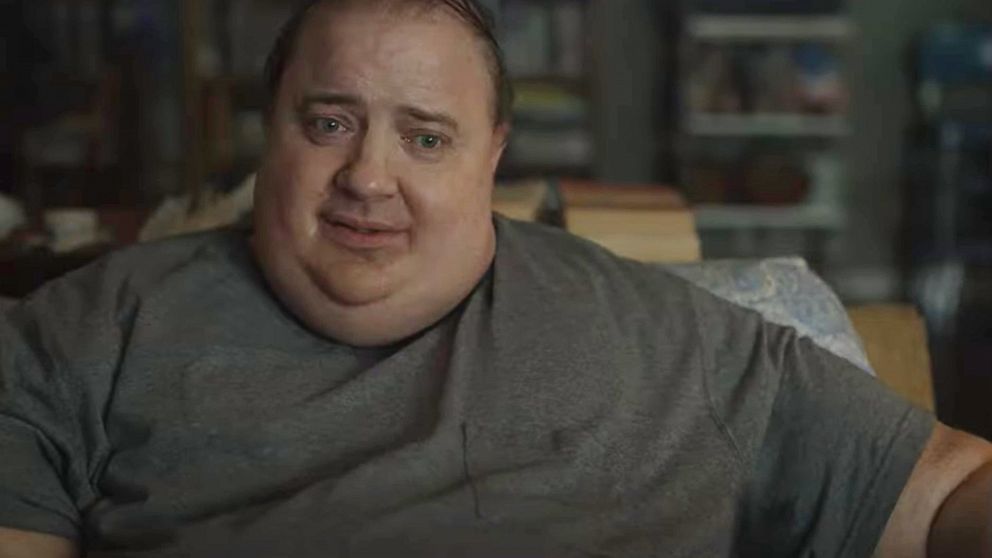
Photo caption: Brendan Fraser in THE WHALE. Courtesy of A24.
The emotionally powerful The Whale depicts a week in the life of Charlie (Brendan Fraser). The first thing we notice about Charlie is his obesity – his 600 pounds makes getting out of a chair a major challenge, and there’s just no way he can bend over to pick anything off the floor. Refusing to seek medical attention despite labored breathing and catastrophic blood pressure, Charlie has exasperated his friend/caregiver Liz (Hong Chau), a nurse. He has congestive heart failure, and both Liz and Charlie know that he may be in his last week of life.
He is a grotesque, but unlike Quasimodo or The Elephant Man, he’s a grotesque of his own making. Charlie is grieving from a loss nine years before and is regretting a failed relationship with his child; he has reacted by emotionally eating himself to near-death. He no longer ever leaves his apartment, where he works remotely by teaching a college writing course on-line.
Charlie is a man of immense sensitivity, unusually moved by the sporadic snippets of crude honesty in his students’ writing. He is so sensitive that he is swallowed by grief, and cannot handle the anger of others. Charlie is constantly saying “I’m sorry”, but there are two things that he is decidedly not sorry for – fathering a daughter and falling in love with a man.
Charlie’s sad routine is interrupted by a visit from the young door-to-door missionary Thomas (Ty Simpkins), and then by an appearance from his estranged daughter Ellie (Sadie Sink), now a seething teen. It’s only a mater of time before Liz brings by his ex-wife Mary (Samantha Morton), too. Will Charlie mend his relationships? Will he find inner peace? Will he even survive?
What makes The Whale an exceptional movie is Brendan Fraser’s unforgettable performance as Charlie. He’s not just impersonating an extremely obese person; he’s portraying a complex character- a man who is weakened by self loathing and physical disability, but whose passions and humanity gleam through. Encased in a latex and CGI fat suit, Fraser makes us understand Charlie with his own beautiful and expressive blue eyes and with Charlie’s lurching and plodding.
Fraser has always been an appealing actor, and one of great humor. 25 years ago, the strikingly handsome Fraser used his physicality in The Mummy franchise and, literally in a loincloth, in George of the Jungle. It’s useful to remember that he did a serious art movie, Gods and Monsters, in that period, too. His build, rangy then, has since morphed into burly, and in last years thriller No Sudden Move, to hulking.
Of course, Fraser will be nominated for an Oscar, because the actors who vote for awards love performances with major physical transformations. But it’s important not to downgrade Fraser’s performance because of that phenomenon – this is a remarkable exploration into a character’s inner life.
Hong Chau has been doing strong and versatile work lately (Driveways, The Menu); her Liz is an uncommonly good and award-worthy performance.
Samantha Morton is piercingly credible as the ex-wife. (Where has SHE been since Minority Report and In America?)
The story is a play by Samuel D. Hunter. Darren Aronofsky, a director known for making splashy, pedal-to-the-metal movies (Requiem for a Dream, The Wrestler, Black Swan) has the artistic judgment to keep the camera in Charlie’s dank, claustrophobic apartment and let Hunter’s dialogue reveal the characters.
While The Whale is one of the best films of 2022, it has its flaws, especially Sadie Sink’s not-very-textured performance as the daughter (and I didn’t find Ty Simpkins very compelling, either). The thread about the young missionary Thomas has at least one contrivance too many. Also, the weepy soap opera music cues underneath The Whale’s most emotionally powerful moments are unnecessary, distracting and unforgivable.
The scenes where Charlie is gorging himself are tough to watch. I saw The Whale at a theater that is essentially next to my favorite French restaurant, and I like to cap a morning movie with a lunch of salade lyonnaise and steak tartare; but emerging from The Whale at lunchtime, I just couldn’t do that. I recommend this film, but not for a movie/dinner or dinner/movie date.
Nevertheless, this is still one of the year’s best films because of Charlie’s compelling story and Brendan Frazier’s magnificent portrayal.
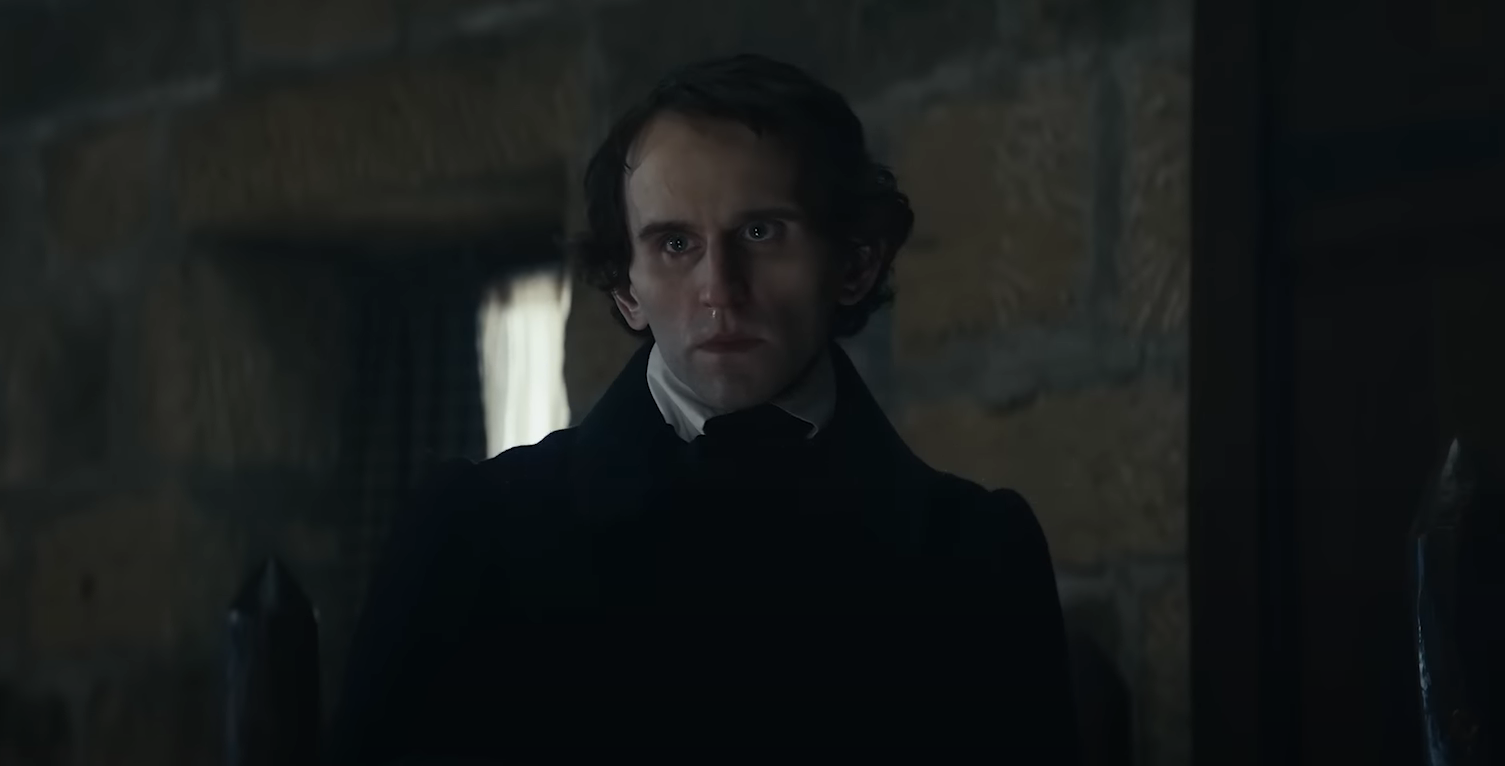
Photo caption: Harry Melling in THE PALE BLUE EYE. Courtesy of Netflix.
The Pale Blue Eye stars Christian Bale as a detective pulled out of retirement to solve a murder mystery at West Point in 1830. He enlists a cadet as his assistant – none other than Edgar Allen Poe (Harry Melling), in his one unsuccessful year at the Military Academy. Except for Harry Melling, The Pale Blue Eye is not great.
As the two keep peeling the onion, the bodies and more weirdness keep piling up, including a distractingly incredible dive into the occult. Just when the whodunit is seemingly wrapped up, there’s one more twisty Big Reveal. The whodunit is far from thrilling, and the final twist isn’t enough to pay off.
The fine director Scott Cooper (Crazy Heart, Hostiles) frames the whole thing in a Gothic horror patina, but that’s not enough to keep the story interesting. Cooper’s adaptation of Louis Bayard’s story is a slog.
Christian Bale ably plays his character with world-weariness and just the right hint of slyness. Two of the world’s greatest screen actors, Charlotte Gainsbourg and Timothy Spall, are embarrassingly wasted in underwritten roles. Toby Jones and Gillian Anderson don’t fare much better.
Harry Melling goes big as Edgar Allen Poe, reveling in a southern accent (Poe grew up in Virginia) and the florid 18th century speech. His Poe has the confidence, perhaps from narcissism, that belies his unpopularity with peers, and his lack of accomplishment. And. of course, Melling embues his Poe with a discernible creepiness. This isn’t a big deal IMO, but Melling is made up to look just like a young Poe would have looked, before the mustache and the dissolution.
As a kid, Melling broke through as Dudley Dursley in the Harry Potter franchise, which he needed to finish in a fat suit because he had slimmed down so much. In the last year or so, Melling has produced some great work in The Queen’s Gambit, Please Baby Please and The Tragedy of Macbeth. Before that, he was the best element of The Ballad of Buster Scruggs. He is now one of cinema’s great scene-stealers.
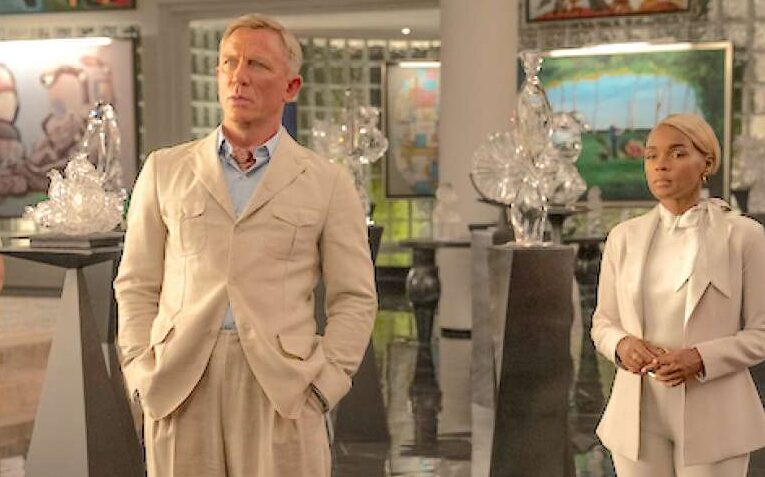
Photo caption: Daniel Craig and Janelle Monae in GLASS ONION: A KNIVES OUT MYSTERY. Courtesy of Netflix.
Writer-director Rian Johnson follows his wonderful Knives Out with Glass Onion: A Knives Out Mystery, another satirical drawing room murder mystery with super detective Benoit Blanc (Daniel Craig). Again, the rich are skewered and, again, Blanc is overshadowed by a younger female of color. It’s all good fun.
Glass Onion is set on the extravagant private island (think the hideout of a Bond supervillain) of an untethered, narcissistic billionaire (think Elon Musk). The billionaire (a perfect Edward Norton) invites four of buddies from his past (Kate Hudson, Dave Bautista, Leslie Odom, Jr., and Katharine Hahn) for a weekend house party, plus a girlfriend (Madelyn Cline) and an assistant (Jessica Henwick – whose compelling presence is wasted in this often sniveling role). And Benoit Blanc comes, too, which is fitting because the weekend’s theme is a Clue-like mystery game. Another mysterious friend from the past (Janelle Monáe) shows up; her relationship to the others is complicated, and she puts everyone on edge.
There’s a murder to be solved and a Macguffin to be found. Along the way there are several massive plot twists. Clues dropped early hint that a fortune has been made, not by intellectual talent and hard work, but by manipulation and cheating. Rian Johnson loves to expose treachery among the 1 percent, and here he brings us a classic emperor-has-no-clothes comeuppance.
Knives Out was one of 2019’s smartest and funniest films, and Glass Onion is not in that class – but is still very entertaining. The first forty minutes of set-up are not that compelling, but the pace picks up once the plot twists start piling up and Janelle Monáe takes over the movie.
Janelle Monáe in GLASS ONION: A KNIVES OUT MYSTERY. Credit: John Wilson. Courtesy of Netflix.
The cast is excellent, especially Craig and Norton. But the most riveting performance is by the singular Janelle Monáe. The stunningly beautiful Monáe is a captivating screen presence. She’s also demonstrated serious dramatic acting chops in her who-is-THAT? performance in her first feature film Moonlight, and again in Hidden Figures. Monáe’s own music and fashion projects are startlingly original, and her artsy sensibility seems impervious to risk. I say, let her direct a movie if she wants – just get her back up on the movie screen.
Glass Onion looks several times glossier than its $40 million budget. Glass Onion has spent over a week as the #1 film on Netflix, which is excellent because it means that Netflix will likely fund another Rian Johnson movie.
Glass Onion: A Knives Out Mystery is streaming on Netflix.
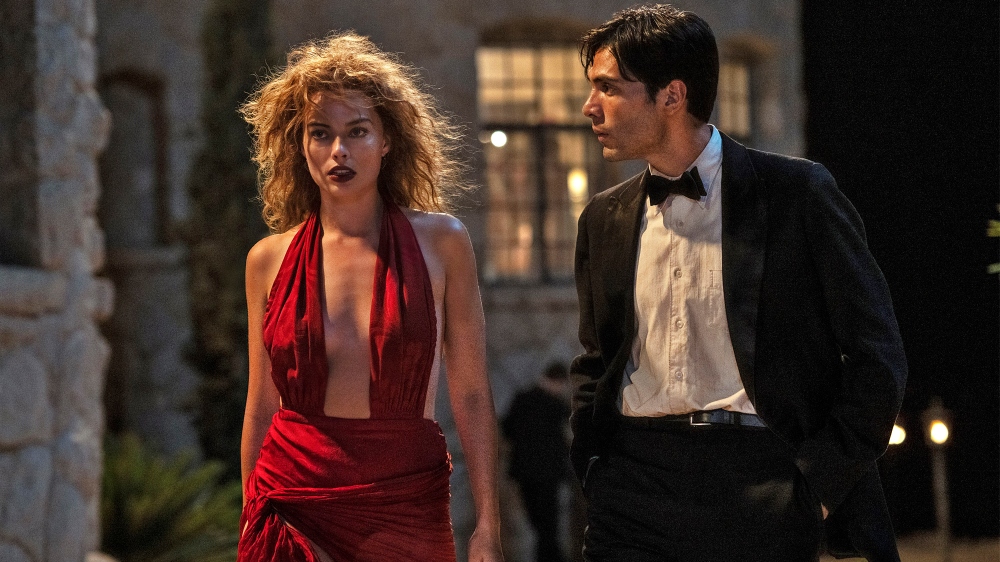
Photo caption: Margot Robbie and Diego Calva in BABYLON. Courtesy of Paramount Pictures.
Babylon is a whole lot of movie. More movie than you’re expecting. And maybe more movie than you want.
Writer-director Damien Chazelle (La La Land, Whiplash) has delivered a kinetic and kaleidoscopic showbiz epic of over three hours, which is visually stunning, ever entertaining and sometimes shocking. Now, is it a good movie?
Set beginning in 1926, Babylon traces Hollywood’s transition from silent film to the talkies by tracing the stories of a mega-movie star Jack Conrad (Brad Pitt), the ambitious starlet Nelly LaRoy (Margot Robbie), the African-American trumpet prodigy Stanley Palmer (Jovan Adebo) and the sultry Chinese entertainer-by-night Lady Fay Zhu (Li Jun Li). The audience largely experiences Babylon from the point of view of Manny Torres (Diego Calva), a Mexican household gofer whose abilities as a fixer propel him up the movie studio ladder. Chazelle’s view of Hollywood is as a human-crunching pool of toxicity, that a person must leave to survive with any decency or happiness.
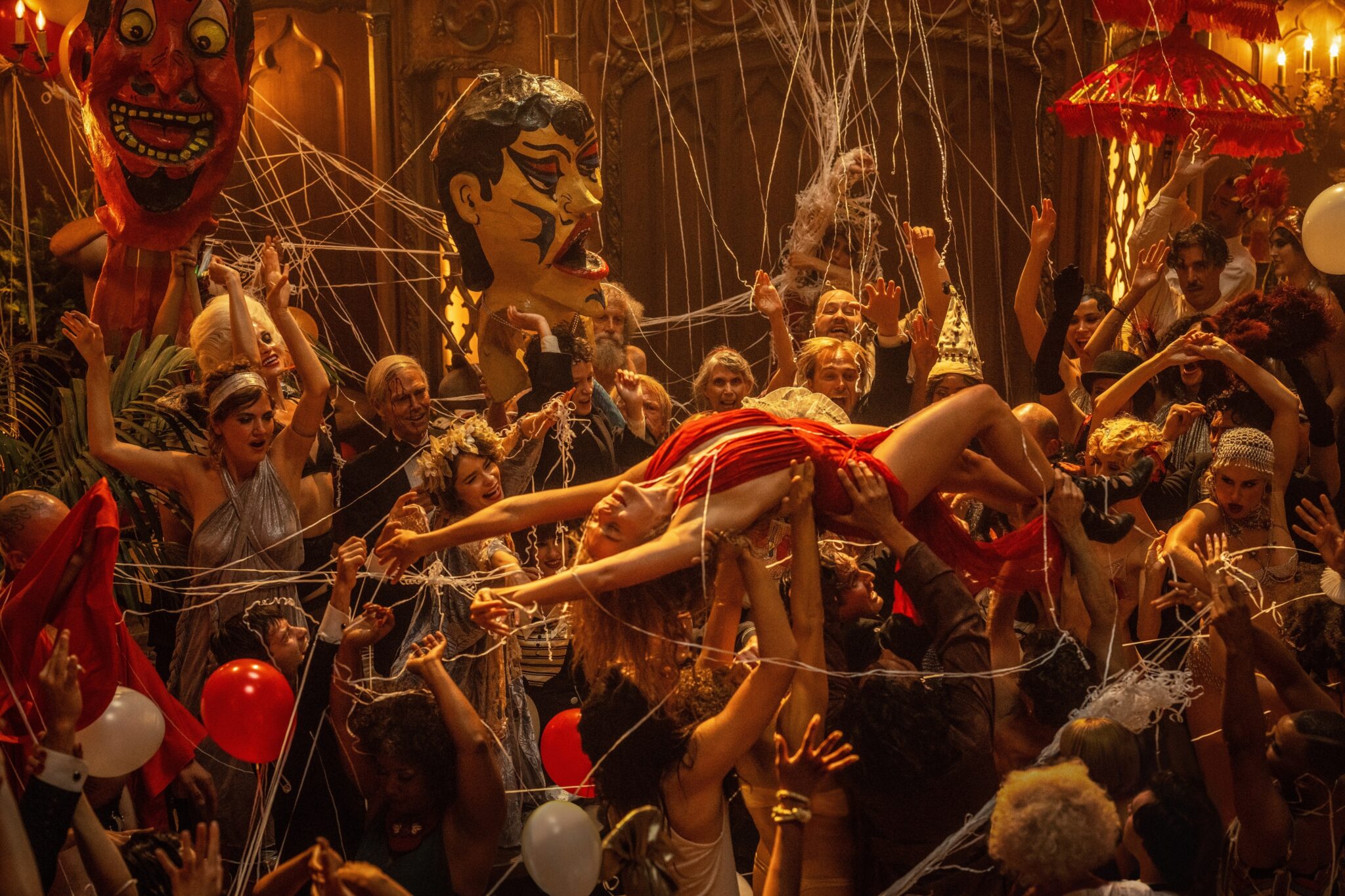
This is also a Hollywood of unsurpassed debauchery and hedonism, which we taste right away in a movie mogul’s house party with lots of bare-breasted women and naked people engaging in sex, kinky sex, and perverted sex. The scene is clearly inspired by Ceil B. DeMille’s orgy scene in the silent The Ten Commandments, which seems quaint in comparison. This scene could have been imagined by Federico Fellini on speed and Hugh Hefner on acid.
Margot Robbie (center) and a cast of thousands in BABYLON. Courtesy of Paramount Pictures.
“Wanton excess” is inadequate to describe this party scene and much of Babylon. Like the guitarist in This Is Spinal Tap, Chazelle has set his amp to eleven. There’s so much eye candy here that Babylon will cause Baz Luhrman to feel bad about himself.
This is also the most scatological mainstream movie that I’ve seen. There’s projectile diarrhea (from an elephant), projectile vomit (from a person on a person) and urination (both from a woman onto a titillated man and from a man onto himself).
Back to the story. Chazelle shows us the Silent Era Hollywood studios with wall-to-wall outdoor movie sets, simultaneously grinding out comedies, romances and westerns. We see a cast of thousands in a medieval battle epic, and the transition to sound during the period when the technical challenges were so excruciatingly unforgiving that the sound men briefly usurped the control from the directors. Babylon’s characters are thinly-disguised recreations of John Gilbert, Clara Bow, Fatty Arbuckle, Anna May Wong, Erich von Stroheim and Louella Parsons, with some real life figures like Irving Thalberg.
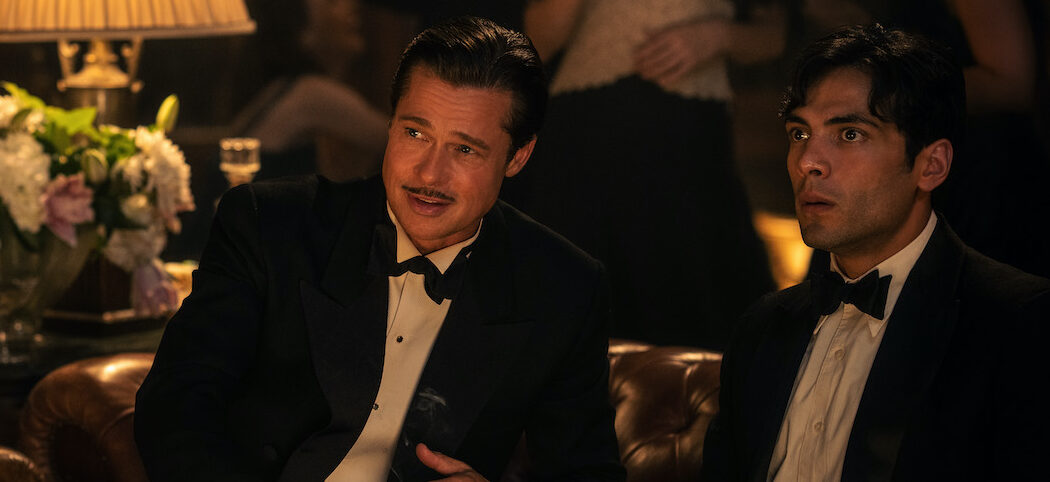
Brad Pitt and Diego Calva in BABYLON. Courtesy of Paramount Pictures.
If you’re going to cast an actor to play a movie star from the classic era, you’re not going to cast Johnny Depp, Tom Hanks, Tom Cruise, Robert Downey Jr. or Bradley Cooper. Just cast Brad Pitt and you’re most of way there in your storytelling – Pitt’s handsome looks are just weathered enough, and he exudes physicality, confidence and insouciance. If you want a Douglas Fairbanks or Clark Gable type – he’s your guy. And, yes, he is perfect in this film.
Likewise, Jean Smart is your gal for a cleareyed, devastating truthteller. Her character’s matter-of-fact Bad News Good News assessment of Jack Conrad’s career may be the distillation of Chazelle’s core message, if there is one. It’s the most compelling speech in Babylon.
I’ve seen actors throw themselves into Wild Child performances, but none with as much abandon as Margot Robbie. It’s a fearless, over-the-top and singular performance. Unfortunately, Chazelle’s Nelly is two-dimensional. There’s not much there except her insatiable grasping for fame and drugs, but Robbie does wring out every ounce of humanity.
This a well-acted film. Other notable pedal-to-the-metal performances:
Li Jun Li soars with sexy charisma in an underwritten part. I want to see more of her.
Eric Roberts sparkles as Nelly LaRoy’s venal and opportunistic father, who has reappeared once she is a money machine of a movie star.
Tobey Maguire’s performance was perfectly described by David Rooney in The Hollywood Reporter as seeking to “out-weird Dean Stockwell in Blue Velvet and Joaquin Phoenix in Joker combined.”
Sydney Palmer’s trumpet work is downright exciting, I assume that someone other than Jovan Adepo is actually playing the instrument, but I couldn’t determine who from the credits. In any case, Adepo gets props for credible fingering, which is no small thing.
The fine cast also includes Lukas Hass, Patrick Fugit, Samara Weaving, Katharine Waterston, Jeff Garlin, Spike Jonze and, very briefly, Olivia Wilde.
Elements of Babylon are indisputably superb and Oscar-worthy, especially the cinematography by Linus Sangren (Oscar winner for La La Land), the production design by Florencia Martin and the costumes by Mary Zophres (Oscar nominated for True Grit, La La Land and The Ballad of Buster Scruggs).
Is this a good movie? There is an unusually wide range of critical assessments, which average into a a middling 59 score on Metacritic. It’s a gorgeous thrill ride, for sure, but we just don’t care about most of the characters. Some viewers will be just too distracted and exhausted by the freneticism. I think it falls short of being a great movie, but it’s so outrageous and fun to watch that it’s a must see.