The environmental justice documentary Demon Mineral explores the impact of uranium mining on the Navajo people. In her first feature, director and co-writer Hadley Austin uses indigenous voices to tell the story, including her co-writer, environmental scientist Dr. Tommy Rock. It’s the testimony of Navajo people themselves that traces the history of uranium mining, subsequent health problems and the science connecting the dots. Some of the first-person narratives are heart-breaking.
This real life story takes place in one of the most iconic locations in American cinema – Arizona’s Monument Valley. (The Navajo themselves have complicated feelings about the legacy of John Ford Westerns made in their homeland.) Cinematographer Yoni Goldstein’s black-and-white photography soars, bringing out the majesty of the harsh landscape and imparting a gravitas to the story.
There’s even a cameo by hard right Congressman Paul Gosar, who is so stupid that he doesn’t comprehend just how stupid he is.
Demon Mineral has enjoyed a robust film festival run and won the Audience Award for Documentary Feature at the 2024 Slamdance.
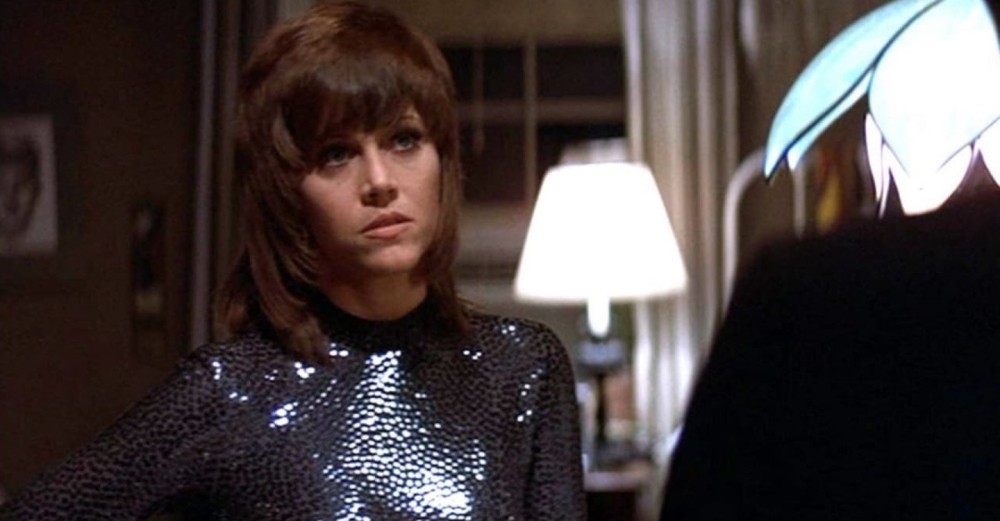
On January 22, Turner Classic Movies is airing Klute (1971), highlighted by Jane Fonda’s first Oscar-winning performance. An out-of-town detective comes to Manhattan on a missing person’s case and becomes embroiled in tracking down a sexually sadistic murderer before he can kill a call girl. What elevates this ostensible mystery to a gripping psychodrama are the main characters and their chemistry.
Bree Daniels (Fonda) is both a masterful call girl and a failed actress/model. Fonda’s Bree is confident, sexy, vulnerable, manipulative and the terrified target of a maniac. She’s also a fashion plate – stylishly braless in long knit dresses and sporting the shag haircut that sparked its own fad. This is Fonda at her iconic peak – she earned six Best Actress nominations in a twelve year period.
Bree Daniels’ foil is the stolid John Klute (Donald Sutherland), who is so clear-eyed and disciplined that he is immune to Bree’s charms – until he isn’t. Sutherland’s career is still peaking today, but he sandwiched Klute between Kelly’s Heroes, M*A*S*H*, National Lampoon’s Animal House and Invasion of the Body Snatchers.
Director Alan J. Pakula takes us to the grimy, seedy NYC of the period, and keeps the tension building. The scenes with Bree’s junkie acquaintances are heartbreaking. Pakula received Oscar nominations for producing To Kill a Mockingbird, directing All the President’s Men and writing Sophie’s Choice. For more on Alan Pakula, you can stream the fine documentary Alan Pakula: Going for Truth, which features Jane Fonda’s memories of Pakula.
Veteran television writer Andy Lewis, with the far less prolific Dave Lewis (presumably his older brother), were nominated for the original screenplay Oscar.
The supporting cast is good, too, Ray Scheider is superb as a smug pimp. In his first movie, Charles Cioffi’s very contained performance makes for a chilling villain; he followed Klute with a key role in Shaft and then essentially left movies for a long career in television (including playing another villain on a TV soap).
Klute has more than its share of bit players who were about to become famous:
Veronica Hamel (a decade before Hill Street Blues) as a model at a cattle call audition;
Richard Jordan (four years before Logan’s Run) as a guy kissing Bree at a disco;
Harry Reems (a year before Deep Throat) as another disco patron;
Jean Stapleton (just months before All in the Family) as the secretary at a garment factory.
I recently rewatched Klute, and it still works today. If you haven’t seen it, or seen it recently, set your DVR.
Photo caption: Line Renaud and Dany Boon in DRIVING MADELEINE. Courtesy of Cohen Media Group.
In Driving Madeleine, a ninety-two year-old Parisienne, having outlived her family, must move from her apartment to a nursing home. Madeleine (Line Renaud) cajoles her harried cabbie Charles (Dany Boon) to visit some of her old haunts along the way. As they stop at the locations where Madeleine’s life pivoted, director Christian Carion reveals that Madeleine has lived a helluva life, one spanning ecstasy, tragedy and even notoriety.
Charles’ family is facing severe financial pressure, he is one traffic violation away from losing his taxi license, and he is practically vibrating from the stress. As he reluctantly complies with Madeleine’s circuitous wishes, he takes some lessons from her life and softens. Driving Madeleine is an unflinchingly sentimental film, which is okay because it’s not trying to be anything else. There is a place for sweet, heartfelt movies.
Driving Madeline’s sweetness doesn’t get syrupy because of the painful injustices Madeleine survived in pre-feminist 1950s France. The cause of her notoriety is an act that I haven’t seen depicted before.
Actress-singer Line Renaud is actually older than her character, and she delivers the mischievousness and steely toughness that is Madeleine. The versatile comedian/actor/writer director Dany Boon easily inhabits the role of Charles; (Boon, often cast in broad comedies, is also in the recent The Crime Is Mine, which will release on VOD within a month.) Alice Isaaz is excellent in flashbacks as the young Madeleine.
Driving Madeleine’s opening tomorrow includes the Landmark Sunset 5 and the Landmark Pasadena; it opens more widely next weekend, including at the Opera Plaza in San Francisco.
Photo caption: Emma Stone and Willem Dafoe in POOR THINGS. Courtesy of Searchlight Pictures.
Well, here’s a movie unlike any you have ever seen. Poor Things begins as a Frankenstein movie, and evolves into an outrageously raunchy, funny and thoughtful feminist triumph. The kindly mad scientist Dr. Baxter (Willem Dafoe behind geologic makeup) implants the brain of a fetus into the body of a young woman and creates Bella (Emma Stone). The adult-sized Bella acts like a baby, then a toddler, then a child and so forth as her brain develops.
The key is that Dr. Baxter, confining her to his house, shields the developing Bella from all societal constructs, like common views of morality, manners, religion and gender roles. Bella is driven by the most basic natural human impulses – for pleasure and safety – without ever having learned any inhibitions.
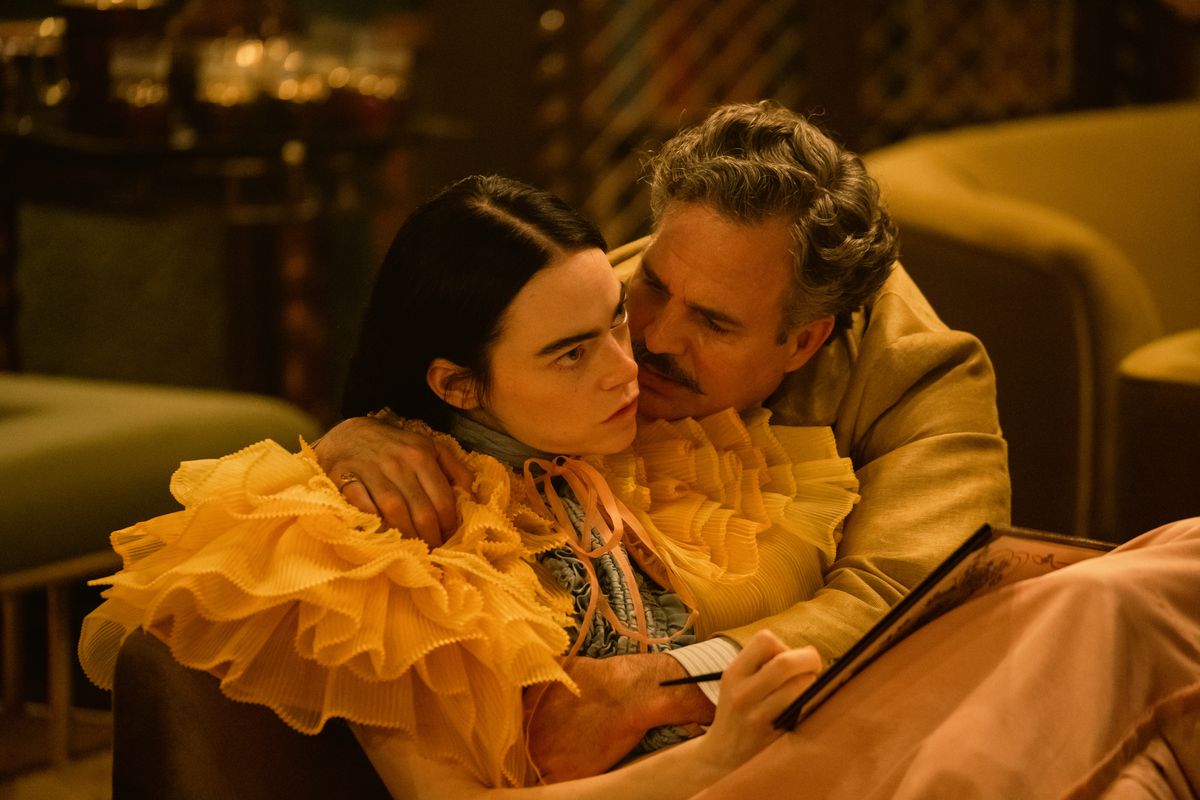
When Bella’s teenage brain rebels, the scientist allows her independence, accepting that she will make mistakes while she learns how to navigate an outside world populated with humans behaving with avarice, lust and ignorance. One such character, hilariously played by Mark Ruffalo, is only too happy to harness Bella’s urges for sexual pleasure to his own benefit. Unfortunately for him, Bella’s brain develops beyond his ability to exploit her.
Emma Stone and Mark Ruffalo in POOR THINGS. Courtesy of Searchlight Pictures.
Poor Things is based on the novel by Alasdair Gray, so he’s the guy who actually imagined this bizarre and singular story, but director/jokester Yorgos Lanthimos has imbued it with his often zany and transgressive sensibilities. I was a big fan of Lanthimos’ absurdist breakthrough film Dogtooth, but then I didn’t like his acclaimed The Favourite and downright hated The Lobster and The Killing of a Scared Deer. I was encouraged by Glenn Kenney’s New York Times dispatch from Venice about how much he despised previous Lanthimos films and yet still loved and admired Poor Things.
The one thing that I didn’t like in Poor Things was when Lanthimos aped Wes Anderson and Terry Gilliam with some overly fanciful sets. Totally unnecessary to the story and a distraction.
Emma Stone’s performance is the year’s most startling. For one thing, she is certainly courageous and a good sport about spending so much of the movie unclothed and simulating sex. But the extraordinary element of her performance is in calibrating the subtle growth in Bella’s development.
Willem Dafoe and Mark Ruffalo are both great, too, and Kathryn Hunter (The Tragedy of Macbeth) elevates yet another supporting role.
Poor Things won the Golden Lion for Best Film at the Venice Film Festival, and made my list of the Best Movies of 2023. A feminist message is cleverly embedded in this brazen, dazzling and very funny movie.
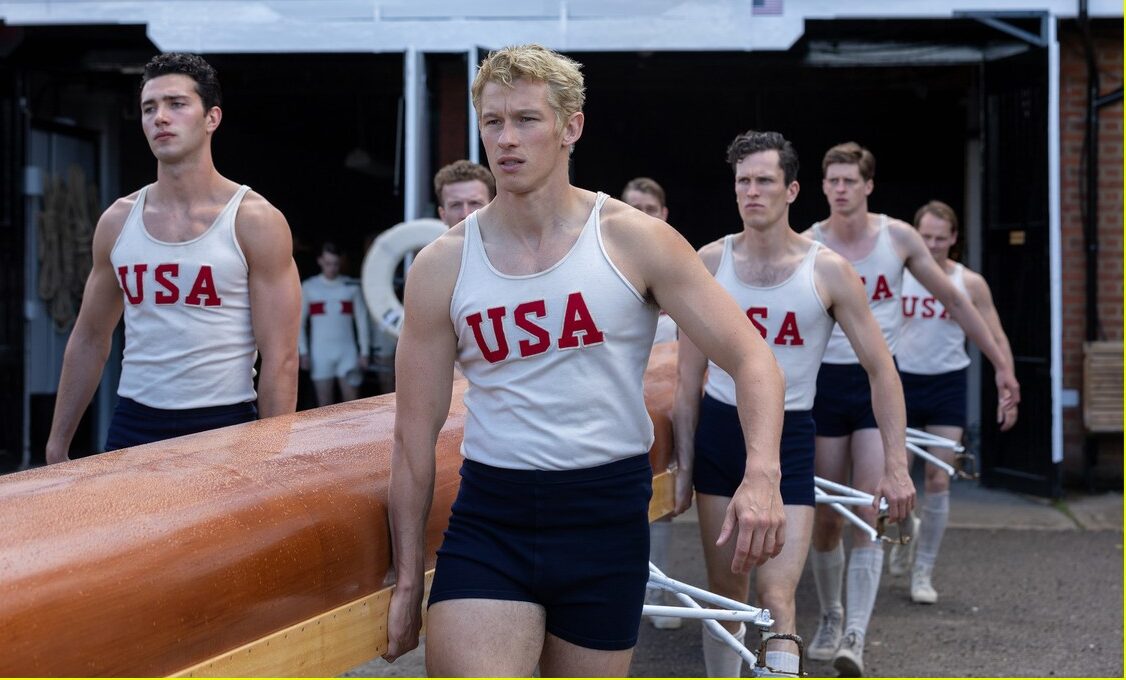
Photo caption: Callum Turner (center front) in THE BOYS IN THE BOAT. Courtesy of MGM.
The Boys in the Boat is the entertaining true story of the ultimate sports underdog – the University of Washington’s junior varsity rowing team, which won gold medals at the 1936 Olympics hosted by Hitler in Munich (the Jesse Owens Olympics). Again, this was UDub’s JUNIOR varsity boat.
The Boys in the Boat follows a familiar arc for sports movies – the heroes must win the Big Race (actually, three Big Races here). We’ve all seen this before, but director George Clooney gets the credit for keeping The Boys in the Boat from becoming unbearably hackneyed or corny. Best known as a movie star, Clooney has proven himself an able director: Confessions of a Dangerous Mind, Good Night and Good Luck, The Ides of March, The Monuments Men.
In telling the story, Clooney emphasizes the Depression setting and how impoverished the kids on the team are, especially the main kid, played by Callum Turner. Joel Edgerton plays the taciturn coach, who must gamble his job on an unconventional decision. Few of us have a deep understanding of the sport of team rowing, so Clooney takes us on a rowing procedural.
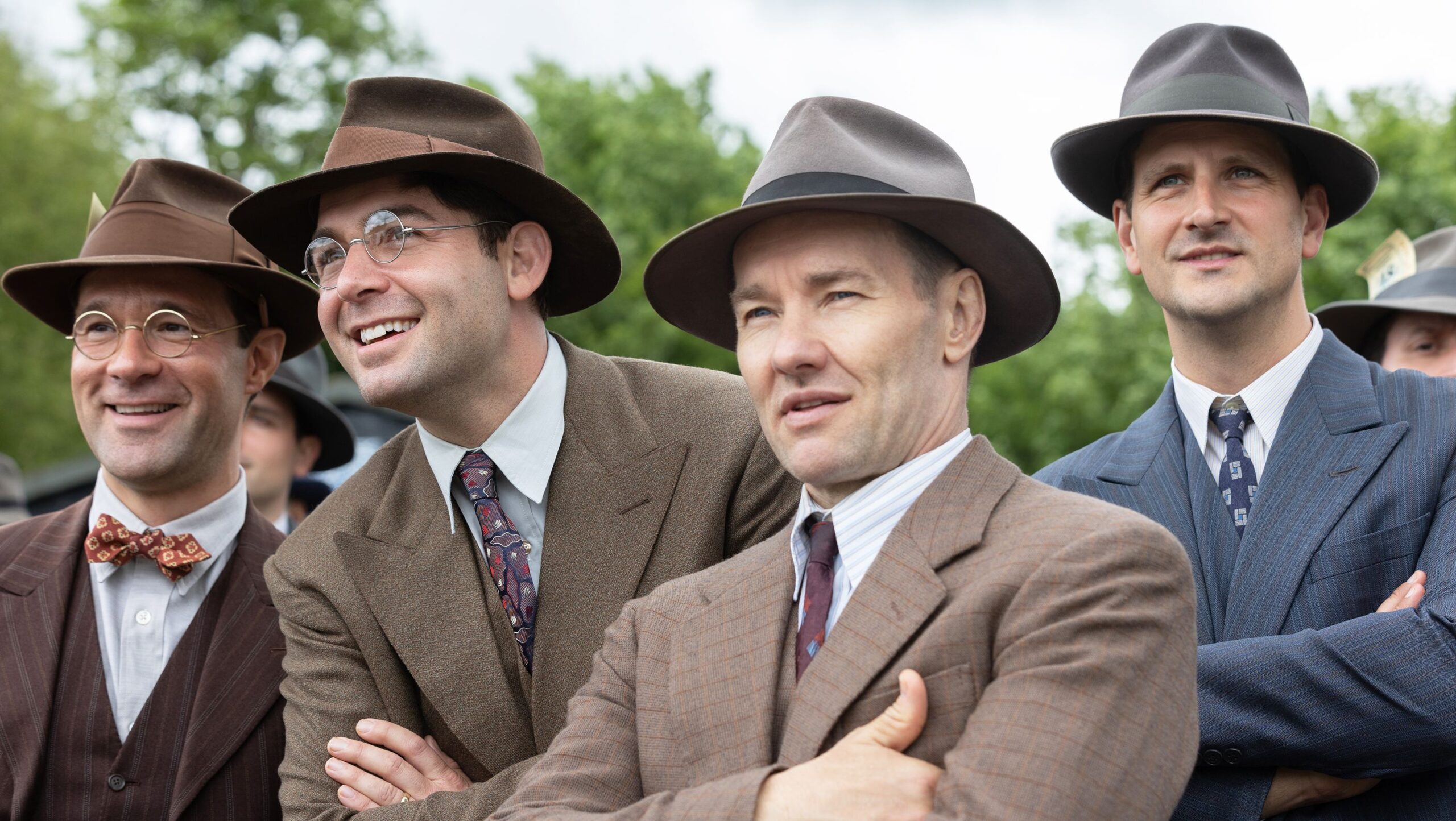
Joel Edgerton (second from right) in THE BOYS IN THE BOAT. Courtesy of MGM.
I love Edgerton in everything, and he’s starred in Master Gardener, Loving and Zero Dark Thirty. I especially recommend watching him in The Gift, which he also wrote an directed. Edgerton is very, very good here.
Callum Turner is adequate, but Luke Slattery and Jack Mulhern are especially vivid as his two of his teammates.
This story is still celebrated in Seattle, where you can still visit the boathouse and see the team’s memorabilia. One race is staged in the Montlake Cut between Lake Washington and Puget Sound. The coolest race scene has an observation train, with bleachers on the rail cars, keeping pace with the boats racing down the Hudson River.
The Boys in the Boat ain’t the most original film, but it’s enjoyable to watch.
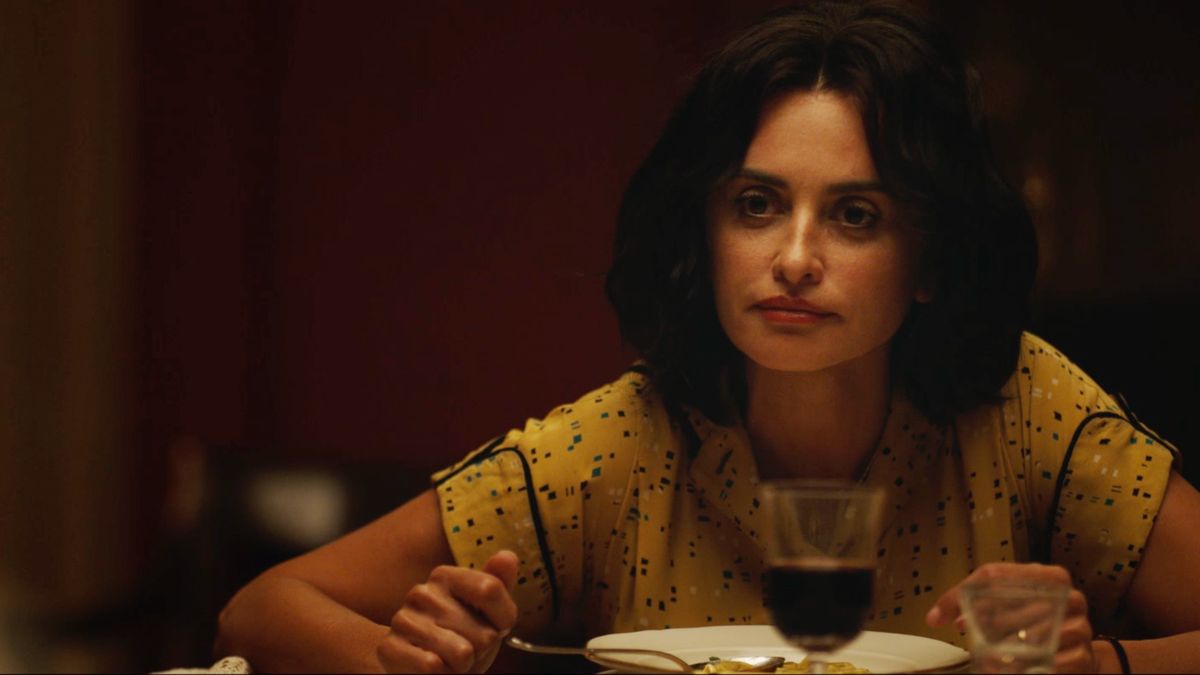
Photo caption: Penelope Cruz in FERRARI. Courtesy of NEON.
Ferrari takes place in 1957, when the groundbreaking auto racing figure Enzo Ferrari (Adam Driver) faces two crises at age 59. To attract a partnership with a larger automaker and save his company, Ferrari must win a famous road race. And, he must navigate the demands of both his wife and his girlfriend. The racing thread and the domestic thread combine to make a well-crafted, satisfying film.
Unconventionally, in Ferrari, Ferrari’s illicit relationship is anything but an exciting dalliance. Ferrari lives in the quiet countryside with his girlfriend Lina (Shailene Woodley) and their nine-year-old son. They live in modest domesticity, and Lina is supportive and generally undemanding.
Ferrari’s wife Laura (Penelope Cruz), on the other hand, is a volcano ready to blow at any moment. We learn that a tragic loss has devastated Enzo and Laura’s marriage, and Laura lives somewhere a simmer and a full blown rage. Complicating matters for Enzo, Laura is his business partner and must sign off on any Ferrari company decisions. And he must return to their Modena apartment on each workday morning.
The one thing that Lina asks for – that her son get his father’s surname – is the one thing that Laura forbids.
Driver, playing a character 20 years older than he is, is very good, and so is Woodley. It is Cruz, however, who has the juiciest role, and she knocks it out of the park. Cruz is outstanding when Laura is bitter or blazing, but beyond superb in a quieter scene where she reflects on the previous family tragedy.
I find auto racing to be the most boring of sporting endeavors, but director Michael Mann thrilled even me with the racing segments. Of course, Mann does know how to make a big, compelling movie (The Last of the Mohicans, Collateral, Heat, The Insider, Ali, Public Enemies).
Ferrari is a pretty good movie, most watchable when Penelope Cruz is on the screen.
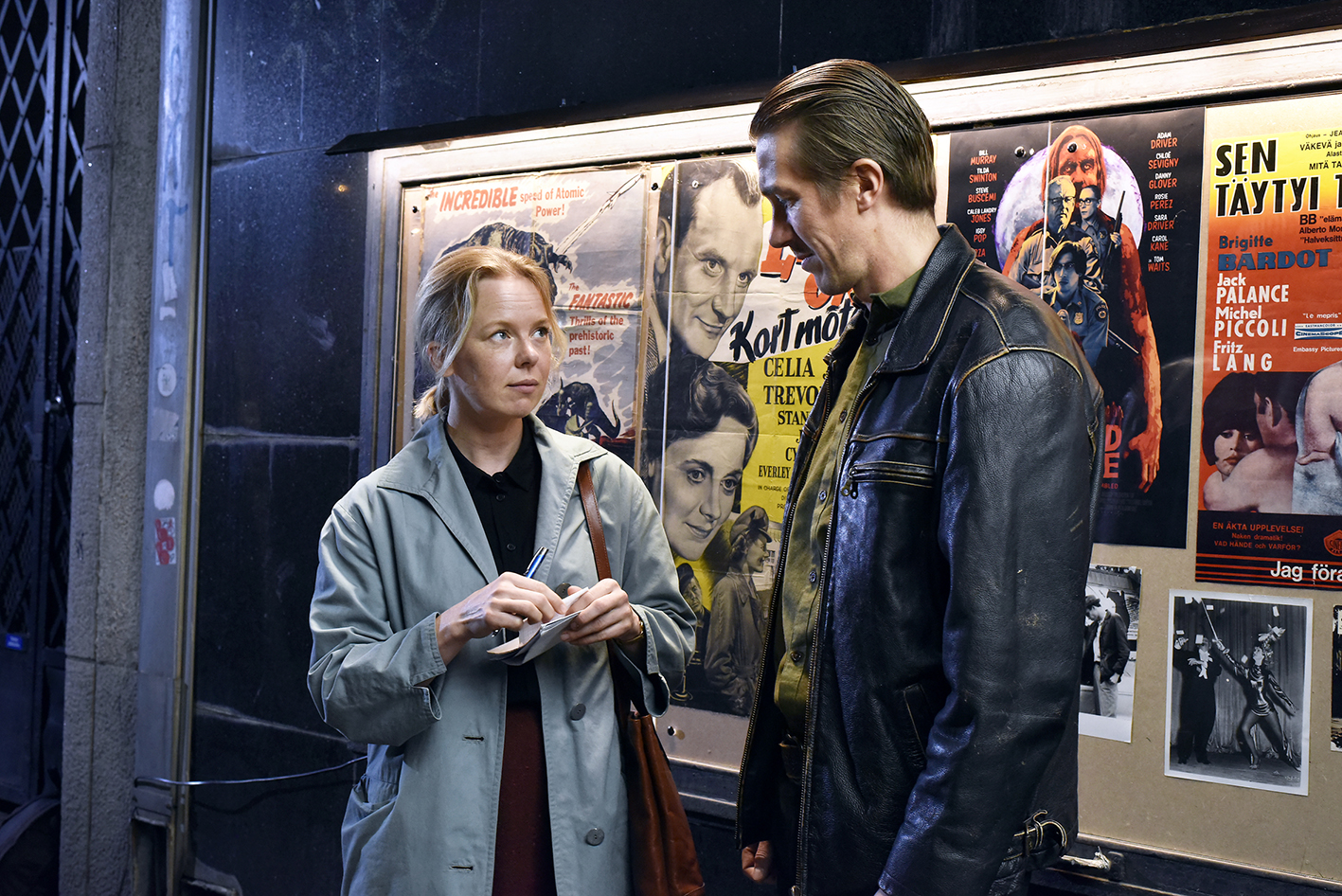
Photo caption: Alma Pöysti and Jussi Vatanen in FALLEN LEAVES. Courtesy of The Match Factory.
The Finnish deadpan comedy Fallen Leaves is the story of two fortyish singles navigating a blue collar world that is filled with disappointment, despite low expectations. We first meet the no-nonsense Ansa (Alma Pöysti) working in a supermarket, and then the sarcastic loner Holappa (Jussi Vatanen), working in a metal scrap yard. Fallen Leaves depicts Finnish middle-managers as tyrannical idiots, so neither Ansa or Holappa get any satisfaction from their work. Neither has much of social life, although they spot each other when accompanying friends to a karaoke bar.
These are two lonely people. But, not only don’t Ansa and Holappa meet CUTE, they keep not meeting AT ALL. Holappa’s shyness precludes an introduction at the karaoke bar, and then happenstance (and Holappa’s drinking) make them keeping missing each other, until a promising encounter is frustrated again.
We know that eventually, Ansa and Holappa will find the opportunity to launch a relationship. The impediment will be Holappa’s alcoholism. Here’s a public service from the Movie Gourmet: If you answer two or more of the following questions in he affirmative, then it is likely you have a problem with alcohol:
Have you been fired more than once for drinking on the job?
Have you passed out at a bus stop?
Do you regularly order three shots with a beer chaser?
Does a bartender tell you “[insert your name}, It’s time to go home so you can come back in the morning“?
Writer-director Aki Kaurismäki creates a humorously grim world for our droll heros and their pals. The dreariest of soulless dive bars, with the barmaid in curlers, is aspirationally named the California Pub. Holappa’s buddy tells him that he is no tough guy, “but maybe you could be a tough guy in Denmark”. Kaurismäki fills the screen with lots of Finns standing very still.
Fallen Leaves is not a Must See, I but I enjoyed the yearning for connection and intimacy, framed in the driest of humor. Many critics have describe the film as bittersweet; I see it as film with humor that is bitter-tinged, and then ultimately purely sweet.
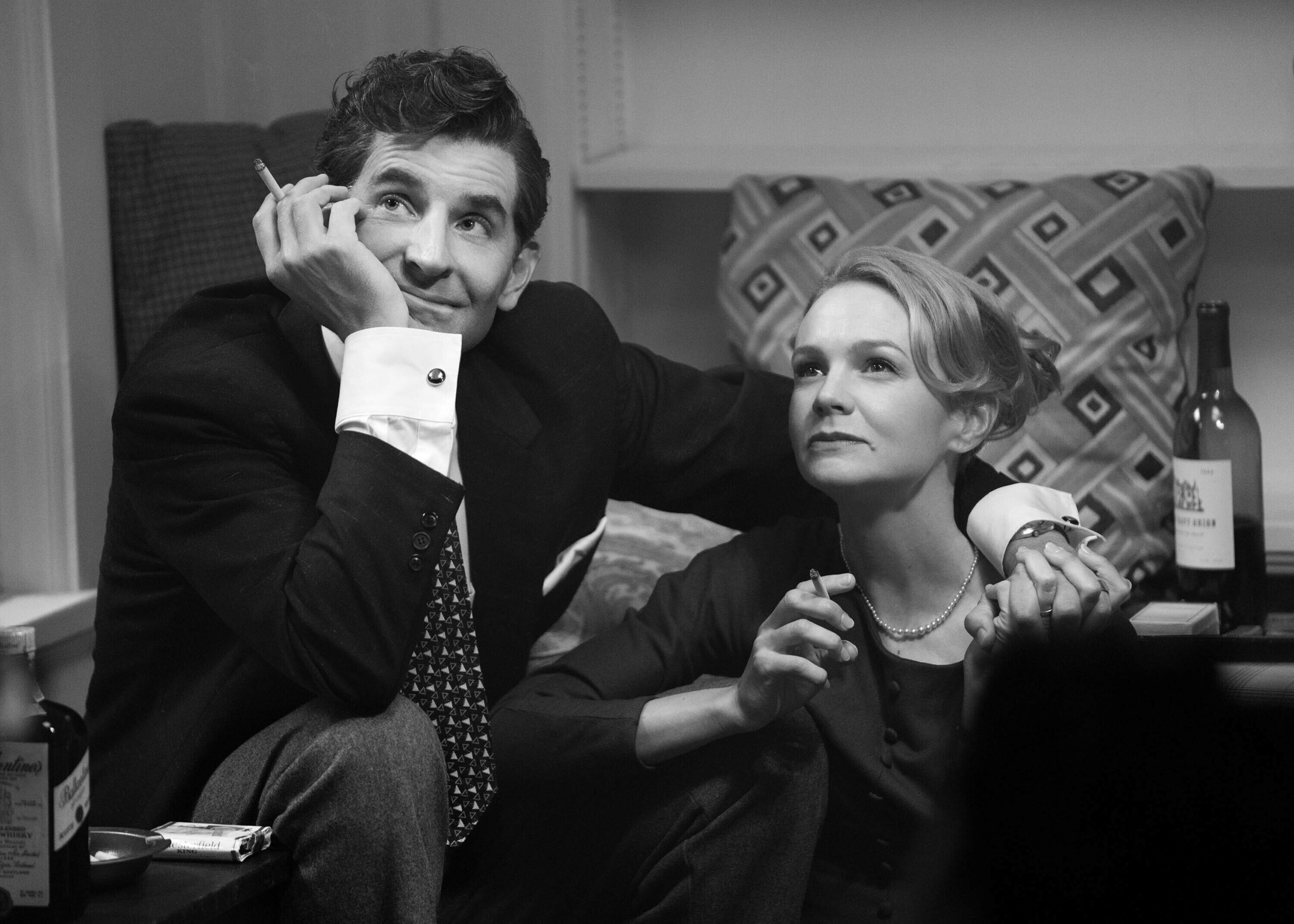
Maestro is the dramatization of the marriage between legendary conductor/composer Leonard Bernstein (Bradley Cooper, who also directed) and his wife Felicia (Carey Mulligan). As portrayed in Maestro, the marriage was shaped by three factors:
The two shared deep affection for each other, along with interests and sensibilities.
Bernstein’s career, driven by his genius, soared into superstardom.
In the first decades of the marriage, the mainstream would not accept a public figure who was gay or bisexual, which Lenny was.
Lenny was the prodigious talent and the celebrity, but Maestro is really Felicia’s story, because she faces the major conflict and because of Carey Mulligan’s sensational performance.
Indeed, although I’m lukewarm about Maestro, Mulligan is one of the two best reasons to see it. The second is a magical six-minute scene in which Bernstein conducts the London Symphony Orchestra in Mahler’s “Resurrection” Symphony No. 2 at Ely Cathedral in 1973; it is as spectacular cinema as we’ve seen (and heard) this year.
Bradley Cooper’s Lenny is a jumble of ebullience, creative energy and conflict-avoidance; he was always, perhaps compulsively, the life of the party. Sharing her life with a guy who sucked out all the oxygen in the room was enough of a roller coaster ride for Felicia. Felicia was pretty open-minded about her husband’s dalliances with other men; but his wanting to bring his male lover (Tommy Cothran, played by Gideon Glick) into her family was a bridge too far.
It seems that Lenny primarily valued Felicia for having his children and accompanying him to trendy parties; theNYT’s Manohla Dargis impeccably describes those as “those fabulously glamorous New York parties that mostly exist in old Hollywood films or in biographies of very important dead people.” He didn’t need her as a business adviser, a creative partner or even a muse, but she was much more than his beard. Her admiration for his artistry wasn’t that of a wannabe or a groupie – Felicia, as a working New York theater actor, was an accomplished artist herself.
So, as was common in the era, its was Lenny who defined their relationship, not he and Felicia together. Carey Mulligan inhabits a character who enjoys the initial exuberance and who slowly observes that Lenny is not going to deliver what she believed that he originally committed to.
Bradley Cooper is an excellent director, as demonstrated by A Star Is Born. Here, he is very cinematic, switching aspect ratios and toggling between black and white and color.
Sarah Silverman is delightful in a very small part as one of Felicia’s friends.
Back when the trailer was released, there was a tempest in a teapot about Cooper’s prosthetic nose, to make him resemble Bernstein, a familiar figure. Bernstein’s his family stepped in and quelled the silliness. But, I was distracted by another prosthetic, the folds of wattles and neck fat on Cooper playing the old Bernstein
I’m decidedly not a fan of classical music (although I did like Amadeus); The Wife likes classical music, and she liked Maestro a bit more than I did. We were both engrossed when Mulligan was onscreen, but I was bored when she wasn’t.
This is a BIG, ambitious movie, and all of my favorite critics liked it more than I did. It’s the kind of movie (like Kramer vs. Kramer or Spotlight) that may garner lots Oscar buzz (with Netflix support), but that we won’t remember in a few years. Maestro is in theaters and streaming on Netflix.
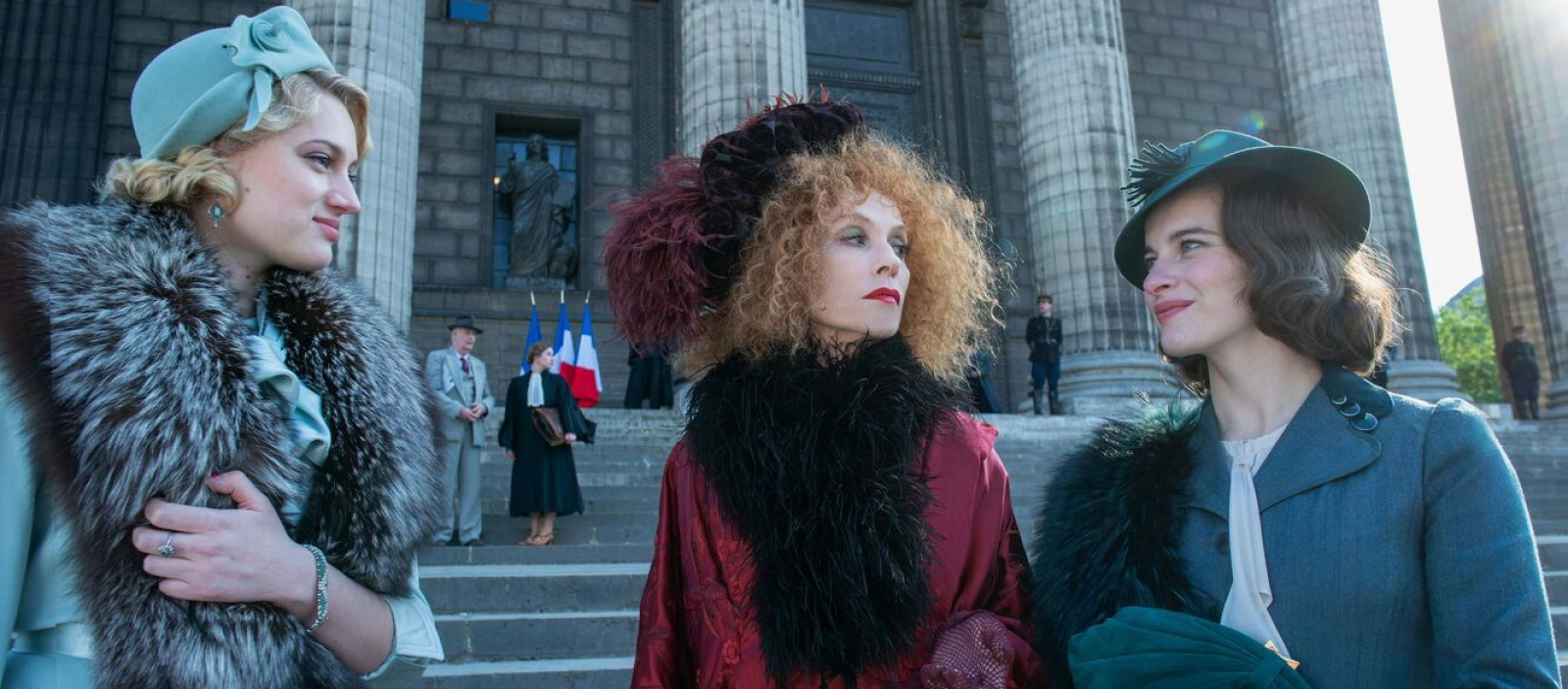
Photo caption: Nadia Tereszkiewicz, Isabelle Huppert and Rebecca Marder in THE CRIME IS MINE. Courtesy of Music Box Films.
Set in 1930s France, the breezy French comedy The Crime Is Mine is a proto-feminist farce. Madeleine (Nadia Tereszkiewicz of Only the Animals) is an actress struggling to find jobs because she won’t submit to the casting couch. Her roommate Pauline (Rebecca Marder) is a lawyer who law firms will not hire because of her gender. Madeleine seems to be the last person seen with a murder victim, a lecherous producer, and falls under police suspicion.
Pauline “defends” Madeleine with an ingenious strategy – confess to a killing that she didn’t commit, claim self-defense and ride the resultant wave of publicity to fame and riches.
The central joke, of course, is that a protagonist is trying to be proven guilty for a crime that she did not commit. The other novelty is that, in a decidedly non-feminist time and place, two young women without means must survive with dignity by their own cleverness and moxie.
I found all this mildly amusing until mid-film, when Isabelle Huppert shows up, playing a once famous diva of the silent screen. This character is unashamedly venal, and Huppert, as we can always expect, goes all in. She’s hilarious.
French comedian Dany Boone is a talented comic actor, and makes another welcome appearance here in a supporting role.
Director François Ozon is known for his light comedies like In the House and Potiche (as well as his recent drama Summer of 85),
As funny as Huppert’s performance is, the overall experience of watching The Crime Is Mine is more cerebral than emotionally engaging. The Crime Is Mine releases into theaters on December 25.
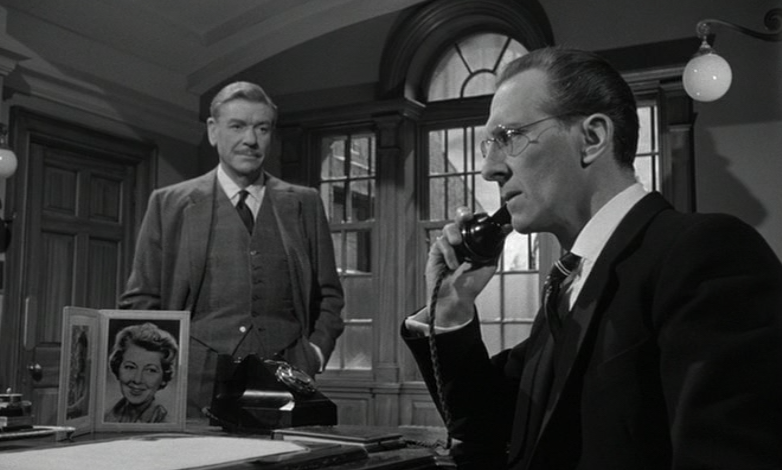
Turner Classic Movies has gift-wrapped a present for us on December 18. Cash on Demand, made in 1962 by the British horror schlock studio Hammer Films, is a ticking bomb suspenser and a Perfect Crime movie. It’s also an unlikely Christmas movie, with characters that evoke Dickins’ A Christmas Carol.
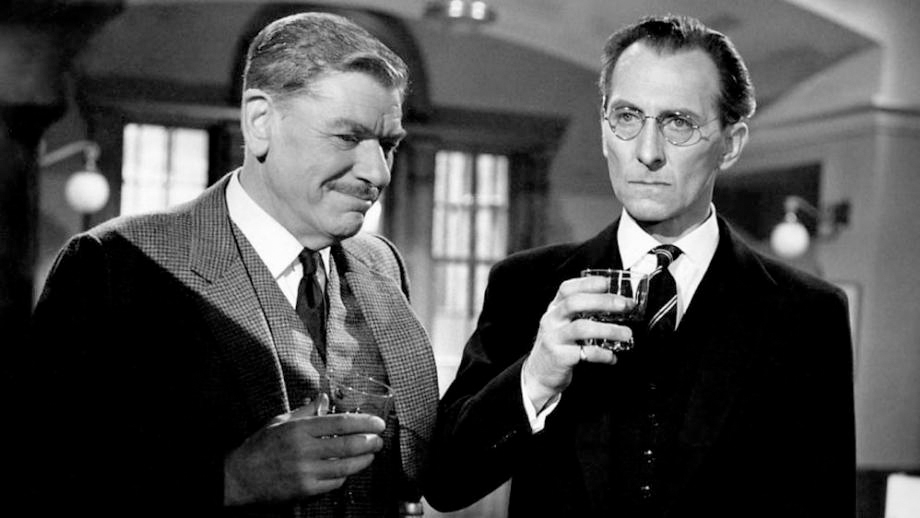
The Scrooge is the manager of a bank branch (Peter Cushing) – everyone’s most despised boss. He revels in the tyranny of his miniature fiefdom and never misses a chance to make the jobs of his underlings unnecessarily onerous or humiliating. The Bob Cratchit (Richard Vernon) is the dedicated and able bank clerk, who is doing his best while under the manager’s sadistic thumb.
The manager gets his comeuppance when a posh customer (André Morell) arrives. The manager’s kowtowing and boot-licking is interrupted by the discovery that the customer is actually pulling a heist and forcing the manager – by threatening his family – to help.
The crook has apparently thought of every possibility and devised a perfect heist. Cash on Demand becomes a bank procedural as we learn about 1862 state-of-the-art vault security.
There’s a deadline – the vault needs to be emptied at a certain time or the manager’s family will come to grief. All of Cash on Demand occurs in real time and all inside the bank, under the inescapable face of the wall clock.
Andre Morell’s bank robber, while ruthless, is generally jovial – the very model of clubby affability. Cash on Demand is a study in contrast between the cool-as-a-cucumber crook and the bank manager, who looks absolutely stricken throughout the movie.
Cash on Demand is sometimes available on TCM Watch and can be streamed from Flix Fling, but your best bet is to DVR its Monday airing on TCM. It’s on my list of Overlooked Noir.