
Safe House: crashes, bangs, thrills and Denzel

Safe House, the first big Hollywood movie of 2012, is a fine paranoid spy thriller.  Ryan Reynolds is a green but determined CIA agent who finds himself isolated in South Africa and forced to bring in rogue superspy Denzel Washington.  Like Hannibal Lector, Denzel’s character Tobin Frost over matches everyone he faces; it takes entire teams of elite commandos to trap and transport Frost, so Reynolds has his hands full. Not to mention that more teams of elite commandos keep popping up, trying to kill them both.  Swedish director Daniel Espinosa keeps his pedal jammed to the floor, and this two hour movie flashes by in what seems like 90 minutes.

It takes a screen presence like Denzel’s to make Tobin Frost, with his unique mix of charisma, menace and lethal skills, credible.   Reynolds holds up well against Denzel, and the always excellent Vera Farmiga, Brendan Gleeson and Sam Shepherd round out the cast.

I wouldn’t rate Safe House at the very top of the genre.  Espinosa didn’t take advantage of the opportunity to flesh out the characters played by Farmiga, Gleeson and Shepherd, who all end up playing oft-recycled types.  And there are some holes in the plot that you’ll recognize in the few moments when you can catch your breath (See spoiler below the trailer).

But the action and thrills are there, and the extremely well-paced Safe House is a satisfying watch.


Spoiler alert:  Since the CIA knows about Reynolds’ girlfriend, why don’t they kidnap her or at least tap her phone to help them track down Reynolds?
The Help: a waste of great actresses

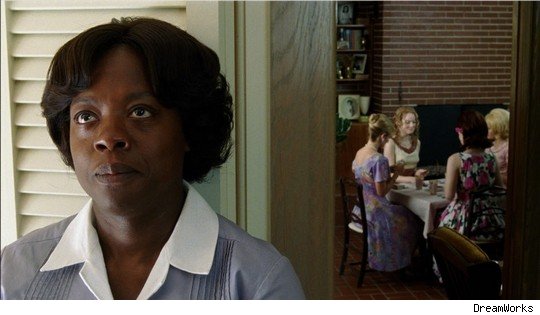
Viola Davis in THE HELP

Well, given the upcoming Oscars, I should weigh in on The Help and its four Oscar nominations.  Based on the well-received novel by Kathryn Stockett, it is the story of black maids raising white children amid the hatefully poisonous racism of 1963 Jackson, Mississippi.  Unfortunately, the film is overlong, plodding and wastes the talents of an unholy multitude of our greatest actresses.

I am told by The Wife that the characters in the novel are full and textured.  The problem with the movie is that the characters are cartoonish cardboard cutouts of real people.  Unfortunately, Stockett’s novel was adapted by director Tate Taylor, and he stripped any hint of nuance or ambiguity from virtually every role.  Octavia Spencer and Allison Janney play characters that have a mix of human virtues and foibles.  But the rest of the awesome cast – Olivia Davis, Bryce Dallas Howard, Jessica Chastain, Cecily Tyson, Sissy Spacek, Mary Steenburgen and Emma Stone – must play either saints or bitches.

Davis and Spencer are nominated for acting Oscars, and I wish them well.  But here’s a baffler – Chastain is a brilliant actress who has delivered not one but FIVE superb performances this year (Take Shelter, The Tree of Life, The Debt, Coriolanus, Texas Killing Fields), yet she is nominated for the one role written so broadly that she is obviously acting (The Help).

Coriolanus: a hero unsuited

The actor Ralph Fiennes directs and stars in Shakespeare’s Coriolanus.  The title character is a fierce and successful military leader upon whom is thrust political leadership that he has not aspired to and to which he is utterly ill-equipped.  It’s not going to end well, and that’s why they call it tragedy.

Coriolanus is devoted to the idea of Rome, which inspires his heroism in its defense.  But he despises most Romans and thinks it would be insincere to show them the least civility, which doesn’t bode well for his political career.  Fiennes does a good job playing Coriolanus, an oddball for whom “curmudgeon” doesn’t begin to tell the story.

Unfortunately, Coriolanus is propelled into the peacetime limelight by his ultra-ambitious mother (Vanessa Redgrave) and an able and well-meaning politician (Brian Cox).  Redgrave and Cox are splendid, and their performances are highlights of Coriolanus.  Coriolanus is well-acted, including by Jessica Chastain, the wonderful Irish actor James Nesbitt and even, surprisingly, Gerard Butler.

Fiennes the director has done well to set Shakespeare’s tale of ancient Rome into the present.  This story of war and politics comes alive in today’s world of cable television news, with its crawling captions and pundits, protest demonstrations and soldiers in Humvees.  By stripping away the swords and togas, Fiennes helps us recognize the ambition, personal stubbornness, political treachery and the fickleness of public opinion at the core of the story.  As Shakespeare probably wanted to, Fiennes is able to put his audience into realistic warfare.  Coriolanus was filmed in the Balkans and, indeed, Butler certainly looks like a Serbian warlord from the very recent past.

The problem with Coriolanus is that we admire Coriolanus’s high-mindedness less than we cringe at his social obtuseness.   But Fiennes (and Redgrave and Cox) have given us one of the best cinematic adaptations of Shakespeare.


A Separation: brilliant film, tough to watch

A contemporary Iranian couple had planned to leave Iran for a better life in the West, but, by the time they have wrangled a visa from the bureaucracy, the husband’s father has developed Alzheimer’s. The husband refuses to leave his father and the wife leaves the home in protest. They are well-educated and secular. The husband hires a poor and religious woman to care for his father (and she does not tell her husband about her job). Then there is an incident which unravels the lives of both families.

This is a brilliant film. Writer-director Asghar Farhadi has constructed a story in which the audience sees and hears everything that happens, but our understanding of the events and characters evolve.  We think we know what has happened, but then other narratives are revealed.  Likewise, the moral high ground is passed from one character to another and to another.  It’s like Rashomon, but with the audience keeping a single point of view.

Much of that point of view is shared by the ever watchful teenage daughter of the educated couple.  She desperately wants her parents back together, views everything through this prism and is powerless to make it happen.  She is played by Farhadi’s real life daughter.

Religion towers above the action – and not in a good way.  It guides the actions of the religious couple into choices against their interest.  The Iranian theocracy restricts the choices of the secular couple and of the judges trying to sort everything out.  Almost every character is a good person who is forced to lie to avoid some horrific result otherwise required by the culture.

One final note:  it will be a lot harder to make an easy joke at the expense of American lawyers after watching the Iranian justice system in A Separation.

The realistic angst of the chapters makes this a difficult film to watch – not a light date movie for sure. But the payoff is worth it, and it’s a must see.

This film is on the top ten list of over 30 critics and is Roger Ebert’s top-rated film of 2011. It is a lead pipe cinch for the Foreign Language Picture Oscar.

Pina 3D: watching dance from amid the dancers

There are two reasons to see Pina 3D – to watch modern dance and to marvel at the use of 3D in a dance film.  This documentary shows the work of the late German choreographer Pina Bausch performed by her dance troupe; it’s at least 90% dance performance.

But the singular feature of the film is director Wim Wenders’ use of 3D – the movie audience is transported on to the stage with and among the dancers.  It’s been easy to dismiss 3D with all the crap 3D product out there, but master directors like Martin Scorsese (Hugo) and Werner Herzog (Cave of Forgotten Dreams) can use the technology to make a film even more brilliant.  Wenders (Paris Texas, Wings of Desire) does that with Pina.

Now, if you don’t like modern dance, you’re not going to like this movie.  But, if you do, you should catch this film during the week or two that it will be out in theaters in Real 3D; I’m not going to recommend it in 2D unless you’re a huge dance fan.

[youtube-http://www.youtube.com/watch?v=LGKzXUWAjnI]

Thunder Soul: funk pride

This good-hearted  documentary is about a national champion high school stage band in the 1970s.  Because of the era, and because we’re talking about inner city Black kids from Houston, the backdrop is the Black Pride movement.  The key character is their band leader, Conrad “Prof” Johnson, who drove them to be technically proficient and flavored their music with his own funk compositions.  Thirty years later, the band members plan a reunion to honor Prof.  The band members are an entertaining bunch, and there’s plenty of footage from the 70s.  Thunder Soul is sure to be a crowd-pleaser and there are lots of great 70s Afros.

Thunder Soul won film fest awards but failed to get an adequate theatrical release, and is now available on DVD.

Blogging from Noir City: It’s Bad Girl Night!

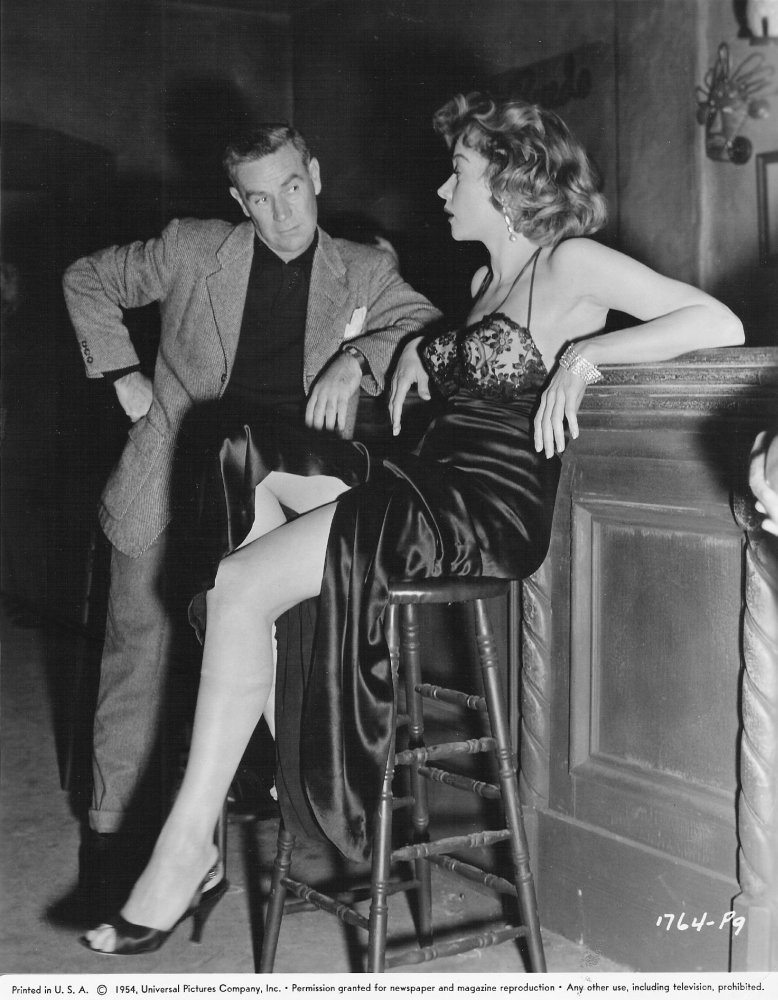
Gloria Grahame with Director Jerry Hopper on the set of NAKED ALIBI

Last night I had a great time at Noir City, the 10th annual San Francisco Film Noir Festival.  Noir City is spearheaded by the film noir expert Eddie “The Czar of Noir” Muller.  Its website also includes top rate film noir resources and merchandise.

Last night’s program was a double feature that is not available on DVD.  In fact, Universal went into its vault for the negative and made what is now the only print of Naked Alibi (1954) for this screening.    Naked Alibi  features Gene Barry as a seemingly regular guy with a violent and unpredictable temper.  Sterling Hayden is a cop from the “I’ll beat a confession out of him” school of law enforcement; Hayden’s obsession, without any apparent empirical basis, is that Barry is a cop killer.  They both vie for Gloria Grahame, a sexy saloon singer with a heart of gold.

Film noir is dependent on its femme fatales and Gloria Grahame may be my all-time fave.  Many of you remember her as the slutty Violet in It’s a Wonderful Life and as Bogie’s co-star in the drama In a Lonely Place.  The fact that Gloria was a Bad Girl in real life doesn’t hurt.  I thank Mark A. Clark and his great blog Film Noir Photos for the great photo above.

The second film was Pickup, a lively and cynical low budget indie from 1951.  The writer/director Hugo Haas made several of these films in the early 50s.  As usual, in Pickup, Haas stars as the middle aged sap in the thrall of a young hottie.  Two things make Pickup an absolute howl.  First,  Haas loses his hearing; when he unexpectedly recovers his hearing, he doesn’t let on that he can hear his trashy young wife and her beau plot to kill him for his money.   Second, Beverly Michaels plays the femme fatale so broadly, creating one of the most unashamedly selfish characters in screen history – a floozy totally devoid of empathy.  Only Ann Savage in Detour was a nastier noir villainess.


Albert Nobbs: the perfomances can’t overcome the story

Glenn Close plays the title character, a woman living as a man in early 20th century Dublin; the woman makes a convincing male waiter at a small hotel.  She is repressed, obsessed with stashing a trove of tips to finance opening a shop and terrified that anyone will discover her secret.

Although Close is very good, the actress Janet McTeer gives the movie’s best performance; I will avoid a spoiler by describing her character.  Pauline Collins is excellent as the hotel’s avaricious owner.  Brendan Gleeson pops in for one of his delightful turns as the hotel’s doctor.

The fine young actress Mia Wasilkowska (The Kids Are All Right, Alice in Wonderland), however, just doesn’t seem to fit the period.  She is stuck with playing the one dimensional role of an oversexed hotel maid who could be wearing a placard that says, “Knock me up”.

The problem with Albert Nobbs is that, to buy the story, you have to accept that a 50-year-old hotel worker has no idea whatsoever about certain aspects of sexuality.  Now Albert Nobbs is asexual and traumatized from an early incident of sexual abuse, but that really doesn’t explain how she could have observed behavior of hotel guests for thirty years without even learning about some basic proclivities.

Another problem is that the visiting English elite is SO cruel to the Irish staff (not just with historically accurate cruelty, but over-the-top  cruelty), that these story elements become broad and campy, which doesn’t mesh with the rest of the movie.  Despite the best efforts of Close, McTeer, Collins and Gleeson, Albert Nobbs just doesn’t work.

[youtube:http://www.youtube.com/watch?v=66N5hjkq740]

Carnage: a comic actors’ showpiece

The sons of two Brooklyn couples have tangled in a schoolboy row.  The couples meet to discuss the matter, but the personality clashes between and within the couples derails an encounter of forced politeness into comic chaos.

Carnage belongs to its actors, and the couples are played by John C. Reilly and Jodie Foster and Christoph Walz and Kate Winslet.  All are very good and very funny.  The Austrian actor Walz (Inglorious Basterds) is especially good; his eyes betray his indifference to parenting and social niceties, but finally gleam when he is spurred to conflict.

Carnage is directed by Roman Polanski, based on the popular comic play God of Carnage by the French playwright Yasmina Reza.   God of Carnage won the 2009 Tony for Best Play.

Polanski (Rosemary’s Baby, Chinatown, The Pianist) is one of the greatest living directors, and knows enough to eschew anything showy here.  He just lets the actors show their chops, which is a very good thing.  Carnage is not one of the year’s best movies, but is a smart and funny comedy.

Haywire: an action star is born

One of the first 2012 releases, Haywire is a rockem sockem spy action thriller by Steven Soderbergh, starring Gina Carano.  I was not familiar with Gina Carano, who is an accomplished star of mixed martial arts.  Haywire is a vehicle seeking to launch her as an action film star.  And why not, for she is attractive (with “real girl”, not Hollywood, looks), well-endowed and can kick ass?  She can, after all, kick ass for real, not just pretend to in a movie.

As an actor, Carano is plenty good enough.  She’s way better than Chuck Norris, Jackie Chan and the Rock, and is at least as good as Schwarzenegger.  And, when she beats up a swat team, it is believable (and fun).

Soderbergh is always interesting, as he moves between high brow/arty (sex lies and videotape, The Good German) and lowbrow/popular (Ocean’s Twelve, Contagion).  Here he takes an inexperienced leading woman and an unremarkable story and makes the most of it.  It’s a good watch.

Soderbergh delivers fast pacing and great locations (Barcelona, Dublin, New Mexico).  Soderbergh and Carano benefit from a top rate cast:  Michael Douglas, Ewan McGregor, Michael Fassbender, Antonio Banderas, Michael Angarano and Bill Paxton.  Overall, it’s good entertainment and, for once,  I’m actually looking forward to the sequels.