Hysteria is a breezy, feminist lark. Victorian doctors are befuddled by all manner of female complaints, which they lump together into the diagnosis of hysteria. One physician becomes popular when he pioneers pelvic massage as treatment. Who knew that rubbing their clitorises (clitorii?) made them happy?
Thankfully, director Tanya Wexler keeps the whole thing light. Maggie Gyllenhaal stars as a proto-feminist and High Dancy plays the doc who invented a proto-vibrator. Rising star Felicity Jone (Like Crazy) pulls off a secondary role.
Christians and Muslims live together in a very isolated Lebanese village. The men, none too bright, flare any perceived grievance into testosterone-fueled tribal fury. Knowing that any trivial incident can spark an escalation to sectarian slaughter, the women, aided by the imam and the priest, work tirelessly to extinguish every possible provocation. The women will stop at nothing, including sabotaging the village’s only TV, faking a miracle, medicating the pastries and even hiring a van full of Ukrainian strippers.
This story could have been played broadly like Lysistrata. There are many funny moments, but Where Do We Go Now? is more than farce. To these women, war is not theoretical. We can tell from their language, which references men crouching in the attics and looking under beds, that they have survived past sectarian violence. And we see the village cemetery, filled with the headstones of young men. The women and the clerics have seen war, and they are desperate to avoid it. That desperation adds a sting to the comedy, and makes Where Do We Go Now? a pretty good movie.
Polisse is a riveting French police procedural about the child protective services unit in Paris. Most cop movies are about how the cops solve the crime. Instead, Polisse is about the job’s emotional impact on the cops themselves – when their assignment is rescuing kids from various degrees of abuse. It’s an uncommonly good film.
Writer-director Maiwenn embedded herself with this police unit for several months. At the San Francisco International Film Festival screening, she said that, although the film is fictional, everything in the movie happened in real life (except for the love story between Maiwenn’s photographer and Joey Starr’s cop). Maiwenn also said that, although the real-life cops were rooting for her to do a movie about their most spectacular exploits, she chose to focus on a realistic cross-section of cases to depict the unit’s actual daily experience.
There are about ten cops in the unit, and it’s an excellent ensemble cast. Joey Starr is the cop who cares too much. Karin Viard (Paris, Potiche, Time Out) is the seemingly together cop whose family life has been sacrificed. Marine Fois (seen earlier this year in Four Lovers) is wound way too tight. Frederic Pierrot (I’ve Loved You So Long, Let It Rain, Sarah’s Key) is the conflict-averse commander trying to keep the lid on his rambunctious unit.
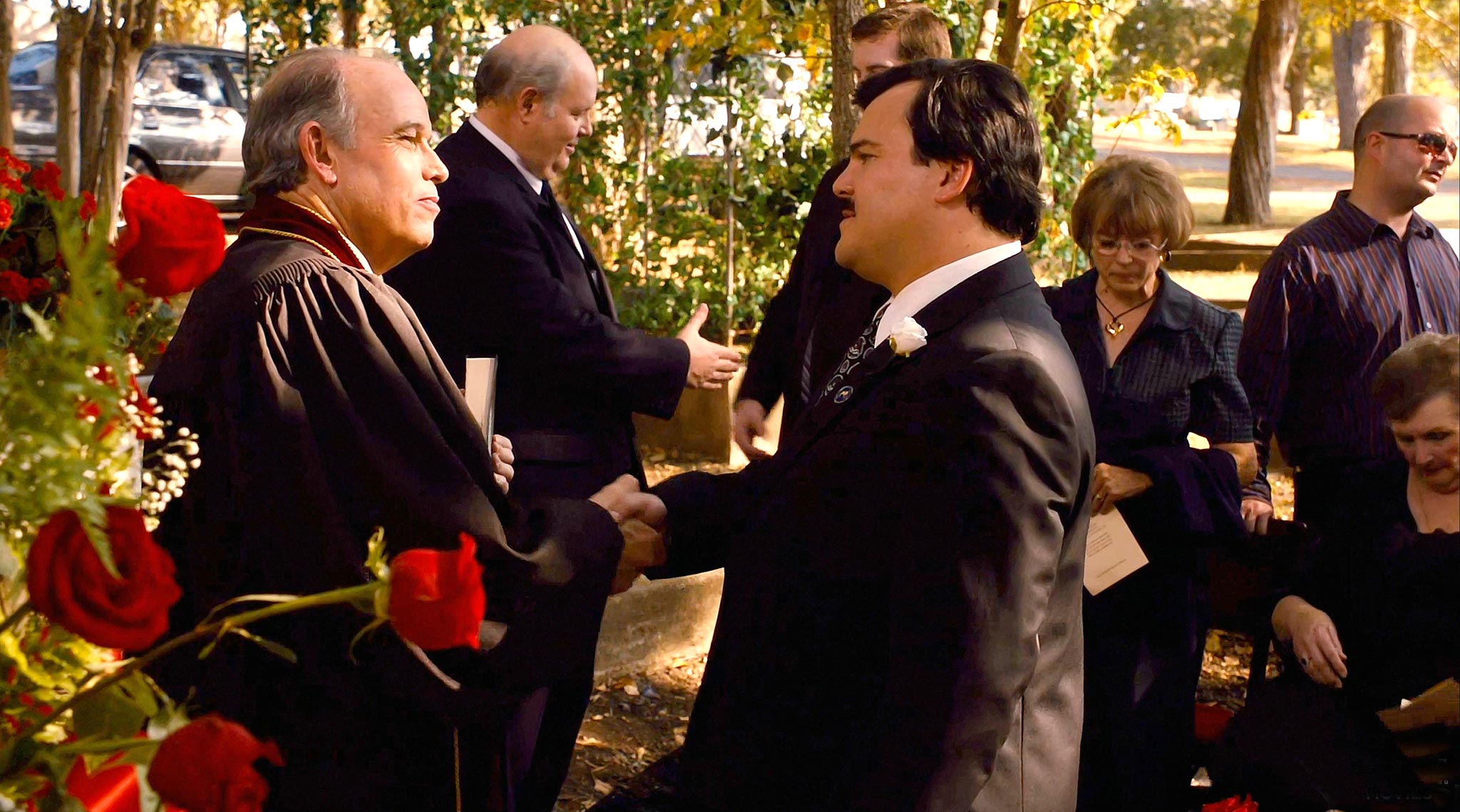
This is one very funny movie. Playing against type, Jack Black is Bernie, an assistant funeral director who is the kindest, most generous guy in a small East Texas town. Bernie becomes entangled with the most malicious town resident, the rich widow played by Shirley MacLaine. We are used to seeing Black playing venal and devious characters, but Bernie is utterly good-hearted. He has built up so much good will in the community that when he snaps and commits one very gravely wrong act, he is still locally beloved. Black also gets to show off his singing voice on some heartfelt gospel hymns.
But the real main character is really the East Texas town of Carthage. Director Richard Linklater has the local residents (some played by actors) tell the story in capsule interviews. Through this chorus, we see how the locals view Bernie and the widow, and we learn a lot about the local values, customs and colorful language. Linklater is from East Texas himself and clearly revels in sharing the culture with us. It’s very, very funny.
The plot takes one improbably funny turn after another – but it’s a true story, which makes it even funnier. You can look it up in the New York Times [major spoilers in the article]. During the end credits, we even see Jack Black conversing with the real Bernie at Bernie’s current residence.
(I’m not embedding the trailer, because it doesn’t make clear that Jack Black’s character is not the winking, edgy guy that he usually plays. Just see the movie.)
As you can see from the trailer, this story of aged Brits seeking a low-budget retirement in India looks like enjoyable fluff with a great cast. I was expecting a fish-out-of-water comedy, but found much more than that. Besides dealing with the culture shock issues (which are plenty funny), the characters each forge their own journeys of self-discovery.
Of course, the cast is a superb collection of British acting talent: Bill Nighy, Judi Dench, Tom Wilkinson, Maggie Smith, Celia Imrie, Penelope Wilton (Downton Abbey). Dev Patel of Slumdog Millionaire is their genial and scattered host.
Nighy is especially brilliant as a guy trapped too long by his own profound decency. Dench delivers an equally outstanding performance as a woman determined to make her own way for the first time. In another acting gem, Tom Wilkinson follows a thread from his secret past and uncovers a moving revelation.
But those are just the highlights. Go see The Best Exotic Marigold Hotel for the rest.
InThe Five-Year Engagement, a couple falls crazy in love as their careers are on the verge of taking off – she’s an academic, he’s a chef. She gets the opportunity to do a post-doc at the University of Michigan, so he shelves the opening of a San Francisco restaurant to follow her to Ann Arbor, where she flourishes. However, he sputters and finally spirals into deep unhappiness. Can their love overcome all? [Yes – this is not Romeo and Juliet where everybody dies].
Of course, they have zany best friends and the usual maddening parents. And a move from the Bay Area to Ann Arbor (depicted as perpetually snow-laden, with occasional parades of reveling frat boys) creates plenty of comic opportunities, especially as he shops his skills in cutting edge cuisine among the local eateries.
But the best thing about Five-Year Engagement is the authenticity of the situation. There are no wacky plot devices; this story could all really happen – and is the narrative for some couples today.
Another plus is that Jason Segal and Emily Blunt are very good as the appealing couple. Overall, the cast is excellent, although the Australian actress Jacki Weaver, who carried Animal Kingdom, is wasted in a one-note role as a nagging mother.
In fact, I feel guilty that I didn’t like Five-Year Engagement more than I did, but it did seem to drag in places. Still, it’s a worthwhile romantic comedy.
The smug Norwegian corporate headhunter named Roger Brown (don’t ask) explains his motivation at the very beginning of the movie: at 5 feet, 6 inches, his insecurity about keeping his six foot blond wife leads him to cut some corners. As ruthlessly successful as he is in business, he feels the need to also burgle the homes of his clients and steal art treasures. So the dark comedy thriller Headhunters (Hodejegerne) begins like a heist movie. But soon Roger becomes targeted by a client with serious commando skills, unlimited high tech gizmos, and a firm intention to make Roger dead.
Roger Brown is played brilliantly by Aksel Hennie, a huge star in Norway who looks like a cross between Christopher Walken and Peter Lorre. The laughs come from Roger’s comeuppance as he undergoes every conceivable humiliation while trying to survive. As a smoothly confident scoundrel, Roger is at first not that sympathetic, but Hennie turns him into a panicked and terrified Everyman when he becomes a human pinata.
Headhunters is based on a page-turner by the Scandinavian mystery writer Jo Nesbo. There are reports that Headhunters will be remade soon by Hollywood. In the mean time, see Headhunters and have a fun time at the movies.
If you like suspense, you will want to check out Diabolique, to be broadcast by Turner Classic Movies on May 12. The headmaster of a provincial boarding school is so cruel, even sadistic, that everyone wants him dead, especially his wife and his mistress. When he goes missing, the police drain the murky pool where the killers dumped the body, and the killers get a big surprise. Now the suspense from director Henri-Georges Clouzot really starts.
A master of the thriller, Clouzot was nicknamed the French Hitchcock. In an achingly scary scene from Clouzot’s The Wages of Fear, two truck drivers try to get a long truck around a cliff side hairpin curve – and the truck is filled with nitroglycerin. If you like Diabolique, you’ll probably also like another domestic murder – this time set in Paris – Quai des Orfevres.
I’ve always loved the good-hearted and wry Aardman Studio films like Wallace and Gromit and Chicken Run. Aardman’s Pirates! Band of Misfits doesn’t quite match up to Aardman’s past work. The claymation is exquisite and the jokes are smart, but the overall effect is merely amusing and guffaw-free. Silly pirate stereotypes should have been much richer fodder for the writers.
I saw this in 3D, but I wouldn’t pay the 3D premium if I were taking a bunch of kids to see it.
In this paranoid thriller, a sinister corporation sends a professional hunter (Willem Dafoe) to Tasmania to find the Tasmanian Tiger, thought extinct. He is given a cover identity as a scientist, which immediately makes him a target of hostile loggers He is renting a room in the primitive cabin of a scientist who searched for the Tasmanian Tiger and has been missing and is presumed dead by everyone except his traumatized family. The scientist’s wife is so heavily sedated that she only briefly wakes into a stupor, the 6-year-old son has become mute and only the 10-year-old daughter is resilient enough to converse. The suspense begins immediately. Will he find the Tasmanian Tiger? What happened to the scientist? Is he being hunted himself?
The weirdly beautiful scenery and breathtaking vistas of Tasmania enhance the dramatic tension. The forests are so primordial that you expect to see a creature from Jurassic park bursting out.
Dafoe’s hunter spends much of the movie alone in the wilderness with no one to talk to and, being on a secret mission, he can’t tell other people what he finds anyway. So his discoveries have to be depicted by the director and their impacts reflected in Dafoe’s expressive eyes.
Overall, it’s a fine genre film, although the paranoia is over the top and some will find the ending too stark. The scenes of Dafoe’s driven hunter, solitary in the wilderness, make up for the flaws.