I liked Looper because it’s old school sci fi – based on an idea, in this case, what happens if humans learn how to time travel? I think that much of the sci fi in that past thirty years hasn’t been idea-based, but more an excuse to clothe a monster movie or an action movie in cool-looking sci fi settings. The credit here goes to writer-director Rian Johnson who has imagined a 2044 in which the richest 10% (including organized criminals) live pretty well, but the rest of us vie for scraps in decayed cities that haven’t seen any investment since maybe 2012. In Johnson’s foul future, time travel is discovered, but by 2074, is used by criminals to dispose of their victims back in 2044.
In Looper, 2044 hit man Joseph Gordon-Levitt is confronted with the 2074 version of himself, played by Bruce Willis. Willis is on a mission to do something in 2044 that will change an outcome in 2074. The mission is shocking – would you murder a child to prevent him from growing up to become a Hitler-like monster?
In a year with many excellent performances by child actors, Pierce Gagnon plays one compellingly terrifying four-year-old. As a bonus, one of my favorite character actors, Garret Dillahunt (No Country for Old Men, Assassination of Jesse James, Winter’s Bone) has a nice turn near the end of the movie.
As Looper climaxes, the audience needs to think along – if history is altered, how will the dominoes fall?
In a fine movie debut, Stephen Chbosky directs the screen version of his novel. A shy high school freshman in 1991 is adopted by two unapologetically misfit seniors, played by Harry Potter’s Emma Watson and Ezra Miller (very different here than in We Need to Talk About Kevin). The Perks of Being a Wallflower is a coming of age story, and a very good one. We’ve all experienced adolescence, so my test for a film in this genre is whether the moments of adolescent awkwardness, peer obsession, self-doubt and discovery feel real. I felt that authenticity with Perks. In addition, the story is textured and unpredictable, and the performances – especially those by Watson and Miller – are excellent.
I liked so much about Liberal Arts that I wondered why I felt so unsatisfied leaving the theater. I finally realized that the central character just didn’t work for me, making an otherwise good movie into a hollow one.
Liberal Arts is written and directed by TV sitcom star Josh Radnor, who also plays the lead character, Jesse, a college admissions officer in NYC. Jesse is now 35 and adrift. He returns to his old college to speak at the retirement of his favorite professor, falls back in love with college life and meets a spirited 19-year-old coed. As Jesse examines where he is in his life, he is book ended by his world weary professors and by the naive young students that he meets.
That’s a promising premise and the very well written supporting characters provide some funny and thoughtful moments. Richard Jenkins is brilliant as a man grappling with the end of his career, and Alison Janney has some delicious moments as a very tough broad whose expertise is Romantic literature. Elizabeth Olsen is very good as the coed, and Zac Efron is downright hilarious as a college age stoner dude.
But it comes down to a main character that has it pretty good, but resists acting like a grownup. He doesn’t get credit from me for figuring it out at least thirteen years too late. The movie wants to give him credit for that, and for a “noble” decision that is implausible.
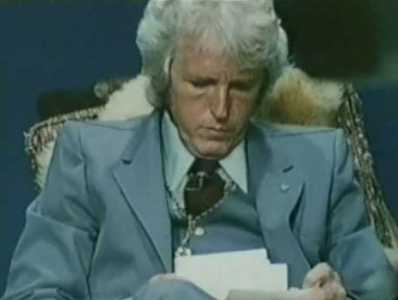
I am a huge fan of Werner Herzog’s documentaries (Grizzly Man, Little Dieter Needs to Fly, Cave of Forgotten Dreams). So I was particularly pleased to come across this 1980 Herzog gem. It’s a 43 minute made-for-TV documentary called God’s Angry Man.
God’s Angry Man is about the late Dr. Gene Scott, a TV preacher who would rail at his audience until they sent him money. You would think that people would turn off a television personality who was hectoring them, but Scott tapped into something spooky within his flock. He was mesmerizing. I myself watched him for many hours late at night, amazed that his followers would tune in to his hard-edged bellowing and choose to be bullied.
Herzog plays it straight and lets Scott speak for Scott, although Herzog must have been puzzled and bemused by the American phenomenon of the TV preacher.
End of Watch is a top notch thriller of a cop movie. Two cops, played by Jake Gyllenhaal and Michael Peña, patrol a hell hole beat in South Central LA. They are well-intentioned cops, but they are testosterone-fueled young guys. They are always looking for action, and this neighborhood has plenty of action. They ultimately bite off more than they should try to chew.
Writer-director David Ayer (Training Day) has made a movie that rises above the genre because of the well-written main characters and their relationship. We watch them chiefly from a camera on the dashboard of their squad car. We learn that they are both decent guys and both adrenaline junkies, but one is more aspirational and one is more settled. They are both funny, and the multiracial theater audience at my screening was howling at the ethnic ball-breaking.
There are also some impressive chases, often filmed with the dashboard camera facing forward. It’s thrilling stuff. There’s a lot of shaky cam (which I usually hate), but here it works well to enhance the chaos of the setting as well as the action.
The rest of the cast is excellent, most notably Natalie Martinez and Anna Kendrick (Up in the Air) as the love interests, David Harbour, America Ferrera and Frank Grillo as fellow cops, and Diamonique as a fierce gangbanger.
And here’s a shout out to Michael Peña. In End of Watch, Peña nails both the humor and the action; he’s on-screen almost the whole movie and has an engaging presence. He has played so many Latino cops, and he really deserves a chance to show what he can do with a different type of role.
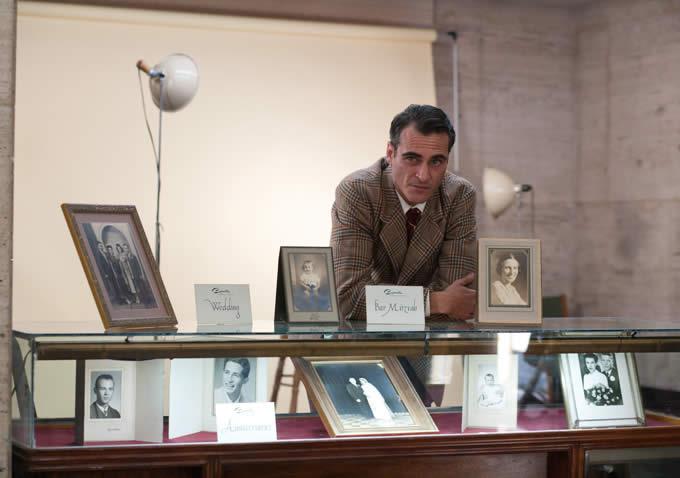
This ultimately unsatisfying film is a visual masterpiece with an extraordinary performance by Joaquin Phoenix. It’s also a brilliant depiction of alcoholism. But the story fizzles out like a spent Roman candle. With all of its achievements, it’s hard for me to imagine The Master pleasing more than the narrowest audience.
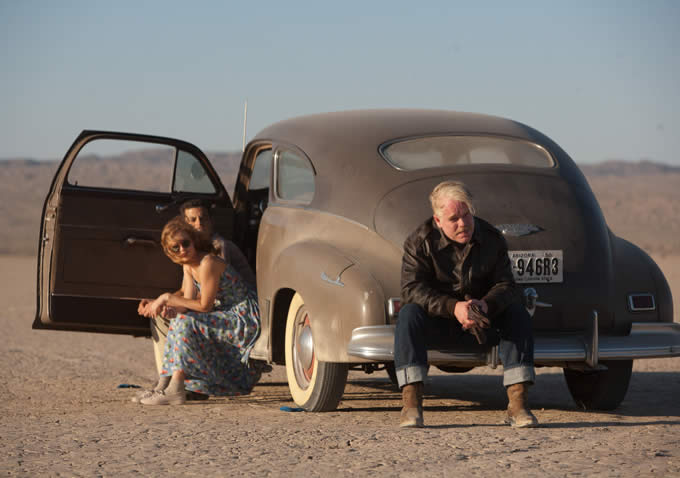
The story is about an emotionally troubled WW II vet (Joaquin Phoenix) who drifts through post-war America, leaving social carnage in his wake. His only success is in making moonshine out of available ingredients ranging from torpedo fuel to paint thinner. He happens upon the charismatic and manipulative author of a new path for seekers (Philip Seymour Hoffman), and the two men forge a bond. The leader enjoys the drifter’s moonshine and, when he needs a thug, harnesses the younger man’s rage. The drifter finds someone who seems to care about him, who offers a place and a sense of belonging.
Phoenix’s performance as Freddie Quell is one of the best of the century. Phoenix took some risks with the physicality of the performance, employing a hunch and a scowl that could have been too much, but instead help create a flawless performance. Freddie can stand quietly at the back of a room filled with people and fidget just enough so you absolutely know that he’s trouble.
Freddie is a damaged soul who self-medicates with alcohol. Joaquin Phoenix’s portrayal of his compulsion to drink and the inevitably unhappy (and sometimes lethal) consequences makes for one of the best ever movie portraits of an alcoholic.
(Two scenes of Freddie’s experience at a military hospital for battle traumatized vets are lifted directly from the brilliant John Huston documentary Let There Be Light, which I have written about and which you can watch for free on-line.)
Philip Seymour Hoffman is superb as the charismatic charlatan. Amy Adams and the rest of the cast give uniformly excellent performances.
Every single shot has been carefully composed, framed and photographed in especially beautiful 65 mm. The story takes place in the early 1950s, and every period detail is perfect. You could use any 100 shots from this film and make one glorious coffee table book.
The Master has been perhaps the years most awaited movie for two reasons. First, the Philip Seymour Hoffman character is inspired by L. Ron Hubbard, the founder of controversial and ever litigious Scientology. But the movie is really the story of the young transient (Phoenix’s character), and the cult created by Hoffman’s character is merely the setting.
Second, it was written and directed by acclaimed filmmaker Paul Thomas Anderson (Hard Eight, Boogie Nights, Magnolia, Punch-Drunk Love, There Will Be Blood). Since the fun and accessible Boogie Nights, Anderson has been specializing in critically anointed films that are not that audience-friendly. This time, Anderson has done his best job of directing, but the movie fails because his screenplay peters out.
I would happily invest two hours and 17 minutes into a good story that looks this good and is about a character this compelling. In the first half of the movie, I was on the edge of my seat, wondering “What will Freddie do next and what will happen to him?”. Unfortunately, the last half of the film takes Freddie a few thousand miles with very little dramatic payoff. So, like a boat inexpertly tied to the dock, the movie drifts in and out and bangs against the pilings. This could have been a masterpiece, but you need a good story to make one of those.
There isn’t a surprising moment in Trouble with the Curve, but as predictable as it is, the fine performances and the setting in an often obscure part of the baseball world combine to make it an enjoyable time at the movies.
It’s a story about a dad-daughter relationship. The dad (Clint Eastwood) is a crusty geezer whose failing eyesight threatens his job as a Major League Baseball scout. The daughter (Amy Adams) is an overachieving, workaholic lawyer who is unsatisfied with a relationship that her dad keeps as superficial as possible. They are improbably forced together on a road trip.
Now you know that she is going to run the pool table at the hick roadhouse. You know that the unlikely kid will turn out to be the real MLB prospect. You know that the geezer’s insight will be proven right in the end. And you know that the daughter will find closeness with the dad and a new boyfriend along the way. As I said, there are no surprises.
Nevertheless, Eastwood and Adams are just perfect in their roles. Eastwood’s graveside monologue and song are particularly moving. Justin Timberlake and John Goodman are excellent, too. Matthew Lillard is dead on perfect as a frat boy turned know it all baseball exec.
And then there’s the baseball setting. The movie had me with the gaggle of elderly scouts traipsing through South Carolina from one high school baseball field to another, breaking each others’ balls at dive bars every night. The Wife, who does not lapse into baseball reverie, didn’t enjoy it as much.
The infuriating dramaThe Words does have a story to tell – a young man finds success by publishing a found manuscript as his own, and then the old man who really wrote the novel shows up. But no aspect of this story is left for the audience to figure out.
Take, for example, the initial writing of the novel. We see, in flashback, that a man’s baby dies and his wife leaves; he then bangs out the novel in a paroxysm of angry grief. Thanks to the actors, we understand that’s what is happening. But – just in case that we’re really dim – it is explained to us in voice over narration. In case we don’t know how to feel about this, there is an overbearing score of soap opera music. But wait – this story is a novel within a novel, so the actors playing the exterior story can explain it to us again. Just to make sure that we get it.
The ham-handed storytelling and the overwrought music combine to make The Words corny. The double and triple explanations of the story are just insulting to the audience.
One good thing about The Words – Jeremy Irons’ performance is superb.
As Sleepwalk With Me begins, the filmmaker lets the audience figure out three basic things about the main character. First, he has the perfect girlfriend and, no matter what happens in his life, he will never do any better. Second, despite her patience after being together eight years, it’s time for him to marry her or not. Third, he is absolutely unready to make that commitment.
That filmmaker is co-writer/co-director Mike Birbiglia, a standup comic whose screenplay is based on his autobiographical one man show. His protagonist’s unpromising career as a comedian is feeding his ambivalence to marry a woman whose career has already stabilized. As he feels more and more relationship and career pressures, he develops REM Behavior Disorder – a rare and particularly dangerous form of sleepwalking.
The sleepwalking, of course, sets up some funny moments, as do the stumbling start to the standup career, the girlfriend angst and the usual maddening set of parents. In a comic triumph, Birbiglia gently and intelligently milks the laughs out of each situation while never losing focus on the fundamental truth of each situation.
The girlfriend is beautiful, good-hearted, smart, sexy and full of life. She is played impeccably by Lauren Ambrose (Six Feet Under. Starting Out in the Evening). Veterans James Rebhorn and Carole Kane are excellent as the protagonist’s bickering parents. Here’s a nice touch: the pioneer scientist of sleep disorder science himself, Stanford professor Dr. William C. Dement, provides a funny cameo.
Lawless is a good looking, well-acted and completely predictable crime drama among moonshiners in Prohibition Era Appalachia. The filmmakers were careful to enrich the film with all kind of period detail – not just the cars and the clothes, but down to the advertisements at the gas station and the footwashing and the Sacred Harp singing at the Church of the Brethren. However, we always know that [minor spoilers] the good guys will defeat the villain and Jessica Chastain will fall for Alpha male Tom Hardy.
The story by musician Nick Cave is based on a real family of Virginia bootleggers and, as typical for Cave, is severely violent. Hardy grunts and snorts, but is convincing as the leader of his brothers, played by Jason Clarke and (why is he a movie star?) Shia LaBeouf.
But the best acting is by the supporting company. As the villain, Guy Pearce plays a lethal dandy. Gary Oldman sparkles as a gangster ally. Mia Wasikowska, looking like she stepped out of a Dorothea Lange photo, is perfectly cast as a teen girl with an eye for bad boys. And every time Jessica Chastain is on camera, she commands the screen and elevates the entire film; her beauty is especially breathtaking in Lawless, particularly when naked.