The Gatekeepers: This Israeli documentary is centered around interviews with all six surviving former chiefs of Shin Bet, Israel’s super-secret internal security force. We get their inside take on the past thirty years of Israeli-Palestinian history. What is revelatory however, is their assessment of Israel’s war on terror. These are hard ass guys who went to the office every morning to kill terrorists. But upon reflection, they conclude that winning tactics make for a losing strategy.
Filmmaker Dror Moreh also makes file footage pop off the screen with 3D effects, and shows us the night vision helmet cam view of an Israeli military raid on a houseful of terrified Palestinians. It’s powerful stuff, and a Must See for anyone with an interest in the Israeli-Palestinian conflict or the American War on Terror.
The Gatekeepers is available to rent on DVD from Netflix and for streaming on Amazon Instant, iTunes, Vudu, YouTube, Google Play and Flixster.
The best movie that I’ve seen so far at Cinequest is the French thriller Lead Us Not Into Temptation. A middle-aged married man does a good deed for a beautiful young woman and finds himself the pawn in a dangerous game. Inventively constructed, we see the story from the perspective of the guy, then from the young woman’s point of view and finally through the prism of another character. Unlike in Rashomon, we don’t see different realities, but, as secrets are revealed, we finally understand the whole picture. It’s a brilliant screenplay by writer-director-producer Cheyenne Carron. In the young woman, Carron has created a character who is both predatory and damaged but who can act charming, vulnerable and sexy. The story hinges on actress Agnes Delachair’s ability to play that complex role – and she delivers a captivating performance. The trailer below is not subtitled. Lead Us Not Into Temptation plays again on March 1 and March 9.
I’ve updated my CINEQUEST 2013 page, which also includes comments on The Sapphires, In the Shadows, The Almost Man, Panahida, Aftermath and The Hunt.
As Lore opens, Hitler has just died and the German defeat in WW II is complete. A Nazi couple are about to be imprisoned for WW II atrocities, leaving their 14- and 12-year-old girls, 8-year-old twin boys and an infant little brother to make their own way through the chaos of post-war Germany. Lore is the oldest sister who must navigate the band to their grandmother hundreds of miles away.
It’s a very harsh environment. Cities are bombed out, the economy has crashed and the German people are suffering such deprivations that even the warm-hearted cannot afford to give away food to strangers – and there aren’t many warm hearts around. Social order has completely broken down, and everyone is suspicious of everyone else. On top of it all, the German people are shaken by the exposure of the extermination camps. The occupying forces run the gamut from hard-eyed Americans to homicidal Russians. The safest route involves hiking through the Black Forest and crossing a major river, all while trying to finagle some morsels to eat and avoid getting killed.
Along the way, they are guided by another refugee, a Holocaust survivor. Yes, that is ironic and unsettling, and the relationship between this figure and the kids never gets comfortable.
Lore’s strength is its singular viewpoint – that of the innocent children of monstrous people. The audience’s instinct to root for children is challenged because these kids, while not culpable for their parents’ crimes, have been indoctrinated with some very ugly beliefs. The arc of the Lore character is particularly dramatic.
However, Lore is very grim. The intensity is so unrelenting, as the children face danger after danger, that it wearies the audience. Aussie director and co-writer Cate Shortland has chosen not to include any moments of respite for the audience. For better movies that mine this subject, see my list of 5 Essential Holocaust Films.
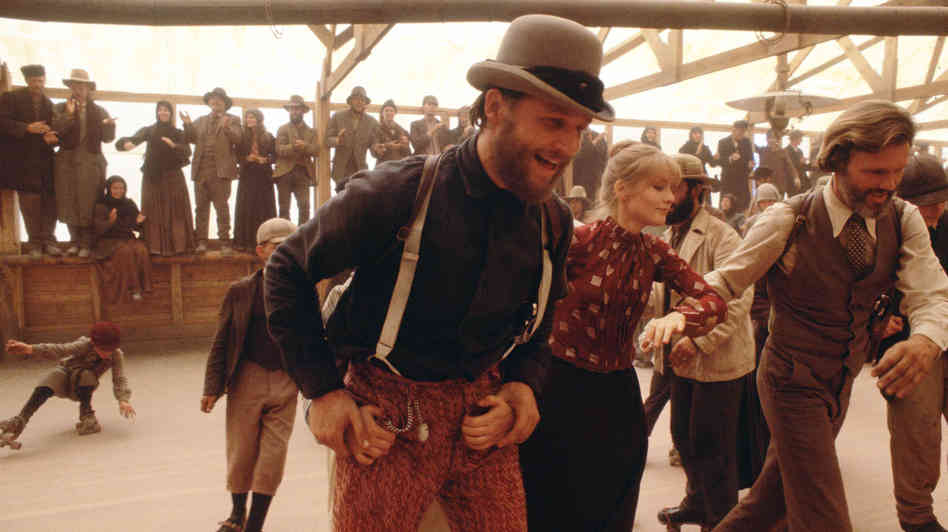
On March 3, Turner Classic Movies will be broadcasting the most historic flop in Hollywood History, 1980’s Heaven’s Gate. Last year, a restored version of Heaven’s Gate screened at the Venice Film Festival and was released on DVD by Criterion Collection. A new generation of American film critics revisited the film, and, surprisingly, some have praised it. The movie has always had its fans in Europe.
Heaven’s Gate starred Kris Kristofferson, Christopher Walken, Jeff Bridges, Sam Waterston and Isabelle Huppert, plus hundreds of extras and horses. It is a revisionist retelling of Wyoming’s Johnson County Wars of 1890 – sinister capitalists hire assassins to claim economic power at the expense of hardworking immigrants. It is three hours and thirty-nine minutes long.
Upon release, Heaven’s Gate was not popular with moviegoers, and consequently was financially unsuccessful. It was also trashed by critics, most notably by The New York TimesVincent Canby. Roger Ebert wrote, “It is the most scandalous cinematic waste I have ever seen, and remember, I’ve seen Paint Your Wagon”.
Here’s why Heaven’s Gate is historically important. In 1967, Bonnie and Clyde and The Graduate kicked off the American New Wave. After the low-budget Easy Rider made gazillions in 1969, Hollywood studios granted funding and artistic freedom to directors like Francis Ford Coppola, Martin Scorsese, Bob Rafelson and Roman Polanski. This resulted in masterpieces like Chinatown, Five Easy Pieces, The Conversation, Jeremiah Johnson, The French Connection, The Last Picture Show and Michael Cimino’s The Deer Hunter. Deer Hunter, a three-hour Vietnam War epic, won five Oscars, including Best Picture and Best Director for Cimino.
To make his next picture, Heaven’s Gate, Cimino sucked $44 million (an immense sum for the era, equivalent to $120 million today) out of United Artists. When the film grossed only $3 million in the US, United Artists was forced to merge into MGM. So Heaven’s Gate single-handedly killed a major Hollywood studio. If that weren’t bad enough, it was also the final straw in a series of artistically driven financial flops, and the studios tightened the leashes on directors and became more risk averse with scripts, thereby bringing an entire era, the American New Wave, to a close.
I have always deeply admired The Deer Hunter, and I eagerly saw the original cut of Heaven’s Gate when it was released 33 years ago. At the time, I found it to be boring, confusing and self-indulgently overlong.
Last year, I took another look at the 2012 restoration of Heaven’s Gate. It is a very ambitious film that contains many visually arresting and especially beautiful shots. It is interesting to see Sam Waterston play a bad guy for once and downright glorious to see the 26-year-old Isabelle Huppert naked. So much for the good news.
Much of Heaven’s Gate is literally dark (as in hard to see the action). Cimino overused smoke and fog, which also obscure the action. Blending together in sepia tones, the immigrants are hard to tell apart and speak in a babel of European languages. Because of the sound mix, it’s very difficult to comprehend much of the dialogue. The politics of the film is laughably heavy handed. The plot is confusing at times and often put on hold for set pieces that do not advance the story, most notably a bizarre roller skating sequence. There are several other scenes which are equally silly, which I won’t spoil for you, but which are described in the Ebert review linked above. The ponderous length of the film is staggering. I still found Heaven’s Gate to be a brutal, if occasionally unintentionally humorous, viewing experience.
Anyway, here’s your chance to see for yourself: March 3 on TCM.
The extraordinary documentary Undefeated begins with a high school football coach addressing his team:
Let’s see now. Starting right guard shot and no longer in school. Starting middle linebacker shot and no longer in school. Two players fighting right in front of the coach. Starting center arrested. Most coaches – that would be pretty much a career’s worth of crap to deal with. Well, I think that sums up the last two weeks for me.
Undefeated is the story of this coach, Bill Courtney, leading his team through a season. The kids live in crushing poverty and attend a haplessly under-resourced high school in North Memphis.
Undefeated may be about a football team, but isn’t that much about football. Instead of the Xs and Os, it shows the emotional energy required of Courtney to keep each kid coming to school, coming to practice and on task. He gets many of the kids to think about goals for the first time in their lives. He is tireless, dogged and often frustrated and emotionally spent.
The film wisely focuses on three players, and we get to know them. Like the rest of the team, all three are from extremely disadvantaged homes. One is an overachiever both on the field and in the classroom, but surprisingly emotionally vulnerable. Another has college-level football talent but very little academic preparation. The third, recently back from youth prison, is impulsive, immature, selfish and extremely volatile.
Undefeated won the 2012 Oscar for Best Documentary for filmmakers Daniel Lindsay and T.J. Martin – but it didn’t get a wide theatrical release. It’s available now to stream from Amazon, Vudu, YouTube and redbox.
In Mea Maxima Culpa: Silence in the House of God, documentarianAlex Gibney explores the Catholic Church’s decades-long cover-up of priest abuse from a Wisconsin parish to the top of the Vatican (and I mean the top). The film begins with the horrifying and disgusting abuse of the most vulnerable – children at a residential Catholic school for the deaf whose devout parents cannot communicate with them through American Sign Language.
At first it seems like another story of Church leaders suppressing the truth to avoid bad publicity and lawsuits – and it is for the first few years. But then we learn about an American bishop trying to remove a pedophile from ministry, but being thwarted by superiors across the Atlantic. As Gibney pulls apart the onion, the focus of the story climbs the Church hierarchy. The brilliant and prolific Gibney’s work includes Enron: The Smartest Guys in the Room, Client 9: The Rise and Fall of Eliot Spitzer, Casino Jack and the United States of Money and the Oscar-winning Taxi to the Dark Side.
I also recommend another documentary on this difficult subject, Deliver Us From Evil, which made my top ten list for 2006. That is the story of a serial pedophile priest moved from parish to parish in the Diocese of Stockton, California. This has become, sadly, a familiar narrative, but what distinguishes Deliver Us From Evil is its breathtaking interviews with the pedophile himself.
Mea Maxima Culpa: Silence in the House of God is now playing on HBO.
The Czech paranoid thriller In The Shadow (Ve Stinu) follows a police detective in 1953 Prague. The Communist government credits him with solving a case – but he figures out that the crime was committed by different perpetrator with a different motive. Unfortunately, the truth is not politically convenient, and he must navigate through the criminal underground, Commie thugs, a former Nazi and Cold War show trials or he’ll become yet another film noir tragic ending.
The cop is played by the Czech actor Ivan Trojan, whose performance I admired so much in the creepy voyeur film Visible World. In Visible Word, Trojan got to play a seriously twisted guy. Trojan’s role in In the Shadow is not as showy, but he creates a hard-boiled character of uncommon determination and devotion to the truth.
In the Shadow is a well-crafted cop movie with added intensity from a nefarious Big Brother. In the Shadow won Best Film at the Czech Film Critics’ Awards and was the Czech submission to the Academy Awards. It plays at Cinequest on February 28, March 6 and March 8. The trailer is in Czech without English subtitles.
Fans of Downton Abbey – do not despair because Season 3 has run its course. Before he created Downton Abbey, Julian Fellowes wrote the 2001 film Gosford Park, also set at the estate of an English aristocrat in the 1920s. The period between the world wars marked the final decline of the Upstairs Downstairs world, and Fellowes, descended from such an upper class family, grew up with relatives who had lived through it. In fact, he modeled the scathingly dismissive character of Constance, Countess of Trentham (Maggie Smith), after his own great-aunt.
Gosford Park won an Oscar for its legendary director, Robert Altman. Altman was a master of weaving together characters and multiple story lines, employing the kind of simultaneous, overlapping speech that people use in real life. In Gosford Park, instead of recording all the actors with the normal boom microphone, he placed radio microphones on each of twenty actors in the large scenes. The result, a triumph of cinematic sound design, is that we can hear key lines of dialogue amidst the realistic cacophony of a large gathering, and our attention can move from group to group within a single camera shot.
Ever unconventional, Altman also showed his genius in the solitary scenes. In one, Helen Mirren’s character has repaired to her own room to reflect on an emotionally shattering development. Instead of a closeup on Mirren’s face, Altman shoots in long shot, allowing Mirren to act with her whole body and emphasizing the loneliness of her life and the situation.
Altman was also known for attracting very deep, top rate casts. Gosford Park contains exceptional performances by Mirren, Kelly Macdonald and Emily Watson. Watson has an outburst at a formal dinner that leaves the audience gasping. American audiences had only seen Clive Owen in the modest art house film Croupier, and the brooding determination in his Gosford Park performance helped make him a star.
As in Downton Abbey, Maggie Smith gets some great lines and makes the most of them. Her performance triggered a stream of spunky roles for Smith, including in the Harry Potter movies, The Best Exotic Marigold Hotel, Quartet and, of course, as Downton Abbey’s Violet Crawley, Dowager Countess of Grantham.
Gosford Park is a great movie, and you’ll recognize its world as Downton Abbey’s. Gosford Park is available on DVD and streaming from Netflix Instant.
Side Effects is a psychological thriller that keeps thriller-lovers on the their toes by constantly changing its focus. First one character is on the verge of falling apart, then another and then another. Initially, we think that the story is about mental illness and prescription psych meds, but then it evolves into something else quite different. The plot might have seemed implausible in the hands of a lesser director, but Steven Soderbergh pulls it off with panache.
Soderbergh got superb performances by his leads: Jude Law, Rooney Mara and Catherine Zeta-Jones. Mara, so striking in The Social Network and The Girl with the Dragon Tattoo, serves notice that she is a perfect fit for psychological dramas; she can turn apparent fragility and unknowability into menace like few other film actresses. And few actors can take a character from charming confidence to a desperate meltdown like Law does here. Zeta-Jones shows that she play a frigid mistress of the universe who is passionate and needy underneath. The supporting players are all perfectly cast.
The insistent music by Thomas Newman, while never obvious, is an integral part of the suspense. Soderbergh, a master who has repeatedly elevated genre films, has another winner in Side Effects.
In the darkly comic Fuzz Track City, writer-director Steve Hicks riffs on the conventions of the detective genre to celebrate the most offbeat sides of LA. Our hero could be a hard-boiled detective if he were more alert. But Murphy Dunn (Todd Robert Anderson) is preoccupied with the death of his partner and the end of his marriage, two numbing losses that stem from betrayals. It takes all of his remaining energy to order his daily Monte Cristo sandwich at the diner.
Look elsewhere for Hollywood gloss. As Dunn searches for the MacGuffin, the B-side of a failed rock band’s long lost 45, he never enters a Bel Air estate. Instead, he pads about the most ordinary neighborhoods of Burbank and Arcadia. His office isn’t in an art deco office building – it’s in a strip on the run down Lankershim Boulevard. Dunn doesn’t drive down storied Mulholland Drive or Sunset Boulevard; his bliss is cruising Ventura Boulevard.
Dunn is a lovable loser, still wearing his high school hair and driving his high school beater. He’s so inexpert with his fists and gun that he needs to get bailed out of a bad situation by his extremely pregnant ex-wife (Tarina Pouncy). The ex-wife witheringly says “take off those sunglasses – they don’t make you look cool” (and she’s right). When he becomes the last LA resident to get a cell phone, he treats it as if it were about to explode.
Along the way Dunn encounters a series of oddballs. One is an agoraphobic vinyl record collector (Josh Adell) who “hasn’t left Burbank in seven years or his house in three” and who scampers about in his tidy whities. Another is a trailer-dwelling former musician (Dave Florek) whose idea of hospitality is to offer a choice of variously colored mouthwashes. Abby Miller (Ellen Mae in Justified) brings some kooky originality to the role of the sad sack waitress. And then there’s the object of Dunn’s schoolboy crush – his high school guidance counselor (Dee Wallace).
As he toys with the tropes of detective fiction, filmmaker Hicks takes us on a leisurely journey through the San Fernando Valley that finally crescendos into an uproarious climax. It’s a fun ride.