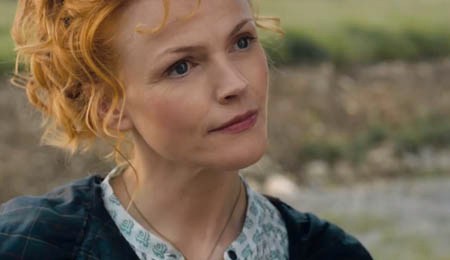
In the indie Run & Jump, a rare type of stroke has changed the personality of an Irish furniture maker; he has survived, but now prone to rages and catatonia, he is never going to be the same as before. He is returned to his family, led by his firecracker wife (Maxine Peake). Along comes an American medical researcher (Will Forte from Saturday Night Live and Nebraska), who moves with the family so he can continually film his patient’s symptoms.
The family initially resents the constant filming, although they desperately need the income from the research stipend. The researcher is so socially awkward that he’s almost catatonic himself, but he is able to provide the adult male presence that the family now misses, and they are eventually drawn to his kindness. Although he tries to maintain clinical distance, he is inevitably attracted to the vitality of the wife – a real live wire. But this isn’t going where you might expect…
Run & Jump succeeds both as a romance and as a family drama. The primary credit goes to co-writer and director Steph Green. A Bay Area filmmaker who now works in Ireland, Green was Oscar nominated for a live action short. Run & Jump is her first feature.
Maxine Peake’s affecting performance as the wife drives the film; Run & Jump is really the story of the wife’s struggles as she fights to keep her family afloat while making a near impossible adjustment.
Run & Jump is available streaming on Amazon, iTunes, Google Play, YouTube and Xbox Video.
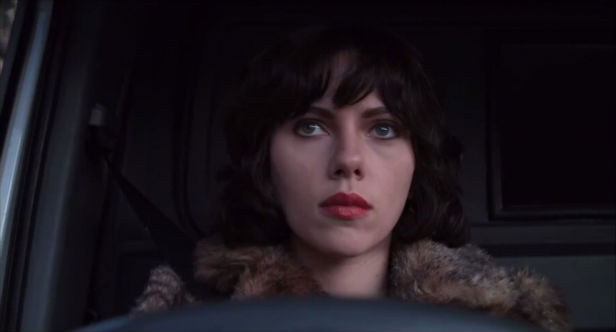
Under the Skin is the most bizarro movie of the year so far – by a long shot. A space alien in the form of a human woman attracts men sexually and then harvests their bodies. As each man steps forward, entranced in lust, he doesn’t notice that he is sinking into an ever deeper black pool until he vanishes. Later, we learn that he is suspended in the viscous liquid until, suddenly, his body is deflated like a popped balloon, leaving just the latex-like skin, while a red pulp (presumably pulverized human bone and tissue) heads up on a conveyor belt to the aliens for their use. This lurid story is set in the gloomy dank of Scotland and yo-yos between the gritty streets of Glasgow and a highly stylized sci-fi world a la Solaris.
Scarlett Johansson, who puts the lure in allure, plays the alien who any heterosexual man would crawl on his knees across broken glass for. Scarlett is a helluva good sport. Johansson is that rare A-list movie star who doesn’t take herself too seriously and has VERY good taste. You can’t criticize her for picking up a paycheck in the occasional comic book movie when you consider a body of top-tier work that is remarkable for a 29-year-old: Ghost World, Lost in Translation, Girl with a Pearl Earring, Match Point, Vicky Christina Barcelona, Her. Here, she is suitably sensual and perfectly nails the alien’s changing degree of emotional detachment/attachment, which is really the core of the movie (I think). And she gets naked several times.
Director Jonathan Glazer (Sexy Beast) co-wrote the screenplay with Walter Campbell from a Michael Faber novel. This is NOT a movie for those who need to know what is going on at all times. And, to connect the dots the best we can, we have to sit through some VERY repetitive action.
Again and again, the alien drives around Glasgow, scanning hundreds of men, asking the ones with the most unintelligible accents for directions and picking up the single ones. This happens a lot. She has an alien handler in the form of a human man dressed in motorcycle gear, who strides around with aggressive purposefulness and speeds around the Scottish back roads on his bike and never speaks. This happens a lot, too.
Under the Skin is getting critical praise (currently a Metacritic score of 77), which I attribute to its novel look and overall trippiness and to its being the first movie in three months that challenges the audience. But overall, the payoff isn’t really worth watching the repetition, trying to figure out what’s going on and why.
SPOILER ALERT: As an alien people-harvester, she is initially emotionally uninvolved with humans. She has no reaction to a family beach tragedy that would highly disturb a human. Dragged into a disco, she is disoriented until some poor guy chats her up and she can lapse into the role she was trained/programmed for.
But then she picks up an Elephant Man for harvesting; she is touched by his longing for companionship and sex – and ends up letting him go. Another man shows her kindness and she tries out humanity, tapping her fingers to human music, trying a bite of chocolate cake (and spitting it out, gagging). She attaches to the kind man but finds herself biologically unequipped to take the relationship to a new level.
And there are some holes in the story. If this alien race is so advanced, why can’t her handler find her with some GPS-like capacity? Why don’t the aliens harvest more people, and why do they just pick the solitary loners? Why don’t they consume the skin? But that’s just thinking too much about Under the Skin.
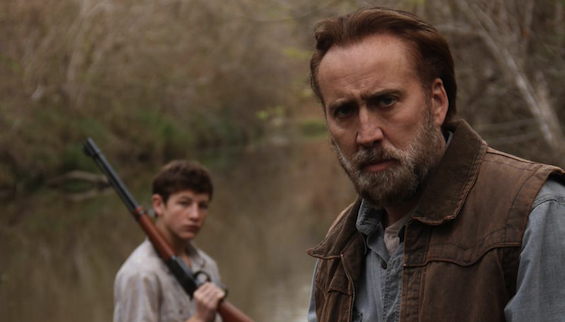
In Joe, Nicholas Cage plays the title character, who lives a solitary life in backwoods Texas – self-isolated by problems with anger management and booze that long ago estranged his family and cost him some time in the state pen. Somehow Joe has stayed out of trouble for years, but he’s always on a slow simmer, seemingly close to boiling over. Joe meets Gary (Tye Sheridan of Mud), a boy who belongs to a family of drifters led by a father who beats them and takes all their money to spend on cheap likker. Joe bonds with Gary, and ultimately finds redemption in a sacrifice he makes for the boy. Dark and violent, Joe is ultimately successful as a gripping drama.
Indie writer-director David Gordon Green excels at authentic character-driven Southern dramas (George Washington, All the Real Girls and Undertow). Here he brings us to a world of nasty chained-up dogs, where everyone smokes cigarettes and eats canned food, and nobody has heard of espresso or the Internet.
Cage’s performance is excellent – never over-the-top and much more modulated and realistic than we’ve come to expect from him.
Sheridan, so good in Mud, might be even better here; he smolders at the abuse and neglect the family suffers at the hands of his father. He’s become a strapping kid who came employ violence against an adult, but the father-son tie keeps him from unleashing it on his despicable father. Sheridan is especially brilliant in an early scene where he playfully banters with his drunken dad and in another where Joe teaches him how to fake a pained smile to attract girls.
The biggest revelation in Joe is a searing performance by non-actor Gary Poulter as the drunken father who may shamble like a zombie, but is always cruising like a shark, on the hunt for someone to manipulate or rob. It’s stirring portrait of final stage alcoholism, where there is no moral filter anymore – he will resort to ANY conduct for some three dollar wine. There is nothing left but evil borne of desperation for a drink. Although Poulter was a reliable member of the filmmaking team, within two months after the conclusion of photography, he had resorted to his previous self-destructive lifestyle and died. Thanks to Green, he leaves one great cinematic performance as his legacy.
Errol Morris is a master documentarian (Gates of Heaven, The Thin Blue Line, Standard Operating Procedure), so he is the perfect guy to explore the personality and career – and, above all, the self-certainty – of Donald Rumsfeld, architect of the American wars in Afghanistan and Iraq. For most of the film, Rumsfeld himself is on-screen talking to Morris’ camera. Rumsfeld is apparently completely immune from self-doubt, but ultimately reveals more about himself than he would like.
The title of the picture comes from a Rumsfeld memo that describes a policy maker’s “unknown known” as that which you thought you know but it turns out that you didn’t. Of course, the classic “unknown known” is the certainty that the Iraq War would be justified and would turn out well.
In contrast, the “unknown unknown” is something that you don’t know that you don’t know and that Rumsfeld says that you have to imagine (such as the Pearl Harbor and 9/11 attacks). Of course, the imagining of all kinds of such attacks drives the neo-conservative theory of preemptive war – to strike at those who can be IMAGINED to threaten you.
Rumsfeld is remarkably glib and very effective at selling his own version of reality. Morris takes this on early in the documentary by getting Rumsfeld to deny linking Saddam with Al Qaeda and then shows him doing exactly that in a pre-Iraq War news conference. Indeed, Morris himself is an effective off-screen participant throughout, sparring with Rumsfeld, with each guy winning his share of verbal tussles.
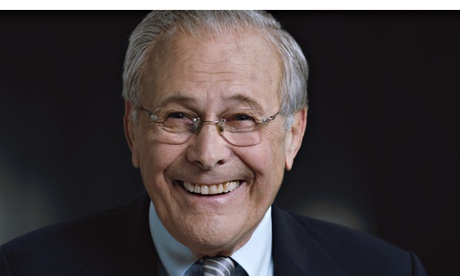
When Rumsfeld thinks that he’s won a point, he grins the infuriating grin in the image above. The one time he loses his smile is when Morris mentions a moment when Rumsfeld almost became Reagan’s Vice-President (and then future President), and Rumsfeld acknowledges that, yes, this was possible. The film is brilliantly edited, and Morris knows EXACTLY how long to extend a shot to catch Rumsfeld in moments of reflection.
The movie traces Rumsfeld’s remarkable life and career from his marriage and early start as a young Congressman thru his roles in the Nixon and Ford administrations with the end of Watergate, the fall of Saigon, his salesmanship for defense spending increases in the 1970s and his service as Reagan’s Middle East envoy. After a time in the wilderness during Bush I, of course, he came to his greatest power during Bush II. He gives a stirring first-person account of the 9/11 attack of the Pentagon, relating what the scene was like even before the first responders arrived. But the core of the film is about the Rumsfeld decisions about Iraq.
Unusual for a current events documentary, there’s also some top shelf music from Danny Elfman, Oscar nominated for Good Will Hunting and Milk.
You can find The Unknown Known tomorrow in theaters and streaming now on Amazon, iTunes, YouTube, Google Play and Xbox Video
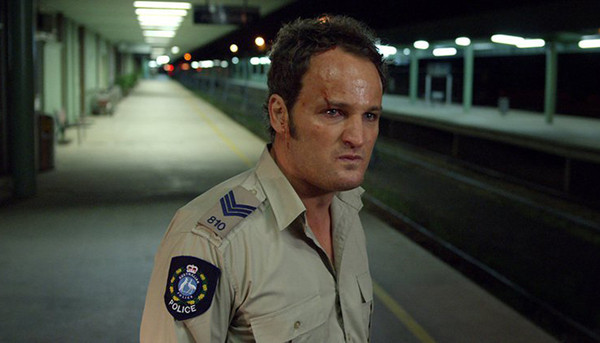
In the Australian thriller Swerve, a Good Samaritan drifter gets caught up in a deadly entanglement involving a briefcase full of drug money, some very dangerous guys and a sexy woman of uncertain loyalty. The movie gets its title from some key moments when vehicles swerve and move the plot along. There’s a lot of convincing action (there not even any dialogue for the first seven minutes and two fatalities), but writer-director Craig Lahiff is a better director than a writer. If you’ve seen a femme fatale and some action thrillers, nothing in the plot will surprise you. Unfortunately, the wife with wandering thighs is played by Emma Booth, who is unable to elevate the Bad Girl to Kathleen Turner/Lana Turner territory.
The best thing about Swerve is that hulking Jason Clarke (Animal Kingdom, Zero Dark Thirty, Lawless) is really good at playing menace and indestructibility, and here he adds a mad glint in his eyes. Plus there some pleasingly absurd touches with marching bands randomly wandering into otherwise tense scenes. Bottom line: Swerve is one hour forty minutes of unsurprising and predictable action peppered with one fun performance.
Swerve is available on DVD from Netflix and streaming from Amazon, iTunes and Vudu.
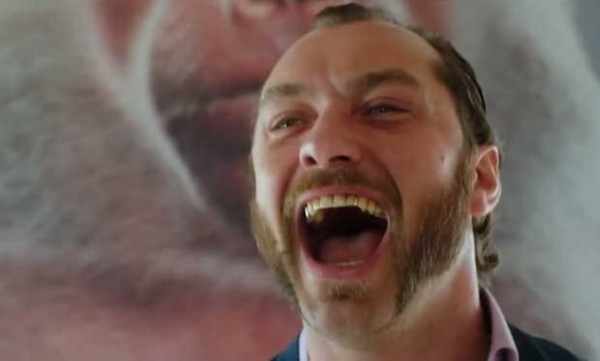
The title character in Dom Hemingway is always in a determined hurry, one of those guys whose brow is always 12 inches in front of his feet. He is played by Jude Law as a force of nature who takes a lickin’ and keeps on tickin’. Dom Hemingway is a none-too-smart professional safe-cracker who has taken the rap for his partners and is just getting out after twelve years in the slammer. He’s been fantasizing about what he wants to do when he gets out, and he intends to do it all in as compressed a time period as possible. Unfortunately, as he tells a small boy, “Dom is English for unlucky sonofabitch”. His headlong onslaught into misadventure is ribald, profane and pretty funny.
This movie is not a masterpiece. Think of Dom Hemingway as The Wolf of Wall Street Lite. Still, Jude Law is very watchable and very funny, as is Richard E. Grant as his almost-as-unlucky and almost-as-dim buddy. Director Richard Shepard made a much better movie in 2005, The Matador with Pierce Brosnan and Greg Kinnear. Still, Dom Hemingway works as a pedal-to-the-metal romp.
I saw Dom Hemingway three weeks ago at Cinequest 2014.
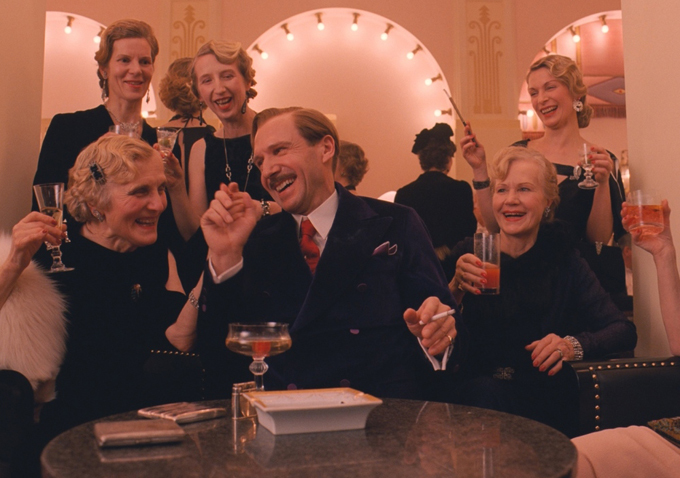
Like all of writer-director Wes Anderson’s films, The Grand Budapest Hotel is wry and imaginative, but it’s not one of his near-masterpieces (Rushmore, Moonrise Kingdom). Ray Fiennes plays one of Anderson’s unique creations, the imperious and shady concierge of an Eastern European hotel between the world wars. His sidekick is the rookie lobby boy (Tony Revolori). Together, they navigate a Mr. Toad’s Wild Ride involving the concierge’s additional vocations of gigolo and lovable scoundrel.
The cast is superb and absurdly deep. I counted THIRTEEN Academy Award nominees (mostly for acting, but Jeff Goldblum won an Oscar for a Live Short and Bob Balaban was one of the producers for Best Picture nominee Gosford Park). It’s overkill, because fine actors like Edward Norton, Tom Wilkinson, Lea Seydoux and Larry Pine don’t really have much to do. F. Murray Abraham, as the lobby boy turned old man, does stand out.
And that points out the weak spot in The Grand Budapest Hotel. I kept saying to myself things like, “Look at the makeup on Tilda Swinton”, “Is that Jeff Goldblum behind that beard?” and “Awwright! Bill Murray!”. That tells me that I wasn’t fully engaged in the story. Some critics have pointed out the historical sweep from the post-imperial 1930s through the crucible of WWII to the boring industrial totalitarianism of the 1950s. For me, that’s still not enough to make a great movie. But The Grand Budapest Hotel is fun to watch, and that’s not bad.
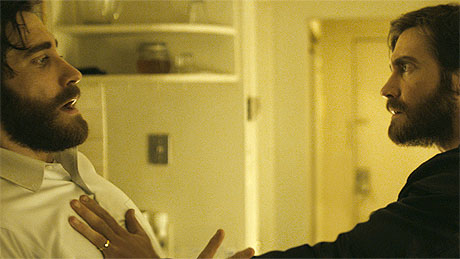
In the psychological thriller Enemy, a guy finds out that he has an exact physical double – down to their voices and the scars on their bellies. He can’t resist looking up and meeting his twin, which unleashes some unanticipated consequences.
One guy is a tweedy college professor, kind and introspective. His doppelganger is an actor who doesn’t filter his own venal self-interest. Essentially, the difference between these two is that one guy has a conscience and the other guy doesn’t. They are both played by Jake Gyllenhaal.
The physical similarities even confound their partners (Sarah Gadon and Melanie Laurent). Gadon’s performance is especially compelling in a scene when she first meets an amiable guy who doesn’t know her, but physically seems to be her husband. Yeesh.
The key to Enemy’s surpassing the gimmick of double casting is that Gyllenhaal’s performance is so brilliant. The difference between the two characters is so subtle.
You always know which guy you’re watching, but, other than wardrobe, it’s often hard to figure out how we can tell – it’s just in Gyllenhaal’s carriage, the occasional gesture and the hint of rapaciousness in the one character’s eyes.
Enemy is not completely literal and realistic. Be prepared for some large and startling creatures that you will not expect.
Director Denis Villenueve knows how to deliver suspense and thrills, as he did in my top movie of 2011, Incendies, and in last year’s underrated thriller Prisoners, (also with Gyllenhaal). Enemy isn’t as good as those films, but it’s an entertaining and mildly thought-provoking thriller.
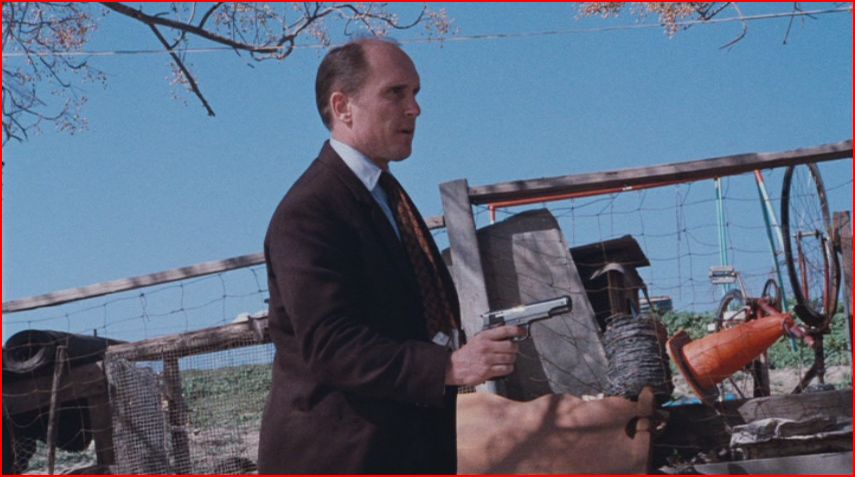
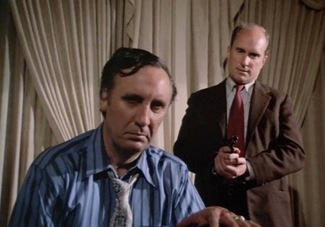
The Outfit (1974) is a revenge/crime story starring Robert Duvall as a bank robber released from prison who starts a campaign of terror against the crime syndicate that killed his brother. It turns out that Duvall’s gang robbed a bank that, unbeknownst to them, was mob-owned.
The Outfit is well acted by Duvall (of course) and his fellow 70s stars Linda Black, Joe Don Baker and Bill McKinney (Deliverance and Worst Movie Teeth). Black delivers one of her patented 70s lovable floozies, defined by a concoction of shopworn sexiness, bad luck and unreliability. Baker is especially appealing as Duvall’s buddy.
The cast also stands out for its crew of 1950s film noir veterans: Robert Ryan (mob kingpin), Timothy Carey (chief henchman), Jane Greer, Elisha Cook Jr and Marie Windsor. Then there’s the dependable Richard Jaeckel, whose career bridged the decades. Joanna Cassidy plays Ryan’s bimbo du moment.
Duvall pisses off Timothy Carey in THE OUTFIT
I was most pleasantly surprised by the directing of John Flynn, who directed a handful of otherwise pedestrian crime films and action vehicles for Sly Stallone, Jan Michael Vincent and even Steven Seagal. Flynn also did have a knack for working with good actors (James Woods, Tommy Lee Jones, Ned Beatty, Frank Langella, Danny Aiello, Brian Dennehy).
In The Outfit, Flynn shows himself to be a master of the stationary camera, the long shot and off-screen action. The movie opens with a driver stopping at a remote gas station and getting out of the car to approach the attendant. We see what happens in a single shot from roadside, outside the car, looking through the passenger side window and then again through the driver’s side window toward the gas station. We see that there’s another man in the back seat, but we can’t identify him. We only hear the ordinary music on the car radio. Still, we can tell that the driver is asking directions, and we sense that the two men in the car are up to no good.
The two men find their destination, and it turns out that they are hit men. We see them sneaking into position around a home while the dog barks, and then we see them fire shots. We don’t see the victim getting splattered. We just see the dog barking his warning while we are hearing the shots. Then the dog becomes agitated and whines. Finally, in long shot, we see the victim prone. It’s another very effective sequence.
Late in the story, we first sense that something has happened to Linda Black when we see the look in Joe Don Baker’s eyes in his rear view mirror.
The Outfit’s story is a little dated (not as violent as today’s crime films), but Duvall and Baker make for an appealing duo, and Flynn gives the film an interesting look. The Outfit plays this week on Turner Classic Movies and is available streaming from Amazon, iTunes and Vudu.
The trailer slaps together every scene with a gun to make The Outfit look like too much like a shoot ’em up, but it does include a great line reading from Timothy Carey.
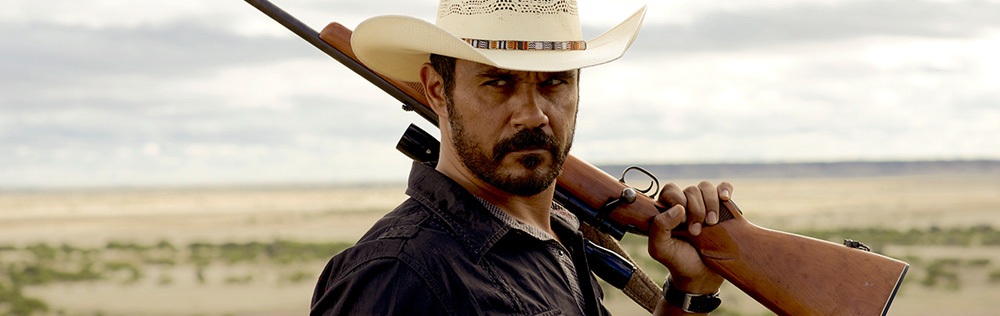
Cinequest spotlighted the contemporary murder mystery Mystery Road, set in the Australian outback. An indigenous detective returns to his small town to encounter racist co-workers, a drunk and shiftless ex-wife and a resentful teenage daughter. The daughter is a concern because her gal pals are starting to turn up murdered one by one. Mystery Road is a solid but unexceptional police procedural except for two things:
the very strong lead performance by Aaron Pederson, who brings out the inner conflict within a guy who needed to leave his hometown and his marriage but is tormented by the consequences of those decisions; and
the movie’s climactic gun battle between guys using hunting rifles through telescopic sights – a real show stopper .
Hugo Weaving chews up some scenery with a supporting role as a cop with ambiguous motivation. Weaving, with his supporting roles in The Matrix, V for Vendetta, Lord of the Rings, Transformers, etc., may be the world’s most financially successful character actor. I first saw Weaving in the 1991 Proof, the breakout film for then 26-year-old Russell Crowe. In Proof, Crowe plays a young buck who falls in with an eccentric blind man (Weaving) and an uncomfortably needy and manipulative woman (Genevieve Picot). Proof (available on DVD from Netflix and streaming from iTunes and Amazon) is an excellent and oft overlooked film. Mystery Road has its moments, too.