MR. HOLMES: in old age, Sherlock reopens his final case

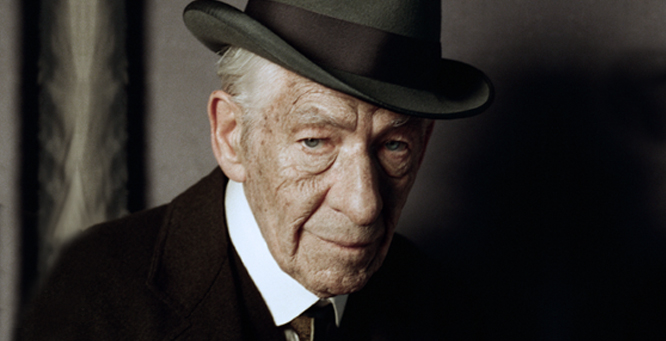
Ian McKellen as MR. HOLMES

It’s 1947 and 93-year-old Sherlock Holmes has been self-exiled to the Dover coast in retirement for almost thirty years. He’s still keenly observant, but his memory is deteriorating with age, and he knows it. That’s a problem as he feels an urgent need to summon up the facts of his final case, left unresolved in 1919. In Mr. Holmes, Ian McKellen plays Sherlock in his 1947 frailty and desperation and in the flashbacks to 1919, when he’s at the top of his game.

As Mr. Holmes, opens, Sherlock has just returned home from a trip to Japan. So desperate to refresh his memory, he has sought a Japanese homeopathic cure (“prickly ash”), in the process meeting a Japanese family with an unsolved disappearance of their own. Back home, he lives with his housekeeper (Laura Linney) and her gifted son, Roger (Milo Parker). Holmes recognizes the boy’s exceptionalism and quasi-adopts as a grandchild. The boy has lost his father in World War II, and his relationship with the old man is another central thread in the movie.

Ian McKellen is delightful and endearing as the crusty Holmes. McKellen is an actor of enough stature to pull off this iconic role, and he is able both to project the Holmes genius and to deliver the humor in this very witty screenplay.

Holmes resents how his former roommate Dr. Watson has depicted him in fiction – and doesn’t like fiction at all (until the very last scene). At least, when they lived together, Watson avoided an onslaught of tourists by publishing the wrong address for their rooms (they actually lived across the street from 221B Baker Street). And Holmes goes to a theater to see a very bad 1940s Sherlock Holmes movie.

I saw Mr. Homes at the San Francisco Film Festival at a screening in which producer Anne Carey and screenwriter Jeffrey Hatcher spoke. When Carey read the source material – the novel “Slight Trick of the Mind” by Mitch Cullin – she recognized the appeal of the central role, the settings and the theme of “don’t wait too long for things important to your heart”. It took her eight years to get director Bill Condon (Gods and Monsters, Dreamgirls) on board, who brought in McKellen.

Hatcher was attracted by Holmes’ relationship to the boy Roger and by theme of how we rewrite our own stories. He pointed out that the 1919 story in Mr. Holmes has four versions: what really happened, how Watsone added a happy ending in his book, the Hollywood melodrama of the film-within-the-film and, finally, as Holmes himself connects it to the Japanese story thread at the end.

Carey and Hatcher revealed that Condon playfully referenced Hitchcock in Mr. Holmes: Ambrose Chapel from The Man Who Knew Too Much, carrying of tea a la Notorious and a “Vertigo” sequence under the arches.

It’s a good story with a superb performance by McKellen. Mr. Homes opens tomorrow.
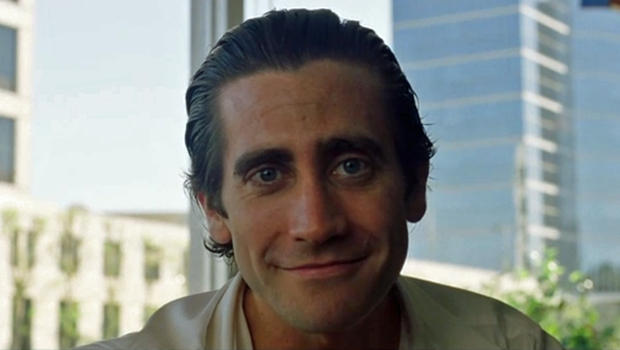
Stream of the Week: NIGHTCRAWLER – Gyllenhaal finally plays 100% psycho

Jake Gyllenhaal in NIGHTCRAWLER

The all-around outstanding actor Jake Gyllenhaal excels at playing guys who are just a little too obsessive (Zodiac, Prisoners, Enemy) to let you get comfortable with them.  In the thriller Nightcrawler, Gyllenhaal gets to play a 100% psycho.  His character is seriously twisted, but in that high functioning way so the other characters don’t suspect it until IT’S TOO LATE.

Gyllenhaal’s bug eyes come in handy in playing the ever-too-intense Lou Bloom, a hustler who talks like a super-caffeinated sales guy, full of the argot of self-help and inspirational speakers.  His bromides about success seem mainstream, but his hyper affect puts off regular folks.  He’s thieving copper when he sees an opportunity to turn himself into a free-lance video journalist.  Nightcrawler is an acid commentary on the TV news world, and Lou has finally found an arena where being balanced is not an asset.

In fact, a cynical TV producer (Rene Russo) finds Lou’s intrusiveness and utter disregard for social boundaries to be helpful.  When placing her order with Lou, she can be entirely unfiltered: “What we re looking for is a woman running down the street with her throat cut”, preferably a “White well-off victim”.

Riz Ahmed, so compelling as The Reluctant Fundamentalist
is unrecognizable here as Lou’s tweaked and shifty homeless assistant Rick.  It’s an effective transformation, and it’s equally great not to see Ahmed stuck playing a terrorist again.

Nightcrawler is successful both as a biting satire and as a charter-driven thriller.  You can stream Nightcrawler from Amazon Instant Video, iTunes and Vudu and rent it on DirecTV PPV.

TESTAMENT OF YOUTH: the tragedy of war

Alicia Viksander in TESTAMENT OF YOUTH
Alicia Viksander bids farewell to Kit Harington in TESTAMENT OF YOUTH

In Testament of Youth, Alicia Viksander plays Vera, a gifted and determined young British woman who overcomes the conventions of the day and the objections of her father to attend Oxford in the 1910s. In 1914, Vera’s brother, fiance and closest male friends all enlist in Britain’s WW I army. No one at the time could have imagined the industrialized carnage that WW I would become, and it’s poignant when the young men say that the war will probably be over before they’ve completed their basic training. The war is, of course, an unspeakable horror. We don’t expect the young men to fare well in the War, and they don’t. Vera suspends her Oxford education to work as a nurse, first in Britain and later at the front. She is in position to observe the effects of war both at the front and on the home front, where her parents are especially impacted.

Testament of Youth is based on Vera Brittain’s popular and influential 1933 memoir of the same name, which is also an icon of feminist literature. Brittain became a pacifist leader.

This story follows a familiar arc, and I often ask “why did someone feel the need to make this movie?”. Testament of Youth, however, is fairly compelling. Credit goes to Viksander and to director James Kent, who somehow prevent the film from slipping into an unwatchable slog of grimness.

The most impressive element of Testament of Youth is the performance of Alicia Viksander as Vera Brittain. Viksander is onscreen in every scene, often in close-up and she carries the film with a flawless performance.  As good as she is here, Viksander is even better in this year’s sci-fi hit Ex Machina, where she plays a machine embedded with artificial intelligence. (Ex Machina is the best American movie of the year so far.)

With Ex Machina, Viksander is exploding into cinema as a major star.  Most Americans first saw the 26-year-old Swede in two 2012 movies.  She played a key supporting role in Anna Karenina and a lead in the Mads Mikkelsen period drama A Royal Affair. Although I thought it too long, A Royal Affair won the Silver Bear at the Berlin Film Festival.  Now she has five films completed or in post-production, including upcoming Derek Cianfrance film The Light Between the Oscars, co-starring Michael Fassbender, who she ihas been dating.  She also has the top credit in the upcoming The Man from U.N.C.L.E., which looks wretched from the trailer.  Plus, she slated to co-star with Matt Damon in the next Bourne movie.  It’s quite a career trajectory, and from what I’ve seen, richly deserved.

Americans will find this odd, but the Swedish Viksander reportedly had to struggle to learn Danish for A Royal Affair.  It seems especially odd, given that she speaks English with a perfect American accent in Ex Machina and perfect middle class British accent in Testament of Youth.

Back to Last Testament of Youth – it’s not a Must See, but it is a well-made and evocative treatment of the tragedy of war.

DOPE: nice little movie

DOPE
DOPE

The appealing coming of age comedy Dope turns a well-worn plot into an engaging movie by juxtaposing stereotypes.  The conventional plot device is the Regular Guy Finds $100,000 of Drug Money In His Backpack.  The regular guy, however, is not just an African-American teen who lives in a nightmarish hood (Shameik Moore), but ALSO a nerdish brainiac who aspires to vault from Inglewood to Harvard.  Writer-director Rick Famuyiwa grew up in Inglewood, so the story and the characters ring true.

The cast is uniformly good.  Zoe Kravitz, who has been stuck in secondary roles in the Divergent movies and Mad Max: Fury Road, plays the mouth-watering love interest here, and she dominates the movie.  Gotta see more of her.  Veteran supporting actor Roger Guenveur Smith is especially good as the kid’s would-be gateway to the Ivy League; Smith’s 76 screen credits include American Gangster and a whole bunch of Spike Lee films.

It may not be life-transforming, but Dope is a smart, original and entertaining little movie.

MAD MAX: FURY ROAD – mobile battles and little else

Charlize Theron in MAD MAX: FURY ROAD

For some reason, the critical consensus on Mad Max:Fury Road has been pretty favorable. It’s 120 minutes long, of which at least 105 minutes are chase scenes that are really mobile battles. They are remarkable battles, but they are just battles. Writer-director George Miller has produced an adrenaline-filled thrill ride with some unique elements. But there just really isn’t anything exceptional – characters, dialogue, plot, setting – besides the action.

Charlize Theron and Tom Hardy are just fine as the good guys. Poor Hardy has to wear a steel mask for a third of the movie like he did for the entire The Dark Knight Rises. Theron is a fantastic actress, but all she has to do here is glint over her shoulder a lot (and she’s looks great doing that). I really loved Nicholas Hoult, who was so engaging in Warm Bodies, here as a Takes A Licking But Keeps On Ticking pawn-of-the-villain.  Zoe Kravitz rides along with Theron and Hardy, looking adorable.

If you feel the need for a simplistic rock ’em, sock’em action movie, this will fill the bill.  Don’t expect any more.

INSIDE OUT: smart but not gripping

INSIDE OUT
INSIDE OUT

I’m a huge Pixar admirer, and I usually walk out of a Pixar movie THRILLED.  That didn’t happen with Inside Out, a smart and entertaining movie, but one that got more attention from my head than my heart.

Inside Out is the story of a well-adjusted girl named Riley, who is yanked out of her comfort zone when her Dad’s job suddenly takes the family to San Francisco.  The story is told from the perspective of her emotions, five characters (Joy, Sadness, Anger, Fear and Disgust) who command her behavior from a Head-Quarters (get it?).   In watching what happens to Riley, kids in the audience get to understand how emotions are okay and how  even sadness is normal; that’s all fine, but, as The Wife reminded me, Inside Out, along with Pixar’s recent Up and Wall-E, is a little preachy.

As one would expect, the animation and the voice acting are top-rate.  Where writers-directors Pete Dockter and Ronaldo Del Carmen really excel, however, is in imagining and then depicting the mechanisms of human thinking and feeling: the Emotions, Islands of Personality, Core Memories, the Train of Thought and the Subconscious.  It’s very smart and original stuff.

The sad parts are very pronounced and, in my opinion, too slow and deeply sad.   As someone scarred by the death of Bambi’s mother,  I was distracted by worrying about the little kids in the theater.  That being said, I accompanied eight-year-old twins and a ten-year-old to Inside Out.  The eight-year-olds were engrossed, and afterwards didn’t mention being too scared or too sad.  The ten-year-old grunted apprehensively a few times during the movie, but afterwards resolutely denied that it was ever too scary.  So there.  But, still, it was too sad for ME in places.

None of the children at the screening got fidgety, despite there being far less than usual of the slapstick humor that kids favor.   Most of the humor seemed adult-centered, evoking lots of knowing chuckles from the grown-ups.  The end credits – with dog, and then cat, emotions – are hilarious.

After those meh comments, I need to draw attention to Lava, the Pixar animated short that precedes the feature.  It’s seven minutes of cinema magic by filmmaker James Ford Murphy.  It’s a musical love story between two Hawaiian volcanoes.  The volcanoes are named Uku and Lele, and the message is a simple and sentimental one (“I Lava You”), but Lava isn’t the least bit corny.  The story is told through song – just two voices accompanied by ukulele – by Hawaiian musicians Kuana Torres Kehele and Napua Greig.   For sheer beauty, it’s up there with the recording of Over the Rainbow by the late Israel Kamakawiwo’ole.  I’m pretty jaded, but anyone too cynical to enjoy Lava should re-examine himself. Loved it.

GEMMA BOVERY: jumping into the plot of a novel

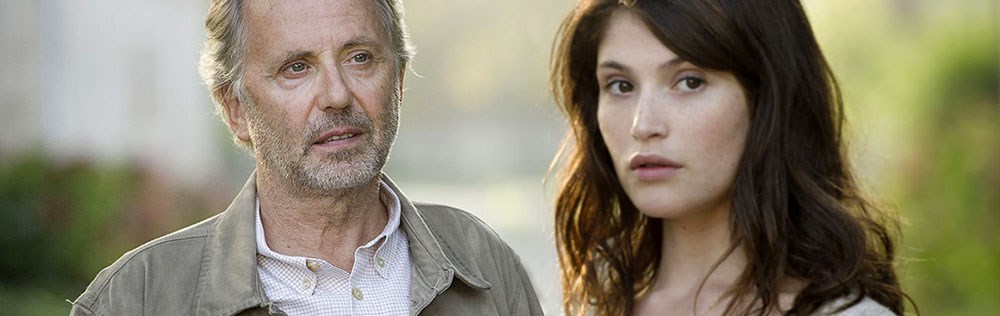
Fabrice Luchini and Gemma Arterton in GEMMA BOVERY

In the delightful dark comedy Gemma Bovery, Fabrice Luchini plays a guy who has left his Type A job in Paris to take over his father’s bakery in a sleepy village in Normandy. He gets new neighbors when a young British couple named Bovery moves in. The young British woman (played by the delectable Gemma Arterton) is named Gemma Bovery, and only the baker notices the similarity to Emma Bovary. But, like the protagonist of Madame Bovary, the young British woman is also married to a Charles, becomes bored and restless and develops a wandering eye. The baker rapidly becomes obsessed with the Flaubert novel being re-enacted before his eyes and soon jumps into the plot himself. Gemma Bovery, which I saw at Cinequest 2015, is a French movie that is mostly in English.

Fabrice Luchini is a treasure of world cinema. No screen actor can deliver a funnier reaction than Luchini, and he’s the master of squeezing laughs out of an awkward moment. For me, his signature role is in the 2004 French Intimate Strangers, in which he plays a tax lawyer with a practice in a Parisian professional office building. A beautiful woman (Sandrine Bonnaire), mistakes Luchini’s office for that of her new shrink, plops herself down and, before he can interrupt, starts unloading her sexual issues. It quickly becomes awkward for him to tell her of the error, and he’s completely entranced with her revelations, so he keeps impersonating her shrink. As they move from appointment to appointment, their relationship takes some unusual twists. It’s a very funny movie, and a great performance.

Gemma Bovery is directed and co-written by Anne Fontaine (The Girl from Monaco, Coco Before Chanel). Fontaine has a taste for offbeat takes on female sexuality, which she aired in the very trashy Adore (Naomi Watts and Robin Wright as Australian cougars who take on each other’s sons as lovers) and the much better Nathalie (wife pays prostitute to seduce her cheating hubby and report back on the details).

Gemma Bovery isn’t as Out There as Nathalie, but it’s just as good. The absurdity of the coincidences in Gemma Bovery makes for a funny situation, which Luchini elevates into a very funny movie.

THE ROUTINE: wicked comment on technology

Today, in only 9 minutes and 35 seconds, we have a wickedly effective commentary on the limits of technology – the 2014 short film The Routine.  The actress Tara Price wrote, produced and stars in The Routine – and it’s quite a performance.  Directed by Brian Groh.  Here’s the entire film.

The Routine (short film) from Tara Price on Vimeo.

ME AND EARL AND THE DYING GIRL: a Must See, perched on the knife edge between comedy and tragedy

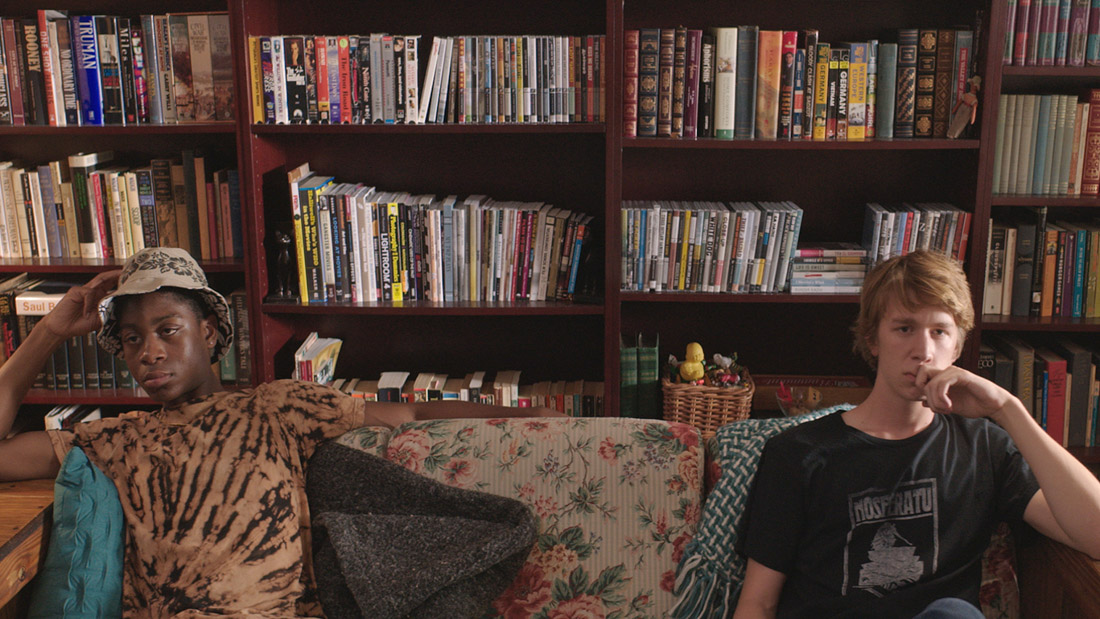
Ronald Cyler II and Thomas Mann in ME AND EARL AND THE DYING GIRL

Here’s a MUST SEE – the unforgettable coming of age Me and Earl and the Dying Girl, a brilliant second feature from director Alfonso Gomez-Rejon.  The title suggests a weeper (and it is), but 90% of Me and Earl is flat-out hilarious.

Greg (Thomas Mann)  is a Pittsburgh teenager who has decided that the best strategy for navigating high school is to foster good relations with every school clique while belonging to none.   Embracing the adage “hot girls destroy your life”, he gives the opposite gender a very wide berth.  Outwardly genial, Greg is emphatically anti-social in practice, except for his best friend Earl (Ronald Cyler II).  But he even refuses to admit that Earl is his friend, describing him “as more of a co-worker”.

Greg’s parents disrupt Greg’s routine by forcing him to visit his classmate Rachel (Olivia Cooke), who has just been diagnosed with leukemia.  Rachel doesn’t want any pity, so this is awkward all around until Greg makes Rachel laugh, which draws him back again to visit -and again.  A friendship, based on their shared quirky senses of humor, blossoms, but – given her diagnosis – how far can it go?

Rachel is delighted to learn that Greg and Earl shoot their own movies – short knock-offs of iconic cinema classics.  She first laughs when she finds that he has remade Rashomon as MonoRash.  Their other titles include Death in Tennis, Brew Velvet and A Box of Lips Now.

Why is Me and Earl so successful?  Most importantly, it perches right on the knife-edge between tragedy and comedy, and does so more than any movie I can think of.  As funny as it is, we all know that there’s that leukemia thing just under the surface.  But, with its originality and resistance to sentimentality,  Me and Earl is the farthest thing from a disease-of-the-week movie.

Any movie lover will love all the movie references, as well as Greg and Earl’s many short films.   Gomez-Rejon shot these shorts with Super 8, Bolex, digital Bolex and iPhone.  Jesse Andrews adapted his own novel, and, as Gomez-Rejon expanded the number of “films within the film”, he called on Andrews to supply him with the new titles – and there are scores of them, right through the ending credits.

Finally, Me and Earl’s art direction is the most singular of any coming of age film.  In fact, all the art direction led to the movie’s very satisfying ending; Gomez-Rejon brought in those surprises on the wall at the end – it’s not in the novel.

But Me and Earl and the Dying Girl is at its heart a coming of age story.  Sure, the character of Greg is an original, but the life lessons that he must learn are universal.

Thomas Mann is hilarious as Greg; he could be a great comic talent in the making.  Cooke and newcomer Cyler are also excellent.  Nick Offerman and Connie Britton are perfect as Greg’s well-meaning parents, as is Molly Shannon as Rachel’s needy mom.  Jon Bernthal also rocks the role of Mr. McCarthy, another great character we haven’t seen before – a boisterously vital, but grounded history teacher; Mr. McCarthy lets Greg and Earl spend their lunch hours in his office watching Werner Herzog movies on YouTube.  (And Herzog himself reportedly loves the references.)

Alfonso Gomez-Rejon started as a personal assistant to Martin Scorsese and worked his way up to second unit director. With the startling originality of Me and Earl, he’s proved his chops as an auteur.

I saw Me and Earl and the Dying Girl in early May at the San Francisco International Film Festival at a screening with Gomez-Rejon.  It also just screened at San Jose’s Camera Cinema Club, another fine choice by Club Director Tim Sika,  President of the San Francisco Film Critics Circle.

Me and Earl and the Dying Girl is a guaranteed crowd-pleaser and a Must See.  It’s one of my Best Movies of 2015 – So Far.


DVD/Stream of the Week: HIS KIND OF WOMAN – he knows the deal is too good

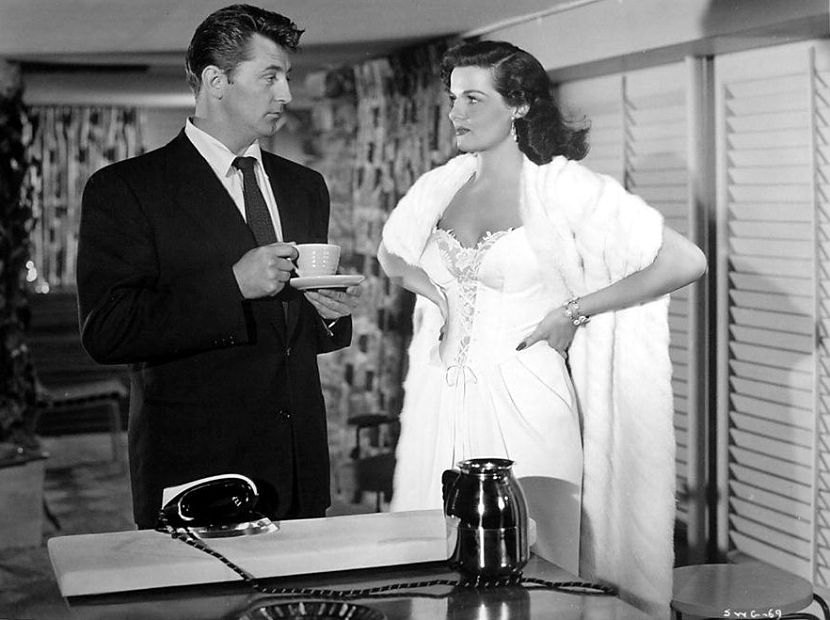
HIS KIND OF WOMAN
HIS KIND OF WOMAN

Here’s a selection from my list of Overlooked NoirHis Kind of Woman. Robert Mitchum plays a down-and-out gambler who is offered a deal that MUST be too good to be true; he’s smart enough to be suspicious and knows that he must discover the real deal before it’s too late. He meets a on-the-top-of-the-world hottie (Jane Russell), who is about to become down on her luck, too.

They are stuck in the confines of a Mexican beach resort with a full complement of shady characters, played by noir standard-carriers Charles McGraw, Jim Backus and Philip Van Zandt. And there’s the star of movie swashbucklers (Vincent Price), who is hiding out from his unhappy marriage. Tim Holt (Treasure of the Sierra Madre) shows up as another guy who isn’t what he seems. And, anchored just offshore, is the ruthless Italian crime lord (Raymond Burr at his most pitiless).

What makes this a noir classic is the complete amorality of the very sympathetic Mitchum and Russell characters. They’re not bad people, but they are playing the hands that they have been dealt. Neither questions the justice of their situations – they don’t feel sorry for themselves, they just deal with it. And they don’t worry about sleeping around or breaking a few laws if they have to. They may not be lucky, but they are determined to survive.

Reportedly, studio owner Howard Hughes fired the director John Farrow and replaced him with noir-master Richard Fleischer (Cry Danger).

His Kind of Woman plays on Turner Classic Movies and is also available on DVD from Netflix and streaming from Amazon Instant Video, iTunes, YouTube, Google Play and Flixster.