The new comedy She’s Funny That Way from 75-year-old master filmmaker Peter Bogdanovich is a light-hearted diversion about the unlikely career path of an escort-turned-screen actress (Imogene Poots). Bogdanovich is responsible for the screwball comedy masterpiece What’s Up Doc? and the grossly under-rated comedy romance They All Laughed. So he knows knows how to choreograph mad cap moments. There’s also an unexpected cameo at the very end, along with very funny end credits.
Along with Poots, Bogdanovich has attracted a top tier cast: Owen Wilson, Rhys Ifans, Will Forte and Kathryn Hahn. It’s especially welcome to see survivors of Bogdanovich’s 1970s oeuvre – Cybill Shepherd, Tatum O’Neal and Austin Pendleton.
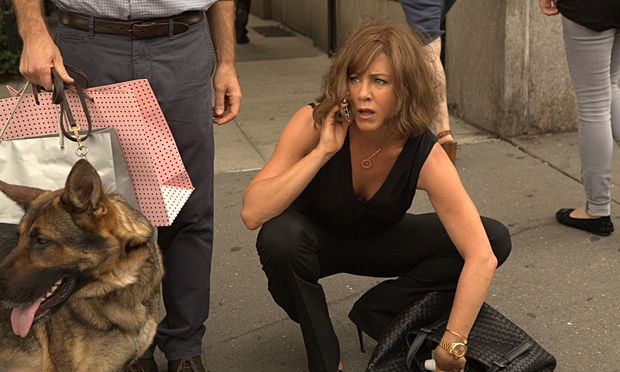
But the real revelation here – and the main reason to see the movie – is Jennifer Aniston’s turn as the most emotionally unhealthy therapist conceivable. It’s written as an extreme character – absolutely no boundaries, utterly self-absorbed, dangerously resentful and completely unprofessional. But Aniston’s performance is so full throttle that the audience delights every time her character comes on-screen.
She’s Funny That Way is just fluff, but it’s well-crafted fluff. It’s is now available to stream from Amazon Instant Video, Vudu, YouTube and Google Play.
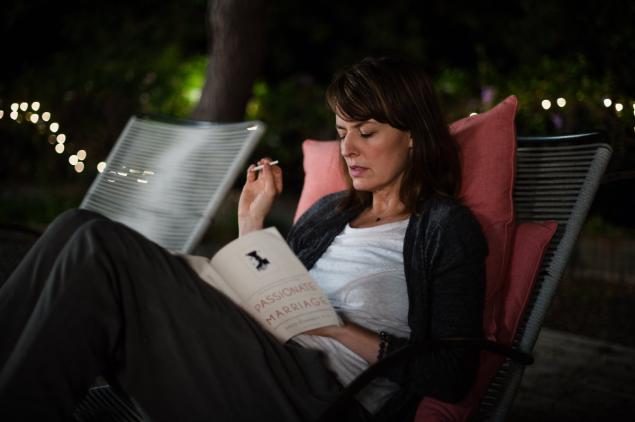
The romantic comedy Digging for Fire is a reflection on that moment when two people who have loved each other have become so consumed by day-to-day child rearing that they have lost heir way as a couple. She’s (Rosemarie DeWitt) fed up and drops the three-year-old with her parents, hoping for a wild weekend with girlfriends while he (Jake Johnson) does the taxes. Of course, he invites his guy buddies over for a bro-bacchanal. Things don’t go exactly as planned for either of them, and their separate weekends morph into adventures that challenge their marriage and trigger some self-examination.
Writer-director Joe Swanberg has a gift for creating characters that act like real people – and NOT like they know they are characters in a romantic comedy. Swanberg created the 2013 Drinking Buddies, a film I found to be “an unusually genuine romantic comedy” and the first Mumblecore movie that I’ve ever liked.
DeWitt and Johnson are very good, and Brie Larson is outstanding as a good time girl who is more – and looking for more – than she seems. Digging for Fire also features Anna Kendrick (against type as an uninhibited party girl) and Sam Rockwell (who has made playing an unreliable character into its own art form). We also see almost everyone who has been in an independent film: Mike Birbiglia, Chris Messina, Melanie Lynsky, Sam Elliott, Judith Light and Jane Adams. Orlando Bloom even drops in as a boor at a bar (albeit an upscale bar).
Two thing for sure: Joe Swanberg’s characters are never predictable and he is definitely a romantic. Digging for Fire is available for streaming from Amazon, Vudu, You Tube and Google Play.
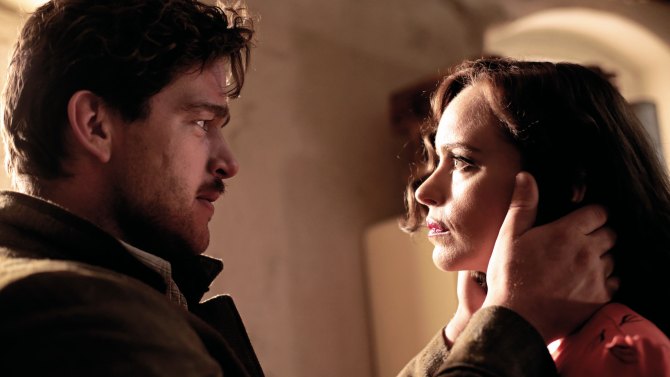
In the German psychological drama Phoenix, Nina Hoss plays Nelly, an Auschwitz survivor whose face has been destroyed by a Nazi gunshot; her sister has arranged for plastic surgery to reconstruct her face. When Nelly gets her new face, we accompany her on an intense quest.
Writer-director Christian Petzhold is an economical story-teller, respectful of the audience’s intelligence. Watching a border guard’s reaction to her disfigurement and hearing snippets from the sister and the plastic surgeon, we gradually piece together her back story. The doctor asks what seems like a very good question – Why would a Jewish woman successfully rooted in London return to Germany in 1938? The answer to that question involves a Woman Loving Too Much.
The sister plans to re-settle both of them in Israel, but Nelly is obsessed with finding her husband. She does find her husband, who firmly believes that Nelly is dead. But he notes that the post-surgery Nelly resembles his pre-war wife, and he has a reason to have her impersonate the real Nelly. So he has the real Nelly (who he doesn’t think IS the real Nelly) pretending to be herself. It’s kind of a reverse version of The Return of Martin Guerre.
It’s the ultimate masquerade. How would you feel while listening to your spouse describe you in detail to a stranger?
Nina Hoss is an uncommonly gifted actress. Here she acts with her face fully bandaged for the first third of the film. We ache for her Nelly’s obsessive need for her husband – and when she finally finds him, but she still doesn’t really have him.
As the husband, Ronald Zehfeld shows us the magnetism that attracts Nina, along with the brusque purposefulness that he thinks he needs to survive and flourish in the post-war Germany.
Christian Petzold and Nina Hoss collaborated on the recent film Barbara (he won the Berlin Film Festival’s Silver Bear for his work). About Barbara, I wrote
“Given that’s it difficult to imagine how anyone else could have improved Barbara, I’ll be looking for Petzold’s next movie.”
Well, here it is, and it’s gripping.
The ending of the film is both surprising and satisfying. Several people in my audience let out an audible “Wow!” at the same time.
Lola Kirke (right) with the always annoying Greta Gerwig in MISTRESS AMERICA
In director Noah Baumbach’s failed comedy Mistress America, an insecure young college student meets her step-sister-to-be (Greta Gerwig), who turns out to be a human whirlwind, dancing on the razor’s edge between frantic excitement and chaos. The premise of an unsure young person becoming captivated by a high energy and charismatic personality is an interesting one. Unfortunately, the movie fizzles because of the shipwreck of a screenplay (co-written by Baumbach and Gerwig) and another aggravating performance by Gerwig.
In the first half of the film NOT ONE WORD seems genuine, like a real character would have uttered it. Mistress America’s worst misfire is the extended screwball sequence at a house in Connecticut – the cast is just flinging the lines as if in a high school play (until a really good actor, Michael Chernus, shows up as a real character).
No actor could save this screenplay, but Greta Gerwig has the gift of making any movie worse and she does here, too. Gerwig plays the same character in every move because she thinks it’s Cute Kooky like Annie Hall. But she’s neither cute nor kooky – just annoying to the point of loathsomeness. Here, her character is a goofy-clumsy social loser, but just so Smart and Wonderful that she uses words like “autodidact” and “my nemesis”. Gerwig tries to be knowing and ironic, but she’s just cringeworthy, the most embarrassing moment coming when her character explains her own jokey “pretend rewind” gesture.
After the screening, another audience member said that Gerwig’s character is obviously not functional because of a bipolar disorder. Well, I’ll bet that Gerwig didn’t think that her character was ill – just charmingly idiosyncratic.
The other lead is played by Lola Kirke, who is pretty engaging; I’d like to see her acting with a real script. There’s also excellent acting by the veteran Chernus (Higher Ground, Men in Black 3, Captain Phillips, The Messenger, Love & Other Drugs). Jasmine Cephas Jones is stuck in a one-dimensional role as a hyper-jealous girlfriend, but she pulls it off with distinction. Rebecca Henderson is excellent as the bitter woman from Gerwig’s past.
I’m not the audience for Mistress America since I avoid Baumbach and especially Gerwig; I only saw Mistress America because I went to a mystery screening. Now I haven’t liked any Baumbach movie since his initial indie hit The Squid and the Whale in 2005. I have nothing against a naval-gazing filmmaker filling his movie with neurotic New Yorkers. Woody Allen has made over thirty of those and seven or eight are masterpieces. But – as sharp as Woody’s lines are crafted – you believe that this characters have thought them up on their own, not so with Baumbach.
One scene in Mistress America is inspired and true to the characters – a bitter woman confronts the clueless Gerwig character with a grudge from high school. But that wonderful moment isn’t worth the nails-on-the-chalkboard experience of the film as a whole. Skip Mistress America (and any upcoming Baumbach/Gerwig project, too, for that matter).
Last week I wrote about the actor Warren Oates and last night’s Oatesathon on Turner Classic Movies. I even included the 53-minute 1993 documentaryWarren Oates Across the Border. I hope that I’ve kindled (or rekindled) some interest in Oates, so here are two Warren Oates classics that TCM didn’t play last night.
They are both from cult director Monte Hellman: Two-lane Blacktop (1971) and Cockfighter (1974). There’s a Criterion Collection DVD for Two-Lane Blacktop which is available from Netflix. You can stream Cockfighter on Amazon Instant Video. Hellman was making low-low-budget exploitation films for Roger Corman, and both of these movies are fine specimens. In both, Oates plays a tough, bottom-feeding grasper who needs a little too much luck.
Two-lane Blacktop is a car chase/road trip movie that was a vehicle for two rock music stars, James Taylor and Beach Boy Dennis Wilson. Taylor plays a guy drifting across America and challenging drivers of other souped-up cars to races (The Driver); Wilson plays his mechanic (The Mechanic). They pick up a comely hitchhiker played by Laurie Bird (The Girl) and challenge the Warren Oates character (G.T.O.) to a road race from New Mexico to Washington, D.C.
Two-lane Blacktop turned out to be the only feature film for both James Taylor and Dennis Wilson. Taylor is pretty good in a very laconic role.
Laurie Bird made only three films – Two-lane Blacktop, Cockfighter and Annie Hall. Having worked as a model, she was cast by Hellman to co-star in Two-lane Blacktop, and soon a romance blossomed between the 41-year-old Hellman and the 18-year-old Bird. Bird also was the movie’s still photographer. After Cockfighter, she moved on from Hellman and became Art Garfunkle’s partner. Before she turned 26, Laurie Bird committed suicide in the NYC apartment that she shared with Garfunkle. In her very limited movie career, she proved to be an appealing and natural actress.
The only professional lead actor in Two-lane Blacktop was Oates. Of course, he was perfect for the role of G.T.O., a guy masking his insecurities with aggressive braggadocio.
In Cockfighter, Oates isn’t the foil, he’s the main guy. But he’s still a low-life, a guy with a cockfighting compulsion that threatens to consume everything he has – his money, his family, his home and his sanity – as he bets more and more on his fighting chickens. For those of us not intimately familiar with this pastime, Cockfighter is a soup-to-nuts procedural on cockfighting. Warning: Cockfighter contains the very definition of animal cruelty- lethal cockfights staged for the camera; (you couldn’t make this movie today).
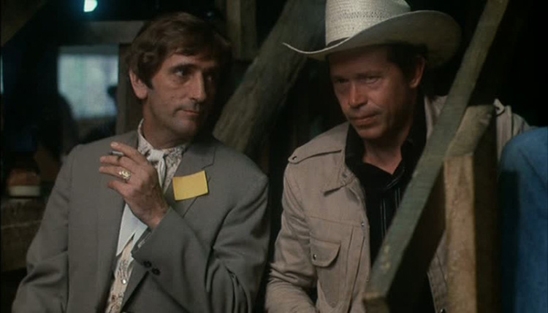
But the whole reason to watch Cockfighter is Warren Oates’ performance as a guy with too much desperation and not enough luck. (And Harry Dean Stanton and Laurie Bird are in the movie, too.)
Courtesy of the Criterion Collection, here’s the scene in Two-Lane Blacktop that sets up the car race.
Joaquin Phoenix and Parker Posey in IRRATIONAL MAN
Woody Allen’s latest, Irrational Man, is about a burn-out who revives his joie de vivre by committing a very grave crime, in the process self-administering a shot of metaphorical adrenaline. That’s all there is in Irrational Man, an entirely plot-driven movie. Skip it.
To be sure, as one would expect with a Woody Allen movie, it is well-acted. Joaquin Phoenix plays the kind of iconoclastic academic whose womanizing and drinking was part of his dashing charm until he sagged into middle age. The ever-lively Parker Posey is a faculty member who is bored with her life and her marriage. Emma Stone plays the precocious but impressionable coed. Besides the cast, the best thing about Irrational Man is the music, especially a wonderfully raucous version of The In Crowd by the Ramsey Lewis Trio.
[SPOILER ALERT: I don’t understand how it’s possible to make a non-exciting movie scene centered around Russian Roulette, but we don’t even momentarily cringe at this one. Maybe it’s the combination of having to explain what Russian Roulette IS (to a character who had somehow made it to college without hearing of Russian Roulette), and then having the ONE CHARACTER who we all know is going to make it to the climax of the movie pull the trigger at the mid-point. Yawn.]
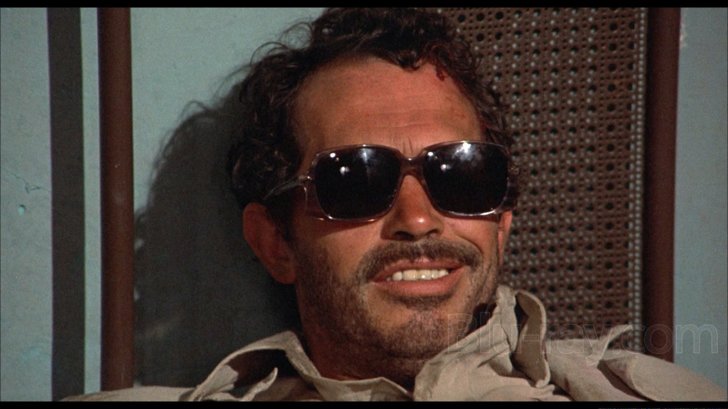
Warren Oates in BRING ME THE HEAD OF ALFREDO GARCIA
I love the character actor Warren Oates for his idiosyncratic performances in the period 1969-74 – and this is Warren Oates Week at The Movie Gourmet. Friday, I’ll write about the upcoming Oatesathon on Monday night, when Turner Classic Movies will be presenting SEVEN Warren Oates movies. And next week’s DVD.Stream of the Week will feature two Oates cult classics that TCM will be missing.
Oates was one of those actors whose performances always make an impression. He could turn a stock Western Bad Guy into a memorable character by adding a touch of cowardice, dimwittedness or venality. In Barquero, he was formidable enough to go gun barrel-to-gun barrel with Lee Van Cleef for 115 minutes.
Oates had a special gift for portraying desperation, so he triumphed in neo-noirs like Chandler, Cockfighter, The Brinks Job and his crowning achievement, Bring Me the Head of Alfredo Garcia. By early 1970s, the counter-culture was bringing lots of screenplay cynicism and anti-hero roles to the movies – both perfect for Oates.
Warren Oates died in 1982 at age 53. He has 123 acting credits on IMDb, mostly Westerns. He was a favorite of directors Sam Peckinpah and Monte Hellman. Indeed, he is most well-known for playing one of the Gorch brothers in Peckinpah’s The Wild Bunch and Sissy Spacek’s father (blown away by teen punk Martin Sheen) in Terence Malick’s Badlands.
Some of Oates’ best work was in 1974 as the leads in Peckinpah’s Bring Me the Head of Alfredo Garcia and Hellman’s Cockfighter. He was also unforgettable in the offbeat Barquero (1970), Hellman’s Two-lane Blacktop (1971) and Peter Fonda’s The Hired Hand (1971).
The 53-minute 1993 documentary Warren Oates Across the Border includes clips of Oates’ work, along with commentary from his widow Teddy Oates, Hellman, and fellow actors Ned Beatty, Robert Culp, Ben Johnson, Peter Fonda, Stacy Keach and Millie Perkins. Here it is.
Rachel McAdams in the second season of TRUE DETECTIVE
So my friend Steve emailed me: “If you include the second season of True Detective in your top ten films of the year you should be required to walk around with a paper bag over your head for at least six months.” He was right – True Detective’s second season was disappointingly lame.
I had high hopes because I loved the first season, and creator Nic Pizolatto returned to write this year’s version. The cast seemed promising, too: the story revolved around three cops (Rachel McAdams, Colin Farrell, Taylor Kitsch) from different agencies investigating a corrupt Southern California city. Vince Vaughn played a shady – and once criminal – businessman, with Kelly Reilly as his wife.
But I never really cared about Kitch’s or Vaughn’s characters. The plot was disjointed and, at time, risible. Pizzolato tried to echo Chinatown’s water scandal with a wholly improbable High Speed Rail scheme. The Wife and I were constantly asking each other “Where are they now?” and “Who is that guy?”. There are many ridiculously impossible coincidence and the like, but I just don’t care enough about True Detective to list them.
Rachel McAdams, forced to wear perhaps this year’s worst hairdo, is very good. So is Farrell, who, as he ages, is more and more compelling in dissolute roles. I always appreciate the chance to see Kelly Reilly – she elevates (almost) everything she’s in.
But the 2015 True Detective is a stinker. Don’t waste your time.
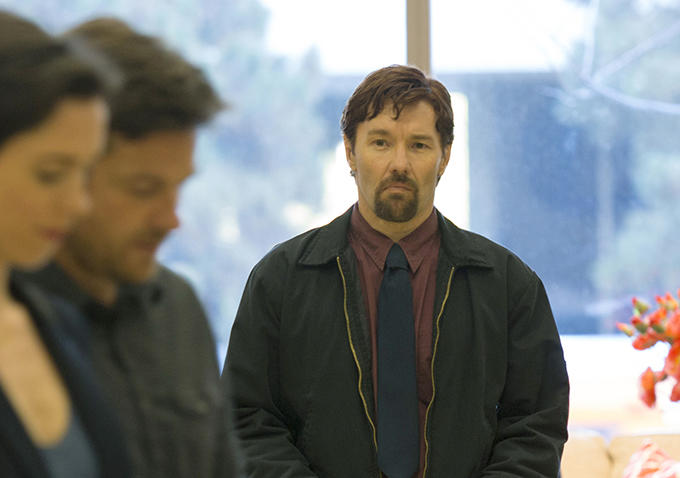
Rebecca Hall, Jason Bateman and Joel Edgerton in THE GIFT
The character-driven The Gift is more than a satisfying suspense thriller – it’s a well-made and surprisingly thoughtful film that I keep mulling over. It’s a filmmaking triumph for writer-director-producer-actor Joel Edgerton, the hunky Australian action star (the Navy Seal leader in Zero Dark Thirty).
Simon (Jason Batemen), a take-no-prisoners corporate riser, has moved back to Southern California with his sweetly meek and anxiety-riddled wife Robyn (Rebecca Hall). In a chance encounter, they meet Gordo (Edgerton), who knew Simon in high school. Gordo is an odd duck, but the couple feels obligated to meet him socially when he keeps dropping by with welcome gifts. At first, The Gift seems like a comedy of manners, as Jason and Robyn try to figure out a socially appropriate escape from this awkward entanglement. But then, the audience senses that Gordo may be dangerously unhinged, and it turns out that Simon and Gordo have more of a past than first apparent. Things get scary.
Edgerton uses – and even toys with – all the conventions of the suspense thriller – the woman alone, the suspicious noise in the darkened house, the feeling of being watched. And there’s a cathartic Big Reveal at the end.
But The Gift isn’t a plot-driven shocker – although it works on that level. Instead it’s a study of the three characters. Just who is Gordo? And who is Simon? And who is Robyn? None of these characters are what we think at the movie’s start. Each turns out to be capable of much more than we could imagine. I particularly liked Bateman’s performance as a guy who is masking his true character through the first half of the movie, but dropping hints along the way. Hall is as good as she is always, and Edgerton really nails Gordo’s off-putting affect.
And, after you’ve watched The Gift, consider this – just what is the gift in the title?
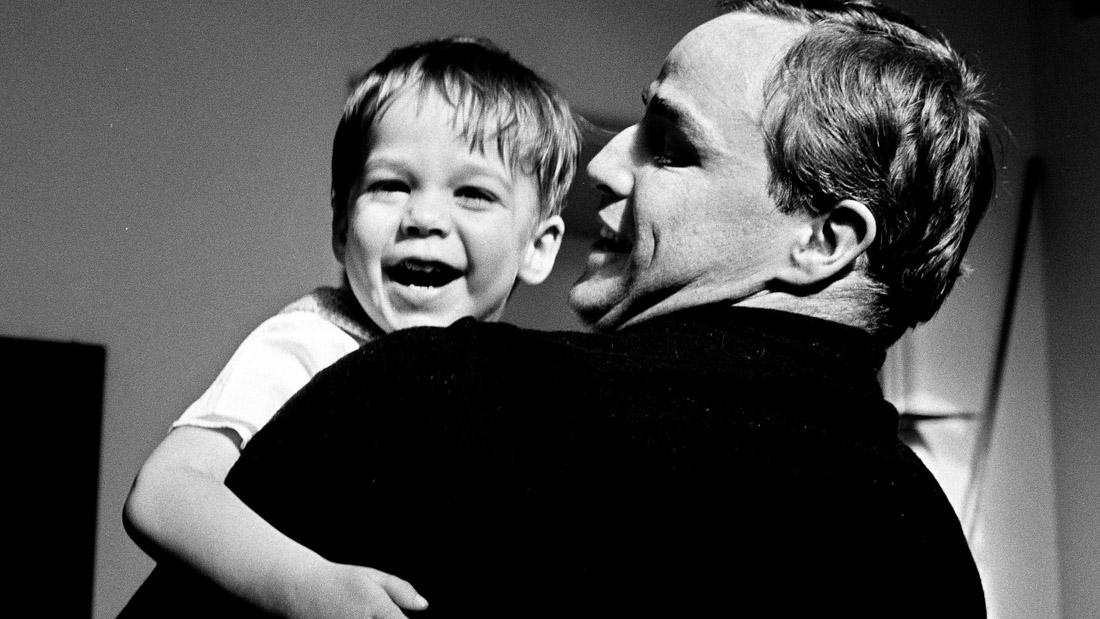
In the documentary Listen to Me Marlon, we hear Marlon Brando relate his life story in his own words – and we ONLY hear Brando’s words. Director Stevan Riley received access to hundreds of hours of audio tapes – self-recording made by Brando while he was alone – and never heard until now. These recordings, along with recorded Brando interviews and clips, are artfully assembled by Riley, and, together, amount to a deep and apparently truthful self-portrait.
Brando was playful and mischievous and often self-important, and the content of his interviews with journalists aren’t that reliable. But it’s clear that he isn’t BSing in these solitary recordings. He is open about his character flaws and their origin in his family background – a brute of a father and a sweet but erratic alcoholic mother.
Speaking in the third person, Brando describes himself as “a troubled man alone…confused”. Listen to Me Marlon is filled with nuggets:
On his upbringing: “My father is never going to come near that child (his first son Christian) because of what he did to me”.
On his art: “you want to stop that motion from the popcorn to the mouth. The Truth will do that.”
On the womanizing that broke up his first marriage “The beast aspect of my personality held sway”.
On the execrable Candy: “the worst movie I ever made” (drawing knowing chuckles from the audience).
Some of the tapes even record self-hypnosis as he battles obesity. And there’s a VERY COOL digitized talking Brando head, swirling around in blue pixels as he expounds.
There are also two outtakes where we SEE Brando’s womanizing in action as he comes on to attractive interviewers. We can recognize the instant that, as he says, he starts “thinking with his penis” and launches his flirtatious charm.
I saw Listen to Me Marlon at the San Francisco International Film Festival, where it will screen again this week. Director Riley spoke at the screening, as did noted film historian David Thomson and Brando’s children, Rebecca Brando and Miko Brando.
Rebecca Brando credits Riley for the film’s “humanity” as it treats Brando’s “childhood pain”. Miko Brando pointed out that the flashing lights in some clips came from the bio-feedback machine that Brando used at night. “He went to work as a movie star and came home – not a movie star – just a father”, said Miko, who had just seen the film for the second time.
David Thomson spoke of Brando’s “momentous” and truthful Method as the birth of “genuinely American approach to acting” and its effect on cinema: “the method is made for the close-up” because “if you are agonizing over what to say”, the audience needs to be close enough to see it.
Stevan Riley made the most of his access to the tapes – it’s a masterful job of selection and editing. Listen to Me Marlon opens tomorrow in theaters, and I expect it to eventually play on Showtime.