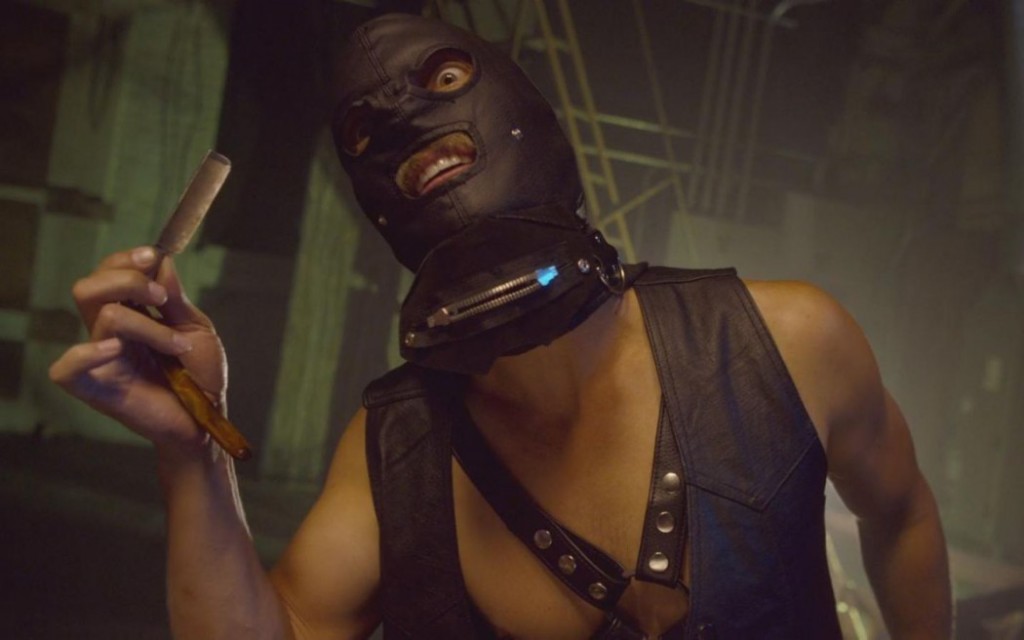
The shamelessly low brow comedy A Beginners Guide to Snuff features a very dim pair of would-be actors who seek to win a horror movie contest by simulating a snuff film. What could possibly go wrong? To get the most realistic performance out of their leading lady, they decide to kidnap her and pretend that they’re going to torture her to death on film. Their choice of that leading lady (played by Bree Williamson) brings some very unexpected consequences.
Most of the humor in Beginners Guide comes from the dumb and dumber filmmakers and spoof on low-budget horror cinema. But Williamson’s electric performance, like a shot of adrenaline, animates and elevates the movie whenever she is on-screen. Her character is so many tiers above the two boobs that she remains in charge even when chained to a table. On top of that, she has some unanticipated skills and characteristics…
A Beginners Guide to Snuff ends with a particularly inspired trailer for the movie-within-the-movie. If you’re looking for broad and dark comedy with a sparkling performance by an actress, this is your movie. World Premiere at Cinequest on March 4, 6 and 11.
Margot is a vibrant and salty 27-year-old Canadian woman. She suffered a schizophrenic break when she was away at college. Now she’s medicated, and fighting to resume her life. Margot is the subject of the documentary Dan and Margot, and I’ll leave you to find out who Dan is or is not.
How do we think of schizophrenia? We often visualize the feral-looking guy ranting to himself outside the 7-11. But how about those who are just slipping into a schizophrenic break or those medicated – with the disorder under control? In this very personal look examination of one person’s illness, Margot and her friends and family share how the disorder can sneak up on not only the individual, but their support system, as well.
Filmmakers Chloe Sosa-Sims and Jake Chirico parachute themselves and their camera into Margot’s life and take advantage of the access without sensationalizing her life. Dan and Margot is a solid and thought-provoking movie.
[Note: there is a little animation in Dan and Margot, but most is live action and almost all of that is Margot herself. The trailer is more representative of the film than is the still image above.]
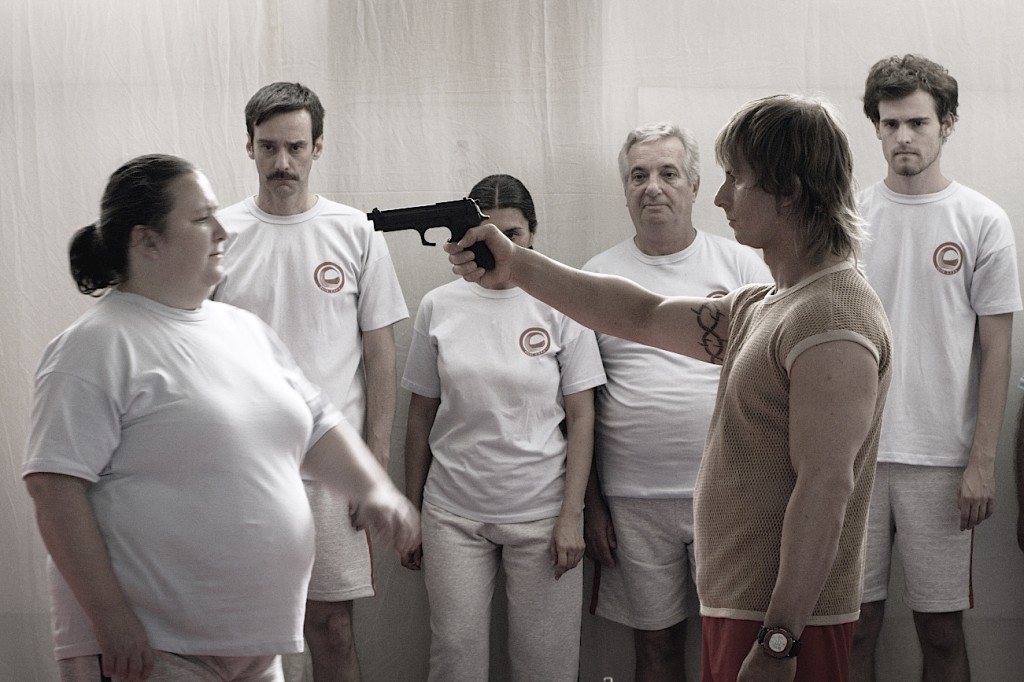
The Argentine drama Parabellumis a trippy movie unlike anything that you’ve seen. Set in a pre-apocalyptic near future, cities are crumbling into disorder and meteors are plunging into the Earth with alarmingly increased frequency. Clearly everyone should be panicking, but no one is.
Instead, the characters in Parabellum don blindfolds and are motored up a jungle river to a secret adventure resort where they learn survivalist skills – kind of Camp Heart of Darkness. The most life-and-death exercises are addressed matter-of-factly, with an absurdly calm determination that makes Parabellum seem like something out of Buñuel.
Parabellum’s measured pace seems so at odds with the impending disaster (whatever it will be), that it’s part of the joke. What the hell is going on and what are these people thinking? Beautifully shot, engrossing and witty – Parabellum is a wacky treat.
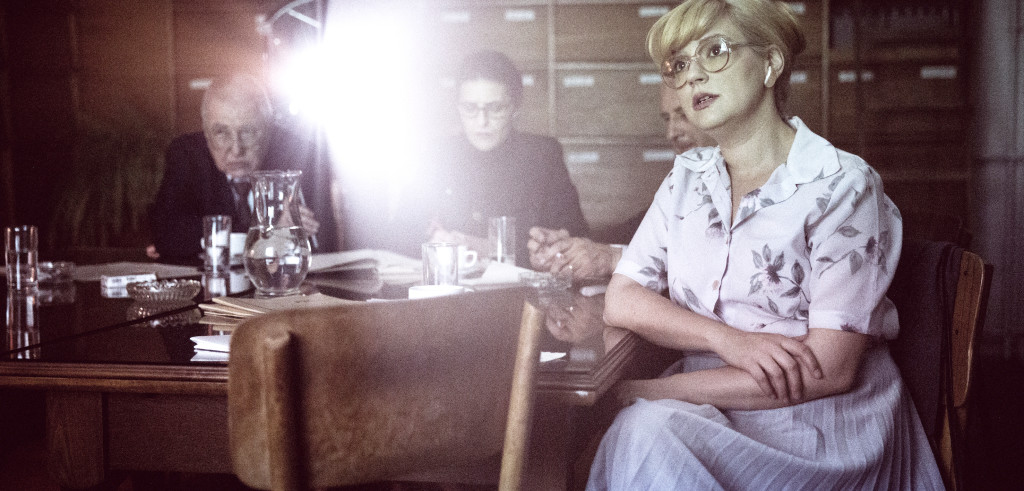
Sex, intrigue and murder – the atmospheric Hungarian drama Demimonde has it all. It’s just before World War I in Pest, and we meet a wealthy kept woman (Patricia Kovács), her longtime housekeeper (Dorka Gryllus) and the new maid (Laura Döbrösi). Indeed, the movie’s title describes the professional courtesan, shamelessly successful as a professional mistress that she can dare to seek riskier and riskier gratification. Mustering more poise, dignity and sexiness than anyone else, she utterly flouts all the conventions of respectability. I don’t need them to respect me, she says, I just need them to be fascinated. Indeed, she fascinates so many of the characters, that the sexual entanglements pile up until there are grave consequences.
All of the characters are hungering for something – sex and status, lost love, new love, sustenance, amusement. The three lead actresses and all the supporting cast are exceptionally good. Director Attila Szász convincingly takes us to the period and keeps the surprises coming.
With all the misbehavior, someone is sure to be punished and, when that happens, Demimonde becomes operatic. It’s one of the most satisfyingly entertaining films at Cinequest, and it plays the festival on March 2, 3, 9 and 10.
During the Communist regime of the repugnant Nicolae Ceaușescu, Romanians could only experience two hours of television per day and all of that was boring Ceaușescu propaganda. They were starving for culture, of any type and any quality, and a ring of smugglers responded to the demand with bootleg VHS tapes of American movies. The rewarding documentary Chuck Norris Vs. Communism tells this story.
Now this isn’t about high cinema from America and the rest of the world inspiring the current crop of Romanian auteurs – although that did happen. This is about ordinary Romanians feasting on even the crappiest American movies, especially the never-ending cascade of action movies (Chuck Norris movies were among the favorites).
The authorities, usually obsessively repressive, turned a blind eye top the VHS smuggling because they totally missed the subversive impact the movies that were not overtly political. But the ordinary Romanians saw abundantly stocked American supermarkets and measured that against their own deprivation.
One guy organized this VHS smuggling ring. Amazingly, one woman narrated a Romanian voiceover for all these movies – hundreds of them. It was a shady business for him and a moonlighting gig for her – but now they are cultural heroes in Romania. We meet these two briefly in Chuck Norris Vs. Communism. And we hear the testimony of Romanians touched by cinema – even trashy cinema.
What is banal in some cultures can have a significant impact on others. Chuck Norris Vs. Communism makes that point engagingly, in a story you won’t see anywhere else. Plays Cinequest on March 4, 6 and 12.
Here’s the problem with the Coen Brothers’ disappointingly empty comedy Hail, Caesar – there is no real story at its core. The plot ostensibly centers on commies kidnapping a movie star and a studio exec mulling over a job outside the movie industry. But these are contrived as an excuse to parody Old Hollywood and the movie conventions of the studio Golden Age. And that’s not enough by itself to make up a really good movie. At the end of Hail, Caesar, the guy sitting behind me said, “That’s it?”.
The parodies are well-executed, and the more you know about movies, the richer the laughs. The characters are making a ponderously devout sword-and-sandal epic called Hail, Caesar, which is closely modeled on the 1959 Ben-Hur, right down to the subtitle of the source novel, “A Tale of the Christ”. The epic stars a charismatic but shallow leading man, played well by George Clooney. This part is funny.
So is a spectacularly executed Busby Berkeley number with Scarlett Johansson as an Esther Williams type aquatic movie star. And Channing Tatum shines in a Gene Kelly-like song-and-dance set piece. Later in the film, famed cinematographer Roger Eakins brilliantly lights Tatum as an icon of Soviet-era Socialist Realism.
By far the best part of Hail, Caesar is Alden Ehrenreich as a singing cowboy. Where did they find this guy? Ehrenreich is convincing and hilarious as he performs tricks with his pistol, horse and lariat in a formula Western and then is forced to fit into a period costume for a drawing-room romantic drama. It’s an exuberantly singular performance, and something we haven’t seen on-screen since Gene Autrey and Roy Rogers.
All of the actors are good here, including Josh Brolin as the lead, and Clooney, Johansson, Tatum, Ralph Fiennes and Tila Swinton. Frances McDormand is wasted in a very brief physical comedy bit. That old scene-stealer Clancy Brown, here growling as the actor playing Gracchus in the Hail, Caesar-in-the-movie-Hail, Caesar shows why he’s one of my favorite character actors
There are always expectations of a Coen Brothers film, because of their masterpieces: Fargo, True Grit, Blood Simple and their seriously underrrated A Serious Man. Plus there’s the critical favorite No Country for Old Men and the cult fave The Big Lebowski. But they’ve also made some more forgettable fare (Inside Llewyn Davis, Burn After Reading) and Hail, Caesar is one of them.
Bottom line: if you want to enjoy a string of first class movie parodies, see Hail, Caesar. If you’re looking for something more, skip it.
In the very satisfying horror film Unfriended, it’s the one-year anniversary of a teenage girl’s suicide, and her bullying peers convene via webcams on social media. But their computers are hijacked by an Unknown Force who starts wreaking revenge. The kids become annoyed, then worried and, finally, panicked for their lives.
Here’s something I’ve never seen before: the entire movie is compiled of the characters’ screenshots. The critic Christy Lemire says that “Unfriended is a gimmick with a ridiculous premise, but damned if it doesn’t work”, and she’s right. Writer Nelson Greaves and Director Levan Gabriadze came up with this device, and their originality pays off with a fun and effective movie.
It’s on both my lists of I Hadn’t Seen This Before and Low Budget, High Quality Horror of 2015. Unfriended is available to rent on DVD from Netflix and Redbox and streaming from Amazon Video, iTunes, Vudu, YouTube, Google Play and Flixster.
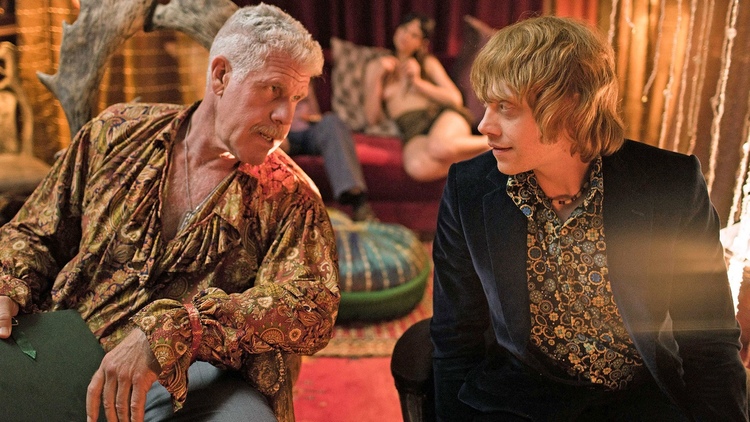
The premise of Moonwalkers is that the US Government conspired to film a simulated moon landing so, just in case something went wrong with the 1969 Moon Landing, they could bamboozle the public with a faux success. (This, of course, is a wry joke on the conspiracy theories claiming that the historical Moon Landing was faked.) In Moonwalkers, a burned-out CIA agent (Ron Perlman) is tapped to get Stanley Kubrick, no less, to shoot the phony movie. Unfortunately, he happens upon precisely the wrong drug addled hustler (Rupert Grint of Harry Potter) to put him in touch with Kubrick, and a mediocre madcap comedy ensues.
Nothing much here, but it’s all in good fun, and Ron Perlman is always a hoot. Moonwalkers is available streaming from Amazon Video, iTunes, Vudu, YouTube and Google Play.
The French drama In the Name of My Daughteruses three characters to probe the themes of obsession and betrayal – and all in a “based-on-facts” story. The ever-glorious Catherine Deneuve plays a dominant and proud casino owner, even desperately proud. Her adult daughter (Adèle Haenel) is a handful but is now vulnerable on the rebound. Her lawyer/fixer (Guillaume Canet) is ambitious and manipulative, and he believes that his smarts entitle him to rise above his station. Everyone FEELS betrayed and that brings on real betrayal.
Astonishingly, In the Name of My Daughter is based on a notorious true story. The end of the story becomes a courtroom procedural.
There’s plenty of eye candy in In the Name of My Daughter, particularly a thrilling motorcycle ride through gorgeous countryside and the casino town set on the Riviera.
The leads are very good, and so is the supporting cast, especially Mercier Guerin and Mauro Conte. There are sex scenes, but the sexiest moment is a fully clothed African dance performed by Haenel. And there’s a wonderful French version of Under the Boardwalk.
In the Name of My Daughter is available to stream from iTunes, Vudu, YouTube and Google Play.
Here’s a movie on my Best Movies of 2015 list with an enthralling Oscar-nominated performance by Charlotte Rampling. In the quietly engrossing drama 45 Years, we meet the married couple Geoff (Tom Courtenay) and Kate (Rampling), a well-suited pair who share each others’ values sensibilities and senses of humor. They are planning a party to mark their 45th anniversary when Geoff learns that the body of his previous girlfriend (killed in a mountain climbing accident 47 years ago ) has been found preserved in ice. He is knocked for a loop, and then slides into complete shock. He becomes brooding, even obsessed about his old flame and his youth.
Kate tries to settle Geoff and be supportive. But she learns one thing about his old flame, and then a second, and suddenly she’s the one who become the most troubled. She says, “I can hardly be cross about something before we existed, could I?….Still…” She asks him a question that she shouldn’t have. Her feelings may or may not be justified or rational, but they are her feelings, and they become the facts on the ground.
Geoff is usually the one who gets to burst out with his feelings, and Kate cleans up after. But Kate’s feelings are so much more complicated than Geoff’s.
45 Years meditates on the power and durability of memories and then shifts into a study of relationships. We see intimacy without the sharing of all truths, and see how the truth can be toxic and destructive. We live based on assumptions, and when those are revealed to be not fully correct, well, you can’t unring the bell. Camera Cinema Club Director Tim Sika overheard a critic colleague describe 45 Years thus, “It’s about nothing until you realize that’s it’s about everything”.
Writer-director Andrew Haigh is a brilliant storyteller. He lets the audience connect the dots. Our involvement in 45 Years intensifies as we piece together the back story and as the characters learn about new developments. There’s a wonderful undercoating of early 60s pop, a great soundtrack that avoids seeming like a jukebox.
Charlotte Rampling is marvelous and gives one of the greatest performances of the year in cinema. Rampling is most searing in Kate’s unspoken moments, in which we see her anguish, amusement, unease, radiance and heartbreak. It’s remarkable that such emotional turbulence can be portrayed without a hint of melodrama.
Before you see 45 Years, I’d suggest a careful reading of the lyrics to Smoke Gets in Your Eyes.
They asked me how I knew
My true love was true
I of course replied
Something here inside
Can not be denied
They, said some day you’ll find
All who love are blind
When you heart’s on fire
You must realize
Smoke gets in your eyes
So I chaffed them, and I gaily laughed
To think they would doubt our love
And yet today, my love has gone away
I am without my love
Now laughing friends deride
Tears I cannot hide
So I smile and say
When a lovely flame dies
Smoke gets in your eyes
[SPOILER ALERT – I think that the tipping point in their relationship occurs when Kate says, “Open your eyes”.]