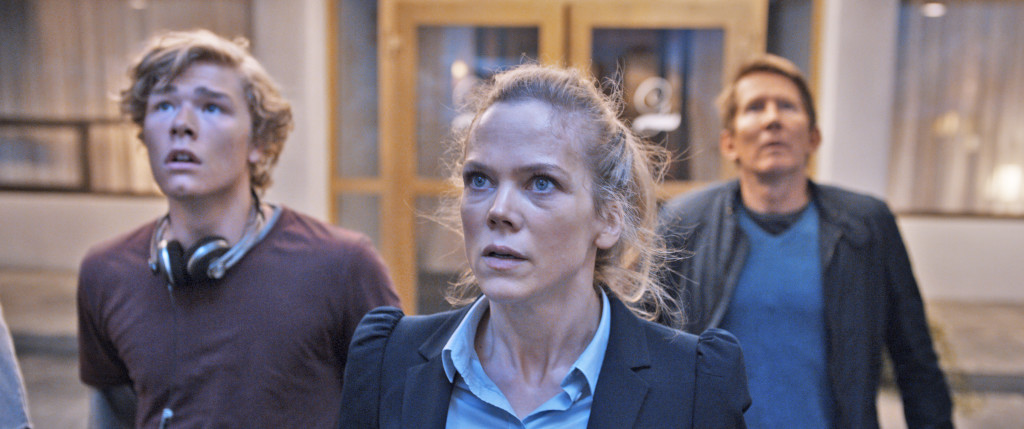
In the very satisfying horror film Unfriended, it’s the one-year anniversary of a teenage girl’s suicide, and her bullying peers convene via webcams on social media. But their computers are hijacked by an Unknown Force who starts wreaking revenge. The kids become annoyed, then worried and, finally, panicked for their lives.
Here’s something I’ve never seen before: the entire movie is compiled of the characters’ screenshots. The critic Christy Lemire says that “Unfriended is a gimmick with a ridiculous premise, but damned if it doesn’t work”, and she’s right. Writer Nelson Greaves and Director Levan Gabriadze came up with this device, and their originality pays off with a fun and effective movie.
It’s on both my lists of I Hadn’t Seen This Before and Low Budget, High Quality Horror of 2015. Unfriended is available to rent on DVD from Netflix and Redbox and streaming from Amazon Video, iTunes, Vudu, YouTube, Google Play and Flixster.
The premise of Moonwalkers is that the US Government conspired to film a simulated moon landing so, just in case something went wrong with the 1969 Moon Landing, they could bamboozle the public with a faux success. (This, of course, is a wry joke on the conspiracy theories claiming that the historical Moon Landing was faked.) In Moonwalkers, a burned-out CIA agent (Ron Perlman) is tapped to get Stanley Kubrick, no less, to shoot the phony movie. Unfortunately, he happens upon precisely the wrong drug addled hustler (Rupert Grint of Harry Potter) to put him in touch with Kubrick, and a mediocre madcap comedy ensues.
Nothing much here, but it’s all in good fun, and Ron Perlman is always a hoot. Moonwalkers is available streaming from Amazon Video, iTunes, Vudu, YouTube and Google Play.
The French drama In the Name of My Daughteruses three characters to probe the themes of obsession and betrayal – and all in a “based-on-facts” story. The ever-glorious Catherine Deneuve plays a dominant and proud casino owner, even desperately proud. Her adult daughter (Adèle Haenel) is a handful but is now vulnerable on the rebound. Her lawyer/fixer (Guillaume Canet) is ambitious and manipulative, and he believes that his smarts entitle him to rise above his station. Everyone FEELS betrayed and that brings on real betrayal.
Astonishingly, In the Name of My Daughter is based on a notorious true story. The end of the story becomes a courtroom procedural.
There’s plenty of eye candy in In the Name of My Daughter, particularly a thrilling motorcycle ride through gorgeous countryside and the casino town set on the Riviera.
The leads are very good, and so is the supporting cast, especially Mercier Guerin and Mauro Conte. There are sex scenes, but the sexiest moment is a fully clothed African dance performed by Haenel. And there’s a wonderful French version of Under the Boardwalk.
In the Name of My Daughter is available to stream from iTunes, Vudu, YouTube and Google Play.
Here’s a movie on my Best Movies of 2015 list with an enthralling Oscar-nominated performance by Charlotte Rampling. In the quietly engrossing drama 45 Years, we meet the married couple Geoff (Tom Courtenay) and Kate (Rampling), a well-suited pair who share each others’ values sensibilities and senses of humor. They are planning a party to mark their 45th anniversary when Geoff learns that the body of his previous girlfriend (killed in a mountain climbing accident 47 years ago ) has been found preserved in ice. He is knocked for a loop, and then slides into complete shock. He becomes brooding, even obsessed about his old flame and his youth.
Kate tries to settle Geoff and be supportive. But she learns one thing about his old flame, and then a second, and suddenly she’s the one who become the most troubled. She says, “I can hardly be cross about something before we existed, could I?….Still…” She asks him a question that she shouldn’t have. Her feelings may or may not be justified or rational, but they are her feelings, and they become the facts on the ground.
Geoff is usually the one who gets to burst out with his feelings, and Kate cleans up after. But Kate’s feelings are so much more complicated than Geoff’s.
45 Years meditates on the power and durability of memories and then shifts into a study of relationships. We see intimacy without the sharing of all truths, and see how the truth can be toxic and destructive. We live based on assumptions, and when those are revealed to be not fully correct, well, you can’t unring the bell. Camera Cinema Club Director Tim Sika overheard a critic colleague describe 45 Years thus, “It’s about nothing until you realize that’s it’s about everything”.
Writer-director Andrew Haigh is a brilliant storyteller. He lets the audience connect the dots. Our involvement in 45 Years intensifies as we piece together the back story and as the characters learn about new developments. There’s a wonderful undercoating of early 60s pop, a great soundtrack that avoids seeming like a jukebox.
Charlotte Rampling is marvelous and gives one of the greatest performances of the year in cinema. Rampling is most searing in Kate’s unspoken moments, in which we see her anguish, amusement, unease, radiance and heartbreak. It’s remarkable that such emotional turbulence can be portrayed without a hint of melodrama.
Before you see 45 Years, I’d suggest a careful reading of the lyrics to Smoke Gets in Your Eyes.
They asked me how I knew
My true love was true
I of course replied
Something here inside
Can not be denied
They, said some day you’ll find
All who love are blind
When you heart’s on fire
You must realize
Smoke gets in your eyes
So I chaffed them, and I gaily laughed
To think they would doubt our love
And yet today, my love has gone away
I am without my love
Now laughing friends deride
Tears I cannot hide
So I smile and say
When a lovely flame dies
Smoke gets in your eyes
[SPOILER ALERT – I think that the tipping point in their relationship occurs when Kate says, “Open your eyes”.]
Samuel L. Jackson and Walton Goggins in THE HATEFUL EIGHT
By now, everyone should understand what you’re going to get in a Quentin Tarantino movie: 1) lots of very harsh and extremely stylized movie violence; 2) lots of witty dialogue before and after the violence; and 3) references to other movies that Tarantino loves. A classic example of Tarantino cinema, The Hateful Eightdelivers on every count.
If you aren’t entertained by gratuitous violence, then don’t go to this movie. The splatter quotient is high.
The Hateful Eight starts out like the great epic Westerns of the 50s and 60s, complete with dazzling vistas and a score by Ennio Morricone (The Good, the Bad and the Ugly). But soon we are inside a single room with a bunch of scoundrels (some more lovable than others) and entangled in a Spaghetti Western plot – constructed to set up the action set pieces. And the violence is so over-the-top that much of it is both shocking and funny.
Those scoundrels are the spine of The Hateful Eight. It’s always been easy to conclude that Samuel L. Jackson was put on this earth to deliver Tarantino dialogue. Now it’s clear that Walton Goggins serves the same existential purpose. Goggins shot to cult fame by playing the loquacious, crafty and manipulative hillbilly crimelord Boyd Crowder in TV’s Justified. Goggins has the rare ability to project a complete absence of personal bravery, a quick-witted resourcefulness and be very, very funny while he’s doing it. The very best aspect of The Hateful Eight is that it evolves into a Samuel L. Jackson/Walton Goggins buddy movie.
And then there’s Jennifer Jason Leigh, always one of our most interesting actresses. In The Hateful Eight, she plays an extreme sociopath who can absorb an alarming amount of physical punishment. Her character is a malevolent and seemingly irrepressible force of nature, and Leigh’s performance is another reason to see this movie.
Jennifer Jason Leigh in THE HATEFUL EIGHT
I saw the regular 2 hours and 48 minute version of The Hateful Eight, projected on the digital system that most theaters now use. There is also a “Roadshow” version , which was shot on and is projected from 70 mm film. The Roadshow version also has a musical overture, an intermission and few minutes of extra action. It all adds up to three hours and 6 minutes. While this three hours and 6 minutes version is playing on 12 screens in the Bay Area, only two of them are the 70 mm projection.
I found the The Hateful Eight to be a hoot-and-a-half, but then I love Tarantino and have a high tolerance for movie violence. The Wife stuck it out like a good sport (“Tell me again why I wanted to see this?), but then she’s a Walton Goggins fan from Justified. If you liked Inglorious Basterds and Django Unchained, you’ll probably like this one, too.
Not just a compelling movie, The Revenant is an experience for the audience and a marvel of filmmaking. Oscar-winner Alejandro Gonzalez Iñárritu (21 Grams, Babel, Biutiful, Birdman) may be the director doing the most groundbreaking work in today’s cinema, and The Revenant, with its long shoot in hostile conditions, is his triumph over the seemingly impossible.
The Revenant is based on the historical episode of mountain man Hugh Glass, who was fur trapping in the Missouri River watershed of the Dakotas in 1823, when the area was completely unspoiled and inhabited only by nomadic bands of Native Americans. Glass was severely injured in a bear attack, left for dead by his companions and crawled 200 miles to safety. A “revenant” is a re-animated corpse, and Glass essentially returned from the dead.
Leonardo DiCaprio plays Glass, and his performance is extraordinary. For one thing – the most obvious – DiCaprio is a human piñata who actually must stand and then submerge in a freezing river, get bounced around by a CGI bear, chew on raw bison liver, crawl across uneven ground, and on and on; he takes a licking and keeps on ticking. And, in at least two-thirds of the movie, Glass either isn’t able to speak or has no one to talk to. So DiCaprio must convey his terror, grief, determination to survive and seek revenge with his physicality.
There are also solid performances by Tom Hardy (being villainous) Will Poulter and Domhnall Gleeson (a good year for him – also Ex Machina, Brooklyn and Star Wars).
There probably isn’t a more overused word in the current culture than “awesome”. But it’s precisely the right word to describe the depiction of Glass’ ordeal. The dazzling scenery as photographed Iñárritu‘s equally brilliant cinematographer Emmanuel “Chivo” Lubezki is awesome, as is the overall filmmaking challenge. In particular, the bear attack and an extended one-shot of a Native American attack with the camera moving by and forth among the combatants are brilliant and unforgettable. Showing off, Iñárritu even throws in an actual avalanche as a background shot.
The result is an utterly authentic film. Now I think I know what it looks like when a bear attacks and when an Indian band raids. DiCaprio shows us convincingly how it looks when a man grieves.
The Revenant is also exhausting – in a good way. As the film opens, we see men creeping through a primordial forest that has been flooded by a river. They are tense and so are we. We can’t tell whether they are hunting or hunted or both. We soon come to understand that their heightened alertness and intense concentration is required to survive a dangerous environment. That level of intensity remains throughout the film, and it wears down the characters and the audience.
History buffs will appreciate that Glass was part of Ashley’s Hundred, an enterprise that included many mountain men (Jim Bridger, Jedediah Smith, Kit Carson) who would later become guides and explorers with central roses in the history of the American West.
I also recommend Sheila O’Malley’s insightful comments on survival movies, in particular the very compelling Touching the Void.
This is one of the very best survival movies. See The Revenant, and make sure that you see on the Big Screen.
The disappointingly empty dramedy Joy traces the story of housewife Joy Mangano (Jennifer Lawrence), who invented the Miracle Mop sold on QVC and became a business success despite the gravity pull of her dysfunctional family.
Why doesn’t this movie work? One pivotal scene illustrates the problem. At this point, her business has imploded, she’s entangled in a hopeless legal morass, and everyone is urging her to file for bankruptcy. She’s facing family disgrace, and she tells her daughter that she’s giving up. But WE KNOW there’s no chance that Joy is really going to give up. We know that Jennifer Lawrence is going to kick ass to a triumphant conclusion. So there’s no tension, and therefore no drama.
Lawrence is very good, and I can generally watch her read a telephone book. The rest of the cast, which includes Bradley Cooper in a brief role, is just fine. But Joy’s slalom course through all her emotionally unhealthy relatives just isn’t very compelling.
Director David O. Russell has previously made two brilliantly entertaining movies with Jennifer Lawrence, Bradley Cooper and Robert DeNiro – Silver Linings Playbook and American Hustle. This ain’t them.
Keith Richards: Under the Influence is a good enough excuse to spend time with the ever genial Keith Richards. Keith is not just a rock icon and a medical marvel, he’s a great raconteur – ever genial, with an omnipresent cigarette-hacking chuckle.
Keith drops many a nugget while relating his own musical journey and much about American music of which he is a devotee:
About meeting Muddy Waters at Chess Records.
That he considers himself a better bass player than a guitar player.
How the intro licks to Street Fighting Man were recorded when only he and Charlie Watts came early to a recording session to mess around.
How his bass line with Charlie’s drumming sped up the pace to Sympathy with the Devil from a lament to really rockin’.
“I’m no longer a pop star and I don’t want to be one”.
A sharp observation that White “rock” can seem like a march, and “I prefer the ‘roll'”.
His period of not working with Mick Jagger in 1985-89 was “World War III”.
And there’s a VERY funny Johnny Cash-in-a-hotel-room story.
Here’s challenge – try to spell out Keith’s raspy chuckle. It’s something like “Huh-whey-whey-heh-heh”.
Keith Richards: Under the Influence has the feel of an infomercial for Richards’ book and newest solo album. But, no matter, it’s time well spent. Keith Richards: Under the Influence is available to stream from Netflix Instant.
During the years 1972-4, documentarian Les Blank hung out and filmed around Leon Russell’s Oklahoma recording studio, and A Poem Is a Naked Person is the result.
This was the period when Russell produced two of my very favorite albums, Leon Live and Hank Wilson’s Back, so I especially enjoyed the music. There’s also a nice snippet of Willie Nelson (pre-beard and pigtails) singing Good Hearted Woman.
In fact, all of the Leon Russell parts (both talking and performing) are great. The problem is that Blank filmed everybody and everything in the neighborhood, including a tractor pull, the demolition of a building and a seemingly deranged and snake-obsessed artist. There’s also a lot of conversation between people who are very stoned. Getting stoned is a lot more fun than listening to stoned people talk.
The documentary’s puzzling title originates from liner notes on a Bob Dylan album.
A Poem Is a Naked Person has been a bit of a Lost Film, until recently only shown at screening where Blank was present. Now you can stream it on Amazon Instant, Vudu, YouTube and Google Play.
The melodramatic docudrama The Danish Girl is based on the real life of Einar Wegener/Lili Elbe, one of the first people to receive sexual reassignment surgery. We begin with a devoted and playful young married couple of Danish painters in the 1920s (Eddie Redmayne and Alicia Vikander). He is a moderately successful landscape painter, and she is a struggling portraitist. As they experiment with sexual role-playing, his self-identification as a woman named Lili is revealed, and their journey continues though his-to-her transgender metamorphosis through the groundbreaking surgery.
There’s a point when he starts acting out his gender identification in ways that are not okay with her, and this is the best part of the film. Vikander plays a woman who is sexually ahead of her time, but anyone would be knocked for a loop when their partner switches genders. It doesn’t help when Lili addresses her very real yearnings with a substantial degree of selfishness.
But then The Danish Girl starts dragging and then ultimately grinds into boredom and predictability. The movie keeps hammering us with the wife’s devoted support of her transforming spouse, the secret they strive to maintain, yada yada. Tom Hooper, the director of The King’s Speech and the literally miserable Les Miserables, is technically quite good; he also knows how to make a movie pretentious and ponderous. There’s probably a better 90-minute movie embedded in The Danish Girl’s 119 minutes.
Vikander is just outstanding as the wife. Redmayne also nails his role, a part every bit as showy as in The Theory of Everything. Matthias Schoenaerts, Amber Heard and Ben Whislaw are excellent in supporting roles. Sebastian Koch, who is always good, is also solid in a secondary role.
The costumes in The Danish Girl are exquisite. The early hints as to his gender identification come with his attraction to the fabric and design of fine clothes. Then Lili expresses her femininity through ever more ravishing and flamboyant fashion. All of the clothes are beautiful to look at, from Vikander’s new nightgown to the dapper suits and cravats on Matthias Schoennaerts. In the second half of the film, Vikander wears a turquoise dress with a vertical decorative panel that is a masterpiece of art deco design.
Excellent acting, phenomenal costumes and some riveting early scenes. Then meh.