The emotionally affecting drama Lion is one of the top crowd pleasers of the Holiday season and of the year. Here are the bones of the plot:
An Indian boy is accidentally separated from his family and lost, ending up in a hellish orphanage.
He is adopted and raised by a loving Australian couple (Nicole Kidman and David Wenham).
As a man, (Dev Patel of Slumdog Millionaire and The Second Best Exotic Marigold Hotel), he sets out on a quest to find his mother and brother in India – a classic Needle in a Haystack search.
Amazingly, it’s a true story.
Before the screening, I was ready to dismiss Lion as a stereotypical family melodrama, what movies studio called a “women’s picture” in the 1940s. But it’s much more than that. The young man has survivor’s guilt that becomes an obsession, explored through how it affects his relationship with his significant other (Rooney Mara). His adoptive parents have another adopted son – one who is severely emotionally disturbed.
Understandably, the young man is driven by an overwhelming need to give closure to his birth mother. What we don’t expect are the needs of the adoptive mother, and what surprises even our main character is what the adoptive mother does and does not need to be protected from.
Lion is the first feature for director Garth Davis, who has made his name in commercials; as one would expect, he is able in manipulating the audience with images and music, but not in a cheap way. The scene where the main character closes in on his search is exceptional.
Patel is remarkably engaging, and our sympathy with his character drives the movie. The other performances are solid. (Wow – Nicole Kidman is now playing the leading man’s Mom!) The two child actors who play the protagonist and his brother as children, Sunny Pawar and Abhishek Bharate, are exceptional.
When The Wife and I saw Lion, pretty much the entire audience was choked up. Stay all the way through the end credits for even more tears.
Ruth Negga and Joel Edgerton in LOVING. Credit: Ben Rothstein/Focus Features
The landmark 1967 US Supreme Court case Loving v. Virginia overturned state laws that banned interracial marriage. Loving is the story of the real couple behind that ruling, and it’s a satisfying love story of two modest people who would rather not have been forced to make history.
Ruth Negga and Joel Edgerton convincingly bring the lead characters to life. As the more vibrant character, Negga is especially winning. Edgerton is just as good as he plays the stolid and far less demonstrative husband.
Marton Csokas, with his pitiless, piercing eyes, is remarkably effective as the Virginia sheriff dead set on enforcing Virginia’s racist statute in the most personally intrusive way. Too often, actors seem to be impersonating Rod Steiger in In the Heat of the Night when they play racist Southern sheriffs, but Csokas brings some originality to his performance.
Loving is directed by one of my favorites, Jeff Nichols of Shotgun Stories, Take Shelter and Mud(which he calls his “Arkansas Trilogy”). Nichols specializes in leisurely paced dramas that evoke their settings in the rural South. Nichols’ languid style works well in telling stories that have moments of shock and violence. However, there is no dramatic courtroom face off or thrilling high point as we watch these people live their workaday lives, so Loving drags a bit in places. Nevertheless, Nichols does an excellent job of depicting the ongoing dread of racist terror that these people lived under.
Michael Shannon, who owes his career breakthrough to Nichols’ Shotgun Stories and stars in his Take Shelter and Mud, shows up in a sparkling cameo as a LIFE magazine photographer. If you perform a Google image search for “Richard Mildred Loving”, you’ll find the real LIFE photos, which make it clear that Nichols went to great lengths to make the characters and the settings look very, very much like the Lovings and their environment. I don’t need “lookalikes” in a historical movie, but the makeup and wardrobe on Edgerton and Negga (and especially Richard Loving’s mother) are remarkably close to the real people. And the scenes at the drag race and on the Loving’s sofa are recreated in almost chilling accuracy.
I studied Loving v. Virginia, along with other major civil rights and individual rights cases, in law school in the mid-1970s . Then, the idea that a government could outlaw a marriage between people of different races (and even the word “anti-miscegenation”) already seemed ridiculously obsolete and perversely quaint. But I hadn’t realized that the ruling in Loving v Virginia was only 8 years old at the time I studied it. California had such a law, too, which wasn’t repealed until 1948, and I have a friend whose Filipino and Mexican-American parents were kept from marrying by that statute.
History is made by real people. Loving is both good history and a watchable personal story.
Casey Affleck and Lucas Hedges in MANCHESTER BY THE SEA
The powerfully affecting drama Manchester by the Seacenters on the New England janitor Lee (Casey Affleck), who must take over care of his dead brother’s teenage son Patrick (Lucas Hedges). The searing performance by Affleck and the masterful story-telling by writer-director Kenneth Lonergan combine to make Manchester by the Sea a Must See and one the year’s very best films.
As the movie opens, we see Lee dealing with a series of apartment tenants, and we learn that he is emotionally isolated, and extremely reluctant to become entangled in any human relationships, even with willing females. Underneath, he is a witty guy, but he masks that with a stoic veneer. We also see that he is suppressing a rage that occasionally erupts.
Why is he like this? It’s hinted that there has been a tragedy for which he feels guilty. Mid-movie, that tragedy is depicted, and it’s hard to imagine a worse one. This is a man who, faced with an event that cannot be undone, has been disabled by grief and guilt. It becomes clear why he is so reluctant to take over the role as his nephew’s guardian.
Patrick has all the typical willfulness and teenage thirst for independence – all while expecting Lee to chauffeur him around his rich teen social life. Any teen is disaffected to some extent, but Patrick’s troubled mother has not been in the picture, and now his father has died. Lee is Patrick’s favorite uncle, and he is hurt and confused by Lee’s reaction, and he doesn’t understand why Lee is unwilling to drop everything to parent Patrick.
The friction between the two is remarkably realistic. Both Patrick and Lee have quick, sarcastic tongues, which make their scenes pretty funny, too. In fact, Manchester by the Sea is filled with humorous moments. There’s that awkwardness: how are you supposed to act when there is a death in the family – and yet something funny happens? Lonergan has an eye for the little things that go wrong in life: when the decedent’s last effects are misplaced, when the gurney won’t fold down to fit into the ambulance, when the cell phone buzzes in the funeral. And when the most horrible tragedy is marked by a forlorn plastic bag of junk food and beer.
A family death is naturally dramatic, and Lonergan uses this event to explore intense feelings of grief, guilt, responsibility and resentment. Absolutely every character acts like people do in real life. The result is a remarkable sense of authenticity.
Affleck has produced some of the greatest recent screen acting performances, in The Assassination of Jesse James by the Coward Robert Ford, Gone Baby Gone and Ain’t Those Bodies Saints. This performance is a career topper, a surefire Oscar-winner that will lead his obit. Just note how Affleck’s Lee answers a bad news phone call and the way he wordlessly eyeballs his ex-wife’s new husband.
Young Lucas Hedges steps up to play against Affleck, and Hedges makes his Patrick completely compelling and believable. Hedge’s Patrick is smart, wounded, insecure, needy, prideful and a smart mouth that we like being around.
As befits a Lonergan movie, all of the acting in Manchester By the Sea is top rate. The final scene between Michelle Williams and Affleck is utterly heartbreaking. I particularly liked C.J. Wilson as the family’s partner in their fishing boat.
As good as it is, Manchester by the Sea is not for everyone. The Wife and her sister had a meh reaction because they weren’t absorbed by Lee’s lack of apparent affect and didn’t think that the story’s arc paid off.
This is the third movie directed by the major American playwright Kenneth Lornergan. who has directed three movies. The first was another actor’s showcase, the excellent 2000 drama You Can Count on Me with Laura Linney as a well-grounded single mom and Mark Ruffalo as her reliably unreliable brother.
Lonergan made his second film, the near-masterpiece Margaret, in 2007. The studio fought with Lonergan over the film’s editing, cut it over his objection, and issued it to theaters in a blink-and-you’ve-missed-it release in 2011. In 2012, a DVD was released with both the studio’s 150-minutes version and with Lonergan’s preferred 186-minute cut. I own the DVD, and have seen the director’s cut. It’s an amazing film, and there’s an even better (shorter) one in there.
You Can Count on Me addresses responsibility, and Margaret deals with the consequences of an act that can’t be undone. Manchester by the Sea deals with these themes even more successfully and evocatively.
I’m trying to decide if Manchester by the Sea is the second best movie I’ve seen this year or the very best. You can be sure that it will be nominated for the Best Picture Oscar. I also think that it will produce the Oscar favorites for Best Actor (Casey Affleck), Best Supporting Actress (Michelle Williams) and Best Original Screenplay (Kenneth Lonergan).
Michelle Williams and Casey Affleck in MANCHESTER BY THE SEA
Michael Shannon, the only reason to see NOCTURNAL ANIMALS
In the would-be-thriller-but-really-squirmer Nocturnal Animals, Amy Adams plays a young woman who becomes infatuated with the romance of being with a starving artist, the sensitive Edward (Jake Gyllenhaal). After the romance wears off, she dumps him for a higher testosterone model, the striving businessman Hutton (Armie Hammer). Twenty years later, she has become a successful art dealer with all the trappings of an affluent life, buy plunges into a midlife crisis. At this moment, Edward finally gets a novel published and sends her an advance copy. Shocked to see that it is dedicated to her, she starts reading it and becomes engrosses, which is exactly what Edward has intended.
Nocturnal Animals is the braiding of three plot threads: the story of the doomed romance between the young Susan and Edward, Susan’s current melodrama with Hutton and a reenactment of the plot of Edward’s novel. The novel’s story takes up most of the screen time. It’s a garden variety, but particularly grim, revenge story, with a man (also played by Gyllenhaal) whose family is high jacked in desolate West Texas by a crew of sadistic lowlifes with the very worst intentions. If you’ve ever seen a crime movie, you know what is going to happen to the guy’s wife and daughter. After an excruciatingly long menace-and-dread segment, Gyllenhaal escapes and stumbles into the potential for revenge, guided by the local detective (Michael Shannon).
If you’ve survived the squirming caused by the unremittingly and gratuitously uncomfortable kidnapping sequence, you’re in for a treat with Michael Shannon’s performance, which is really the only reason to see Nocturnal Animals. Shannon doesn’t make any unnecessary movements, which focuses us his piercing and unblinking eyes, which make clear that he is a particularly dangerous man. And, we learn, even more dangerous because he is a man without anything to lose.
Actually, though, Laura Linney is also superb as Susan’s mom, unrecognizable underneath a formidable Dina Merill bouffant. Linney actually gets the one sure thing LOL laugh line in the movie. Aaron Taylor-Johnson is also devastatingly despicable as the most sadistic and loathsome of the thugs. Adams, Gyllenhaal and Hammer are all fine, too.
This is the second movie from director Tom Ford, the fashion designer; it’s nothing at all like the his A Single Man, with its exploration of loneliness, grief and identity repression. Ford’s background in fashion probably informs some jokiness in Susan’s world of overly precious art dealers and silly avant garde “art”. But other than that, there really isn’t any humor to leaven the unpleasantness of the Gyllenhaal story.
The reason that Susan’s dumping of Edward is supposed to be so scarring is overblown, and I’m finding it has become an all too easy screenwriting device. (We’ve come a long way since Alfie in 1966.)
I should note that I think that I do GET this movie, with its layers of revenge and its comments on art. I just don’t think that the payoff is there. Nocturnal Animals will make for a solid $3.99 video rental so you can fast forward until you see Michael Shannon on the screen.
The extraordinary performance of French actress Isabelle Huppert makes the already subversive Elle into a Must See. Huppert plays the middle-aged businesswoman Michèle, who is raped in her home in the first seconds of this movie. Elle is likely to be controversial; Michèle’s reaction to the rape will not meet anyone’s expectations. At first, Elle seems like it will be a looks like a whodunit (who is the attacker?), then it shifts into a revenge fantasy, all the while remaining, at its core, an amazing study of Michèle, a character that we haven’t seen before. This is a woman who refuses to accept – and may not be capable of – victimhood.
The screenplay, which turns upside down any expectations we may have, is written by David Birke from a Philippe Djian novel. The hunted becomes the hunter, we never know what to expect from Michèle and shockers abound. Who better than Paul Verhoeven (Basic Instinct) to direct? Especially since the willful Michèle has a lusty sexual appetite, with adventuresome tastes.
Michèle needs to be in control, and she’s generally tough enough to stay in charge. The way to understand her actions is that she will do anything to regain that control and to avenge any moment that someone else has wrested it from her. One would expect the rape to be shattering enough, but Michèle starts getting messages from her attacker that would send ANYONE into a puddle of paralyzing terror; instead she’s only momentarily unnerved.
With the exception of two monsters, all the men in Elle are weak (despite any internal sense of bravado), and she handles them all easily. (Those two monsters better watch out, too.)
One way of watching Elle is to keep score, as in: Michèle 6, Men 0. But Elle is not a man-bashing film – Michèle’s ridiculously self-centered mom and her son’s abusive nightmare of a girlfriend are just as unsympathetic as all but two of the men.
There’s plenty of dark humor in Elle. For example, immediately after the opening rape scene, we watch Michèle at work as the founding CEO of a video game company. She’s watching a clip from her company’s newest video game in development. The clip is so hyper-violent and misogynistic that it would trigger massive PTSD for any rape victim, but Michèle’s complaint is that it’s NOT VIOLENT ENOUGH.
Isabelle Huppert may be the best screen actress working today, she’s certainly the most fearless. She’s so fearless, you gotta wonder if there any scripts that she rejects for being TOO weird, challenging or transgressive. She is comfortable with roles that range from the kinky (The Piano Teacher) to the most twisted (Ma Mere).
Huppert is especially gifted at playing impenetrable. She is at her best when she simply REGARDS other characters, assessing and judging them. With almost no lines,and very little screen time, her sphinx-like character dominated the recent Louder Than Bombs.
I also have to note that her character in Elle is in her early 50s – a sexy early 50s – while Huppert herself is 63. She seems to have somehow stopped the aging process about 15 years ago.
Elle ends in a moment of friendship, with the final line an homage to my favorite movie of all time. There’s a difference between perverse and perverted, and Elle keeps just inside that fine line. The shockers, the very dark humor and Huppert’s singular and compelling performance make Elle one of the year’s most absorbing films. Two weeks after screening it, I’m still thinking about it.
The documentary The Lovers and the Despottells one of those you-would-never-believe-it-if it-were-made-up stories. The late North Korean nutcase Kim Jong-Il, dissatisfied with the cinematic element in his propaganda machine, sought an upgrade by KIDNAPPING a top South Korean director and his movie star wife.
The story of the kidnapping and their escape spans two decades and is a real Cold War thriller. One interesting aspect is that there was some question as to whether the two were actually kidnapped or instead defected – after all, the director’s career was in a downturn in South Korea and was ultimately resurrected in the North. But, come one, who escapes from South Korea to North Korea?
The proof of their kidnapping is both convincing and mind-boggling. The craziness of the North Korean regime has created such anti-communist paranoia in South Korea that the kidnapping vs defection question is still unresolved for some – and that’s crazy in and of itself.
The Lovers and the Despot will make good companion piece to Under the Sun, the documentary expose of Korea under its current Great Madman Leader, Kim Jong-il’s son Kim Jong-un.
The Lovers and the Despot is now available streaming from Amazon Instant, iTunes, Vudu, YouTube, Google Play and cable and satellite TV on demand.
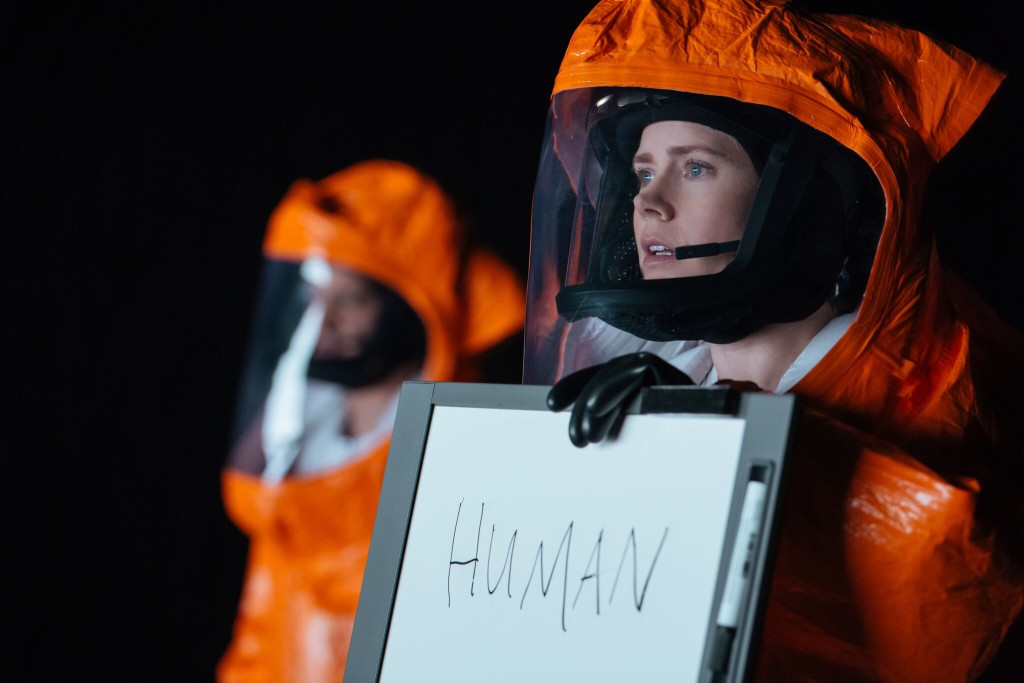
In Arrival, Amy Adams plays a linguistics professor at a Midwestern college who is drifting, having not recovered emotionally from the death of her child and the failure of her marriage. When space aliens come to earth (!) with very unclear intentions, she is deployed to figure out how to communicate with them.
Now if aliens (meaning living creatures in the universe who are not us) ever DO visit earth, I guarantee that we will be surprised at their appearance. I can’t imagine what they will look like, but they won’t look like the ones in The Day the Earth Stood Still, E.T. or Close Encounters of the Third Kind. Here, Arrival hits a home run. These aliens don’t look how we would expect, they don’t sound like we would expect and they don’t communicate like we would expect.
More central to the story, the aliens don’t think like we do. For them, time is not linear, which adds the mystic element that defines Arrival. Will our linguist learn how to communicate with these advanced beings who don’t seem to have language as we understand it? Will she connect with beings that think in different (additional?) dimensions?
Arrival is directed by Denis Villaneuve, who made Incendies, rated at the #1 slot on my Best Movies of 2011, as well as the thrillers Prisoners, Enemy and Sicario. His skill at thrillers pays off in the scenes with the aliens, when we are constantly on the edges of our seats. The people are actually going INTO the alien spacecraft? Holy Moley!
I loved Amy Adams in Arrival, as I tend to do in everything she does. Jeremy Renner, Forest Whitaker and Michael Stuhlbarg are also solid. The Wife pointed out that Renner succeeds in an unusual movie role – a hotshot with a healthy ego who recognizes that someone else has the better idea and becomes collaborative. But Arrival is about the story, not the performances.
Arrival is real science fiction. So many so-called “sci-fi” movies are really just war movies, revenge dramas, survival tales or Westerns that are set in the future or in space. Fortunately, we have recently had some truly thoughtful sci-fi including I Origins, Her and, now, Arrival.
Every viewer will be transfixed by the first 80% of Arrival. How you feel about the finale depends on whether you buy into the disconnected-from-linear-time aspect or you just get confused, like I did.
David Oyelowo and Dianne Wiest in FIVE NIGHTS IN MAINE. Photo courtesy of San Francisco Film Society
An Atlanta man (David Oyeowlo) suddenly loses his wife to an auto accident and is completely shattered by the depth and the jarring abruptness of his loss. Pushed by his sister out of his paralysis, he drives up to Maine to visit his wife’s mother (Dianne Wiest). She is a person who is generally harsh, judgemental and irritating at all times, but is more so now that her own health is failing. His experience with her becomes the antithesis of the comfort and support that one would expect. As she probes and spars with him, the two are each driven to their own catharsis. The end of Five Nights in Maine also comes abruptly, leaving us to reflect on the lessons learned by the leading characters and how their grief is resolved.
Five Nights in Maine uses a handheld camera and LOTS of close-ups. This was a conscious choice by first-time writer-director Maris Curran, who sought a “closing in” effect because “grief is claustrophobic”.
Dianne Wiest’s performance is an awards-worthy tour de force. Flashing fiery looks and shooting piercing remarks from an invariably rigid posture, she commands our attention every moment that she is on-screen. As we would expect, Oyewolo is outstanding, especially in the early scenes where he collapses into shock. Rosie Perez, not as sassy, but every bit as appealing, as usual, is rock solid in the supporting role as the mother’s nurse. As the sister, Tenoyah Parris (Chi-Raq, Dear White People, Mad Men) gives yet another flawless performance.
I saw Five Nights in Maine at the 59th San Francisco International Film Festival (SFIFF), where Director Maris Curran, producer Carly Hugo and actor David Oyelowo appeared at the screening. Curran said she was motivated to write a story about loss as her own marriage was falling apart; when the ground was pulled out from under her, she created a protagonist in that situation.
Aiming for a sensual look for an emotional film, Curran was able to snare Tunisian cinematographer Sofian El Fani, fresh from his exquisite work in from Blue Is the Warmest Color, for his first American film. Budgeted for a 19-day shoot, the crew finished in only 18.
Oyewolo, happily married for 18 years, found exploring the territory of losing his wife to be very uncomfortable. Five Nights in Maine was shot right after Selma, so his exhaustion from Selma helped him find this “hollowed-out” character. Oyewolo sees Five Nights in Maine as a fish out of water story – not just geographically but emotionally (a man not used to or prepared for grief). Oyewolo prefers women directors because he “wants to be part of stories that are emotionally challenging”.
Fortunately, Curran leavens this dark-themed story with bits of sharp humor. It’s an emotionally affecting and authentic movie. Five Nights in Maine is available to stream on Amazon Instant, Vudu, Google Play, YouTube and DirecTV.
The talented and idiosyncratic filmmaker Kelly Reichardt’s Certain Women is another of her languorous observations of real people in the Northwest. It’s a classic Slice Of Life movie, with three slices, actually. Reichardt adapted the screenplay from short stories by Maile Meloy, and we have three barely interlocking tales of three women around the hamlet of Belfry, Montana. There’s the lawyer (Laura Dern) struggling to make her brain addled client (Jared Harris) understand and accept that he has no adequate legal recourse for a work injury. There’s a part-year resident (Michelle Williams) with a husband trying to reconnect with her and a very “teenage” teenager. And there’s a horse handler (Lily Gladstone) who gets a crush on a night school teacher (Kristin Stewart).
Not much happens. None of the main characters is in a substantially different place at the end of the film, although Gladstone’s rancher has learned a lesson about attraction. I’m going to blow right through my usual reticence about spoilers and tell you that Michelle Williams’ character gets her pile of rocks.
As a director, Reichardt is a brilliant observer, always picking up on the little awkward moments that are a part of life. She’s the perfect filmmaker to show Gladstone’s horse tender walking through downtown Livingston, where she knows no one, at night and peering in windows at people dining and getting their hair cut. Not only is there a solitary light bulb on a lonely character’s ceiling, but no one has finished the taped-and-mudded sheet rock around the bulb.
All three major actresses are very good. The performances by Lily Gladstone, Jared Harris and Rene Auberjonois (as an old man having trouble staying focused) are especially indelible.
I was a huge fan of Reichardt’s Old Joy, less so of her western misfire Meek’s Cutoff, and I thought that her Wendy and Lucy is a masterpiece. (BTW Certain Women is dedicated “For Lucy”, the dog in Wendy and Lucy.) If you are a patient moviegoer and/or a fan of Reichardt’s, then you should see Certain Women. But renting her Wendy and Lucy would be a better choice.
After a few minutes of The Handmaiden, we learn that it’s a con artist movie. After 100 minutes, we think we’ve watched an excellent con artist movie, but then we’re surprised by a huge PLOT TWIST, and we’re in for two more episodes and lots of surprises in a gripping and absorbing final hour. It’s also one of the most visually beautiful and highly erotic films of the year.
Director and co-writer Chan-wook Park sets the story in 1930s Korea during Japanese occupation (Japanese dialogue is subtitled in yellow and Korean dialogue in white). A young heiress has been secluded from childhood by her guardian uncle, who intends to marry her himself for her fortune. A con man embarks on a campaign to seduce and marry the wealthy young woman to harvest her inheritance himself. The con man enlists a pickpocket to become handmaiden to the heiress – and his mole. I’m not going to tell you more about the plot, but the audience is in for a wild ride.
The Handmaiden takes its time revealing its secrets. Who is conning who? Who is attracted to whom? How naive is the heiress? How loyal is the handmaiden? Who is really Japanese and who is really Korean? What’s in those antique books? What’s in the basement? Is the uncle perverted or REALLY perverted? And what legendary sex toy will show up in the final scene?
THE HANDMAIDEN
Chan-wook Park’s 2003 US art house hit Oldboy is highly sexualized, trippy and disturbing. The Handmaiden is much more mainstream and accessible than Oldboy, but its sexuality packs a punch.
Gorgeous and erotic, The Handmaiden is one of the most gloriously entertaining films of the year.