Streams of the Week: MYSTERY ROAD and GOLDSTONE

Aaron Pederson in MYSTERY ROAD

Writer-director Ivan Sen’s Australian crime dramas Mystery Road and Goldstone both feature Sen’s wholly original protagonist Detective Jay Swan (Aaron Pederson). Swan is an indigenous police investigator who must face racist locals and his own demons.  Pederson’s performances in both movies are very strong, bringing out the inner conflict within a guy who needed to leave his hometown and his marriage but is tormented by the consequences of those decisions.

In the contemporary murder mystery Mystery Road, Detective Swan returns to his small town in the Australian outback to encounter racist co-workers, a drunk and shiftless ex-wife and a resentful teenage daughter.  The daughter is a concern because her gal pals are starting to turn up murdered one by one.  Mystery Road is a solid but unexceptional police procedural except for two things: the movie’s climactic gun battle between guys using hunting rifles through telescopic sights – a real show stopper .

Hugo Weaving chews up some scenery with a supporting role as a cop with ambiguous motivation.  Weaving, with his supporting roles in The Matrix, V for Vendetta, Lord of the Rings, Transformers, etc., may be the world’s most financially successful character actor.
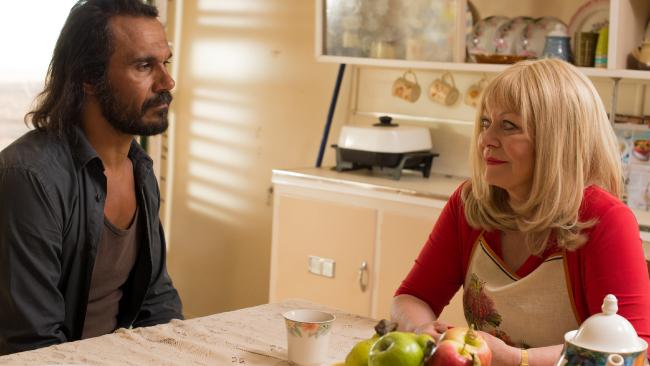
Aaron Pederson and Jacki Weaver in GOLDSTONE


In Goldstone, Swan is still reeling from a family tragedy when he finds a dark personal tie to the latest crime scene. Alcohol doesn’t help. A missing persons case brings Swan to a remote mining outpost. There’s a young local cop of ambiguous motivation – will he obstruct Swan, compete with him or become an ally? The local cop is working a human trafficking case, and the two cops pursue their investigations on dueling separate tracks until they inevitably converge.

Once again, the great Jacki Weaver (Animal Kingdom, Silver Linings Playbook) plays a peppy, ever-pleasant cutthroat as only she can.

The dialogue and most of the plot in Goldstone are pretty paint-by-the-numbers, but just as with Mystery Road, the character of Jay Swan and the performance by Aaron Pederson, along with the Outback setting, make Goldstone very watchable.

Both Mystery Road and Goldstone played at Cinequest. Mystery Road is available to rent on DVD from Netflix and can be streamed from Netflix, Amazon, iTunes, Vudu, YouTube and Google Play. Goldstone can be streamed on Netflix, Amazon , iTunes, Vudu, YouTube and Google Play.


Stream of the Week: UNA – two twisted people

UNA
UNA

The psychological suspense movie Una revolves around two twisted people, one of whom has been damaged by trauma. Here’s what the audience can be confident really happened: at age 14, Una (Rooney Mara) was seduced by a much older man, Ray (Ben Mendelsohn); she became infatuated with Ray and they carried on a sexual relationship for three months until he was caught and imprisoned for four years. Upon leaving prison, he changed his name and started a new life. It’s now fifteen years after the original crime and Una has tracked him down.

We can tell that Una is obsessed with Ray. What we don’t know is whether Una is seeking vengeance or whether she is in love with him – or both. She’s so messed up that even she may not know.

Lolita was a novel with a famously unreliable narrator. Una presents us with TWO unreliable narrators. Almost every statement made by Ray COULD be true, but probably isn’t. He was in love with her, he came back for her, she was his only underage lover, he’s not “one of them”, he’s told his wife about his past – we just can’t know for sure. Ben Mendelsohn delivers a performance that tries to conceal whatever Ray is thinking and feeling but allows his desperation to leak out.

The excellent actor Riz Ahmed (Four Lions, The Reluctant Terrorist) is very good as Ray’s work buddy, who must deal with one totally unforeseeable surprise after another.

Una really relies on Rooney Mara to portray a wholly unpredictable character in every scene, and she succeeds in carrying the movie. Mara’s face is particularly well-suited when she plays a haunting and/or haunted character, and it serves her well here.

I originally saw Una at Cinequest.  You can stream it from Netflix Instant, Amazon, iTunes, Vudu, YouTube and Google Play.
 

THE CHAPERONE: deeper than it looks

Elizabeth McGovern in THE CHAPERONE

The Chaperone is a pleasing period tale of self-discovery in 1921 America. Louise Brooks (Haley Lu Richardson) is not yet the silent movie sex symbol that she would become; she’s a 15-year-old from Wichita who has a wonderful opportunity – she can attend a cutting edge NYC dance school, if only she can get a chaperone. Local Wichita matron Norma (Elizabeth McGovern) volunteers to be that chaperone. Highly spirited and supremely confident, Louise is a Wild Child who can shock Norma’s sensibilities. But we learn that Norma has a secret reason for leaving Wichita and another secret reason to visit New York City…

This could have been a standard Odd Couple-type romp, but it’s surprisingly deeper. That’s because it centers on the adult character of Norma and benefits from McGovern’s performance. She has a sense of decorum, but she’s not a garden-variety prude. She doesn’t really appreciate her own inner strength and what that strength has helped her survive already. Now, for the first time, she reflects on what it would take to achieve happiness for herself.

Of course, adoptees longing to find out about their biological parents, child sexual abuse, closeted homosexuality and passionless marriages all existed in 1921, but American society was ill-equipped to deal with (or even acknowledge) them. Those are the pivot points in this screenplay written by Downton Abbey’s Julian Fellowes.

Richardson’s persona as Louise does not resemble the sensuous adult Brooks, but she captures the youthful exuberance and confidence of the role. This is only the second American film for Hungarian actor Géza Röhri (from the brilliant but impossibly grim Son of Saul). Röhri is able to project a fundamental decency that is very appealing.

The Chaperone is a satisfying and easy watch, which I would expect to end up on PBS after its theatrical run. The Chaperone played at Cinequest in March.

TEEN SPIRIT: a well-crafted genre film with a heart

Elle Fanning in TEEN SPIRIT

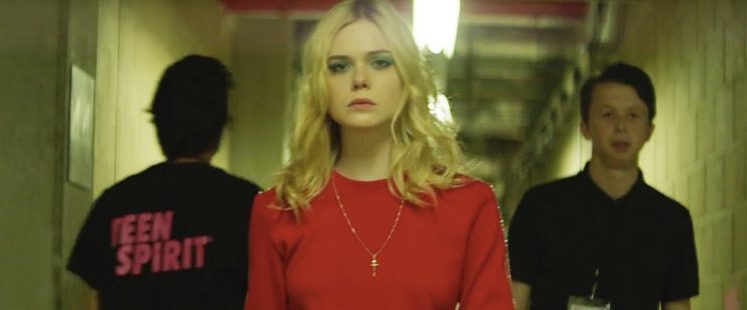
In the appealing Teen Spirit, Elle Fanning plays a Polish working class girl on the Isle of Wight who competes in a fictional British version of American Idol.  Even though she is immensely talented, she is not one of the popular kids.   And, recognizable as a teenager – she is bored and she resents being bored.  Seemingly a hopeless underdog, she finds a mentor in the local barfly Vlad (Zlatko Buric), a former opera singer fallen on hard times.

Yes, Teen Spirit is firmly in the underdog competition genre – and we know that the story will climax in the Big Game, the Big Match or – as here – the Big Sing-off.  As with any genre, one of these movies can be an empty, cliche-ridden formula or a masterpiece (Rocky) or something in between.  Teen Spirit may not be a Rocky, but, thanks to writer-director Max Minghella, it is well-crafted and has a heart.

It should be noted that Elle Fanning actually does the singing in Teen Spirit – and sings very well.  Given that Rami Malek just won an Oscar for lip-syncing, we should bestow a Nobel upon Fanning.  She has an ethereal voice and has shown herself to be a fine actress who can carry a more challenging story than this.  Both she and Buric are excellent.

First time director Minghella paces the film very well and delivers some flashy movie making, with fast cuts and pounding soundtrack, sometimes giving the effect of being inside a disco ball.  All for the good.  To his credit, Minghella also follows Billy Wilder’s screenwriting advice – when your story is finished, don’t hang around.

I saw Teen Spirit at Cinequest, and Elle Fanning appeared for a post-screening interview.  Teen Spirit opens this weekend in the Bay Area.

TRANSIT: the thrill was gone

.
Paula Beer and Franz Rogowski in TRANSIT. Courtesy of Music Box Films

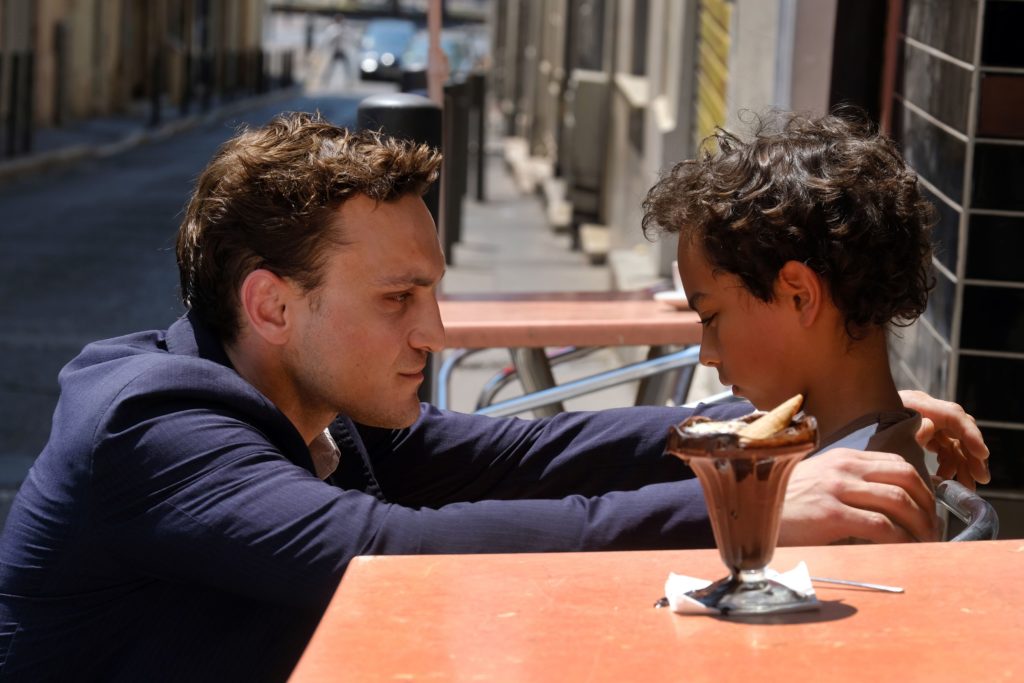
In Christian Petzold’s puzzling thriller Transit, George (Franz Rogowski) flees Paris for his life, just ahead of the invading Nazis.  He assumes the identity of a dead author, which comes with a ticket from Marseilles to the safety of the Western Hemisphere.  Trouble is, the ship won’t leave for weeks, so he must wait it out in Marseilles as the Nazis get closer and closer.  He finds himself in a community of other refugees – all forlornly hoping for a ticket, a visa, a letter of transit so they can get out, too. Completely at the disposal of impenetrable bureaucracies, their situation is Kafkaesque.  It’s a puddle of human desperation, and the clock is ticking.

Georg glimpses a mysterious beauty, Marie (Paula Beer). She turns out to be the widow of the man that Georg is impersonating, but she doesn’t know that her husband is dead.  What Georg knows is that he also has papers for her to join him on the escape ship.  While waiting for her husband to appear in Marseilles, she has taken up with the altruistic doctor Richard (Godehard Giese).

So, we have European refugees holed up, trying to get letters of transit to escape the Nazis. Our protagonist is in love with a woman, who is with a selfless idealist. Yes, this story does have its similarities to Casablanca – there’s even a dramatic sacrifice at the end.  But the impeccably plotted Casablanca is easy to follow, and Transit has its surreal aspects. Casablanca is of its time – when individuals subsumed their interests to a great, global cause: “I’m no good at being noble, but it doesn’t take much to see that the problems of three little people don’t amount to a hill of beans in this crazy world.”  Set in the same wartime period, Transit is of our time – focused on the micro-plight of individuals.

I’m trying to think how to explain this – it’s a period story shot in modern times. So, the characters wear 1940s clothes and use 1940s typewriters. But the environs are modern Paris and Marseilles, so the storm troopers are modern French SWAT teams and the police vehicles are modern French cop cars with their Euro sirens. It may sound weird, but it worked for me. I just became absorbed in figuring out what was going on.

Franz Rogowski and Lilien Batman in TRANSIT. Courtesy of Music Box Films

There is a sweet and effective subplot involving Georg and a boy with a disability.  Their relationship is the most relatable part of Transit.

Franz Rogowski (so good as Boxer in Victoria) has an intensity that pays off in his portrayal of  Georg, who is either escaping or, when he has a moment, seeking.  Beer captures Marie’s  unreliability and fragility; she makes us understand why Georg’s would be so attracted to Marie – and why that might not work out for him.

At some point in Marseilles, Transit lost me.  I still was engaged in the intellectual execise of figuring out the puzzles, but I stopped caring about Georg and Marie.  Christian Petzold’s previous films Barbara and Phoenix prove that he is an exceptional filmmaker. Transit, for all its originality just isn’t Petzold’s best.

THE HUMMINGBIRD PROJECT: it’s a movie about nanoseconds, but it slows to a muddle

Salma Hayek and Jesse Eisenberg in THE HUMMINGBIRD PROJECT

In The Hummingbird Project, two brothers take on Wall Street power in a race to build a fiber-optic cable network from Kansas City to New York City. They plan to take advantage of getting financial data several nanoseconds before everyone else and to become zillionaires. Vincent (Jesse Eisenberg) is the wheeler-dealer and Anton (Alexander Skarsgård) is the technical whiz.  It’s a ridiculously audacious bet, and the movie is about whether they can pull it off.

Their ruthless Wall Street competition is personalized in the character played by Salma Hayek.  Hayek is okay, but she appears to be performing in a different (and better) movie than the other leads.

The Hummingbird Project doesn’t quite work.  Eisenberg is not a stranger to jittery, fast-talking roles.  But here, he accelerates into auctioneer-pacing, and he speaks so quickly that it’s hard to follow.  There’s too much film footage invested in the cable-laying procedural.   And why the hell does Vincent return a THIRD time to visit the Amish farmers in the rainstorm?

There are two good scenes in The Hummingbird Project, both involving Anton.  In one, he decides to physically run away from the FBI and, in the other, he exacts some hacking revenge on the Wall Street baddies.

I saw The Hummingbird Project at Cinequest, and it is now playing in Bay Area theaters.

RICH KIDS: topical, but…

kids (but not the lead kids) in RICH KIDS

Rich Kids has topicality going for it, as it explores our society’s disparity of wealth.  Matias (Gerardo Velasquez), his brainy crush Vanessa (Michelle Magallon) and their pals are dirt poor teens.  There’s a nearby vacant luxury home, and the kids hop the fence  for a dip in the pool.  The pool party moves inside, and the kids get to experience what to them is fantasy opulence.    Drama ensues.

Unfortunately, Rich Kids wears its  social message on its sleeve.  The dialogue is too obvious and heavy-handed.  Rich Kids becomes a predictable screed.  Most of the actors playing the kids are too old to pass for high school students, and they just aren’t able to elevate the dialogue.

On the other hand, the opening scene pulses with verisimilitude, and the actors who play Matias’ parents  (who I believe are Ricky Catter and Amelia Rico) are really good.

Rich Kids played at Cinequest.

THE MAN WHO KILLED DON QUIXOTE: finally!

Adam Driver and Jonathan Pryce in THE MAN WHO KILLED DON QUIXOTE

The Man Who Killed Don Quixote is director Terry Gilliam’s final conquest of the iconic Miguel Cervantes novel. Gilliam has been trying to make this movie for decades, and the 2002 documentary Lost in La Mancha, which chronicles one disastrous attempt, is a more entertaining movie than this one. Lost in La Mancha can be streamed on Amazon and iTunes.

Adam Driver plays Toby, a film director, in demand for his commercials, who had failed at a Don Quixote film as a young indie director. Now Toby returns to Spain, and tries again with more resources. He finds that the older local man (Jonathan Pryce) in the first film shoot has become deluded that he really is Don Quixote. He also finds that his earlier venture changed the life of a young girl from the village (Joana Ribeiro).

Terry Gilliam is nothing if not imaginative, as demonstrated by his earlier films Brazil, The Adventures of Baron Munchausen, The Imaginarium of Doctor Parnassus, The Zero Theorem). Here he creates thread after thread of deluded quests and braids them together. He captures the combination of absurdity and futile earnestness in the source material.

The Man Who Killed Don Quixote is witty and well-made, but neither Gilliam’s nor Cervantes’ stories make the film engrossing. I saw The Man Who Killed Don Quixote at the 2019 Cinequest, where it was the closing night film.

SOMETIMES ALWAYS NEVER: wry, deadpan and never frenetic

Bill Nighy in SOMETIMES ALWAYS NEVER

In the wry and deadpan Bill Nighy vehicle Sometimes Always Never, a father and son make an unwelcome road trip – a pilgrimage to identify a corpse, possibly that of their long-missing son/brother. This often sweet and more often funny film poses a serious question – how does one resolve the unresolvable – a tragedy in the past that is still unexplained? And, in searching obsessively for the Prodigal Son, what about the Other Son?

Writer Frank Cottrell Boyce and director Carl Hunter combine to flesh out Nighy’s character with a lot of singular touches. Nighy’s proper-looking father is an enthusiastic and ruthless Scrabble hustler (who knew THAT was a thing?). And, from some combination of a grief reaction and OCD, he tries to impose order upon his universe with a Label Maker.

The most compelling reason to watch Sometime Always Never is that Bill Nighy is always such a pleasure to watch. Here, he is delightful when he is devious at Scrabble and when he benevolently unblocks his grandson’s courtship. Perhaps one day. iPhones will learn not to autocorrect his name to “Night”.

Hunter’s pacing is most decidedly not frenetic and his color palette is Mid-Century Modern in a contemporary story.

And here’s a random note: I enjoyed seeing the actress Jenny Agutter again, 43 years after she captivated me in Logan’s Run

I saw Sometimes Always Never at Cinequest, where the affable and mischievous Bill Nighy made a personal appearance at the screening.

Stream of the Week: MAGALLANES – some wrongs cannot be righted

Magallanes_Still

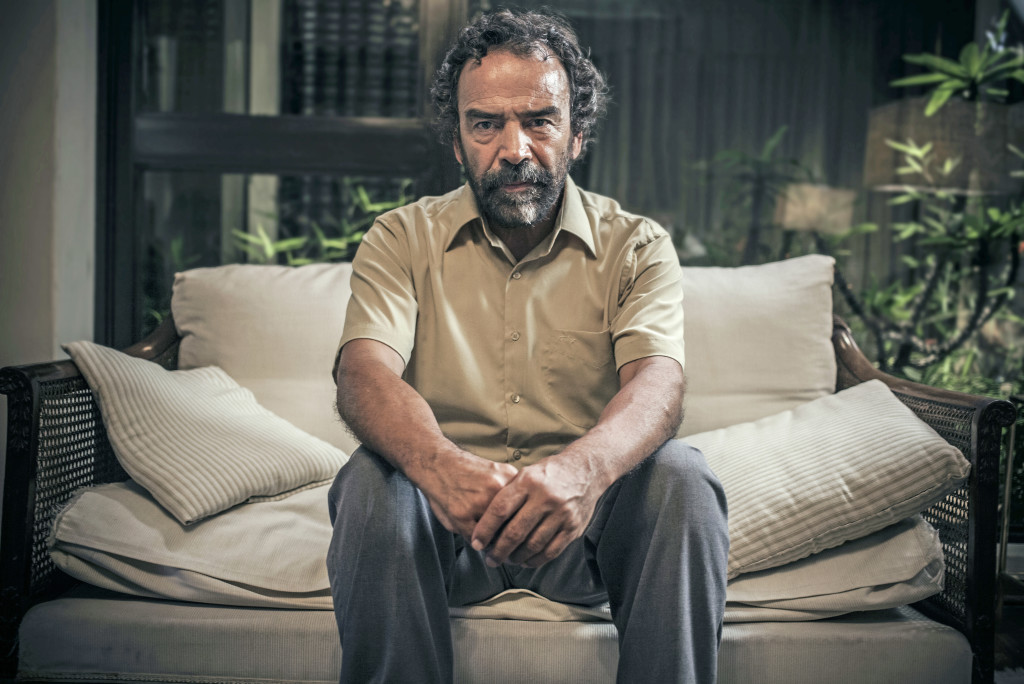
To honor Cinequest, my stream of the week is a remarkable drama from the 2016 Cinequest. The title character in the Peruvian psychological drama Magallanes is a loser, but is he a lovable loser? Played by Damián Alcázar, Magallanes bounces around from odd job to odd job. He can’t break even driving a borrowed outlaw taxi around the squalid streets of Lima, he lives in a basement hovel and he has one friend. Magallanes glimpses a person from his past, and it rocks him into a series of life-changing events.

Magallanes starts out as a caper movie. But we learn that his one friendship is from his military service in a death squad unit, dispatched to repress the indigenous population with the harshest methods. What this unit did years ago has scarred all the characters (except two snarky cops), and Magallanes is revealed to be a study of PTSD.

What is driving Magallanes’ behavior in this story? We find that he is trying to right a past wrong. But what? And by whom? The revelation in Magallanes is that some wrongs cannot be righted.

Magallanes is a showcase for Mexican actor Alcázar, whom U.S. art house audiences saw in John Sayles’ Men with Guns and as the lead in Herod’s Law. Alcázar makes Magallanes so sympathetic that the movie’s climax is jarring and emotionally powerful.

Magallanes can be streamed from iTunes, YouTube and Google Play.