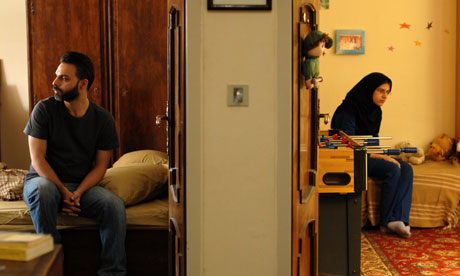
George Clooney and Shailene Woodley in THE DESCENDANTS
The best films in theaters are the magical silent romance The Artist, Director Alexander Payne’s (Sideways) family drama The Descendants with George Clooney, Martin Scorsese’s revelatory 3D tale Hugo, the rockem sockem thriller The Girl with the Dragon Tattoo, and the searing and brilliantly constructed Iranian drama A Separation.
I have also commented onSteven Spielberg’s War Horse, the sex addiction drama Shame, the biopic The Iron Lady, the very odd fable Albert Nobbs, the feminist action thriller Haywire and Ralph Fiennes’ contemporary adaption of Shakespeare’s Coriolanus.
The actor Ralph Fiennes directs and stars in Shakespeare’s Coriolanus. The title character is a fierce and successful military leader upon whom is thrust political leadership that he has not aspired to and to which he is utterly ill-equipped. It’s not going to end well, and that’s why they call it tragedy.
Coriolanus is devoted to the idea of Rome, which inspires his heroism in its defense. But he despises most Romans and thinks it would be insincere to show them the least civility, which doesn’t bode well for his political career. Fiennes does a good job playing Coriolanus, an oddball for whom “curmudgeon” doesn’t begin to tell the story.
Unfortunately, Coriolanus is propelled into the peacetime limelight by his ultra-ambitious mother (Vanessa Redgrave) and an able and well-meaning politician (Brian Cox). Redgrave and Cox are splendid, and their performances are highlights of Coriolanus. Coriolanus is well-acted, including by Jessica Chastain, the wonderful Irish actor James Nesbitt and even, surprisingly, Gerard Butler.
Fiennes the director has done well to set Shakespeare’s tale of ancient Rome into the present. This story of war and politics comes alive in today’s world of cable television news, with its crawling captions and pundits, protest demonstrations and soldiers in Humvees. By stripping away the swords and togas, Fiennes helps us recognize the ambition, personal stubbornness, political treachery and the fickleness of public opinion at the core of the story. As Shakespeare probably wanted to, Fiennes is able to put his audience into realistic warfare. Coriolanus was filmed in the Balkans and, indeed, Butler certainly looks like a Serbian warlord from the very recent past.
The problem with Coriolanus is that we admire Coriolanus’s high-mindedness less than we cringe at his social obtuseness. But Fiennes (and Redgrave and Cox) have given us one of the best cinematic adaptations of Shakespeare.
Drive is a movie that you haven’t seen before – a stylishly violent noir tale unfolding on a brilliantly filmed canvas.
Ryan Gosling stars as a stunt driver by day, criminal getaway driver by night. He hardly talks and doesn’t emote. Indeed, his character is listed in the credits as “Driver” and sometimes referred to in the dialogue as “The Kid”. He is motivated only by his pursuit of adrenaline rushes and the opportunity to do something good for a vulnerable mom (Carey Mulligan). Indeed, Gosling is superb.
But the real star of Drive is its Danish writer-director, Nicolas Winding Refn. The film has a noir plot but Refn eschews the shadowy black and white of traditional noir for especially vivid scenes of Los Angeles. For example, early in the film, Gosling enters a convenience store and the screen is filled with the garish colors of junk food packaging. It’s one of the most artfully lit and photographed scenes in the last year.
Drive abounds in nice touches. While being hunted by the cops, Gosling’s driver is listening to both the police scanner and a radio broadcast of the Lakers game; unexpectedly, it turns out that there is an essential reason that he’s listening to the Lakers.
This movie contains some extreme violence – violence that is intentionally extreme for its effect.
The cast is excellent, with especially memorable turns by Albert Brooks, Bryan Cranston (Breaking Bad) and Oscar Isaac.
(I admired Refn’s 2008 Bronson, the story of a Britain’s “most dangerous convict” who parlayed a seven-year sentence into 34 years (30 of them in solitary) by repeatedly taking hostages and beating up the SWAT teams that rescue them. Roger Ebert called Bronson “92 minutes of rage”.)
Drive has been nominated for the Sound Editing Oscar (but is up against some tough competition).
If you’re going to celebrate Valentine’s Day with a romantic movie tonight, I recommend the magical romance The Artist.
Although they are excellent films, tonight I would avoid the two films of marital breakdown, The Descendants and A Separation. You don’t want to kill the mood.
Or you could stream Franco Zefferelli’s 1968 Romeo and Juliet, with its ultra romantic score by Nino Rota. It’s an exceptionally beautiful film, which won Oscars for cinematography and costume design.
Some of the year’s very best films are in theaters now. I especially recommend these four:
The Artist: A magical romance given us through the highly original choice of an almost silent film.
The Descendants: Director Alexander Payne’s (Sideways) family drama is set in Hawaii and contains a brilliant performance by George Clooney.
Hugo, Martin Scorsese’s revelatory 3D tale of an orphan living in the bowels of a 1920s Paris train station who strives to survive by his wits, keep his independence and solve the puzzle of an discarded automaton.
I highly recommend A Separation, the searing and brilliantly constructed Iranian drama, but it’s a tough watch. It’s a cinch for the Best Foreign Language Oscar.
Here are my comments on some other current films, the sex addiction drama Shame, the biopic The Iron Lady and the very odd fable Albert Nobbs.
This week’s lightweight pick is the feminist action thriller Haywire. My heavyweight pick is Ralph Fiennes’ very fienne contemporary adaption of Shakespeare’s Coriolanus.
I haven’t yet seen the Denzel Washington spy thriller Safe House, which opens this week. You can read descriptions and view trailers of upcoming films at Movies I’m Looking Forward To.
A contemporary Iranian couple had planned to leave Iran for a better life in the West, but, by the time they have wrangled a visa from the bureaucracy, the husband’s father has developed Alzheimer’s. The husband refuses to leave his father and the wife leaves the home in protest. They are well-educated and secular. The husband hires a poor and religious woman to care for his father (and she does not tell her husband about her job). Then there is an incident which unravels the lives of both families.
This is a brilliant film. Writer-director Asghar Farhadi has constructed a story in which the audience sees and hears everything that happens, but our understanding of the events and characters evolve. We think we know what has happened, but then other narratives are revealed. Likewise, the moral high ground is passed from one character to another and to another. It’s like Rashomon, but with the audience keeping a single point of view.
Much of that point of view is shared by the ever watchful teenage daughter of the educated couple. She desperately wants her parents back together, views everything through this prism and is powerless to make it happen. She is played by Farhadi’s real life daughter.
Religion towers above the action – and not in a good way. It guides the actions of the religious couple into choices against their interest. The Iranian theocracy restricts the choices of the secular couple and of the judges trying to sort everything out. Almost every character is a good person who is forced to lie to avoid some horrific result otherwise required by the culture.
One final note: it will be a lot harder to make an easy joke at the expense of American lawyers after watching the Iranian justice system in A Separation.
The realistic angst of the chapters makes this a difficult film to watch – not a light date movie for sure. But the payoff is worth it, and it’s a must see.
This film is on the top ten list of over 30 critics and is Roger Ebert’s top-rated film of 2011. It is a lead pipe cinch for the Foreign Language Picture Oscar.
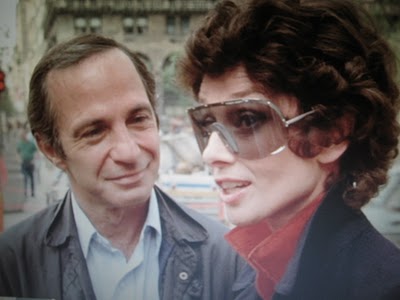
Farewell to actor Ben Gazzara, dead at 81. Cinephiles point to Gazzara’s work in groundbreaking two John Cassavetes films, Husbands and The Killing of a Chinese Bookie. Most Baby Boomers first saw him as the star of the 60s TV series Run for Your Life. Along the way he was married to Janice Rule and had an affair with Audrey Hepburn.
Although I’m a big fan of Gazzara in Chinese Bookie and Peter Bogdanovich’s Saint Jack, I immediately thought of the Coolest Movie Character Ever, John Russo in Peter Bogdanovich’s They All Laughed. Despite being a middle-aged guy with a receding hairline, John Russo is a streetwise private detective who is adored by his tween daughters and can disarm any woman with a glance and a smile. For my money, John Russo is right up there with Bogart’s Rick Blaine and the coolest Mitchum and Clooney characters.
And here’s a tidbit about his performance in They All Laughed. According to the New York Times, Gazzara “I was in a depression during the whole shooting, and I was terrific in that film,” he said. “And I don’t remember doing it.”
There are two reasons to see Pina 3D – to watch modern dance and to marvel at the use of 3D in a dance film. This documentary shows the work of the late German choreographer Pina Bausch performed by her dance troupe; it’s at least 90% dance performance.
But the singular feature of the film is director Wim Wenders’ use of 3D – the movie audience is transported on to the stage with and among the dancers. It’s been easy to dismiss 3D with all the crap 3D product out there, but master directors like Martin Scorsese (Hugo) and Werner Herzog (Cave of Forgotten Dreams) can use the technology to make a film even more brilliant. Wenders (Paris Texas, Wings of Desire) does that with Pina.
Now, if you don’t like modern dance, you’re not going to like this movie. But, if you do, you should catch this film during the week or two that it will be out in theaters in Real 3D; I’m not going to recommend it in 2D unless you’re a huge dance fan.
This good-hearted documentary is about a national champion high school stage band in the 1970s. Because of the era, and because we’re talking about inner city Black kids from Houston, the backdrop is the Black Pride movement. The key character is their band leader, Conrad “Prof” Johnson, who drove them to be technically proficient and flavored their music with his own funk compositions. Thirty years later, the band members plan a reunion to honor Prof. The band members are an entertaining bunch, and there’s plenty of footage from the 70s. Thunder Soul is sure to be a crowd-pleaser and there are lots of great 70s Afros.
Thunder Soul won film fest awards but failed to get an adequate theatrical release, and is now available on DVD.
Imagine if Michael Moore directed a profile of Mitt Romney’s career as co-founder of Bain Capital. Well, the 28-minute short film When Mitt Romney Comes to Town is an even more devastating critique of Romney than a Moore film would be.
The storyline of When Mitt Romney Comes to Town is essentially 1) you are happily living in Middle America, working in a factory and paying your mortgage and your taxes; 2) Mitt Romney’s Bain Capital buys and then loots your company; 3) you lose your job and then your home; and 4) repeat several times.
Amazingly, the film was directed by Jason Killian Meath, a Republican media consultant and culture warrior. It is being shilled by a Newt Gingrich-friendly SuperPAC.
Meath’s film is heavy-handed and manipulative (as a Michael Moore film would be). Meath doesn’t have Moore’s sense of humor, but also doesn’t have Moore’s abrasiveness and self-righteousness, which makes his film smoother, more broadly accessible and ultimately more persuausive. In an appeal to Republican primary voters, Meath uses Reaganesque “Morning in America” music and imagery, and I don’t think that it’s an accident that most of Bain Capital’s victims in the film are White.
The oddest thing about When Mitt Romney Comes to Town is that it is not just an attack on Mitt Romney, but against the type of Vulture Capitalism tolerated or even promoted by all four of the current Republican presidential candidates. It’s sure to constitute a major thread of the Obama narrative against Romney or any other GOP candidate.