The new comedy She’s Funny That Way from 75-year-old master filmmaker Peter Bogdanovich is a light-hearted diversion about the unlikely career path of an escort-turned-screen actress (Imogene Poots). Bogdanovich is responsible for the screwball comedy masterpiece What’s Up Doc? and the grossly under-rated comedy romance They All Laughed. So he knows knows how to choreograph mad cap moments. There’s also an unexpected cameo at the very end, along with very funny end credits.
Along with Poots, Bogdanovich has attracted a top tier cast: Owen Wilson, Rhys Ifans, Will Forte and Kathryn Hahn. It’s especially welcome to see survivors of Bogdanovich’s 1970s oeuvre – Cybill Shepherd, Tatum O’Neal and Austin Pendleton.
But the real revelation here – and the main reason to see the movie – is Jennifer Aniston’s turn as the most emotionally unhealthy therapist conceivable. It’s written as an extreme character – absolutely no boundaries, utterly self-absorbed, dangerously resentful and completely unprofessional. But Aniston’s performance is so full throttle that the audience delights every time her character comes on-screen.
She’s Funny That Way is just fluff, but it’s well-crafted fluff. It’s is now available to stream from Amazon Instant Video, Vudu, YouTube and Google Play.
The Mill Valley Film Festivalalways showcases many of the most promising prestige films that are scheduled for release during Award Season. It’s the best opportunity for Bay Area film goers to catch an early look at the Big Movies. Last year’s fest featured an array of Oscar winners and Oscar-nominated films: The Imitation Game, Whiplash, Wild, Foxcatcher, Mr. Turner and Two Days, One Night, along with Force Majeure, which made it on my Best Movies of 2014 list.
Again this year, the film fest is especially rich with Oscar bait:
Bridge of Spies – Steven Spielberg’s espionage thriller with Tom Hanks;
Carol – fest favorite about lesbian awakening with Rooney Mara and Cate Blanchett;
Dheepan – the French immigration thriller that won the Palm d’Or at Cannes;
The Danish Girl – Eddie Redmayne portrays one of the recipients of gender reassignment surgery;
Son of Saul – the Hungarian movie about Auschwitz that stunned critics, both for its intense brilliance and for the discomfort in watching it;
Suffragette – Carey Mulligan wins women the vote; and
The Assassin– an especially epic Chinese costume epic.
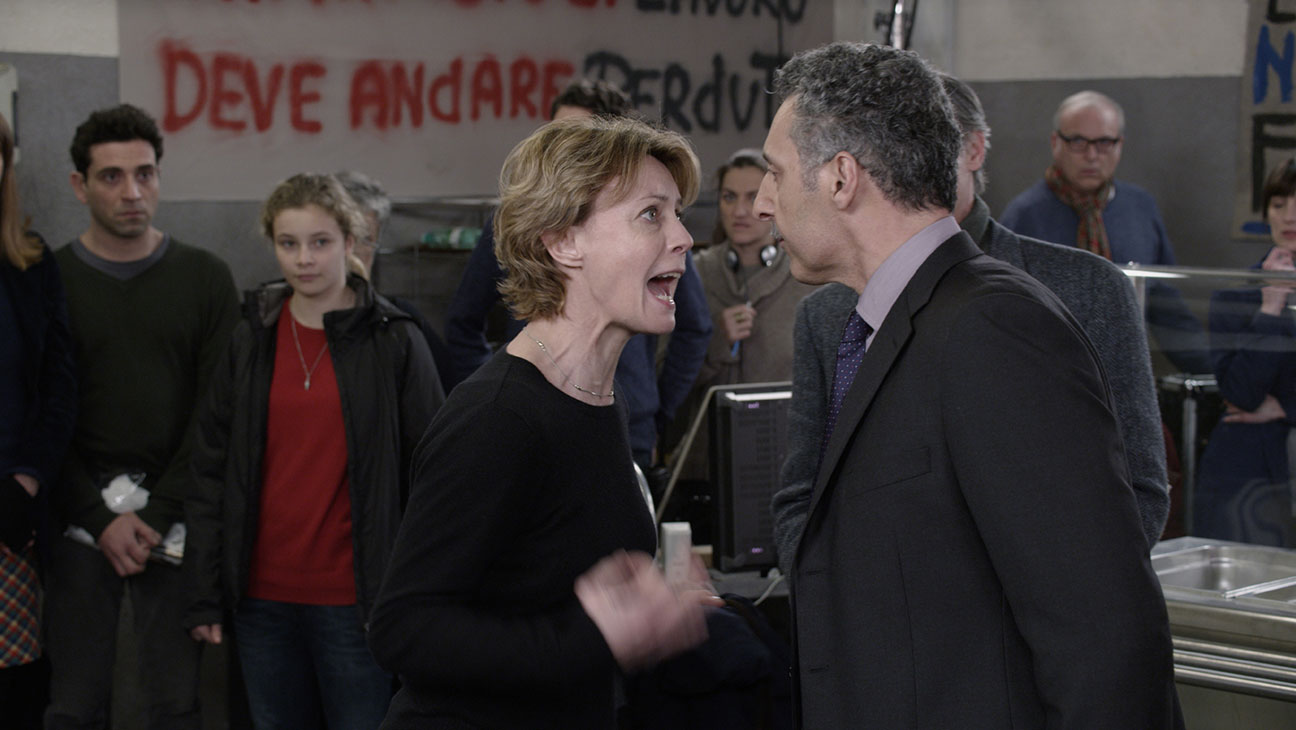
I’m especially looking forward to My Mother from Italy, about a film director who is simultaneously dealing with her dying mother, challenging teenager and hilariously pompous leading man (John Turturro). I’m also eager to see I Smile Back – Sarah Silverman has been getting buzz for a reportedly searing performance as an alcoholic.
Those are the Big Movies, but there’s also a promising assortment of the indies, foreign flicks and documentaries that I usually cover. Here’s the schedule.
The fest runs October 8-18 in Mill Valley, San Rafael and Corte Madera. Tickets are now available to members and will go on sale to the public on September 19.
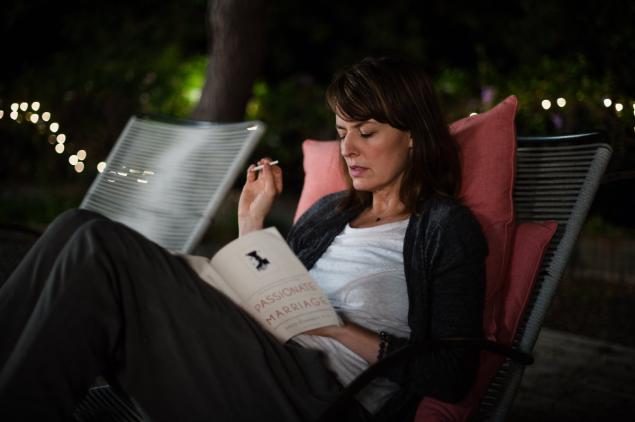
The romantic comedy Digging for Fire is a reflection on that moment when two people who have loved each other have become so consumed by day-to-day child rearing that they have lost heir way as a couple. She’s (Rosemarie DeWitt) fed up and drops the three-year-old with her parents, hoping for a wild weekend with girlfriends while he (Jake Johnson) does the taxes. Of course, he invites his guy buddies over for a bro-bacchanal. Things don’t go exactly as planned for either of them, and their separate weekends morph into adventures that challenge their marriage and trigger some self-examination.
Writer-director Joe Swanberg has a gift for creating characters that act like real people – and NOT like they know they are characters in a romantic comedy. Swanberg created the 2013 Drinking Buddies, a film I found to be “an unusually genuine romantic comedy” and the first Mumblecore movie that I’ve ever liked.
DeWitt and Johnson are very good, and Brie Larson is outstanding as a good time girl who is more – and looking for more – than she seems. Digging for Fire also features Anna Kendrick (against type as an uninhibited party girl) and Sam Rockwell (who has made playing an unreliable character into its own art form). We also see almost everyone who has been in an independent film: Mike Birbiglia, Chris Messina, Melanie Lynsky, Sam Elliott, Judith Light and Jane Adams. Orlando Bloom even drops in as a boor at a bar (albeit an upscale bar).
Two thing for sure: Joe Swanberg’s characters are never predictable and he is definitely a romantic. Digging for Fire is available for streaming from Amazon, Vudu, You Tube and Google Play.
Love & Mercy, the emotionally powerful biopic of the Beach Boys’ Brian Wilson, is the true life story of an extraordinarily gifted person facing three monsters. Wilson is a musical genius, one of the great songwriting, arranging and producing talents of his century. But his art and his very survival were tested by his tormentors until unselfish love found him an escape to treatment, and, ultimately, his salvation.
In his first feature as a director, veteran producer Bill Pohlad chose to depict two phases of Wilson’s life, with Wilson played by Paul Dano and John Cusack.
The first monster is Wilson’s father Murry (Bill Camp), an abusive father whose adult sons still fear after they have fired him as their manager. What kind of father needs to belittle and sabotage his sons so he doesn’t have to acknowledge that their success surpasses his own? Brian Wilson is deaf in one ear from his father’s punches, but the psychological scars are even more deeply felt.
The second monster is Brian’s own schizoid affective disorder, a condition causing auditory hallucinations. Brilliantly, Pohlad has chosen to let the audience hear what Brian hears. This can be thrilling in moments of musical inspiration. And, of course, it is terrifying most of the time.
The third monster is charlatan psychologist Dr. Eugene Landy (Paul Giamatti), a Svengali-like manipulator, who over-medicates Brian, then confines him, while controlling and watching his every move. Landy leeches off Brian’s fortune and is ruthlessly protective of his racket.
Murry and Landy are so scary that Beach Boy Mike Love, known to be (and portrayed here as) a colossal jerk, almost seems sympathetic by comparison.
In the younger Dano segments, we see Brian at his creative peak, emotionally tortured by Murry and about to be driven into a breakdown by his condition. In the middle-aged Cusack parts, we see Brian, broken down by his illness, utterly helpless against and captive to Landy’s web of control.
Dano shows us Brian’s vulnerable genius. Cusack shows us Brian as gentle and genuine. The story of Love & Mercy is about how he escapes being under the thumb of his monsters, chiefly from the perspective of Melinda Ledbetter (Elizabeth Banks), the woman who would become his second wife. As good as are Dano and Cusack, Banks is absolutely stellar; her character must continually react to the unpredictability of Brian’s illness and the increasing horror of Landy’s tyranny.
From the beginning, Love & Mercy sweeps us up into the highs and lows of Brian Wilson’s life – and it’s a helluva life. Love & Mercy is one of the Best Movies of 2015 – So Far. Watch the end credits all the way to the end.
Love & Mercy is available on DVD from Netflix and Redbox and streaming from Amazon Instant Video, iTunes and Vudu.
The German psychological drama Phoenix is taut, intense and has a superb ending – surprising and satisfying. Phoenix may only be in theaters for another week or so.
Going Clear: The Prison of Belief, documentarian Alex Gibney’s devastating expose of Scientology, originally shown on HBO in April, is now in theaters.
Other possibilities:
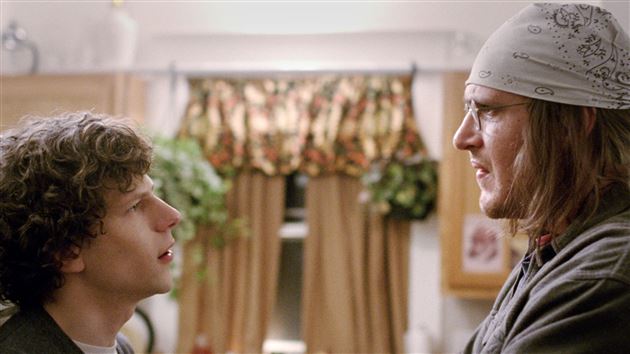
The End of the Tour is the smartest road trip movie ever, starring Jason Segel and Jesse Eisenberg. Be sure to see it. It’s the only movie on my list of Best Movies of 2015 – So Far that’s currently playing in theaters.
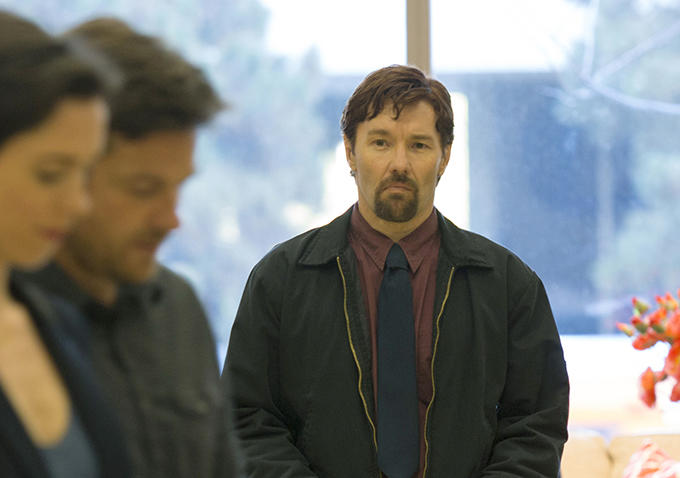
Joel Edgerton’s The Giftis a satisfying thriller – and much more.
In Mr. Holmes, Ian McKellen is superb as the aged Sherlock Holmes, re-opening his final case.
My Stream of the Week is I’ll See You In My Dreams, available to stream from Amazon Instant Video, iTunes, Vudu, YouTube and Google Play.
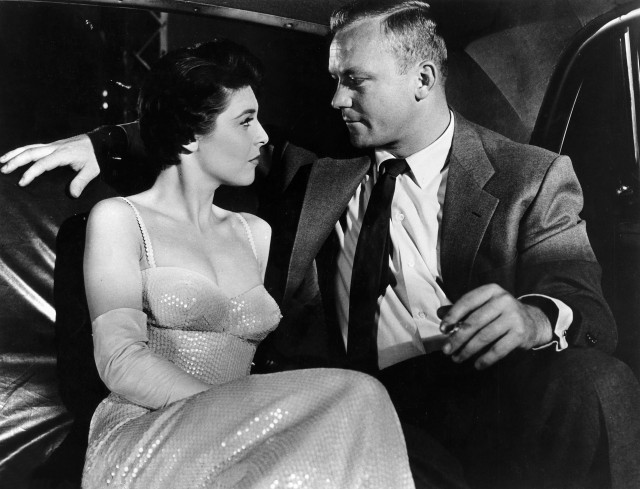
On September 17, don’t miss the Turner Classic Movies cablecast of the classic film noirNightfall (1956). Aldo Ray plays a hard luck guy who is framed and hunted by both the bad guys and the cops when he meets a beautiful but broke model (Anne Bancroft). It’s a crackerjack plot, and the final confrontation involves death by snow plow. Nightfall is one of my Overlooked Noir.
Sam Elliiott and Blythe Danner in I’LL SEE YOU IN MY DREAMS
The gentle, thoughtful and altogether fresh dramedy I’ll See You in My Dreams is centered on 72-year-old Carol (Blythe Danner), a widow of 21 years living a life of benign routine. Every day, she rises at 6 AM in her modest but nicely appointed LA house, reads by the pool, hosts her gal pals from the nearby retirement community for cards and is in bed by 11 PM to watch TV with her elderly canine companion. It’s not a bad life, but it’s an unadventuresome one.
Then some things happen that give her an opportunity to choose to take some chances. In short order, she has to put down her dog and deal with an unwelcome rodent. Her friends (Rhea Perlman, June Squibb and Mary Kay Place) suggest that she try speed dating. She opens her social life, developing a friendship with a much younger man (Martin Starr – Gilfoyle in Silicon Valley) and being courted by a dashing man of her own age (Sam Elliott).
What happens is sometimes funny, sometimes sad and always authentic. This is NOT a formulaic geezer comedy, but a story about venturing outside one’s comfort zone – with all the attendant vulnerability – to seek some life rewards. Carol may be 72, but she is still at a place in her life where she can grow and be challenged. I’ll See You in My Dreams proves that coming of age films are not just for the young.
I saw I’ll See You in My Dreams at the Camera Cinema Club, at which director, editor and co-writer Brett Haley was interviewed. Haley said that he and co-writer Marc Basch wanted to “avoid the obvious joke of older people doing what younger people do”. Instead, they intended to make a movie “about love, loss and that you can’t get through life unscathed – and that’s okay”. Haley and Basch certainly succeeded in creating a film about “living life without the fear of loss”.
Danner sparkles in the role (and gets to nail a karaoke rendition of Cry Me a River). Always special when playing solid-valued but rascally guys, Elliott still retains his magnetism.
We don’t often get to see realistic movies about people in their early 70s, but I’ll See You in My Dreams respects its protagonist Carol by putting her in plausible situations. Neither farcical nor mawkish, I’ll See You in My Dreams is a surefire audience pleaser.
I’ll See You in My Dreams is available to stream from Amazon Instant Video, iTunes, Vudu, YouTube and Google Play.
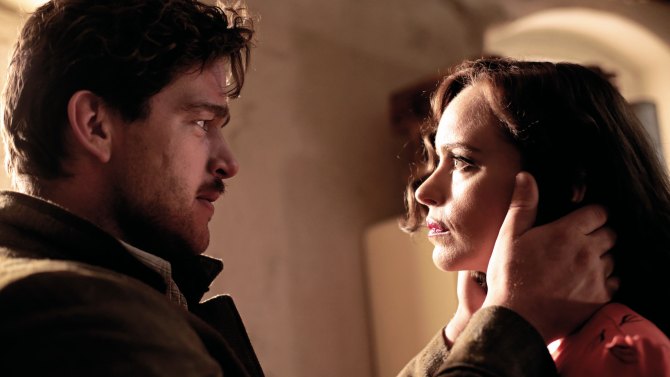
In the German psychological drama Phoenix, Nina Hoss plays Nelly, an Auschwitz survivor whose face has been destroyed by a Nazi gunshot; her sister has arranged for plastic surgery to reconstruct her face. When Nelly gets her new face, we accompany her on an intense quest.
Writer-director Christian Petzhold is an economical story-teller, respectful of the audience’s intelligence. Watching a border guard’s reaction to her disfigurement and hearing snippets from the sister and the plastic surgeon, we gradually piece together her back story. The doctor asks what seems like a very good question – Why would a Jewish woman successfully rooted in London return to Germany in 1938? The answer to that question involves a Woman Loving Too Much.
The sister plans to re-settle both of them in Israel, but Nelly is obsessed with finding her husband. She does find her husband, who firmly believes that Nelly is dead. But he notes that the post-surgery Nelly resembles his pre-war wife, and he has a reason to have her impersonate the real Nelly. So he has the real Nelly (who he doesn’t think IS the real Nelly) pretending to be herself. It’s kind of a reverse version of The Return of Martin Guerre.
It’s the ultimate masquerade. How would you feel while listening to your spouse describe you in detail to a stranger?
Nina Hoss is an uncommonly gifted actress. Here she acts with her face fully bandaged for the first third of the film. We ache for her Nelly’s obsessive need for her husband – and when she finally finds him, but she still doesn’t really have him.
As the husband, Ronald Zehfeld shows us the magnetism that attracts Nina, along with the brusque purposefulness that he thinks he needs to survive and flourish in the post-war Germany.
Christian Petzold and Nina Hoss collaborated on the recent film Barbara (he won the Berlin Film Festival’s Silver Bear for his work). About Barbara, I wrote
“Given that’s it difficult to imagine how anyone else could have improved Barbara, I’ll be looking for Petzold’s next movie.”
Well, here it is, and it’s gripping.
The ending of the film is both surprising and satisfying. Several people in my audience let out an audible “Wow!” at the same time.
Jesse Eisenberg and Jason Segel in THE END OF THE TOUR
Summer is winding down, and we’ll soon see some good September releases (I’ll soon be writing about Meet the Patels and 99 Homes). The prestige releases will start rolling out in October, but in the meantime, I suggest that you make a special effort to see The End of the Tour, which may only be available in theaters for another week or so. Here are all three of my suggestions.
The End of the Tour is the smartest road trip movie ever, starring Jason Segel and Jesse Eisenberg. Be sure to see it. It’s the only movie on my list of Best Movies of 2015 – So Far that’s currently playing in theaters.
Joel Edgerton’s The Giftis a satisfying thriller – and much more.
In Mr. Holmes, Ian McKellen is superb as the aged Sherlock Holmes, re-opening his final case.
No new DVD/Stream of the Week this week, but I recently featured:
Ex Machina, another of my Best Movies of 2015 – So Far. It’s available on DVD from both Netflix and Redbox and streaming from Amazon Instant Video, iTunes, Vudu, YouTube, Google Play and Xbox Video.
The Oscar-winning The Secret in Their Eyes. It’s available on DVD from Netflix and streaming from Amazon Instant Video, iTunes, Vudu, YouTube, Google Play, Xbox Video and Flixster.
The startling documentary Art and Craft, available on DVD from Netflix and streaming on Amazon Instant Video, iTunes, Vudu, YouTube, Google Play and Xbox Video.
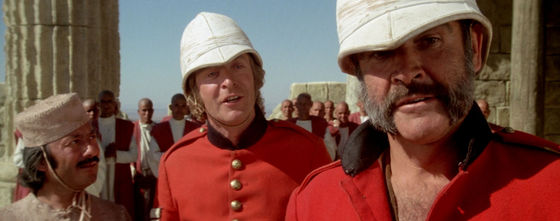
Turner Classic Movies is playing the unforgettable The Man Who Would Be King (1975) on September 8. Sean Connery and Michael Caine star as two vagabond British soldiers adventuring in colonial India when one of them is mistaken for a god by the indigenous people. They play the misunderstanding into a kingdom – until hubris, greed and lust causes them to reach a little too high. It’s a great story, well told by director John Huston. Connery and Caine are wonderful.
Michael Caine and Sean Connery in THE MAN WHO WOULD BE KING
My DVD/Streams of the Week are Cockfighterand Two-Lane Blacktop, with unforgettable performances by Warren Oates. There’s a Criterion Collection DVD for Two-Lane Blacktop, which is available from Netflix. You can stream Cockfighter on Amazon Instant Video.
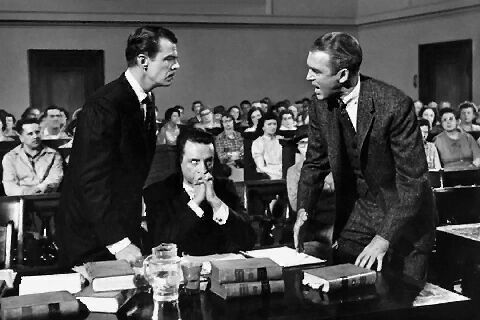
On August 29, Turner Classic Movies presents the Otto Preminger masterpiece Anatomy of a Murder (1959). This movie has everything: Jimmy Stewart’s portrayal of a wily lawyer, content to underachieve in the countryside, Stewart’s electrifying courtroom face off with George C. Scott, great performances by a surly Ben Gazzara and a slutty Lee Remick, a great jazz score by Duke Ellington and a suitably cynical noir ending.
On September 3 on TCM, we meet Robert Young as one of cinema’s least sympathetic protagonists in They Won’t Believe Me(1947). A decade before Father Know Best and two decades before Marcus Welby, M.D., Young plays a weak-willed and impulsive gold-digging womanizer. He’s married for money, but he also wants his girlfriend (the rapturous Jane Greer) AND his second girlfriend (a gloriously slutty Susan Hayward) AND his wife’s money. He’s making every conceivable bad choice until, WHAM BANG, circumstance creates a situation where he can get everything he wants …until it all falls apart. They Won’t Believe Me has one of the most ironic endings in the movies.
James Stewart (right) and George C. Scott (seated) tangle in ANATOMY OF A MURDER
Lola Kirke (right) with the always annoying Greta Gerwig in MISTRESS AMERICA
In director Noah Baumbach’s failed comedy Mistress America, an insecure young college student meets her step-sister-to-be (Greta Gerwig), who turns out to be a human whirlwind, dancing on the razor’s edge between frantic excitement and chaos. The premise of an unsure young person becoming captivated by a high energy and charismatic personality is an interesting one. Unfortunately, the movie fizzles because of the shipwreck of a screenplay (co-written by Baumbach and Gerwig) and another aggravating performance by Gerwig.
In the first half of the film NOT ONE WORD seems genuine, like a real character would have uttered it. Mistress America’s worst misfire is the extended screwball sequence at a house in Connecticut – the cast is just flinging the lines as if in a high school play (until a really good actor, Michael Chernus, shows up as a real character).
No actor could save this screenplay, but Greta Gerwig has the gift of making any movie worse and she does here, too. Gerwig plays the same character in every move because she thinks it’s Cute Kooky like Annie Hall. But she’s neither cute nor kooky – just annoying to the point of loathsomeness. Here, her character is a goofy-clumsy social loser, but just so Smart and Wonderful that she uses words like “autodidact” and “my nemesis”. Gerwig tries to be knowing and ironic, but she’s just cringeworthy, the most embarrassing moment coming when her character explains her own jokey “pretend rewind” gesture.
After the screening, another audience member said that Gerwig’s character is obviously not functional because of a bipolar disorder. Well, I’ll bet that Gerwig didn’t think that her character was ill – just charmingly idiosyncratic.
The other lead is played by Lola Kirke, who is pretty engaging; I’d like to see her acting with a real script. There’s also excellent acting by the veteran Chernus (Higher Ground, Men in Black 3, Captain Phillips, The Messenger, Love & Other Drugs). Jasmine Cephas Jones is stuck in a one-dimensional role as a hyper-jealous girlfriend, but she pulls it off with distinction. Rebecca Henderson is excellent as the bitter woman from Gerwig’s past.
I’m not the audience for Mistress America since I avoid Baumbach and especially Gerwig; I only saw Mistress America because I went to a mystery screening. Now I haven’t liked any Baumbach movie since his initial indie hit The Squid and the Whale in 2005. I have nothing against a naval-gazing filmmaker filling his movie with neurotic New Yorkers. Woody Allen has made over thirty of those and seven or eight are masterpieces. But – as sharp as Woody’s lines are crafted – you believe that this characters have thought them up on their own, not so with Baumbach.
One scene in Mistress America is inspired and true to the characters – a bitter woman confronts the clueless Gerwig character with a grudge from high school. But that wonderful moment isn’t worth the nails-on-the-chalkboard experience of the film as a whole. Skip Mistress America (and any upcoming Baumbach/Gerwig project, too, for that matter).