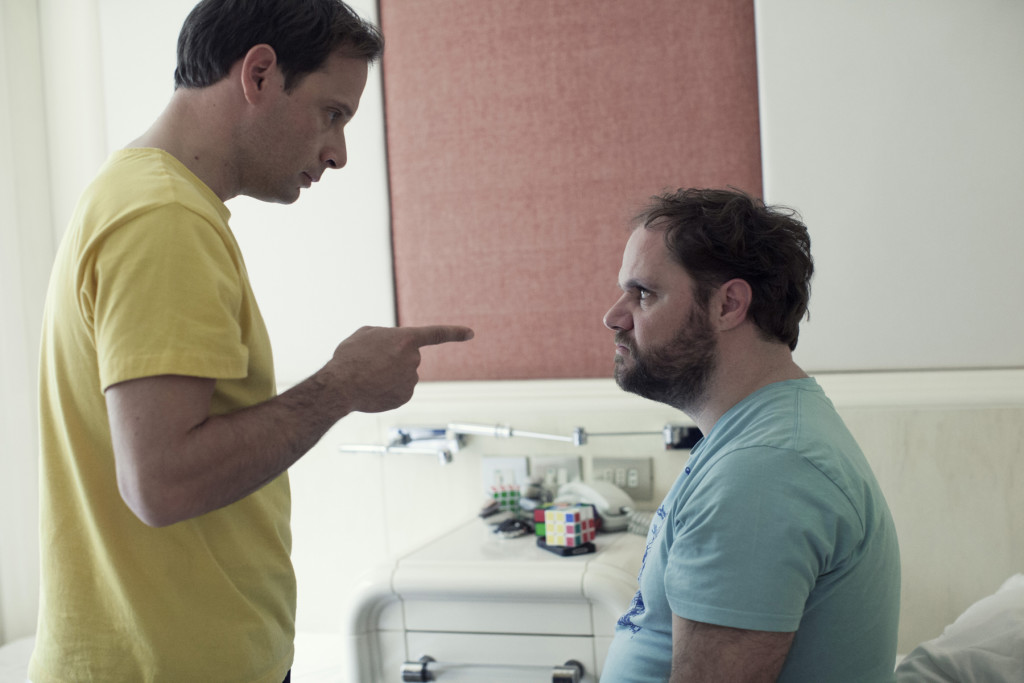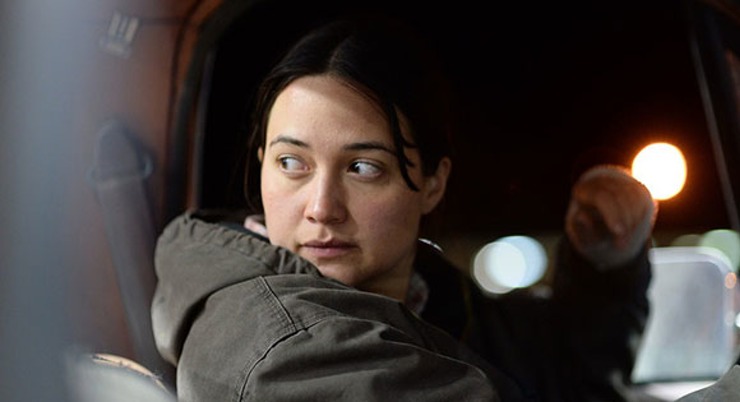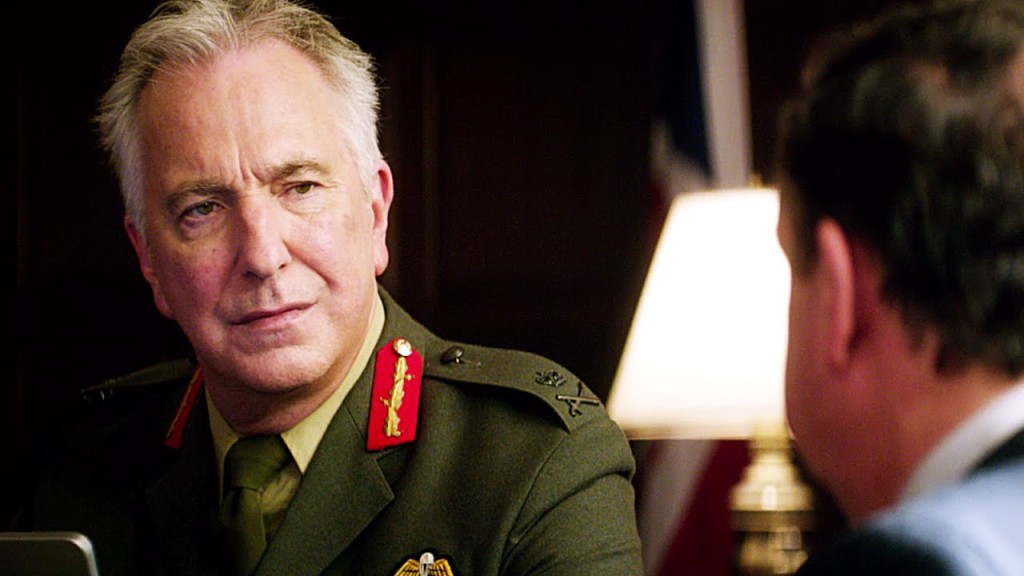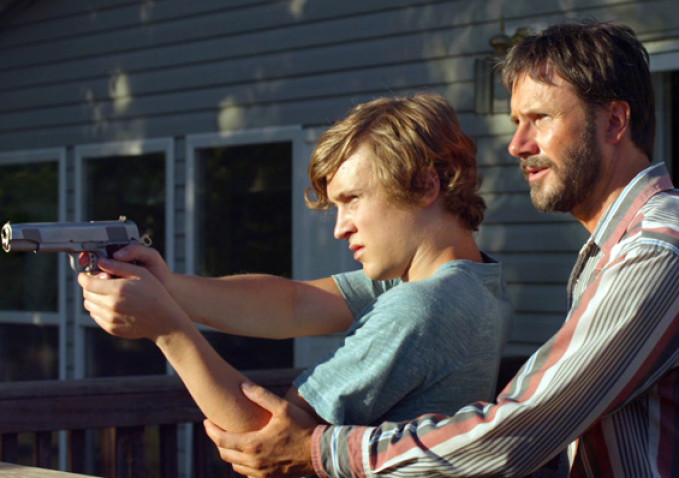
Topping my recommendations is the best movie of the year so far – the character-driven crime drama Hell or High Water. It’s atmospheric, gripping, and packed with superb performances. Hell or High Water is a screenwriting masterpiece by Taylor Sheridan. Must See.
Here are other attractive movie choices:
Really liked the New Zealand teen-geezer adventure dramedy Hunt for the Wilderpeople.
Florence Foster Jenkins is not just a one-joke movie about a bad singer – it’s a love story about trying to protect the one that you love.
I found the documentary about Burt Reynolds and his stuntman/director Hal Needham, The Bandit, very enjoyable; it’s playing on CMT.
Don’t Think Twice is a dramedy set in the world of comedy, another smart, insightful little film by Mike Birbiglia.
Woody Allen’s love triangle comedy Cafe Societyis a well-made and entertaining diversion, but hardly a Must See.
Don’t have an unbridled recommendation for Mia Madre.
My DVD/Stream of the Week is the painfully timely Weiner, one of my Best Movies of 2016 – So Far. Weiner is available on DVD from Netflix and to stream from Amazon Video, iTunes, Vudu, YouTube, Google Play and DirecTV.
Today, Turner Classic Movies airs The Conversation. And coming up on September 12, TCM delivers early Spielberg: The Sugarland Express(1974). White trash anti-heroes (Goldie Hahn and William Atherton) pull off a jail break, but their harebrained scheme evolves into a man-hunt and then a hostage standoff. The wonderfully underused Ben Johnson plays the lawman.
The young Steven Spielberg’s career trajectory as a director began with Duel and a couple of other TV movies, and then The Sugarland Express was his first feature. Right after Sugarland came Jaws and Close Encounters and Raiders and ET and etc. The Sugarland Express was made in that very brief period when big movie studios let auteur directors tell stories that today could only be made as “indies” (like The Conversation, Five Easy Pieces, The Last Picture Show, Taxi Driver, All That Jazz).
Don’t Think Twice is a dramedy set in the world of comedy. Six artists of varying talent have formed an improvisational comedy troupe. They’re scraping by without much affirmation and with no financial success when one of them gets a chance to join the cast of a hit show a la Saturday Night Live. How do they react when only one attains the stardom that they all crave?
The comic Mike Birbiglia wrote and directed Don’t Think Twice about a world that he knows well. Like his previous Sleepwalk with Me, Don’t Think Twice is smart, funny and filled with authentic human reactions.
Here are the questions that Don’t Think Twice explores. When is “following your dream” an excuse for staying comfortable? When is it delusional? When is it an excuse to sabotage your own success? And when does following your dream keep you from following a more promising dream? When do you call it off?
Keegan-Michael Key and Gillian Jacobs flash the best performances, but the entire troupe is watchable. Generously, Birbiglia plays the least sympathetic character himself. Birbiglia, who is in real life a brilliant comic, is up to the challenge of playing someone whose talent just falls short.
Because it is about very funny people who work in comedy, Don’t Think Twice is very witty. It’s also packed with moments of Cringe Humor, and we’re cringing because we’ve seen these behaviors in our own lives. This is another good little movie by Mike Birbiglia.
Friday, September 9, Turner Classic Movies is presenting one of the greatest movies ever – The Conversation (1974). At the height of his powers, Francis Ford Coppola directed The Conversation between The Godfather and The Godfather: Part II, and The Conversation is every bit the masterwork as the others.
In a role just as iconic as in The French Connection, Gene Hackman plays an audio surveillance expert entangled in a morally troubling assignment – and then obsessed. Veteran character actor Allen Garfield is just as good and the irreplaceable John Cazale makes us cringe and ache as always. Look for a very young Harrison Ford and for a glimpse of an uncredited Robert Duvall as a corpse.
The most significant achievement in The Conversation, however, is the groundbreaking sound editing by Walter Murch. After experiencing The Conversation, you’ll never again overlook movie sound editing.
This week’s recommendation couldn’t be any timelier, given Anthony Weiner’s disgraceful collapse into yet another texting scandal, resulting his getting dumped by his wife, Hillary Clinton confidante Huma Abedin. Don’t miss the political documentary Weiner, probably the best documentary of the year. It also provokes some reflection on the media in this age. It’s on my Best Movies of 2016 – So Far.
You may remember Anthony Weiner as the politician forced out of Congress in a sexting scandal. A couple of years later, he tried to make a comeback by running for mayor of New York City. Weiner is the inside story of that campaign, which self-immolated when the sexting scandal popped up again. Weiner is a marvelously entertaining chronicle of the campaign, a character study of Anthony Weiner himself and an almost voyeuristic peek into Weiner’s marriage to another political star, Huma Abedin.
Co-director Josh Kriegman served as Weiner’s Congressional chief of staff and left politics for filmmaking. When Weiner was contemplating the run for mayor, Kriegman asked to shadow him in the campaign, and Weiner agreed. Kriegman and co-director Elyse Steinberg shot 400 hours of backstage footage and caught some searing moments of human folly, triumph and angst.
In office, eight-term New York Congressman Anthony Weiner was a firebrand, pugnacious and a master debater with a vicious sense of humor, always eager to mix it up. He is married to Huma Abedin, a close Hilary Clinton advisor often described as “Hilary’s other daughter”. Huma is as reserved as Anthony is ebullient, and her own distinguished career in politics has been behind the scenes. He lives for the limelight, but she is uncomfortable in it.
Anthony begins his comeback with brutally painful media launch. The press is in a complete feeding frenzy – all revisiting the scandal and nothing else. One of the highlights of Weiner is a montage of talking heads reviling Weiner, including Donald Trump, who bellows, “We don’t want any perverts in New York City”.
But when Anthony goes on the campaign trail, the electorate begins to really respond to his passion and feistiness. Weiner unexpectedly surges into the lead 10 weeks to go. We are treated to a first-class procedural and see what only political pros see – the banal opening of a campaign office, rehearsing speeches, shooting commercials, dialing for dollars.
But then the scandal re-opens when a publicity-seeking bimbo releases a photo of Anthony’s penis that Weiner had texted her. We see his Communications Director as the new scandal unfolds in real-time, her eyes becoming lifeless; my day job for the last thirty years has been in politics, and I have gotten some bad news, but nothing like this.
Amazingly, we see Anthony calling Huma and telling her. When the screenshot of Anthony’s penis shot goes viral, we watch as Hums see it for the first time on the Internet, and her anger builds into rage. Anthony finally kicks out the camera.
New York Post prints headlines like “Weiner: I’ll Stick It Out” and “Obama Beats Weiner”. Anthony tells his shell-shocked and pissed off staff “nobody died”, but nobody’s buying it. Anthony has masterfully redefined himself to be more than the punchline once, but the second set of revelations make him indelibly a punchline – and no one can come back from that. From behind the camera, Kriegman plaintively asks Weiner.”Why did you let me film this?”.
Anthony’s pollster gives him the bad news: “There’s no path anymore to get to a runoff” and “So this is a solo flight”. The smell of death is about the campaign at the end, but Anthony is in “never quit” phase.
Anthony’s best moment is when he is obligated to face a hostile neighborhood meeting in the Bronx neighborhood of City Island. He knows that he is doing poorly there, and there aren’t many voters out there anyway, but he keeps his head high and delivers a courageous effort.
Anthony’s worst moment may be when he is re-watching himself in a mutual evisceration of a TV host on YouTube. He is relishing the combat, but Huma, behind him, is appalled by Anthony’s Pyrrhic victory. He smugly thinks that’s he won the verbal firefight, but Huma just says, “It’s bad”. She’s right.
I saw Weiner at the 59th San Francisco International Film Festival (SFIFF) at a screening with co-directors Josh Kriegman and Elyse Steinberg. Kriegman said that he “intended to show the humanity behind the headline – the nuance that is Anthony”. Steinberg noted that “the most exposed are the least revealed”. As of the SFIFF screening on April 23, Anthony Weiner had to date declined to watch Weiner. In Weiner, Anthony looks back after the campaign and ruefully sums it up, “I lied and I had a funny name”.
Weiner has more than its share of forehead-slapping moments and is often funny and always captivating. It’s almost certainly the year’s best documentary and one of best films of 2016, period. Weiner is available on DVD from Netflix and to stream from Amazon Video, iTunes, Vudu, YouTube, Google Play and DirecTV.
Toby: “You’re talkin’ like you don’t think we’re going to get away with it.”
Tanner: “I never met anyone who got away with anything.”
The character-driven crime drama Hell or High Water is remarkably atmospheric and gripping, and I’ll be putting it at the very top of my Best Movies of 2016 – So Far. As it begins, we think we’re watching a very well-made film about white trash losers on a crime spree, but eventually, as we understand how original the characters are and how intricate the plot is, we understand that we’re watching a triumph of the perfect crime genre – and with an embedded political point of view. Screenwriter Taylor Sheridan, an actor who wrote last year’s Sicario, has proven that he is an artist of uncommon depth.
Director David Mackenzie imbues Hell or High Water with an astonishing sense of time (the present) and place (rural West Texas). The story is set in the dusty flatlands between Lubbock and Wichita Falls (shot just over the border in eastern New Mexico). Mackenzie employs Giles Nuttgens’ cinematography and the music, some composed by Nick Cave, to evoke an environment that is rich in horizons but, except in the bursts of occasional oil booms, dirt poor in every way. He begins Hell or High Water with a 360 degree shot of a bank branch parking lot with a teller sneaking the last cigarette before her shift; the starkness and anonymity of the dying downtown immerses us right where Mackenzie wants us.
It’s a place where people know the difference between Dr. Pepper and Mr. Pibb – and it’s important. It’s also a place where many civilians are gun-totin’, which adds a whole new element to the average bank robbery.
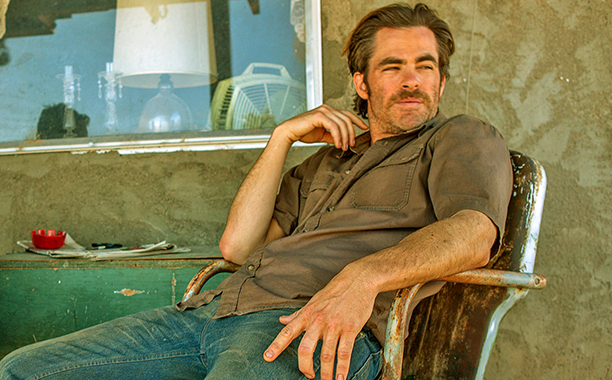
Toby (Chris Pine) and Tanner (Ben Foster) are brothers. Toby is the more complex – both poorly educated and wise. While Toby takes personal responsibility for the bad choices of his youth that have ruined a marriage and left him unable to contribute to the future of his two sons, he appreciates that generational poverty and the economic system have stacked the odds against him. Toby cared for his dying mother and is now committed to making things right for his sons and ex-wife; he is highly moral but he’s not about to follow rules that he sees as unjust. He looks like another unemployed oilfield roughneck, but he’s surprisingly cagey and strategic.
Tanner is the classic lowlife psychopath, whose impulses have always led him into trouble with the law. Asked “How have you stayed out of jail for a year?”, Tanner replies, “It’s been difficult.” He’s also a little smarter and lot more charming than he looks, but it’s clear that he is destined for a bad end.
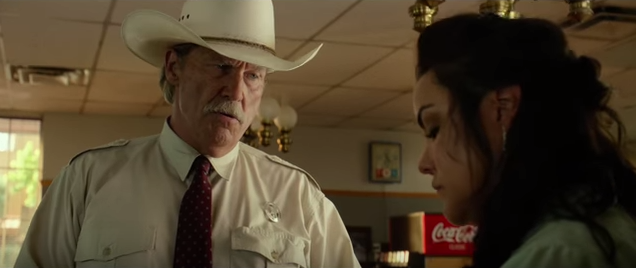
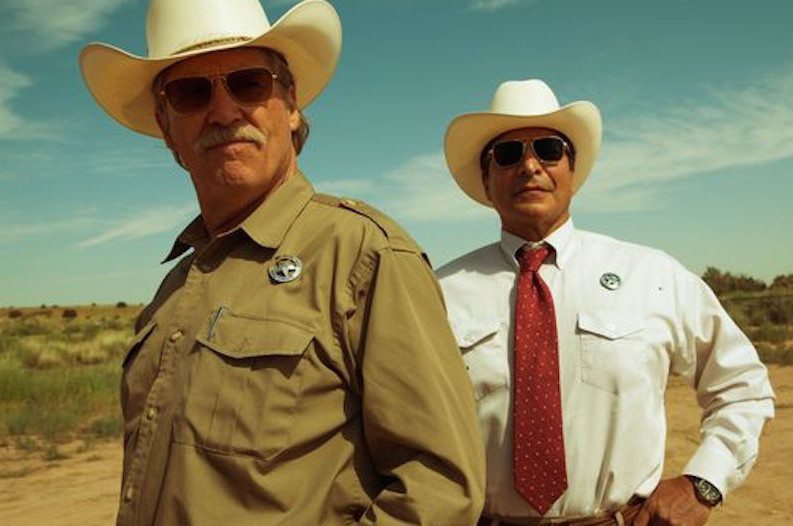
Marcus Hamilton (Jeff Bridges), an aged Texas ranger who is three weeks from retirement, is on the brothers’ trail. Marcus is an astute and unsentimental student of human behavior. Marcus relishes a good whodunit, and the wheels in his mind are always turning. His partner Alberto (Gil Birmingham) offers that, for a happy retirement “you’ll need someone to outsmart”. Indeed, it’s from Marcus, not the brothers themselves, that we learn that the bank robbers are likely raising money for some cause, against some deadline
In Hell or High Water, the banks are the real robbers. Marcus spots a bank manager with “Now this looks like a man who could foreclose on a house”. In the world of Bonnie and Clyde, victims of the Depression lost farms to foreclosure, but many banks failed, too; that movie’s anti-heroes were misfits like Tanner. In the world of Hell or High Water, the game is fixed so that the banks can’t fail, and so banking is just legalized criminality.
Jeff Bridges and Gil Birmingham in HELL OR HIGH WATER
Hell or High Water is exceptionally well-acted. This is the best work so far by Chris Pine (Kirk in Star Trek). Ben Foster, unsurprisingly, nails the Born To Lose character of Tanner. Gil Birmingham (Billy Black in the Twilight movies) is stellar as Marcus’ reflective and long-suffering partner Alberto. Jeff Bridges has matured into a master actor who delivers absolute perfection and makes it look effortless.
And the high quality performances just keep coming throughout Hell or High Water. The film opens with nice turns by Dale Dickey (unforgettable in Winter’s Bone) and veteran Buck Taylor. Marin Ireland is excellent as Toby’s ex-wife, and Margaret Bowman sparks a diner scene as the world’s most authoritarian waitress. Katy Mixon is Oscar-worthy in a role as a waitress who may long for companionship, but really, really needs to keep her tip; I just hope enough people see this movie and experience Mixon’s eyes narrowing and gleaming with resolve.
While Jeff Bridges is reason enough to see Hell or High Water, all of its elements add up to a masterpiece. Not that Chris Pine needs a star-making breakthrough performance, but Hell or High Water certainly proves that he can carry a better movie than Hollywood franchises allow. I’m going to see Hell or High Water again; then I’m going to line up to see Taylor Sheridan’s next film, whatever and whenever that will be.
Meryl Streep and Hugh Grant in FLORENCE FOSTER JENKINS
Traditionally movie-poor August is past, but these are good choices:
Really liked the New Zealand teen-geezer adventure dramedy Hunt for the Wilderpeople.
Florence Foster Jenkins is not just a one-joke movie about a bad singer – it’s a love story about trying to protect the one that you love.
I found the documentary about Burt Reynolds and his stuntman/director Hal Needham, The Bandit, very enjoyable; it’s playing on CMT.
Woody Allen’s love triangle comedy Cafe Societyis a well-made and entertaining diversion, but hardly a Must See.
I haven’t seen them yet, but readers with really good taste have recommended Captain Fantastic and Hell or High Water.
Not an unbridled recommendation for Mia Madre, opening today.
Tonight, Turner Classic Movies airs Robert Redford and Gene Hackman in Director Michael Ritchie’s Downhill Racer. It’s one of the best sports movies ever (Olympic skiing), and it came as all three filmmakers were poised to do some of their greatest work (The Candidate, The Sting, The French Connection).
On September 5, Turner Classic Movies brings us a fantastic comedy, My Man Godfrey (1936). An assembly of eccentric, oblivious, venal and utterly spoiled characters make up a rich Park Avenue family and their hangers-on during the Depression. The kooky daughter (Carole Lombard) brings home a homeless guy (William Powell) to serve as their butler. The contrast between the dignified butler and his wacky employers results in a brilliant screwball comedy that masks searing social criticism that is sharply relevant today. The wonderful character actor Eugene Pallette (who looked and sounded like a bullfrog in a tuxedo) plays the family’s patriarch, who is keenly aware that his wife and kids are completely nuts.
William Powell and Carole Lombard in MY MAN GODFREY
On September 2, Turner Classic Movies is airing 1970’s Downhill Racer, set in the world of competitive Alpine skiing. Robert Redford plays a handsome and talented, but insolent, ski star with daddy issues and a tendency to self-sabotage. As he strives to make the US team, he clashes with the no-nonsense coach (Gene Hackman). Downhill Racer came at a pivotal point in the careers of Redford, Hackman and the director Michael Ritchie.
As a filmmaker, Ritchie was comfortable telling a story without much dialogue – very spare, Hackman’s character is terse, and Redford’s is a sphinx. Redford’s character, especially, is often quietly observed as he goes about his business, emphasizing his self-isolation. The ski races are classic, with soundtrack adorned only with the swishing of the skis and the crunching of the snow.
Downhill Racer remains at the top of the ski movie genre. The great sound is matched by beautiful mountain visuals and groundbreaking camerawork.
To most Americans, alpine skiing was pretty new and sexy in 1970. We had become familiar with the sport through ABC’s Wild World of Sports and the 1968 Olympics, dominated by the handsome Jean-Claude Killy. The sport’s American stars were not from the among the affluent Americans who took ski vacations, but from workaday kids who grew up in the Rockies – just like Redford’s character.
When they made Downhill Racer, the three principals were each at the cusp of stardom. Ritchie had directed lots of TV, but this was his first theatrical feature. He followed it with his masterpiece The Candidate, still the best film ever about American politics. He followed that with work that included The Bad News Bears, Semi-tough, Fletch, The Scout and The Positively True Adventures of the Cheerleader-Murdering Mom; note that, except for Fletch, those films centered on competition in sports and politics.
Redford became well-known for Barefoot in the Park in 1967 and then a huge star with Butch Cassidy and the Sundance Kid (1969). In 1970, he was poised for an amazing run with The Candidate, Jeremiah Johnson, The Way We Were, The Sting, The Great Gatsby, The Great Waldo Pepper, Three Days of the Condor and All the President’s Men – all made in the FIVE years 1972-1976
Gene Hackman had a memorable supporting turn in 1967’s Bonnie and Clyde and then starred in The Gypsy Moths (1969). He made Downhill Racer just before his career exploded with I Never Sang for My Father, The French Connection, The Conversation and his two Oscars.
So let’s get one thing straight right up front – Mia Madre is NOT a dramedy. It’s an Italian drama that is leavened with bits of comedy. Writer-director Nanni Moretti has constructed a deeply personal portrait of a person in mid-career and mid-life who is losing her aged parent. There’s never a convenient moment to go through this experience, and Moretti’s protagonist, a movie director (Margherita Buy), is juggling her job and her relationships with her teen daughter, her ex-husband and her brother (played by Moretti). It’s all very complicated – just like it is in real life, and Moretti brings authenticity to the story.
All of this is pretty somber, but our heroine is making a movie, and she has cast an astonishingly pompous American star (John Turturro) who claims to speak more Italian that he really does and who can’t remember his lines. Every scene with Turturro is hilarious as he bumbles through the filmmaking with shameless bravado.
Nanni Moretti is a gifted filmmaker who has been successful in varied genres. I really enjoyed his comedy We Have a Pope, about a newly elected pope who suffers a panic attack and flees the Vatican. This is more serious stuff. The Wife, who liked it less than I did, refers to it as the “depressing Italian dying mother movie”. I found it very affecting, especially the emotionally satisfying ending.
I saw Mia Madre at the Mill Valley Film Festival in October 2015, but its theatrical release in the bay Area was delayed until this weekend..
Julian Dennison and Sam Neill in HUNT FOR THE WILDERPEOPLE
The Movie Gourmet has been very quiet of late because I’m dealing with a major home remodel and a temporary move, as well as the demands of my day job, which seem to increase during even-numbered years. But I’ll be back in full force by mid-September, just in time for the big prestige movies of 2016. In the meantime:
Really liked the New Zealand teen-geezer adventure dramedy Hunt for the Wilderpeople.
Florence Foster Jenkins is not just a one-joke movie about a bad singer – it’s a love story about trying to protect the one that you love.
I found the documentary about Burt Reynolds and his stuntman/director Hal Needham, The Bandit, very enjoyable; it’s playing on CMT.
Woody Allen’s love triangle comedy Cafe Societyis a well-made and entertaining diversion, but hardly a Must See.
I haven’t seen them yet, but readers with really good taste have recommended Captain Fantastic and Hell or High Water.
On September 1, Turner Classic Movies will be presenting the best work of Preston Sturges, the first workaday Hollywood screenwriter to transition into a major writer-director. TCM will be screening The Lady Eve, Sullivan’s Travels, Hail the Conquering Hero! and The Great McGinty, an impressive body of work that Sturges churned out between the ages of 42 and 46. Unfortunately, his turbulent personality led to conflict in his business affairs, which exacerbated his drinking. He burned out and was dead at age 60, but he left behind some of the very, very smartest and funniest movie comedies.
Veronica Lake and Joel McCrea in SULLIVAN’S TRAVELS
The Japanese domestic drama Our Little Sister is remarkably uplifting. I would seek it out because it’s unlikely to remain in theaters for more than two or three weeks.
Zero Daysis a documentary on a jaw-dropping hacker mystery – who and how was able to get Iranian military computers to destroy the hardware for their own nuclear weapons program.
Really liked the New Zealand teen-geezer adventure dramedy Hunt for the Wilderpeople.
The subversive documentary Under the Sun is a searing insight into totalitarian North Korean society, all from government-approved filming that tells a different story than the wackadoodle dictatorship intended.
Woody Allen’s love triangle comedy Cafe Societyis a well-made and entertaining diversion, but hardly a Must See.
Finding Dory doesn’t have the breakthrough animation or the depth of story that we expect from Pixar, but it won’t be painful to watch a zillion times with your kids.
I’m not writing about Ghostbusters, but I’ve seen it, and it’s not terrible. Kristen Wiig and Melissa McCarthy are brilliant talents, and they produce some laughs in Ghostbusters.
Tomorrow, I’ll be writing about The Bandit, coming up on on CMT tomorrow night.
My DVD/Stream of the week is the hilariously dark Argentine comedy Wild Tales. Writer-director Damián Szifron presents a series of individual stories about revenge. It’s still high my list of Best Movies of 2015 – So Far. It’s now available on DVD from Netflix and streaming from Amazon Instant Video, iTunes, Vudu and Xbox Video.