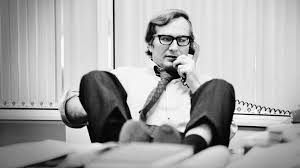
Photo caption: Seymour Hersh in COVER-UP. Courtesy of Netflix.
Cover-Up is a biodoc of the hard-charging investigative journalist Seymour Hersh, who uncovered the My Lai massacre and the Abu Ghraib abuses, and reported on the Nixon-Kissinger secret war in Cambodia and Watergate. These were important stories, and Hersh demonstrated remarkable resourcefulness and determination in his work.
He was a hyper-competitive practitioner of gotcha journalism, who himself was once gotten when duped by a salacious forgery
In Cover-Up, we hear about Hersh’s life and career, chiefly from Hersh himself, so we get a flavor of the man. I thought I was familiar with the My Lai massacre, but we hear about details that emerged after the initial sensation – details that I wish that I still didn’t know.
Today, we have a 24-hour news cycle, publication of gossip and fabrications, facts denied as fake news, media empires that are essentially propaganda, infotainment and so-called news obsession with celebrity. Seymour Hersh is an important figure in an era of journalism – the Woodward and Bernstein Era – that we have have moved past., IMO for the worst So, his story, while a notable episode in US political history during the Vietnam War, just isn’t that relevant today.
Cover-Up, which may interest some Baby Boomers, is streaming on Netflix.
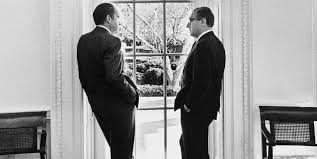
The exceptional American Experience biodoc Kissinger brings a balanced perspective to one of the most visible and important figures in 20th Century US history, Henry Kissinger. It neither canonizes or vilifies Kissinger, but presents a clear-eyed, unsparing look at his career. That’s important, because Kissinger’s genius at public relations may have exceeded his formidable diplomatic skills and distorted his image during his lifetime.
Kissinger is solid, well-sourced history. We hear directly from several former Kissinger staff members with an intimate, inside view of Kissinger the man and his work, We also hear from Kissinger’s son, who adds insightful personal stories about his father. And, of course, we hear and see archival footage of Kissinger himself, although perhaps never candidly. Kissinger is told in two parts over three hours.
Kissinger emerged into American public consciousness seemingly fully-formed in his mid-forties, a Harvard brainiac with a heavy German accent. Kissinger brings us his German childhood, family emigration to the US and the WW II and college experiences that molded him.
Naturally, Kissinger details the two great foreign affairs triumphs of Kissinger’s partnership with President Richard Nixon. First, there was the historic opening of relations with China, a hitherto mysterious and sinister closed society, The story of Nixon’s original idea, of the ping pong diplomacy and Kissinger’s secret trips is still exciting.
Second, once Nixon and Kissinger had established a relationship with China, they had outflanked the Soviet Union. That resulted in detente with the USSR and the SALT negotiations leading to the Anti-Ballistic Missile Treaty, the first limitation of the proliferation of nuclear arms.
These were real, groundbreaking achivements that sprang from Kissinger’s brilliance, but also his sense of realpolitik. He was all about superpower positioning, which he prioritized above other considerations. Along the way, Kissinger found tradeoffs acceptable that had undeniably momentous consequences.
In the decade from 1965 though 1975, American society was torn apart by the Vietnam War. Taking responsibility for the war in 1969, Nixon and Kissinger based their policy on “peace with honor”, which meant they wanted to avoid the unpleasant optics of Vietnam falling to the Communists. But, from 1968, at the latest, it was always apparent that the Republic of Vietnam would fall to North Vietnam as soon as the US abandoned their South Vietnamese allies. Wanting to avoid the PR consequences of South Vietnam’s ignominious collapse, Nixon and Kissinger extended the war for another six years. That six-year extension of the cost 38,094 American and countless Vietnamese lives, all to achieve exactly the same outcome as a withdrawal in January 1969.
Kissinger references, but does not emphasize something even worse – that Kissinger and Nixon encouraged the Vietnamese Communists NOT to settle with the US in 1968, but to hold out for a better deal with Nixon.
Kissinger does document, in the greatest detail I’ve seen, the Kissinger-Nixon secret war in Cambodia, and their paranoid and unconstitutional concealment of it. And it covers Kissinger’s role in the overthrow of Chile’s leftist, but democratically elected government, leading to decades of human rights violations by the repressive Pinochet regime. Kissinger also presents voices from Cambodia and Chile, pointing out how, over fifty years later, the two nations remain traumatized by Kissinger policy.
And then there’s Watergate. Kissinger shows how the Nixon Administration’s secret wiretapping of Americans was started b.y Kissinger, wiretapping his own staff suspected of leaks to the press. Of course, the paranoid and vindictive Nixon took it from there. Ironically, this led to Nixon’s downfall, while Kissinger remained at the heart of US foreign policy in the successor administration. Of course, Kissinger was always Teflon to Nixon’s Velcro.
While in government, Kissinger’s public image was shaped by his sickening manipulation of the press, who made him popular celebrity. The public thought of Nixon’s War in Vietnam and Nixon’s bombing of Cambodia, while ,lauding Kissinger for diplomatic wins with China and the USSR. It culminated with Kissinger actually winning a Nobel Peace Prize for ending a war that he had extended for six years. The guy with whim Kissinger negotiated, Le Duc Tho, turned down his Nobel, rightfully noting that the war was still going on, albeit with Americans having left.
So, Kissinger lays out the history and lets us connect the dots and assesses the legacy of Kissinger’s pragmatism and opportunism. We are able to talk with the Chinese government today, although the relationship is wary at best. We were able to avoid a nuclear showdown with the USSR up to the disintegration of the Iron Curtain in 1991, although Russia remains our most volatile foreign enemy. But at what cost?
If your goal is to project American influence around the world, it’s a fair question to ask, just what does America stand for? If you think that America stands for democratic values, why destroy a democratically elected government? If you think that America stands for freedom of thought and expression, why persecute Americans for their advocacy?
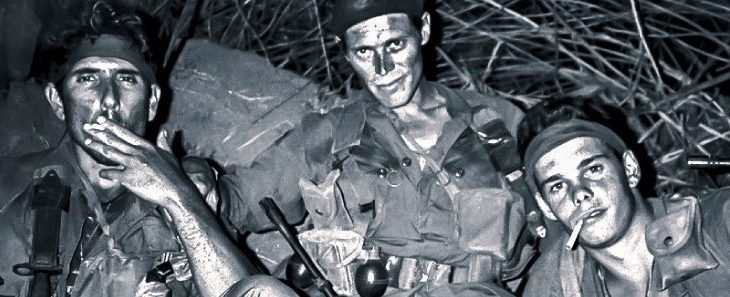
Brothers in Arms is a documentary on the making of Platoon, directed by Paul Sanchez, who played Doc. Platoon, of course, won the Best Picture Oscar and launched the careers of many actors in its young cast. Except for Tom Berenger, this was the first movie job for most of them. including Charlie Sheen, Johnny Depp and Willem Dafoe.
Director Oliver Stone, a Vietnam vet himself, assembled the cast two weeks before filming and put them through basic military training in the Philippine jungle under real military trainers. The cast developed an usual bond during that process, as well as in coping with the mercurial Stone.
In Brothers in Arms, we get to hear from the actors (except for Dafoe, who was making a movie in South Africa) and the military advisers (but not from Oliver Stone). There plenty of entertaining anecdotes and some insights into the filmmaking.