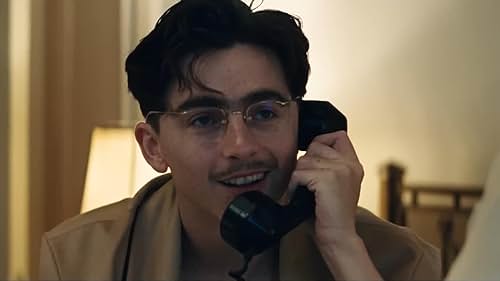
Photo caption: Timothee Chalamet in MARTY SUPREME. Courtesy of A24.
In the superficially entertaining Marty Supreme, Timothee Chalamet plays Marty Mauser, a young 1950s New Yorker obsessed by an imagined future that everyone else finds most unlikely. Marty sees his path to fame and fortune as becoming a world ping pong champion, elevating the sport and monetizing his competitive success. This is not a delusion, because Marty is good enough to compete at the highest level, ping pong was a rising sport, and world champs can garner money from sponsorships and merchandising. All Marty has to do is to bend everyone else to his will – and, ay, there’s the rub.
(In the 1950s, ping pong was generally thought of as a game one played at summer camp, so no other character thinks that Marty’s dream is possible. But, the Marty Mauser character is based on a real guy, Marty Reisman.)
Narcissism and irascibility is a bad combination. Marty sees every human interaction in light of how it can advance his dream, and he’s always ready to embrace mendacity and disloyalty to hurdle an obstacle. Accordingly, he leaves a wake of burned bridges in his wake. The humor in Marty Supreme stems from his ridiculous entitlement and the outrageous lengths to which he will go.
Marty lives life at a frenetic pace, and director Josh Safdie, as he did in Uncut Gems, has the audience frantically keeping pace. It’s a two-and-a-half hour movie, but it feels substantially shorter.
Chalamet is very good at playing monomania, as he showed in A Complete Unknown, and he’s fun to watch here. Gwyneth Paltrow is excellent as a jaded former movie star. So is Odessa A’zion as Marty’s childhood friend, who at first seems like a victim, but turns out to equal Marty in moxie and resourcefulness.
I’ve read that Chalamet trained in ping pong for four years, and his ping pong skills are impressive. The ping pong scenes are mostly shown in long sot, with both players’ full bodies visible, so Chalamet is performing the sport without a double. It’s high level ping pong, and one scene where Marty and a partner are showing off with trick shots is especially cool. (BTW I know my ping pong, having once been a serious player, and even having played a match against someone from the US team’s 1971 ping pong diplomacy trip to China.)
Marty Supreme enjoys a very high Metacritic rating and some Oscar buzz. It is certainly well-crafted, but I didn’t like it that much. MILD SPOILER: I think the problem is, after watching Marty think of no one but himself and treat everyone else badly for two hours plus, I didn’t buy the final 90 seconds,in which Marty finally cares about another human.
Timothée Chalamet in A COMPLETE UNKNOWN. Courtesy of Searchlight Pictures.
A Complete Unknown, James Mangold’s brilliant biopic of Bob Dylan, is a film about genius. If you need to understand why Dylan is the only songwriter to win the Nobel Prize for Literature, here is why. It’s a fascinating story, and Mangold’s telling of it is insightful and entertaining.
The story begins with 19-year-old Bob Dylan showing up in New York City. No one knows who he is (a complete unknown), because he hasn’t done anything, but he wants to meet his hero, the now hospitalized folksinger Woody Guthrie. Dylan can’t pretend to be anything but another homeless musician wannabe, but legendary folksinger Pete Seeger (Edward Norton) takes Dylan under his wing. Starting with open mic nights, Dylan starts playing around the Greenwich Village folk scene.
Dylan meets Sylvie Russo (Elle Fanning) a student activist Dylan whom appreciates because she is pretty, smart, opinionated and has an apartment. Sylvie is a barely fictionalized Suze Rutolo, Dylan’s girlfriend of the period, who appears on the cover of his The Freewheelin’ Bob Dylan album.
Dylan meets another woman his age, Joan Baez (Monica Barbaro), who is already a big deal. Baez had played the Newport Folk Festival at age eighteen and had already recorded three albums. Bob is excited by Baez’s stardom, and Joan admires Bob’s still undiscovered song writing. Without falling in love exactly, they begin an affair. Bob takes advantage of Joan’s connections and credibility (and apartment); he lets her cover Don’t Think Twice, It’s All Right before he released his own version. You get the impression that Joan could have fallen in love with Bob if he would treat her with decency and affection, but Bob is only in love with himself.
Seeger, Baez and others in Greenwich Village’s music world soon recognize the extraordinary, generational genus of Dylan’s songwriting. He finally gets to record his own material in 1963 with The Freewheelin’ Bob Dylan; it was an auspicious and transformative collection of original songs from a 22-year-old: Blowin’ in the Wind, Masters of War, A Hard Rain’s Gonna Fall and Don’t Think Twice, It’s All Right.
In what I found to be the most thrilling moment in A Complete Unknown, Dylan debuts The Times They Are a-Changin‘ to a live audience, and all the listeners, including Seeger and Baez, are captivated, by each new groundbreaking verse. Come mothers and fathers…Throughout the land…And don’t criticize…What you can’t understand…Your sons and your daughters…Are beyond your command. The song – and this scene in A Complete Unknown – completely capture the zeitgeist of the time.
Dylan becomes a huge star and cultural icon – a symbol of a generation. And he immediately is alienated by the accompanying trappings of celebrity.
Dylan also evolves musically from his roots in acoustic folk music. His mentors in the Folk Music movement have a tough time with that, and it all explodes at the 1965 Newport Folk Festival when Dylan defiantly shows up with an electric rock band, the climax of A Complete Unknown.
The folk purists, like Pete Seeger and the musicologist Alan Lomax, saw folk music as politically significant and rock and roll music as politically inconsequential – history soon proved them very wrong about this. The old folkies had also suffered for their movement by being victimized in the McCarthy Era, earning some of their self-righteousness. What the old folkies could not comprehend – and would find abhorrent if they did – is that Bob Dylan was bigger than the genre of Folk Music itself.
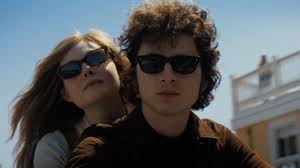
Elle Fanning and Timothee Chalamet in A COMPLETE UNKNOWN. Courtesy of Searchlight Pictures.
So, just who IS Bob Dylan? We expect any biopic to reveal, but Mangold has targeted one of our culture’s most notorious enigmas. Mangold and Chalamet give us a Dylan perhaps less complicated than his image. Here, Dylan is ambitious and absolutely committed to his art. He will not prioritize any relationship or behavioral norm above his songwriting or his career.
He wants the recognition, fame and money that comes from having an audience and fans but, in person, he doesn’t want to experience the fandom or even respect the audience. In pursuit of his own vision, Dylan is not afraid to disappoint (or enrage) anyone else, nor does he feel constrained by loyalty. (Although, if consistent with his vision, he can be kind to his hero Woody Guthrie.)
There’s more than a touch of narcissism there, too. A Complete Unknown depicts Dylan between the ages of 19 to 24, when he was only as mature as most of us were at that age; after all, one can be important while still very immature. He can be a brat, but he isn’t a bad person; he just isn’t capable of a reciprocal relationship. Sylvie Russo and Joan Baez both come to understand that, whoever he really is, he’s not interested in giving them what they want.
The older generation of folksingers certainly don’t GET Dylan, His manager Albert Grossman (Dan Fogler) doesn’t get him, but is fiercely devoted, anyway. In A Complete Unknown, the only people who get Bob are Bobby Neuwirth (Will Harrison), the singer-songwriter who became his road manager, and another icon, Johnny Cash (Boyd Harrison).
As far as I can tell, A Complete Unknown is remarkable for its historical accuracy. There are a few tiny factual quibbles (Dylan actually changed his name from Zimmerman just AFTER he arrived in New York), but none of them are important or detract from the essential truth.
A Complete Unknown is also a time capsule of the early 1960s, and will be especially evocative for Baby Boomers like me, right down to the institutional green paint on Woody Guthrie’s hospital walls. LBJ hadn’t yet escalated the Viet Nam War, so peaceniks were campaigning against the threat of nuclear annihilation and white college kids were flocking to the Civil Rights Movement. Mangold perfectly captures the instant terror and helplessness that Americans felt during The Cuban Missile Crisis – and the suddenness of relief when it was over.
If you know the story, there are lots of delicious tidbits. For example, in the recording session for Like a Rolling Stone, Al Kooper (Charlie Tahan of Ozark), whose services were not needed on guitar, switches instruments so he can get paid for the session and invents the 1960s’ most iconic organ riff.
Monica Barbaro and Timothee Chalamet in A COMPLETE UNKNOWN. Courtesy of Searchlight Pictures.
Chalamet, whom I’ve always seen as a little kittenish, finally gets to be a little dangerous and is appropriately prickly as Bob Dylan. Chalamet portrays Dylan’s aching and yearning for artistic achievement, which allows us to root for a guy who often behaves badly.
Barbaro’s Joan Baez is especially vivid, especially as she sizes up Dylan’s talent and assesses his behavior. Bob, you’re kind of an asshole.
Scoot McNairy’s performance as Woody Guthrie is especially haunting. Guthrie had been suffering from the then little understood Huntington’s disease; because of the disabling neurological effects and the behavioral symptoms, he spent his final years confined in psychiatric hospitals.
Big Bill Morganfield’s performance as a fictional blues artist named Jesse Moffette, who clearly stands in for Muddy Waters, is especially charismatic. Morganfield happens to be the son of Muddy Waters.
Chalamet, Norton, Barbaro and Boyd Harrison do their own singing in A Complete Unknown, which has been much ballyhooed, but I don’t find that important to a successful biopic. Their singing in character is all very good, and I was impressed by how perfectly Barbaro nails Baez’s unique voice. Norton, BTW, plays his own banjo, which is also impressive.
The editing by Andrew Buckland and Scott Morris is exceptional – none of the shots or scenes linger even a half-second too long. This is a two hour, twenty minute film that never lags.
A Complete Unknown is the best biopic, showbiz or otherwise, since Walk the Line (also a James Mangold film) and it’s one of the Best Movies of 2024.
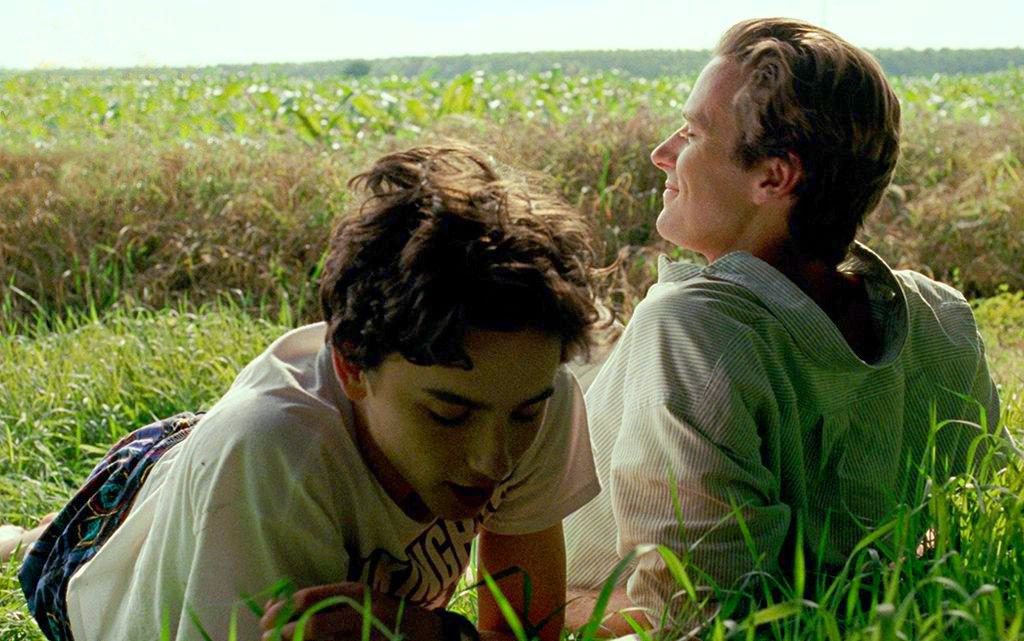
Timothée Chalamet and Armie Hammer in CALL ME BY YOUR NAME
Call Me by Your Name is an extraordinarily beautiful story of sexual awakening set in a luscious Italian summer. The film is gorgeous and magnificently well-acted, but flawed.
Each year, the family of 16-year-old Elio (Timothée Chalamet) spends the summer in a villa in Northern Italy. Elio’s father is an American professor of ancient Greek and Roman culture, and each summer he invites a different grad student to live in their villa and work on scholarly pursuits. In this summer of 1981, that lucky grad student is the 26-year-old Oliver (Armie Hammer). Elio is attracted to Oliver, who is a closeted gay man. Oliver is attracted to Elio, but initially resists Elio’s overtures. What follows between the two of them is an enthralling and authentic exploration of first love.
Timothée Chalamet is really perfect as Elio, a musical prodigy who is beating off the girls with a stick. Even really handsome and talented 17-year-olds have some awkwardness, especially while they’re trying too hard to be cool. Chamalet captures that perfectly, along with the obsessive longing of a first romance. (Chalamet is also in Lady Bird, where he plays the dreamy kid who plays in a band, the object of Lady Bird’s desire.) Armie Hammer is also superb as the more worldly Oliver, whose external confidence masks inner conflicts.
Timothée Chalamet in CALL ME BY YOUR NAME
The story of the two main characters would have made a perfect film, but famed screenwriter James Ivory adds some distracting implausibility with the other characters. First, there are Elio’s impossibly cool and understanding parents (Michael Stuhlbarg and Amira Casar) who practically push their teen son into the arms of an older man; nobody has parents like that, especially TWO of them. (And, yes, I did understand the dad’s motivation, made almost explicit in his final monologue). Second, Elio hurts the feelings of a girl (in a way that almost every male has hurt some girl). Later, she forgives him and it’s all made to be okay. This is just too convenient for Elio, and I didn’t buy it.
And then there’s one of my own movie pet peeves. I generally despise musical interludes in movies, when the dialogue is suspended and a song is played over a montage of imagery. This usually indicates a lack of imagination in the story-telling. A movie gets negative bonus points from me when the music is an insipid pop ballad. In Call Me by Your Name, there are two such Euro-pop interludes.
On the other hand, the depiction of the Italian countryside, with its rustling breezes, orchards heavy with fruit, ancient buildings and is pure travel porn. I think that The Wife would have walked out of Call Me by Your Name – not because she wouldn’t have liked it – but to make reservations for a return to Tuscany. Director Luca Guadagnino (A Bigger Splash, I Am Love) has a gift for making his native Italy unbearably attractive on the screen. Between the work of Guadagnino and Paolo Sorrentino (The Great Beauty), Italy has been well-celebrated in recent films.
Call Me By Your Name is a very good movie, and the core story of Elio and Oliver is great cinema.