DIE MY LOVE: Jennifer Lawrence ablaze

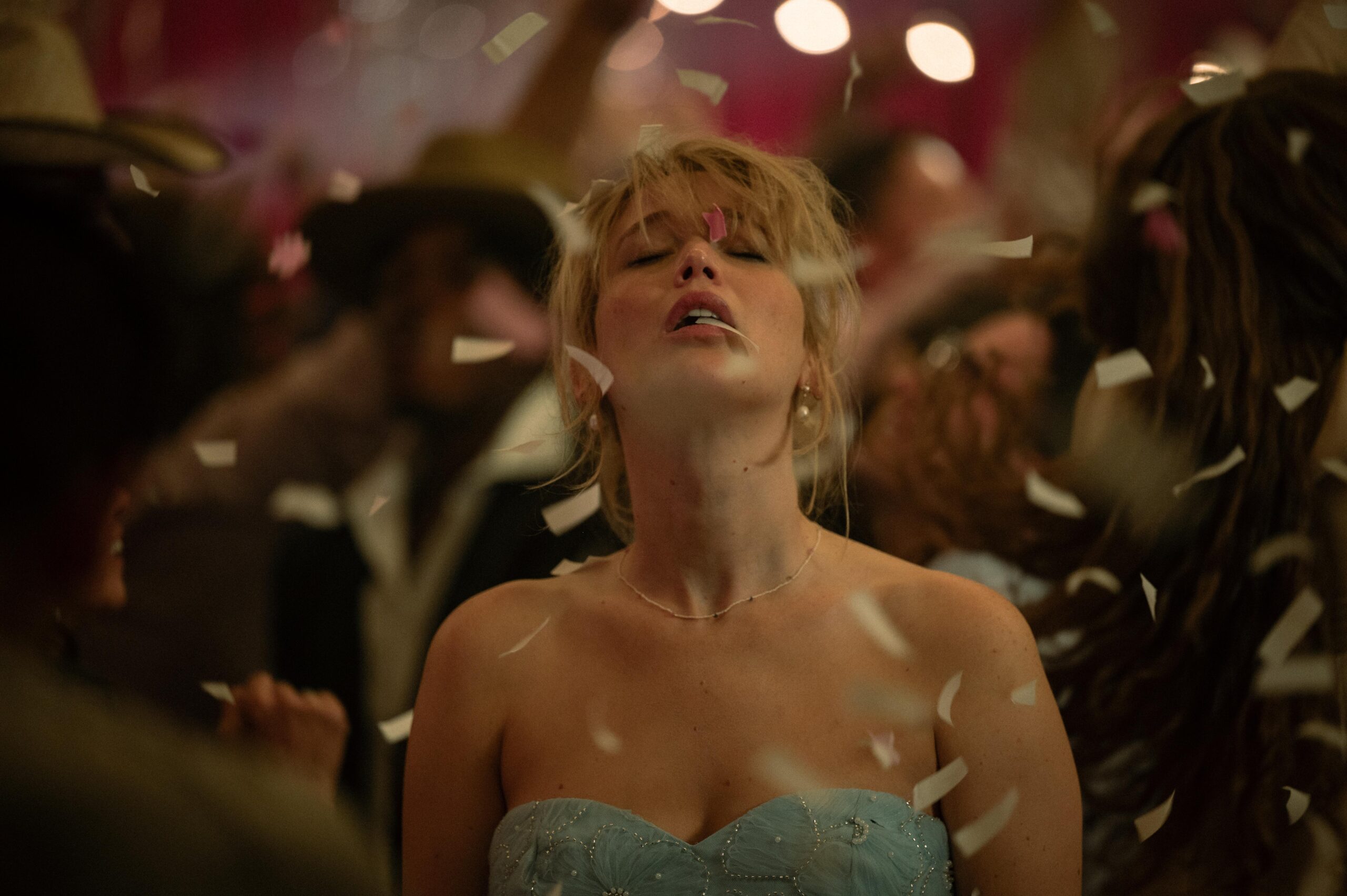
Photo caption: Jennifer Lawrence in DIE MY LOVE. Courtesy of MUBI.

In perhaps the year’s best onscreen performance, Jennifer Lawrence delivers an astonishing portrait of a young woman’s mental breakdown in Die My Love. Lawrence plays Grace, a writer who marries Jackson (Robert Pattison), whose job requires him to be on the road for days at a time. They move into Jackson’s inheritance, a ramshackle house in Montana outside the town Jackson’s mom Pam (Sissy Spacek) lives in. And they have a baby.

Grace is playful and imaginative, and she adores her baby. But she’s isolated at home with no relief from the grind of the baby care. She has lost her interest in writing. She becomes tired, irritable and down in the dumps. Jackson is selfish, clueless about Grace’s changing needs, and has a knack for doing exactly the wrong thing, like bringing home the most annoying pet dog on the planet.

Grace’s mother-in-law Pam, who likes Grace, sees that she is struggling and tries to help. But Grace slides into depression with ever more alarming symptoms and decompensates. Finally, Grace’s behavior shocks Jackson, who starts doing everything he can think of to help, but he is ill-equipped, and it’s too little, too late.

Many actors would love to portray an explosive meltdown, and Lawrence makes you lean back in your theater seats when Grace goes off. But Jennifer Lawrence’s genius is most apparent in the moments that she is just BEING in her condition and in the moments that she is trying to hold it together for others. As Grace’s psyche evolves, this is a performance of astonishing texture and nuance.

Robert Pattinson and Jennifer Lawrence in DIE MY LOVE. Courtesy of MUBI.

Pattinson is excellent as Jackson, who the audience initially sees as a shit, but who becomes very sympathetic as he struggles to help Grace get right, before her illness destroys him, too. Sissy Spacek, is perfectly cast as Pam, who has her own struggles with grief and aging, but brings her good heart, intuition and common sense to become the audience’s surrogate.

What’s going on with Grace? I think The Wife was correct is suggesting that Grace came with an underlying bi-polar disorder which was exacerbated by the postpartum depression. Early in the movie, we see Grace as playful, but maybe that playfulness is a bit frenzied. Of course, it’s fun for Jackson then, but she’s destined to become way more than he can handle. Late in the movie, we see flashbacks from their wedding, and the signs are there.

Die My Love was directed and co-written by Lynne Ramsey, who seems to specialize in madness (We Need to Talk About Kevin, You Were Never Here). Ramsey keeps us off-balance by keeping us unsure about whether what is onscreen is Grace’s real experience or a dream, delusion, or hallucination. Both a black horse and the LaKeith Stanfield character appear to Grace multiple times, but perhaps only once each in reality. It’s just not always clear. After the movie, The Wife and I actually had different views about which of the ending scenes really happened or were imagined. This is smart, artsy filmmaking, which works to keep us guessing.

So, should you see Die My Love? It’s an epic acting performance in a well-made Feel Bad movie, so there you are. Die My Love is now in theaters.
MICKEY 17: lovable loser in space

Photo caption: Robert Pattinson in MICKEY 17. Courtesy of Warner Bros.

In Bong Joon Ho’s futuristic comic fable Mickey 17, Robert Pattinson plays Mickey, a dim bulb looking to escape a nasty loan shark. Mickey’s desperation is so high, and his self esteem is so low, that he takes a horrific assignment on a space colonization expedition. Mickey’s new job title is Expendable – his body and brain are scanned so that he can be replicated and reprogrammed with his own memories if he is killed; that allows the expedition to use him as a guinea pig and a scout, who can test pilot conditions that might be lethal. Indeed, Mickey has been killed so often that his seventeenth version – Mickey 17 – has just been 3-D printed.

The expedition is led by a buffoonish narcissist and media hog (Mark Ruffalo). He is an election loser who seeks to regain his Big Fish status on a frozen planet. Headstrong and intellectually lazy, he hasn’t bothered to research the destination planet, figuring that he can bull ahead and overwhelm any obstacles with resources, aggression and technology. Does this profile remind you of anyone? He is amoral and utterly ruthless, as is his wife (Toni Collette) . She is kind of a demented Lady Macbeth, obsessed with concocting something she calls “sauce”.

As the colonization attempt faces more challenges and the leader becomes more awful and more unhinged, the expedition’s survival depends on poor Mickey and his closest two colleagues (one of which is really, really, really close). Comic situations and sci fi action ensues.

Although Mickey 17 is a comedy, I only heard the occasional chuckle from the audience. I found the ending to be predictable.

Director and writer Bong Joo Ho adapted the screenplay from the Edward Ashton novel Mickey 7. Bong is a critic of unfettered capitalism, and, Mickey 17, like SnowpiercerOkja and his Oscar-winner Parasite, takes on the issues of class and corporate greed.

Part of the problem is that Bong asked Ruffalo (with gleaming teeth and a rich guy haircut) and Collette to deliver over-the-top performances, and they obliged. The social satire would have packed more of a punch with more realistic characters, as in Parasite.

This may be, however, a career-topping performance by Robert Pattinson, who nails Mickey’s goofy resignation. His narration, in Mickey’s voice, is a hoot.

Besides Pattinson, the standout is British actress Naomi Ackie, who plays what is essentially the female lead. She’s wonderfully charismatic, and badass,

Bong Joo Ho makes movies so original that it’s been said that he is his own genre. His Memories of Murder is, for my money, the very best serial killer movie. Mickey 17 is always entertaining, but, on th whole, one of Bong’s lesser efforts.

THE LIGHTHOUSE: enough to drive a guy crazy

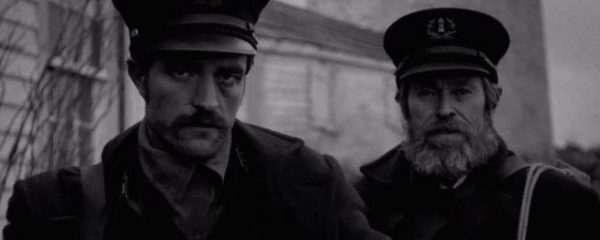
Robert Pattinson and Willem Dafoe in THE LIGHTHOUSE

In The Lighthouse, it’s the 1890s and Wake (Willem Dafoe) and Winslow (Robert Pattinson) are two lighthouse keepers isolated on a New England island. The operative word is “isolated”, because it’s a long time between relief and supply boats, so these guys only have themselves and the gulls for company for weeks on end.

Wake is in charge, which means that he can command Winslow to perform all the tasks. I get the whole chain of command thing, but Wake is a first class jerk, and he unnecessarily makes every moment of Winslow’s life insufferably hard and humiliating. On the surface, not much goes on in The Lighthouse. But a psychological typhoon is brewing, as Winslow’s misery and desperation compounds. The hardship and the annoyances are enough to drive many a person mad, and, as Winslow starts to decompensate, we start expecting something extreme to happen.

Director and co-writer Robert Eggers seems to be aiming at a trippy 21st century take on Gothic Horror, but he fails at basic storytelling. The problem with The Lighthouse is that we don’t really care about these two characters enough to endure the slog. Then, the bleak ending doesn’t justify sitting through the first 90 minutes of bleakness.

I am far more likely than most movie viewers to embrace a slow burn. Here, the “slow” is glacial, and the “burn” seems powered by the hot plate in a 1970s studio apartment.

Willem Dafoe channels Robert Newton from the 1950 Treasure Island to give us the full Long John Silver. It’s an, ahem, unrestrained performance by one of our best screen actors. Dafoe does have one marvelously entertaining dialogue when Wake tags Winslow with a curse from Neptune himself.

Pattinson is the lead here, and he does an excellent job going mad. I admit that I didn’t use to take Pattinson seriously, because of the material, when his career was launched in the Twilight series. But he proves here, as in The Lost City of Z, that he is the real deal.

Because The Lighthouse has an original and artsy look, it’s gotten extra points from many critics. But watching it is an ordeal, no matter how many hallucinatory mermaids there are. I was wondering whether I would go crazy before Pattinson’s Winslow.

The Rover: bleakness and hyperviolence aren’t not enough

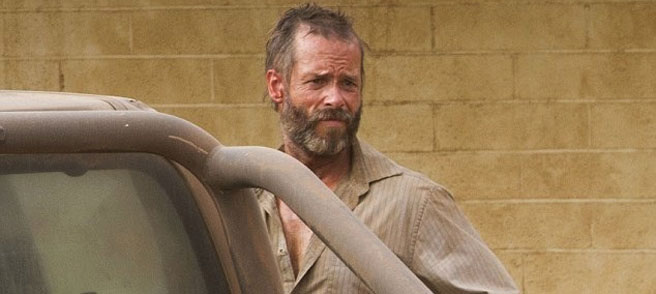
Guy Pearce in THE ROVER

Man, I was really looking forward to the violent Aussie thriller The Rover, because its co-writer/director David Michôd had written and directed one of my recent favorites: Animal Kingdom. Unfortunately, although The Rover delivers the dark violence of Animal Kingdom, it really just doesn’t have enough story.

That story is set “10 years after The Collapse”, in an Australian outback where the social order has completely broken down. No manufactured goods seem to available except for gasoline, which fuels the armed thugs who cruise through the severely bleak landscape preying on what locals remain fortified in their homes and on each other. A perpetually angry and sweaty loner (Guy Pearce) has his car stolen by a gang of robbers, and sets off after them. He soon picks up the injured, half-witted brother of one of the gang (Robert Pattinson of the Twilight movies), who had been left to die at a robbery gone bad. Driving and violence ensues.

By the end of the story co-written by Michôd and the actor Joel Edgerton, we learn why Pearce’s character is so angry and why he wants his car back. But those answers just aren’t enough of a payoff to justify the ride.

I gotta mention the eccentric performance by Pattinson, adorned with some really bad teeth and, for some reason, effecting a West Virginia hillbilly accent. It’s been a long, long time since I’ve seen an actor employ more tics – so many that Pattinson often looks like he is doing a Joe Cocker impression. The rest of the cast, especially Pearce and Gillian Jones, are uniformly excellent.

Skip The Rover and watch Animal Kingdom again instead.