With Nouvelle Vague, one of America’s greatest filmmakers, Richard Linklater, pays tribute to the French New Wave, which invigorated global cinema and inspired generations of American indie filmmakers. Nouvelle Vague, Linklater’s first film in French, tells the story of Jean-Luc Godard making his first film, the groundbreaking and influential Breathless. And it’s a hoot.
The French New Wave was a period when the young film writers at a cinema magazine got to direct their own movies. Basically, this was a time in the late 1950s when a bunch of movie nerds got to create their own cinema, resulting in a burst of freshness and originality. Godard’s peers Francois Truffaut and Claude Chabrol had already transitioned from film critic to movie director, but Godard still hadn’t directed his first film, and he was itching to get started.
With all the arrogance of a 29-year-old novice who is certain of his abilities, Godard famously proclaimed that all you need to make a movie is a girl and a gun. This is that film.
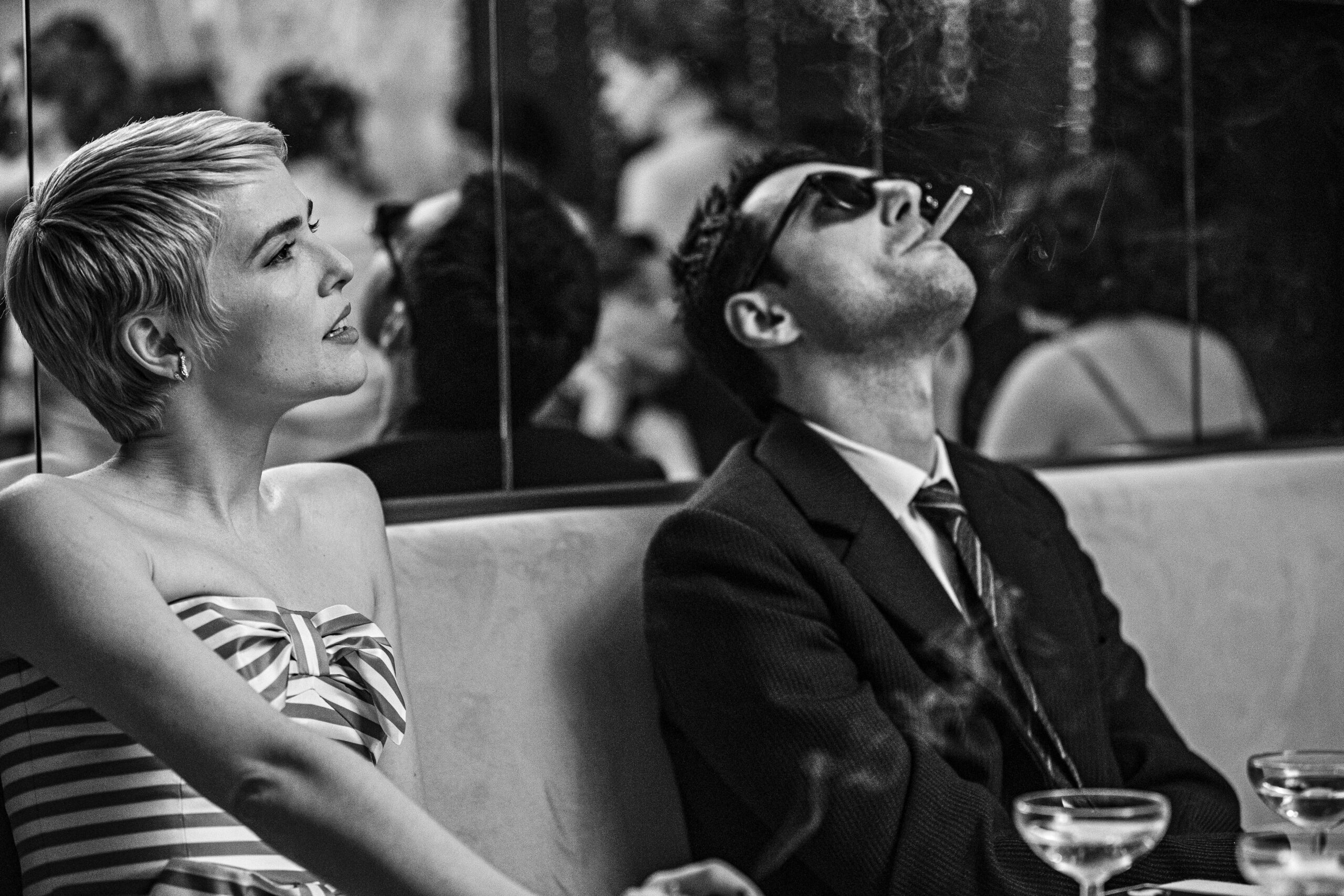
In Nouvelle Vague, Godard (Guillaume Marbeck) gets the casting gift of a famous Hollywood starlet, Jean Seberg (Zoey Deutch), to team with his boxer buddy Jean-Paul Belmondo (Aubry Dullin, who is an acting novice. Godard leads his cast and crew on an anarchic 20-day shoot that Godard makes up as he goes along, with no script and no shooting schedule, which challenges the mental health of his producer Georges de Beauregard (Bruno Dreyfurst). No one can tell if the film, if it gets finished, will be any good.
The key here is the character of Godard himself (brilliantly played by Marbeck in his feature debut), who is posing as an important artist even as he tries to become one, wearing sunglasses day and night. A subversive trickster, he is strong-willed and self-confident for sure, but is he just a narcissistic dilettante? Is his artistic vision just a delusion? So, the making of Breathless is a wild ride, one turns out to be interesting because we know that Breathless will turn out to be an artistic success and an important, influential film.
Linklater fills the Nouvelle Vague with a Who’s Who of French New Wave figures and plenty of jokey references to that style of filmmaking. LInklater even shows the last scene of Truffaut’s The 400 Blows, with its indelible freeze-frame, reflected in Godard’s sunglasses.
So, can you enjoy Nouvelle Vague even if you’re unfamiliar with the French New Wave, and haven’t seen any Godard films? Yes. The madcap nature of the shoot, and the other characters all reacting with amusement, frustration and disbelief to Godard’s outsized personality are plenty entertaining.
But, if you a cinephile, then Nouvelle Vague is a Must See. Linklater’s references are delightful. The actors physically look just like the real people they are playing, and Zoey Deutsch looks phenomenal in Seberg’s iconic blonde pixie cut and Breton stripes. Not many faces resemble Belmondo’s but Aubrey Dullin’s does; Dullin perfectly captures Belmondo’s rogueish charm and working class lack of pretension.
This is the Jean-Luc Godard of his early masterpieces (Breathless, Contempt, Band of Outsiders), before his arrogance made him into a tiresome polemicist. That later insufferable Godard is satirized in Godard, Mon Amour by Michel Hazanavicius (The Artist), which would make a fine second feature on the double bill. (I have found all of the Godard films since 1967’s Weekend to range from disappointing to completely unwatchable.)
Nouvelle Vague is streaming on Netflix.