BLUE MOON: wit and vulnerability

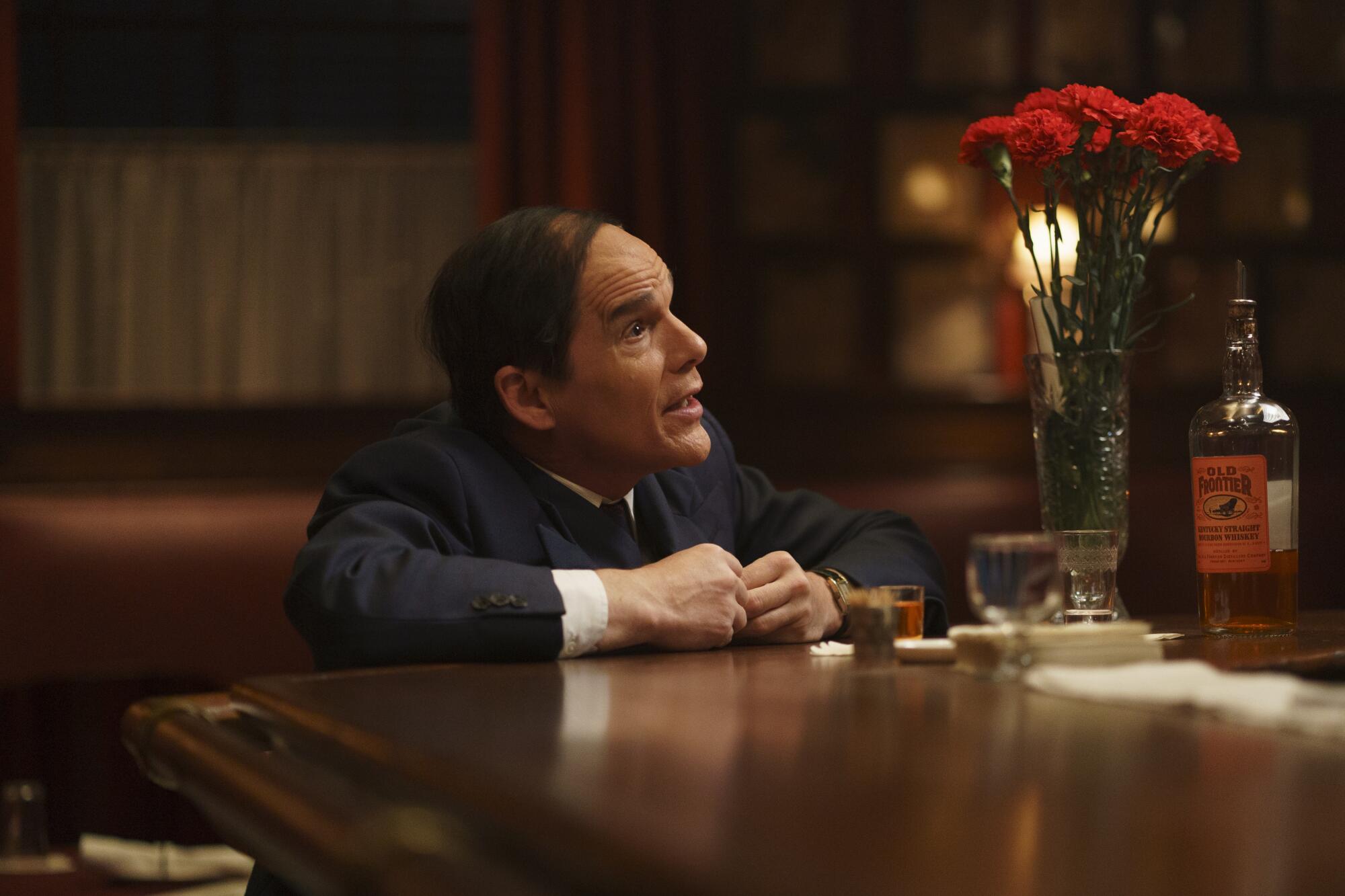
Photo caption: Ethan Hawke in BLUE MOON. Courtesy of Sony Pictures Classics.

The protagonist of Richard Linklater’s Blue Moon is lyricist Lorenz Hart (Ethan Hawke), who Linklater immediately shows us dying of alcoholism, before taking us to a night eight months earlier. Hart, having left the opening night production of Oklahoma!, has entered a familiar haven, the bar at Sardi’s, where he is ready, as always, to hold forth. His longtime partner Richard Rodgers has dumped him for a new collaborator, Oscar Hammerstein, and Hart has immediately recognized that the new duo’s debut musical would dwarf the success of the Rodgers and Hart work. It’s hard to feel good about yourself when you are dumped by your partner of 24 years, who then soars to new heights with a different collaborator.

Beginning in 1919 (when Hart was 24 and Rodgers only 17), the two created 28 stage musicals (including Babes in Arms and Pal Joey and more than 500 songs for Broadway and Hollywood, many of which have become American standards, like Manhattan, The Lady Is a Tramp, My Funny Valentine, and, of course, Blue Moon.

Seeing that body of work eclipsed in one night has Hart reeling. But, now, in 1943, Hart was 48 and Rodgers 41. Hart’s alcoholism has made him unreliable, so Rodger has moved on. Hart’s gift at wordplay is as brilliant as ever, but his confidence is crushed – and he is desperate to work again, and, in his wildest dreams, with Rodgers.

Hart’s career desperation is matched by his romantic desperation – from a doomed fixation with the comely Yale coed, Elizabeth (Margaret Qualley). Elizabeth is self-confident and ambitious, towers over the shrimpish Hart and can match wits with him . Hart is a successful celebrity, but not rich or conventionally attractive, and being an over-the-hill drunken gay man, neither the audience or other characters in Blue Moon see Hart’s pursuit of Elizabeth as anything but a pathetic fantasy.
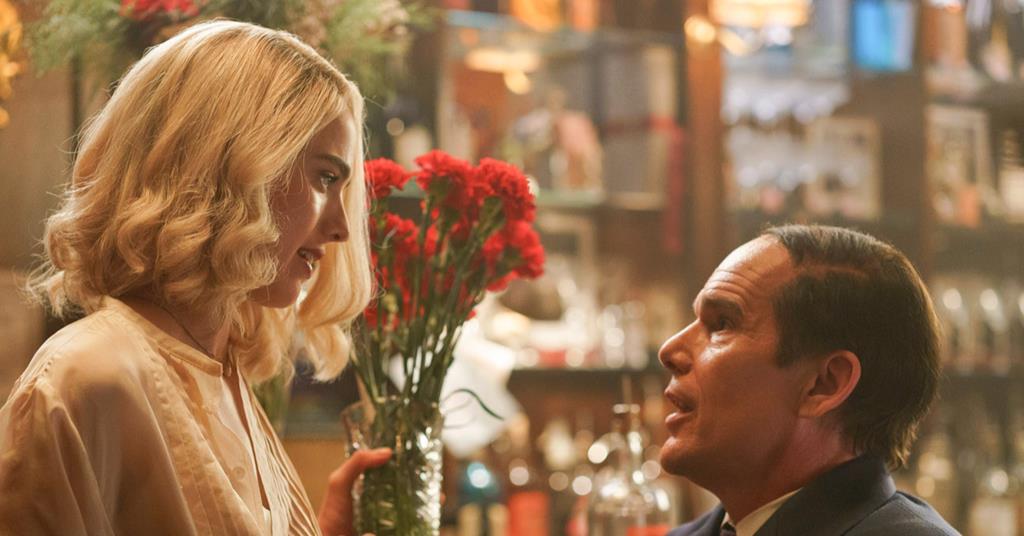
Margaret Qualley and Ethan Hawke in BLUE MOON. Courtesy of Sony Pictures Classics.

Hart presides over all conversation in the bar, and proves himself a most witty raconteur. Hart, usually unintentionally, reveals himself in banter with Sardi’s affable bartender (an excellent Bobby Cannavale).

Finally, Richard Rodgers (Andrew Scott) leads in his entourage from Oklahoma! for the opening night party, and Hart explodes into the full wheedle. Moment by moment, we learn more about Rodger’s complicated experience with Hart. It’s clear that Rodgers is genuinely grateful for Hart’s contribution to his life and is also relieved not to no longer be a secondary victim of Hart’s drinking. Rodgers still is affectionate and nostalgic with Hart, but wary about reliving Hart’s worst behavior. When Hart offers a celebratory glass of champagne, Rodgers recoils and barks, “I won’t drink with you!”, registering the pain that Hart’s drinking has inflicted on him over many years.

Why isn’t Blue Moon, a portrait of a man’s crash-and-burn, unwatchably sad?

  • Foremost, even when Hart is being sad, he’s very, very funny.
  • Hawke’s performance is deliciously vivid.
  • We stay engaged in sussing out the complicated relationship between Hart and Rodgers.
  • We delight in the stellar cast and in Richard Linklater’s storytelling genius.

Hawke is one of our very most interesting actors, and his turn as Hart is exceptional, plumbing all of Hart’s desperation, self-loathing and vulnerability. Of course, Hawke, who is 5′ 10″, can play a dreamy romantic lead, so there’s some movie magic – and a bad comb over – employed to help us see him as a 5 foot gnome. Others have described Hawke’s performance here as career-topping, but it’s hard for me to see this performance, as good as it is, as even better than those in Before Sunrise, Before the Devil Knows You’re Dead, and First Reformed, for example.
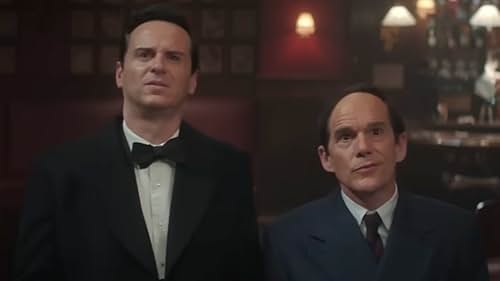
Andrew Scott and Ethan Hawke in BLUE MOON. Courtesy of Sony Pictures Classics.

Lorenz Hart is a flashy role, but Andrew Scott (Tom Ripley in the recent television episodic Ripley) is quietly mesmerizing as Rodgers, who struggles to contain the embarrassment, wariness, revulsion, pity and love that Hart triggers. Scott won the supporting actor Silver Bear at the Berlinale for this performance.

Qualley just seems to brighten every movie that she’s in – shall we call it the Joan Blondell quality?

One of the most interesting encounters in Blue Moon is between Hart and another bar patron, the writer E.B. White (Patrick Kennedy). The two know and admire each other’s work, although they are conversing for the first time. White can keep up with Hart intellectually, and also has the emotional intelligence to see, without comment, what’s going on with Hart. It’s a remarkably subtle performance by Kennedy.

The entire movie takes place in Sardi’s, except for two or three minutes at and near the beginning. Over 80% of the story takes place in Sardi’s bar. But Blue Moon never looks as inexpensive as it must be. No filmmaker has delivered more fine movies on low budgets than Linklater; I couldn’t find a Linklater movie budgeted at more than a frugal $35 million (School of Rock). Nevertheless, Linklater has created the three most thoughtful romances in cinema (the Before Sunrise series) and the milennium’s best film (Boyhood), along with launching an entire generation of actors in Dazed and Confused.

Here, Linklater turns one night into a vivid portrait of a man’s life and times, and Blue Moon is both funny and profound.


HONEY DON’T: kinda funny, disposable

Photo caption: Margaret Qualley in HONEY DON’T. Courtesy of Focus Features.

In Ethan Coen’s dark comedy Honey Don’t, the potential clients of private eye Honey O’Donahue (Margaret Qualley) keep getting killed, and she suspects that the deaths are connected to a sexually predatory sham preacher (Chris Evans). She’s a whip-smart lipstick lesbian, and she sizzles with the local cop MG (Aubrey Plaza). Honey and the phony pastor have lots of robust sex, none of it with each other. We think we know who the big villain is going to be, but there’s a big surprise twist.

There’s a lot of sassy dialogue, and there are some LOL lines like “no, but I saw Palmdale” that could have become iconic if this were a better movie. It’s kinda funny, dotted with a few inspired moments, but, on the whole, a disposable movie.

Director Ethan Coen co-wrote Honey Don’t with longtime Coen Brothers editor Tricia Cooke, who also co-wrote his Drive Away Dolls. In a twist on the detective genre, the oversexed, badass characters are women – Honey, MG and a mysterious, motor scooter-riding drug importer (Lera Abova). The two main male characters are Evan’s predatory minister, a doofus who thinks he’s a mastermind, and a smarmy cop (Charlie Day), who knows that he’s a doofus and is blissfully content with being one. That being said, Honey Don’t is all about the carnage-laden comic violence that men tend to enjoy, and I doubt that the female-centric angle is enough to draw women into the audience.

Qualley and Evans are both very good, and I will watch anything that features Aubrey Plaza. There are excellent comic performances by Josh Pafchek, as an impressively dim thug, and Kale Browne, as an old man whose identity isn’t revealed right away.

One of the most distinctive and fun stars of the film is its setting – emphatically downscale Bakersfield. I’m not convinced that there is a nice part of Bakersfield, but, if there is, we sure don’t see it here. Californians will also enjoy the references to Lancaster and Palmdale.

Honey Don’t is a mildly enjoyable 87 minutes, but not a Must See.

THE SUBSTANCE: the thinking woman’s Faust, if you can take the body horror

Photo caption: Demi Moore in THE SUBSTANCE. Courtesy of MUBI.

Wow, this movie sizzles with originality and it’s a showcase for an emerging female filmmaker, but I’m not sure if you’ll want to watch it. In The Substance, writer-director Coralie Fargeat comments on all the perversity around the unrealistic ideals of female beauty by reimagining the classic Faustian bargain – what would you give up to restore physical youthfulness? Fargeat has made a sharply funny movie that melds the science fiction and horror genres. It’s absolutely brilliant, but some viewers may not be able to get past the body horror.

Elisabeth (Demi Moore) was a big movie star thirty years ago, and is now starring in a network fitness show (think Jane Fonda’s Workout franchise). Elisabeth is happy with her life until the male suits at the TV network tell that she’s passed her Sell By date and prepare to dump her for a younger, hotter starlet. The shock jars Elisabeth into a desperate spiral of body-loathing. Of course, this is absurd because I would describe Demi Moore as the world’s most beautiful 47-year-old woman, except she’s really 62.

Elisabeth finds a mysterious underground pharmaceutical (called The Substance) that will miraculously take 30 years off her appearance. There is a at least one catch. She has to inject a substance, which triggers the formation of a clone in a separate, younger body – but only for a week; then she needs to recover by re-inhabiting the older body. Off and on she goes, alternating weeks and the older and younger versions. Eventually, she learns about an even more significant side effect.

The clone is Sue (Margaret Qualley), who immediately is hired to replace Elisabeth on the show and vaults to stardom herself. With her celebrity, riches and stunning beauty, Sue’s life is pretty damn great – until each week is over. We soon realize that this is not going to end well for either Elisabeth or Sue.

There is a lot of body horror in The Substance, beginning with an icky “clone birth” scene and the weekly transitions between Elisabeth and Sue. The Substance ends with an over-the-top, splattering finale that makes Carrie look like a finger prick. It’s not going to work for most of my readers whom I know personally. I’m not a big horror fan and especially don’t care for body horror, but I’m glad I hung with it.

Margaret Qualley in THE SUBSTANCE. Courtesy of MUBI.

The Substance is the second feature for French writer-director Coralie Fargeat. Her first film Revenge (which I haven’t yet seen) won accolades as a feminist take on the rape revenge genre. To keep her right of final cut, Fargeat spurned Hollywood financing and made The Substance on spec. It is now the highest grossing film for MUBI, which bought the distribution rights. She knows what to do with the actors, the camera and the soundtrack, and is unafraid of coloring outside the lines. Wow, Fargeat is impressive.

The first three scenes are enrapturing. The first is an overhead shot of a broken egg, which is injected with a syringe and then clones a second yolk. The second scene is another overhead shot, this one of Elisabeth’s star on the Hollywood Walk of Fame, which traces the arc of her career. The third is of Elisabeth leaving the set of her show, as she absorbs the accolades of her stardom, the unwelcome birthday wishes and some rude hints to her aging out of being a sex symbol. Really smart storytelling.

Predictably, given my personal bias, I thought that the running time 2 hours, 20 minutes was too long, but it’s not like the movie dragged.

The male characters in The Substance are not very smart nor even minimally evolved; they are so broadly played that it’s even fun for men in the audience.

This is career-topping performance for Demi Moore, who , besides being uniquely physically perfect for the role, brings out all of Elisabeth’s yearnings and vulnerabilities – and her fraught ambivalence for continuing with The Substance. Moore is also a good sport about working under some some very extreme prosthetics.

Margaret Qualley always brings energy and magnetism to her performances, and she’s superb here as s Sue who, like Elisabeth, wants it all and wants it too much.

Dennis Quaid takes boorishness to new lows as a shamelessly sexist network boss. Quaid must have had lots of fun in this role, and he’s hilarious.

The Substance got a standing ovation at its premiere at Cannes, and won the People’s Choice Award at Toronto. The Substance is now streaming on Amazon and AppleTV, and it’s free on MUBI.

KINDS OF KINDNESS: disgustingly indulgent

Photo caption: Jesse Plemons in KINDS OF KINDNESS. Courtesy of Searchlight Pictures.

Yorgos Lanthimos (Poor Things) probably enjoyed writing and directing his disgustingly self-indulgent Kinds of Kindness, but there’s no reason for an audience to waste three hours on it. There are three separate stories – equally bizarre fables in Kinds of Kindness. The same ensemble of actors play different roles in each of the three stories: Jesse Plemons, Emma Stone, Willem Dafoe, Margaret Qualley, Mamadou Athie, Hong Chau and Joe Alwyn.

I like absurdism in cinema (see this week’s Mother Couch), but to SOME end; Kinds of Kindness is just an unremitting sequence of outrageously transgressive behavior in weird circumstances. Lanthimos has been quoted that we was exploring relationships and memory, but all we get is a torrent of provocations. So much is being thrown at the screen, including cannibalism, that, at least, it’s not boring.

  • In the first story, Jesse Plemons plays a corporate lackey who owes everything to his nightmarishly micro-managing boss (Willem Dafoe), who decrees what he wears, what he eats and drinks, when he has sex with his wife. He’s finally baited into saying “no” to th boss for the first time in eleven years, as his life dissolves.
  • In the second, Plemons plays a cop devastated by the disappearance of his wife (Emma Stone, a marine biologist on a research mission. When she is miraculously rescued, he is convinced that it’s not really her, but some malevolent double. There are two extremely funny moments in this chapter – a stunningly ineffectual psychiatrist and a riotously inappropriate home movie. And, then, there’s cannibalism on the menu.
  • The final episode involves a cult with a weird fascination for water purity that has sent out scouts (Stone and Plemons) in search for a prophesied young woman who can raise the dead. Stone’s character is kicked out of the cult, and she goes to great lengths to get back in.

Jesse Plemons is exceptional in each of his three roles, and he’s by far the best element of Kinds of Kindness. There’s isn’t a bad performance in Kinds of Kindness, just the finest of screen actors trapped in a bad screenplay. Margaret Qualley continues to act unclothed in what seems to me to be a high proportion of her films.

Lanthimos co-wrote Kinds of Kindness with Efthimis Filippou, as he did with his most off-the-wall work – Dogtooth, which I loved, and The Lobster and The Killing of a Sacred Deer, both of which I hated. (Filippou also co-wrote Athina Rachel Tsangari’s hilarious skewering of male competitiveness, Chevalier (which I REALLY loved). )

Unfortunately, Kinds of Kindness is really just Lanthimos’ exercise in devising outrageous behavior for his characters, just because he can. We don’t need to watch.

STARS AT NOON: needs less sweat and more sizzle

Photo caption: Margaret Qualley in STARS AT NOON. Courtesy of A24.

In the atmospheric neo-noir Stars at Noon, it’s the early 1980s in Nicaragua, and wannabe journalist Trish (Margaret Qualley) is learning that one can not always live by ones wits. She’s hoodwinked a magazine into paying her way to write a travel puff piece, while always intending to write a political expose; that article has annoyed the government to the point of revoking her press pass and confiscating her passport. Now she’s broke, unable to pay her way out of the city’s cheapest motel and into the airport, cadging meals from hotel buffets and obsessing on how to procure some shampoo for her increasingly sweaty scalp.

What she has going for her is command of the Spanish language and having learned her way around the country, geographically and culturally. She’s mastered the alphabet soup of Central American intelligence and security entities, each nastier and more ruthlessly repressive than the last. Trish is also highly manipulative and eager to sleep with any man who might help her in any way.

She picks up the handsome Brit Daniel (Joe Alwyn) at his upscale hotel, intending to get a roll in the hay, 50 dollars US and some stolen hotel shampoo out of the encounter. When Trish finds a hidden gun in his stuff, she (and the audience) think he must be dangerous, like a hit man or an intelligence operative. When she finds that he’s also in over his head, she and he have fallen in love with each other.

He’s not dangerous to others – he’s dangerous to be with. She was in desperate circumstance, but now the two of them are desperate for their lives. It’s too late – their fates are now entangled. And they’re going to have to make a mad dash for the border.

Stars at Noon won the Grand Prixe, essentially second place at Cannes, and this must have been because of the jury’s reverence for Claire Denis, the iconic French director, and a glass ceiling-busting female filmmaker at that. As one would expect from a Denis film, Star at Noon is competently crafted, but it’s just way too long at two hours and twenty minutes. Although Qualley and Alwyn spend a lot of that time unclothed and grinding away, I didn’t find their chemistry to smoke. Stars at Noon is too needlessly languorous and not sizzling enough to be a really good movie.

Qualley pulls her dress over her head within minutes of meeting any man; if the director weren’t female, Stars at Noon would face criticism for male gaze exploitation.

Denis also has oddly chosen a sound track that could have lifted from Showtime soft porn.

Qualley with her fidgety energy and her hyper-direct gaze, is perfectly cast as Trish. I first saw Qualley when she jumped off the screen as a Manson Girl in Once Upon a Time..In Hollywood and then in Fosse/Verdon. She has the charisma to carry a movie much better than Stars at Noon.

Joe Alwyn is dreamy enough to make it credible that Trish would fall hard for Daniel.

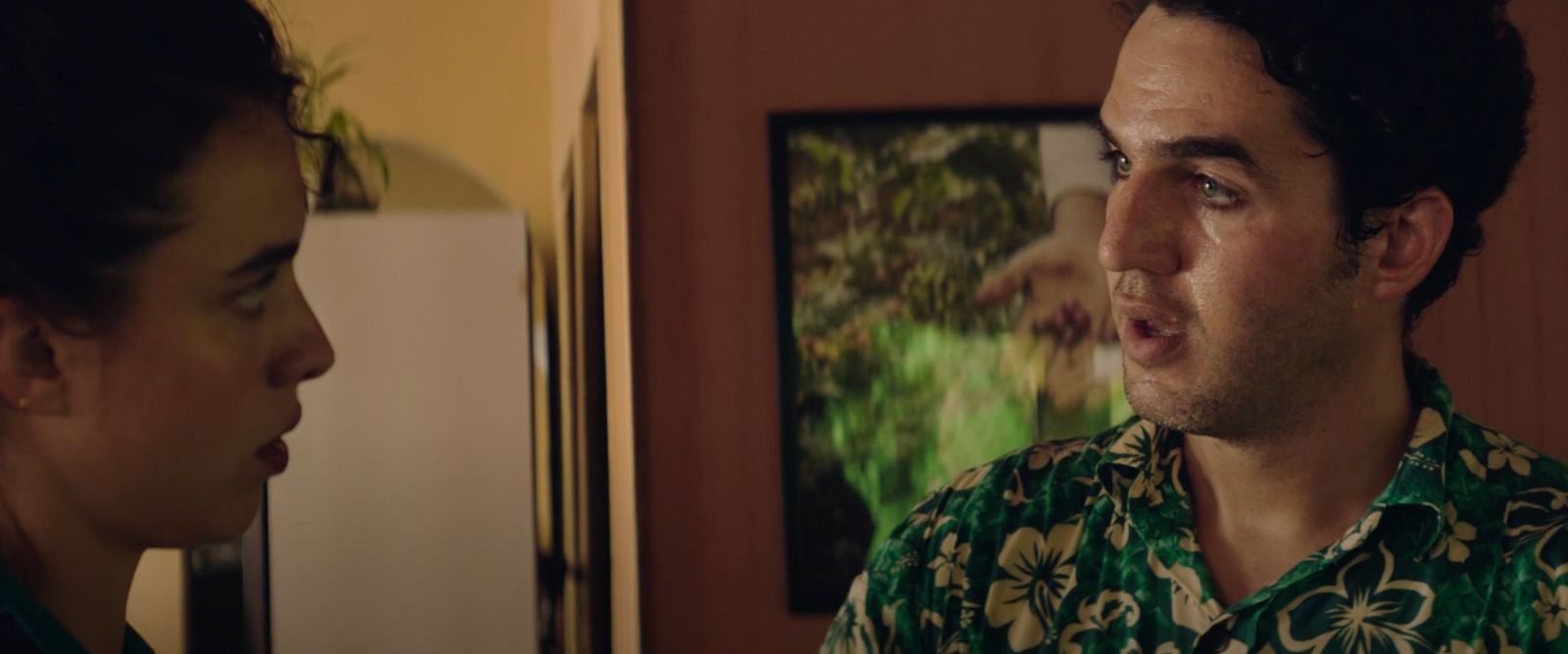
Photo caption: Margaret Qualley and Benny Safdie in STARS AT NOON. Courtesy of A24.

I can’t say enough about Benny Safdie’s performance as a character credited as CIA Man. His affability makes him all the more sinister. The CIA Man knows that he holds all the cards, and there’s no need to seem like a brute, even if he is going to compel Trish into an egregious and traumatizing act. It’s all business, thank you very much.

I usually think of Benny and his brother Josh as indie directors (Uncut Gems), but Benny has been acting and he has real chops. In Licorice Pizza, he nailed the role of the closeted, charismatic do-gooder politician,

John C. Reilly shows up briefly, wearing a wild 1980s-perm-gone-wrong as the editor that Trish has burned her very last bridge with, and his cameo is hilarious.

I watched Stars at Noon on Amazon, one of the many streaming platforms which offer it.

NOVITIATE: seeker finds grim slog

Melissa Leo in NOVITIATE

In Novitiate, a young girl (Margaret Qualley) from a broken family finds comfort and stability in the Catholic Church  As a teen, she plunges into a spiritual quest and commits herself to becoming a nun.  As Sister Cathleen, she is looking for Love and Sacrifice, but she gets too much sacrifice and discipline from the abbess Reverend Mother (Melissa Leo).

Novitiate is set in 1962, and the order is severe, requiring silence and Grand Silence.  Unfortunately for the young wannabe nuns, the drill sergeant in this nun boot camp is a sadist.  Under the guise of discipline, there is self-flagellation, self-starving, walking on knees along the stone floors, and, worst of all, the “Chapter of Faults” group sessions of emotional abuse.  The Reverend Mother is a bully, so profoundly mean, so devout to the discipline and so devoid of love.

All of this is taking place as Vatican II seeks to update the Church, a movement that the Reverend Mother resists in every way she can.  She is afraid of losing both the routine she finds meaningful and her position of authority.

Sister Cathleen is on a romantic quest, where the romance is with a theoretical object, an ideal.

Because of Margaret Qualley’s performance in the lead role, we believe Sister Cathleen’s resolute commitment to her quest and the extremes to which it leads.  Melissa Leo has gotten Oscar buzz for her performance, and she is good in a role less textured than she has pulled off in Frozen River or Treme.  The best acting comes from Dianna Negron (Glee), as the promising #2 nun who leaves the convent, and from Julianne Nicholson as Sister Cathleen’s mother, who can’t understand how her daughter has come to this.

The story is one of unrelenting grimness and the film viewing experience becomes tedious.  Novitiate is by no means a bad movie, it’s just a long slog through Eat Your Broccoli territory.

Novitiate is the debut feature of writer-director Margaret Betts, who shows promise as a director of actors and as a visual director.  The film’s shortcoming is the story.

[SPOILER:  The Wife aptly pointed out that the girl-on-girl sexual action is entirely unnecessary in the scene where Sister Cathleen yearns for physical and emotional comfort.  There had already been a same-sex encounter between minor characters at the nunnery, and this scene, which is about the need for comfort as a relief from the all-consuming severity, didn’t need to go there.  There’s also an utterly gratuitous glimpse of Qualley’s nipples that is only prurient.  This is disappointing for a woman director, but, reading recent revelations from Salma Hayek and others, you never know if this wasn’t Betts’ idea at all.]