
THE FRIEND: grieving with an enormous dog

Photo caption: Naomi Watts and Bing (as Apollo) in THE FRIEND. Courtesy of Bleecker Street.

We don’t see much of the womanizing writer Walter (Bill Murray) in the The Friend, but it doesn’t take long to see how selfish he was before his death by suicide. He leaves behind unfinished projects, a wife and two ex-wives, a neglected adult daughter and the deep, longtime friendship with his editor Iris (Naomi Watts). He was seemingly indifferent to suicide’s impact on the people in his life, but he has saddled Iris with the care of his surviving pet dog, Apollo. Apollo, while sweet-tempered, is an enormous Great Dane, and Iris’ apartment building does not allow dogs.

For all their qualities, Great Danes are not easy to care for, especially in Manhattan, and Iris must hustle to find a placement for Apollo while she is scrambling to save her final project with Walter and profoundly grieving. Iris is really angry at Walter, but the Apollo situation is so consuming that expressing that anger doesn’t occur to her. Will Iris be able to navigate her grief? Will she be able to keep her apartment? And what will happen to Apollo?

Directors Scott McGehee and David Siegel make very few films, but they’re superb (The Deep End, Montana Story); The Friend is one of their lesser works, but it’s well-crafted and satisfying. They are able to keep the material sentimental, but not overly sentimental. This is a weeper, and The Wife and her friend liked it more than I did.

The soundtrack elevates the other elements of the film, especially a cover of Fred Neil’s Everybody’s Talkin’ by Iggy Pop.

Apollo is a dog of uncommonly sensitive eyes, who can express a wide range of emotions with a still gaze. He is played by Bing, also a Great Dane.

The Friend was the opening night film at this year’s Cinequest, but I missed it there. It’s now streaming on Amazon, AppleTV and YouTube.
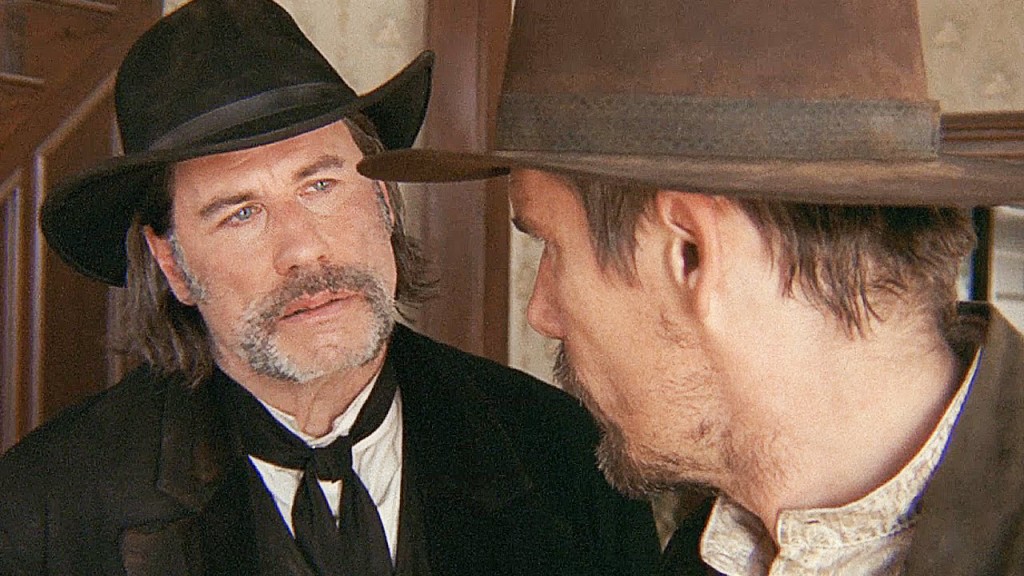
IN A VALLEY OF VIOLENCE: a drifter with PTSD and his dog find Travolta in the Old West

valley-violence

Writer-director Ti West brings some new touches to the spaghetti western in his mostly successful In a Valley of Violence.  Ethan Hawke plays Paul the drifter, passing through town with his fly-catching dog Abbie.  He runs afoul of the local bully, which unleashes bloody (and, in one instance,  gruesome) revenge.

Right away, the music and the opening titles tell us that we’re watching a spaghetti western.  The dramatic rock formations and thirsty scrub of New Mexico work, too.  But this is a 21st Century take on the genre, with a protagonist suffering from PTSD.  Guilt-wracked, he becomes bent on revenge but remains ambivalent about the killing that his vengeance will require.  There’s also a bad guy with a conscience (but not enough of one).  And the superb final shootout is unlike any that you seen in another dusty street.

John Travolta is exceptional as the town marshal, burdened by wisdom enough to know that he is surrounded by idiots and perhaps to be entangled in their fates.  The marshal is well-seasoned and perceptive.  He reads every character with pinpoint accuracy.  He is one tough, crafty and ruthless hombre, but his actions are motivated by what must be done, not by empty machismo.

As befits a spaghetti western, the end of In a Valley of Violence (including the really violent parts) are filled with dark humor.   James Ransome is very funny as the compulsively foolish town bully, springing relentlessly from one bad choice to another.  One of the bad guys picks the most nail-biting moment to resist fat-shaming: “Don’t call me Tubby – my name is Lawrence”. The film’s highlight may be the LOL dialogue between Hawke and Travolta as they try to navigate not killing each other, all while stalking each other through the back streets.

Abbie the dog (played by Jumpy) is especially endearing and fun to watch.  She even rolls herself up in her blanket by the campfire.   In a Valley of Violence’s credits include the Dog Trainer, three Animal Wranglers and a Vulture Handler

In a Valley of Violence isn’t a perfect film.  The event that motivates the vengeful onslaught is predictable and upsetting to dog lovers.  And, other than Travolta and Hawke, the actors seem like they are modern folks dragged out of a Starbucks and dressed up in cowboy gear.

For what it’s worth, In a Valley of Violence’s climactic gunfight is historically consistent.  Contrary to the tradition in movie Westerns, very few of the Old West gunfights were of the “quick draw” variety.  The real cowboys, outlaws and lawmen tended to sneak up on each other and fire from cover.  When they did approach each other in the street (as here), their guns were usually already drawn.

I’ll watch ANY spaghetti western, but I found In a Valley of Violence to be a particularly successful one.  The dark humor and the performances by Hawke, Travolta and Jumpy are plenty reason to see In a Valley of Violence.