The Secret Agent is both a superb movie and an unexpectedly original immersive experience. Writer-director Kleber Mendonça Filho embeds his slow burn thriller into 1977 Brazil, and Mendonça creates an unsurpassed sense of time and place, which is absolutely absorbing.
Wagner Moura plays a man traveling under an assumed name, making his way across the country in a VW Beetle. Eventually, we learn that his name is Armando, and he’s returning to his home city of Recife. He’s on the down low now, on the run from something, but when he later learns the particulars of the threat against him, his flight becomes increasingly urgent and cloak-and-dagger.
In the first scene, at a rural gas station, Mendonça tells us three things about the setting. Disorder reigns. Life is cheap. The police are unabashedly corrupt.
Mendonça doesn’t paint a picture of a regime like Pinochet’s Chile, where th state itself is hunting down its perceived dissenters and eliminating them by imprisonment, torture and extra-judicial execution. Rather, Mendonça’s 1977 Brazil is chaotic, where the government, casually and without much organization, tolerates or even perpetrates murder at the private whims of the rich. While the rich and their henchmen call their targets “communists”, this isn’t ideological, it’s for the most personal of interests, such as revenge and greed. Indeed, Armando isn’t a dissident activist; he’s a technology professor whose success at his job has become inconvenient for a crooked industrialist.
The cops are portrayed, often comically, as vulgar louts; the ongoing feeling of menace in The Secret Agent stems from their unaccountability. The Secret Agent simmers with tension until Mendonça brings the story to a boil with Hitchcockian suspense in a humdrum government office and an explosively thrilling chase through the sidewalks and alleys of Recife.
In juxtaposition to the life-and-death stakes of Armando’s story, it is Carnival time, and the population at large is embracing boisterous partying and carefree sensuality. The local media has created a fantastic bogeyman to sell newspapers, which Mendonça hilariously brings to life. There are recurring themes of sharks, dismembered legs and movies.
One of the movies (also shark-themed) is Jaws. Besides the movies and popular music, Mendonça brings us the cars and the dress of 1977, down to details like a Nadia Comaneci poster in the background. I have no idea how he filled the street of Recife with hundreds of extras, all dressed as in 1977 fashion. It’s very, very hot, and the men wear their shirts open, or not at all.
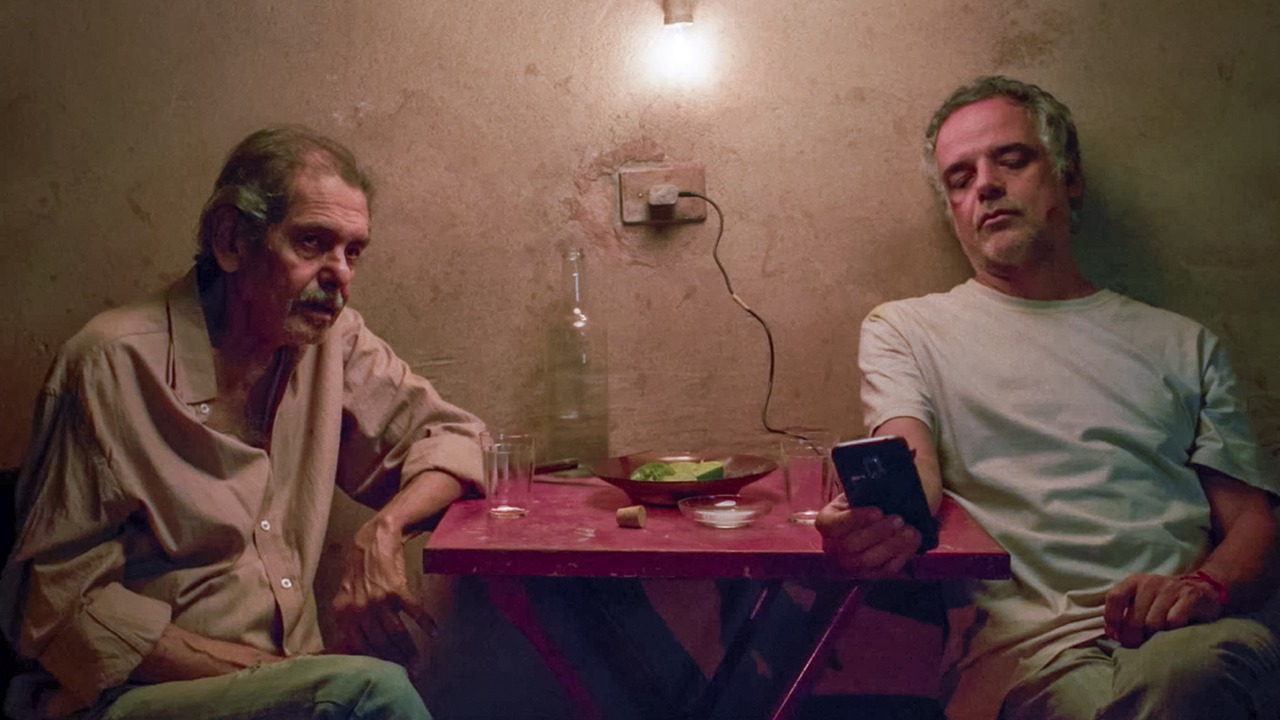
We’re jarred when we see an iPhone on a tabletop, Mendonça’s clever tipoff that he has jumped the story 48 years into the future.
The plot is about what will happen to Armando, and Mendonça reveals the answer in a surprisingly non-exploitative way. It’s underplayed, and it’s really perfect.
Wagner Moura carries the film, emanating Armando’s unusual decency, intelligence, and determination (and maybe too much stubborness for his own good).
As good as is Moura, The Secret Agent astounds with its amazingly deep cast and pitch-perfect performances. We come to know even the most minor characters as distinct individuals without tereotypes, and there are over 20 indelible performances. In particular, the child actor Enzo Nunes, playing Armando’s six-year-old son, gives a strongly textured performance reacting to Armando’s explanation of his mother’s death. Their are eight villains, each loathsome in entirely singular ways. This is the first year that the Academy Awards are granting an Oscar for casting, and The Secret Agent is justifiably nominated.
Mendonça had a US arthouse hit in 2016 with the Sonia Braga showcase Aquarius. That film was critical of the political status quo, and the Brazilian government’s refusal to submit it for the Best Foreign Language Picture Oscar created a controversy, detailed in this New York Times article.
The Secret Agent is nominated for four Oscars: Best Picture, Best International Picture, Best Actor and Best Casting. It should have been nominated for Best Director. You can stream it from Amazon, AppleTV, YouTube and Fandango.