
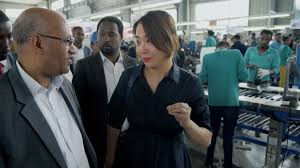
In the scintillating documentry Made in Ethiopia, businesswoman Motto is the face of a huge, new Chinese industrial park in Ethiopia. How huge? A factory with 3,000 workers is just one of its 130 businesses – and Motto is working on an 18,000-acre expansion.
Motto is smart, zealous, charismatic and utterly non-ironic. Along with the other Chinese, she has drunk the Koo-Aid and sees the park as entirely benevolent – bringing large scale employment and investment to a poor and neglected society. A visiting Chinese official exclaims, “it’s just like China used to be!“.
All of the workers are Ethiopian, who earn $50 per month in what is essentially a clean and gleaming sweatshop. All of the supervisors are Chinese who have left their families behind in China. The local farmers feel ripped off by their government, and an armed rebellion may be brewing. Apart from a global pandemic, what could possibly go wrong? In their first feature, directors Xinyan Yu and Max Duncan have created a brilliant exploration of clashing cultures and economic imperialism.
I screened Made in Ethiopia for the SLO Film Fest, where it made my Best of the SLO Film Fest. Now it’s on PBS’ POV. You can stream Made in Ethiopia on the PBS app or directly at the POV website.
