The Cheshire Murders: beyond the police procedural

THE CHESHIRE MURDERS

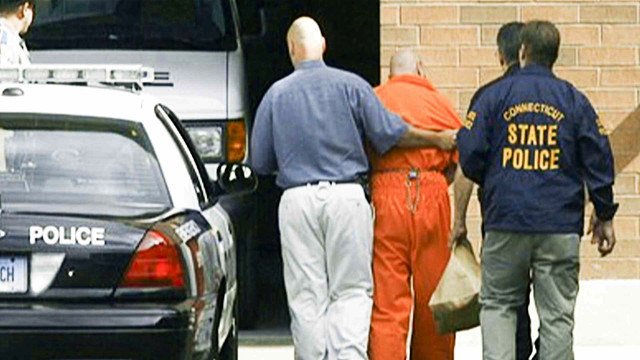
The Cheshire Murders, another in HBO’s fine summer documentary series, takes us beyond the familiar police procedural.  This is not a whodunit – we immediately know what happened and who committed the crimes.  Three murders were committed in a home invasion, and the two perpetrators were caught red-handed – their guilt confirmed by confessions and DNA and other forensic  evidence.

Instead, as The Cheshire Murders peels back the onion, we hear about the crime’s impact on a quiet Connecticut suburb and on the families of the victims and the perpetrators. We trace the unanswered questions on the police response.  We follow the life journeys of the murderers which culminate in this horrific crime.  We see how the case affected the political debate over capital punishment in Connecticut, and test our own views on capital punishment with the facts of  a heinous crime, certain guilt and monstrous offenders.

The Cheshire Murders is all the more effective because the filmmakers refused to sensationalize the case.  The facts, speaking for themselves, are compelling enough.

The Cheshire Murders is currently playing on HBO.  Note: Some of the victims of this wanton, senseless and disgusting crime were children; although there are no grisly images, the facts of the case are disturbing.
TCM’s June feast of noir

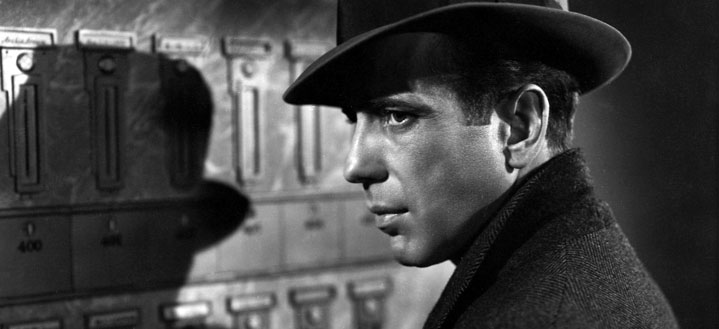
Humphrey Bogart in THE MALTESE FALCON (1941)

It’s more than a film fest, it’s a feast of film noir.

This June, Turner Classic Movies’ Friday Night Spotlight will focus on Noir Writers.  The guest programmer and host will be San Francisco’s Eddie Muller, founder and president of the Film Noir Foundation.  The Foundation preserves movies from the traditional noir period that would otherwise be lost.  It also sponsors Noir City, an annual festival of film noir in San Francisco, which often plays newly restored films and movies not available on DVD.  (My favorite part is Noir City’s Thursday evening Bad Girl Night featuring its most memorable femmes fatale.)

Muller (the Czar of Noir) has selected films from the work of noir novelists.  Friday night, he kicks off with films from the novels of Dashiell Hammett: the 1931 and more famous 1941 versions of The Maltese Falcon, plus the 1936 version (Satan Met a Lady) and After the Thin Man and The Glass Key.  (Muller informs us that Hammett pronounced his first name da-SHEEL.)

On June 14, Muller continues with the work of David Goodis, The Burglar, The Burglars, The Unfaithful, Shoot the Piano Player and Nightfall.  (You may have seen Goodis’ Dark Passage with Bogie and Bacall.)

On June 21, we’ll see films from the novels of Jonathan Latimer (Nocturne, They Won’t Believe Me) and James M. Cain (Double Indemnity, The Postman Always Rings Twice).

TCM and the Czar of Noir wrap up on June 28 with movies from the novels of Cornell Woolrich (The Leopard Man, Deadline at Dawn) and Raymond Chandler (Murder My Sweet, The Big Sleep, Lady in the Lake, Strangers on a Train).

These two movies aren’t part of the Friday night series, but on June 11, TCM features two of the nastiest noirs:  Detour and The Hitchhiker.

Set your DVR and settle in for dramatic shadows, sarcastic banter and guys in fedoras making big mistakes for love, lust and avarice.

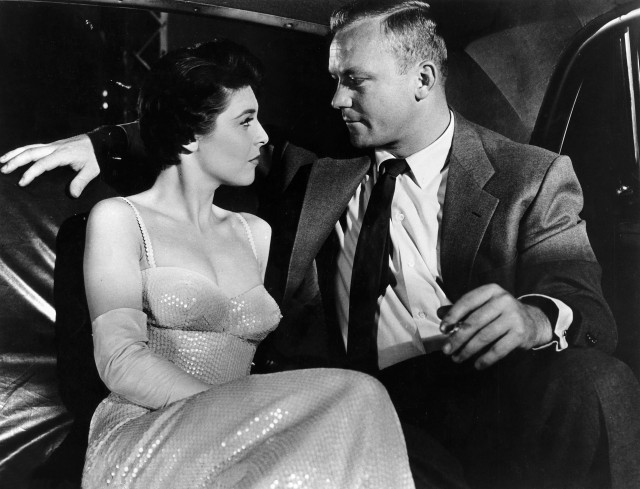
Anne Bancroft and Aldo Ray in NIGHTFALL

Coming Up on TV: 3 noir classics

OUT OF THE PAST

On May 7, Turner Classic Movies is broadcasting three classics of film noir.

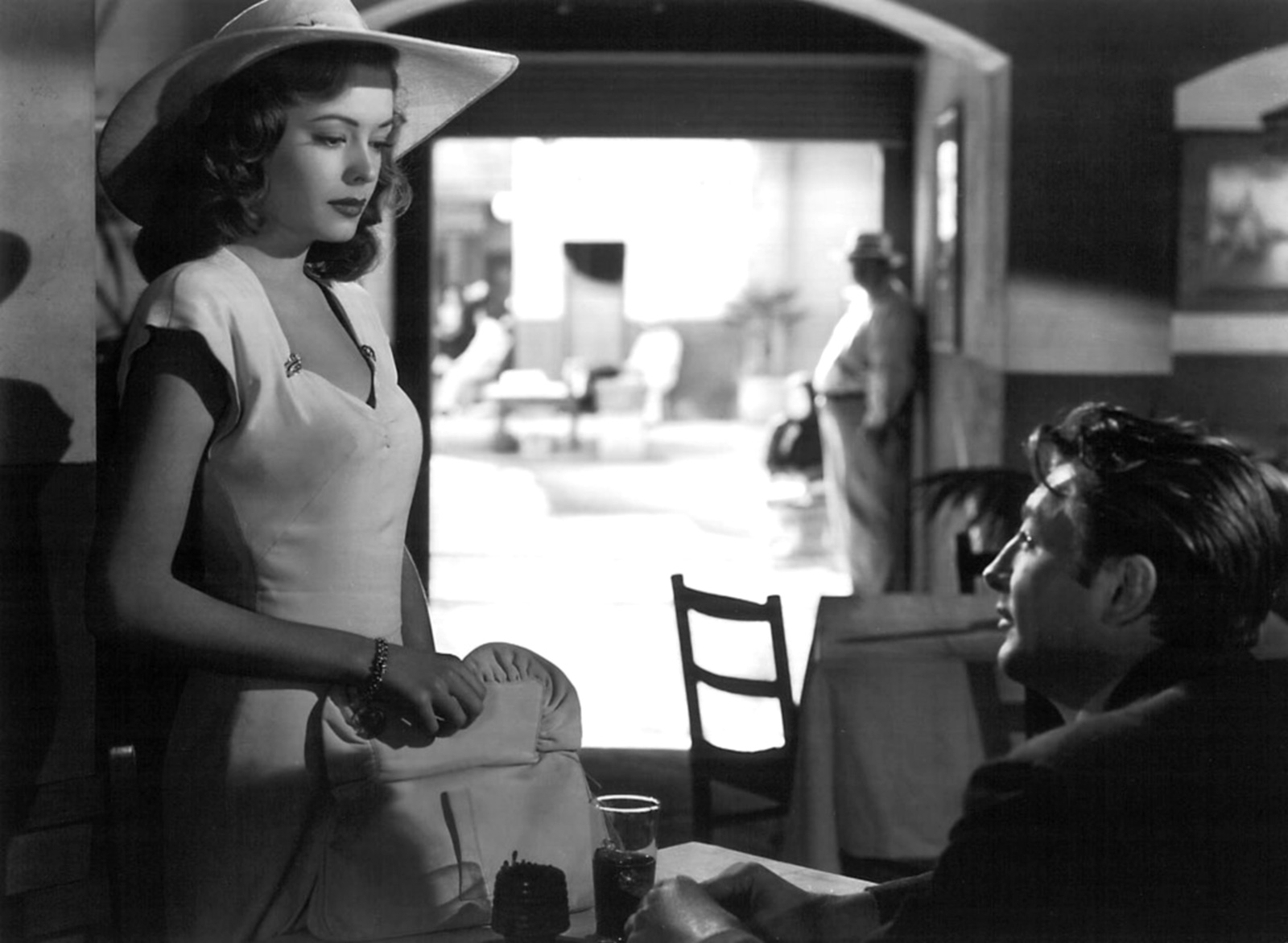
You really haven’t sampled film noir if you haven’t seen Out of the Past (1947).  Perhaps the model of a film noir hero, Robert Mitchum plays a guy who is cynical, strong, smart and resourceful – but still a sap for the femme fatale…played by the irresistible Jane Greer.  Greer later reported that she received this guidance from director Jacques Tourneur: “First half of the picture – good girl.  Second half – bad girl.”  Kirk Douglas plays The Bad Guy You Don’t Want to Mess With, emanating a mix of evil and power.  With Out of the Past, Tourneur crafted one of the most dramatically lit and photographed noirs – not one puff of cigarette smoke goes uncelebrated.

THE ASPHALT JUNGLE

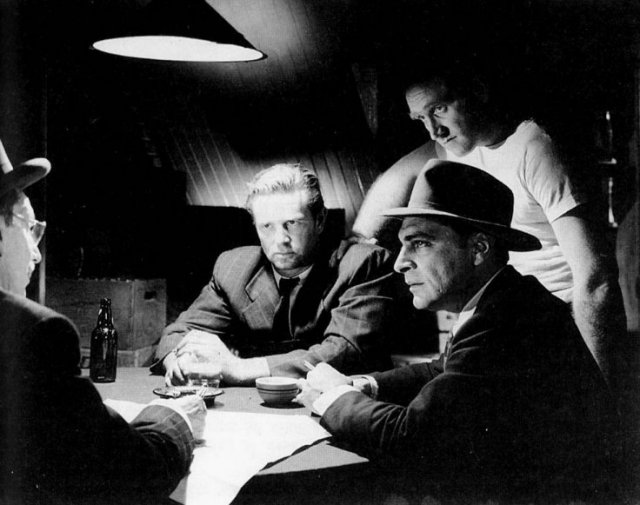
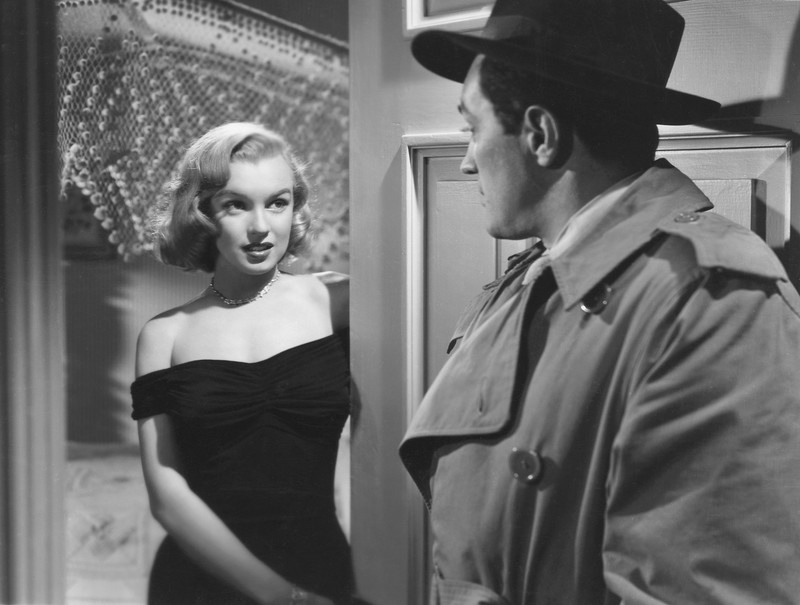
In The Asphalt Jungle (1950), the crooks assemble a team and pull off the big heist…and then things begin to go wrong.  There aren’t many noirs with better casting – the crooks include Sterling Hayden, Louis Calhern, Sam Jaffe and James Whitmore.  The 23-year-old Marilyn Monroe plays Calhern’s companion in her first real speaking part.  How noir is it? Even the cop who breaks the case goes to jail.  Directed by the great John Huston.

Every police procedural from 1948 through today’s Law and Order and CSI owes something to the prototypical The Naked City (1948). Tenacious New York City cops solve a murder amid gritty streets and shady characters. Unusual for the time, it was shot on location.   Directed by noir great Jules Dassin, The Naked City won Oscars for black and white cinematography and film editing.

THE ASPHALT JUNGLE

Fuzz Track City: I’ll have another Monte Cristo, please

In the darkly comic Fuzz Track City, writer-director Steve Hicks riffs on the conventions of the detective genre to celebrate the most offbeat sides of LA.  Our hero could be a hard-boiled detective if he were more alert.  But Murphy Dunn (Todd Robert Anderson) is preoccupied with the death of his partner and the end of his marriage, two numbing losses that stem from betrayals.   It takes all of his remaining energy to order his daily Monte Cristo sandwich at the diner.

Look elsewhere for Hollywood gloss.  As Dunn searches for the MacGuffin, the B-side of a failed rock band’s long lost 45, he never enters a Bel Air estate.  Instead, he pads about the most ordinary neighborhoods of Burbank and Arcadia.  His office isn’t in an art deco office building – it’s in a strip on the run down Lankershim Boulevard.  Dunn doesn’t drive down storied Mulholland Drive or Sunset Boulevard; his bliss is cruising Ventura Boulevard.

Dunn is a lovable loser, still wearing his high school hair and driving his high school beater.  He’s so inexpert with his fists and gun that he needs to get bailed out of a bad situation by his extremely pregnant ex-wife (Tarina Pouncy).  The ex-wife witheringly says “take off those sunglasses – they don’t make you look cool” (and she’s right).     When he becomes the last LA resident to get a cell phone, he treats it as if it were about to explode.

Along the way Dunn encounters a series of oddballs.  One is an agoraphobic vinyl record collector (Josh Adell) who “hasn’t left Burbank in seven years or his house in three” and who scampers about in his tidy whities.  Another is a trailer-dwelling former musician (Dave Florek) whose idea of hospitality is to offer a choice of variously colored mouthwashes.  Abby Miller (Ellen Mae in Justified) brings some kooky originality to the role of the sad sack waitress.  And then there’s the object of Dunn’s schoolboy crush – his high school guidance counselor (Dee Wallace).

As he toys with the tropes of detective fiction, filmmaker Hicks takes us on a leisurely journey through the San Fernando Valley that finally crescendos into an uproarious climax.  It’s a fun ride.

DVD of the Week: The Paperboy

Set in 1969 Florida, The Paperboy is a coming of age film nestled within a deliciously pulpy crime drama.  The story is centered around an overlooked younger son (talented up-and-comer Zac Efron) who is thrilled when his older brother (Matthew McConaughey) returns to their swampy backwater after making it in the big time of Miami.  The older brother is an investigative reporter who seeks the truth about a sensational death row case.

The strength of the film is in the supporting characters.  David Oyelowo plays the older brother’s cynical and self-absorbed partner.  John Cusack’s death row inmate is utterly animalistic, a real departure for Cusack.  Nicole Kidman plays the convict’s pen pal fiance; the younger brother falls for her, but she’s apparently screwing everyone except him.

But the surprise performance in The Paperboy is by recording artist Macy Gray, who plays the family domestic.  With complete authenticity, Gray is playful, hurt, dignified, angry, funny, tough, cagy and vulnerable and, as the narrator, she keeps the movie together.  It’s a really superb performance, and I look forward to seeing Gray in more high profile parts.

This is director Lee Daniels’ follow up to his heart rending Precious.  Once again, his  character driven story-telling is first rate.  The Paperboy is dark, violent, sexy and gripping with vivid characters.

Watch for Kidman’s particularly alarming treatment for jellyfish stings.

The Paperboy: a trashy Nicole Kidman and a canny Macy Gray

Set in 1969 Florida, The Paperboy is a coming of age film nestled within a deliciously pulpy crime drama.  The story is centered around an overlooked younger son (talented up-and-comer Zac Efron) who is thrilled when his older brother (Matthew McConaughey) returns to their swampy backwater after making it in the big time of Miami.  The older brother is an investigative reporter who seeks the truth about a sensational death row case.

The strength of the film is in the supporting characters.  David Oyelowo plays the older brother’s cynical and self-absorbed partner.  John Cusack’s death row inmate is utterly animalistic, a real departure for Cusack.  Nicole Kidman plays the convict’s pen pal fiance; the younger brother falls for her, but she’s apparently screwing everyone except him.

But the surprise performance in The Paperboy is by recording artist Macy Gray, who plays the family domestic.  With complete authenticity, Gray is playful, hurt, dignified, angry, funny, tough, cagy and vulnerable and, as the narrator, she keeps the movie together.  It’s a really superb performance, and I look forward to seeing Gray in more high profile parts.

This is director Lee Daniels’ follow up to his heart rending Precious.  Once again, his  character driven story-telling is first rate.  The Paperboy is dark, violent, sexy and gripping with vivid characters.

Watch for Kidman’s particularly alarming treatment for jellyfish stings.

Killer Joe: OMG

Here’s a movie that will either thrill or disgust you. Either way, you sure ain’t gonna be bored.

In Killer Joe, Thomas Haden Church, Gina Gershon and Emile Hirsch play a white trash family with a get rich quick scheme.  They give a hit man (Matthew McConaughey) the teen daughter (Juno Temple) as a deposit.  They’re all as dumb as a bag of hammers, so what could go wrong?

Killer Joe was directed by William Friedkin (The French Connection, The Exorcist) and shot by cinematographer Caleb Deschanel (The Right Stuff, The Natural) in just 20 days.  These guys know how to tell a story, and Killer Joe pops and crackles.

Killer Joe is rated NC-17 for good reason and Friedkin accepts the rating without complaint.  Indeed, Killer Joe has its share of Sam Peckinpah style screen violence and an unsettling deflowering scene.  But the piece de resistance is an over-the-top sadistic encounter between McConaughey and Gershon involving a chicken drumstick,  at once disturbing and darkly hilarious.   But Sam Fuller and Quentin Tarantino would have loved it, and so did I.  Nevertheless, some viewers will feel like they need a shower after this movie.

The cast does a good job, but the picture really belongs to McConaughey and Temple.  McConaughey is currently recalibrating his career a la Alec Baldwin – he’s moving from playing pretty boys in the rom coms to taking meatier, more interesting roles.  He is both funny and menacing as Killer Joe (and I liked him in Bernie and Magic Mike, too).  I’m really looking forward to seeing him in Mud and The Paperboy.

The movie slowly makes Juno Temple’s character more and more central, until she takes command of the denouement.  Temple is always sexy (Kaboom and Dirty Girl), and here she is able to ratchet down her intelligence to play a very simple character, always exploited by others, who is finally empowered to take control.

I saw Killer Joe at a screening where Friedkin said that the screenwriter saw Juno Temple’s character as the receptacle for all feminine rage.  Friedkin himself sees it as a Cinderella story – just one where Cinderella’s Prince Charming is a professional killer.  hat’s all pretty deep sledding to me – I see Killer Joe as a very dark and violent comedy – kinda like In Bruges with twisted sex.

DVD/Stream of the Week: This Is Not a Robbery

After 87 years of abiding the law, J.L. “Red” Rountree robbed a bank in 1998.  In fact, he became a serial bank robber, robbing banks until his final incarceration at age 92.  The documentary This Is Not a Robbery explores how this could have happened.  Spoiler: nonagenarians do not excel at the art of the getaway.

Cleverly structured, This Is Not a Robbery intersperses the modern robberies with biographical segments that finally reveal the arc of Rountree’s singular journey.  We get to see Rountree explaining himself. He’s a kick, but the most revealing comments are from his friends, who relate the pivotal points in his business career and family life.

At only 70 minutes long, it’s a good watch.  This Is Not a Robbery is available on DVD, on Netflix streaming and sometimes plays on the Sundance Channel.

Elena: a vividly dark peek into contemporary Russia

Elena is a superbly crafted film that vividly peeks into a dark, very dark contemporary Russia.  Directed and co-written by Andre Zvyagintsev (The Return), Elena is the triumph of drama over melodrama.  There is an absolute minimum of on-screen action and no histrionics at all, yet the story simmers throughout.

Zvyagintsev builds the story upon his characters.  It is set in a toney apartment in a quiet upscale Moscow neighborhood, home of Vladimir and Elena.  Vladimir is pushing 70 and rich.  I doubt that any softies got rich in post-Soviet Russia, and Vladimir is a hard man, devoid of sentimentality except for his estranged daughter.   Late in life, he has married the working class Elena, his one-time nurse, now in her 50s.  They have a comfortable, frank, affectionate and practical relationship.

Both have adult children from previous marriages.  Vladimir’s daughter Katerina has no use for her father, but he subsidizes her lifestyle of perpetual partying.  Vladimir and Katerina finally share a moment, bonding over their shared cynicism.

Elena’s nogoodnik son Sergey lives in a hard scrabble suburb and embraces his chronic unemployment with alarming indolence.  His equally lazy and selfish teenage son, having an indifferent high school career, is now facing the dreaded Army unless someone can bribe his way into a college.

Elena is desperate to rescue her grandson from his self-inflicted predicament, but only Vladimir’s money can help, and Vladimir despises Elena’s trashy and shiftless family.  The movie is built on this conflict, and it is Elena’s story.   As Elena, the actress Nadezhda Markina reveals Elena’s affection, desperation and determination with her eyes, face and movements.  Perfectly framing Markina’s outstanding performance by isolating it, Zvyagintsev delivers the film in a series of long shots, with terse dialogue and a spare soundtrack. There is no expository dialogue explaining the plot or swelling music manipulating our reaction.

Elena is a dark movie that asks its audience to invest patience, thought and energy – so it’s not for everybody.  Elena is also one of the year’s best films, and an extraordinary example of a very pure breed of filmmaking.