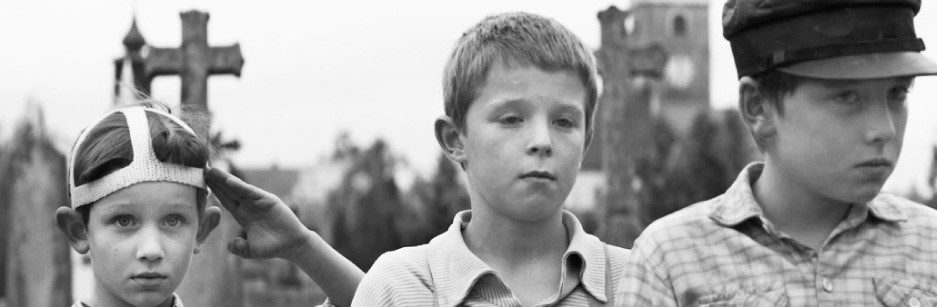
The excellent Czech historical drama Barefoot is from director Jan Sverák, who won an Oscar for Kolya. It’s the coming of age story of a small boy named Eda and is set during World War II. The local puppets collaborating with the Nazis make it impossible for Eda’s father to stay in the city, so he moves his family to his rural home village.
In the countryside, Eda develops a gang of buddies and meets his mysterious uncle Wolf. In the city, Eda’s father had been courageous – even risking his life – to undermine the Nazis; but, in the village, the father is completely submissive to his own father and the rural extended family.
The war is in the background, occasionally protruding into the forefront. The Germans are on their heels and a Russian victory is inevitable, but the Germans are still in control and dangerous.
We follow the story through the boy’s lens, and there’s an effective balance of humor and drama. Whether in wartime or peacetime, a boy must grow and learn life lessons and form his character.
I saw Barefoot at Cinequest, where Director of Programming Mike Rabehl secured the rare black-and-white director’s cut. The black-and-white is splendid, and there’s a sleigh ride scene that is magical.
Barefoot, which is way better than the Oscar winner Kolya, is another gem from Cinequest’s international film scout Charlie Cockey. It doesn’t yet have distribution in the US, but I’ll let you know when it’s available to US audiences.
A less-remembered moment in human history makes for a great story in Joe Wright’s Darkest Hour, which takes place entirely in May 1940, the period after the German blitzkrieg through the Low Countries on the way to Paris and just before the Dunkirk evacuation.
It’s not always easy today to remember that there was a time when it appeared that Hitler would win WW II. In May 1940, the Nazi empire had swallowed essentially all of Central and Western Europe except for France, which was teetering on the verge of imminent surrender. The entire British Army was trapped, surrounded on a French beach across the Channel.
The UK was both damaged and entirely isolated. Stalin had split Poland with Hitler, and it was over a year before Hitler’s invasion of the USSR. It was also 19 months before Pearl Harbor brought the US into the war. With no hope of external help, Winston Churchill even publicly contemplated the war being carried on by the Commonwealth nations after the German conquest and occupation of the island of Britain.
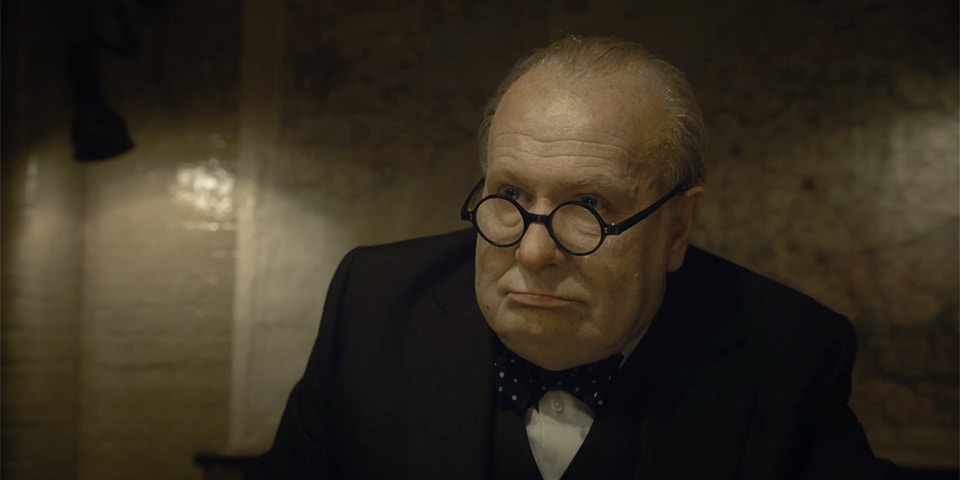
in Darkest Hours, Winston Churchill (Gary Oldman in a superb, Oscar-worthy performance) has just become Prime Minister. At the time, Churchill was a 66-year-old who had peaked at forty. He had been a superstar daredevil in his twenties who squandered his celebrity in a career dotted by Bad Gambles, where he had repeatedly gone All In and lost all of his chips. By 1940 he was well-known for engineering a horrific military disaster at Gallipoli in WW I and for a series of political party changes. Not the confidence-inspiring figure we think of today.
So in this situation, what to do? One option was to embark on what one could rationally conclude would be a suicidal course of waging aggressive war and risking obliteration. Another option would be to negotiate the most favorable surrender with Nazi Germany. No good choices here.
If Churchill begins trash talking the Germans just before their invasion, is that delusional or intellectually dishonest? Or a moment of inspired leadership?
Churchill’s selection as Prime Minister was forced on the former Prime Minister Neville Chamberlain and his top foreign affairs expert Lord Halifax, and the two were understandably concerned that Churchill might be leading the nation to its (literal) ruin. They lay a trap, but great politicians like Lincoln and Churchill do not let themselves be trapped.
The core of Darkest Hour is Churchill probing for a solution while under the most oppressive stress and pressure. In Darkest Hour, his outsized personality and eccentricities sprinkle the story with humor. Churchill, well-known for consuming a bottle of champagne with both lunch and dinner and working, slugging down brandy and whisky, late into the night, is shown having breakfast eggs with champagne and whisky. When the King, at lunch, asks him, “How do you manage drinking during the day?”, Winston replies, “Practice”.
Oldman is as good as any of the fine actors who have played Churchill. Kristin Scott-Thomas is especially excellent (no surprise here) as Churchill’s wife of then 32 years, Clementine. Lily James (Lady Rose in Downton Abbey) is appealing as the fictional secretary through whose eyes the audience sees the private Churchill. Ben Mendelsohn is very good as King George VI, who has watched Churchill’s career to date askance. Stephen Dillane is particularly good as Lord Halifax,
There is one especially touching, but wholly phony scene with a “poll” in the Underground, but, other than that, Darkest Hour is very solid history.
Joe Wright is a fine director, and, here, has selected a moment in history that has sparked an exceptionally good movie. I saw Darkest Hours with a multiplex audience, which erupted into a smattering of applause at the end.
In Dunkirk, Christopher Nolan has written and directed a gripping historical thriller, somehow both personal and vast. It’s a remarkable achievement of both storytelling and filmmaking. Nolan chooses to tell us the story through the lenses of a few minor participants without losing any of the epic sweep of the event.
Dunkirk is the story of one of World War II’s most pivotal events. It’s May, 1940 – over a year before Hitler invaded Russia and over a year-and-a-half before the US entered the war. German forces have swept across Europe and now control the entire continent. It’s very thinkable that Germany will invade Britain. Germany is winning, and it’s more plausible than not that Germany will win the war.
The Germans have trapped a British/French army of 400,000 on a beach in France, certain to be captured or annihilated. The British navy has the capacity to evacuate 40,000 of them in the best case. But the best case can’t be operationalized because, when the British load 800 soldiers on a destroyer, German bombers and submarines sink it. So the British resort to a desperate measure by enlisting 700 small civilian boats – fishing boats, pleasure craft, trawlers, ferries and tugs – to cross the English Channel and pick up the soldiers from an active battle zone. Amazingly, it worked and 340,000 of the troops were rescued, saving them to deter a German invasion of Britain.
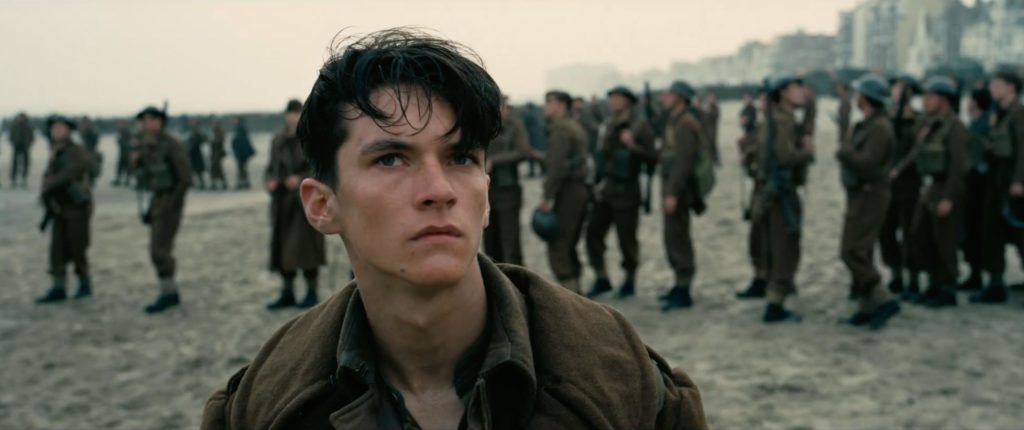
Nolan shows us every conceivable peril faced by the rescuers and the rescued, from aerial bombardment to submarine attack. He starts us following a couple of ordinary infantrymen (Fionn Whiteheand and Aneurin Barnard). When they find a wounded man on the beach, they look at each other wordlessly, toss him on a stretcher take off at the full run for a waiting naval vessel; it’s not spelled out, but they aren’t being selfless – they are trying to jump the line to the ship and get evacuated before hundreds of thousands of other men. They learn that getting off the beach isn’t that easy. Soon, Nolan weaves in a determined civilian heading his tiny boat across the English Channel (the great actor Mark Rylance) and the RAF fighter pilots (the commander played by Tom Hardy) who try to protect the beaches and the evacuation vessels. It’s a race against time for each of the characters as they navigate hazard after hazard, and the experience throbs with intensity
Dunkirk is very historically accurate, although the story has been compressed to a couple of days, and the actual evacuation took over a week. Nolan jumbles his timelines, and sometimes we are jarred by moving from daytime in one story thread to nighttime in another. But the threads eventually converge.
In particular, the depiction of aerial warfare is extraordinary, including what it must have been like inside a cockpit that is hit by enemy fire. Dunkirk contains probably the best ever movie shot of a plane ditching in the ocean. We see what it must have been like to be on a ship sunk by submarine torpedo (hint: much less romantic than Titanic‘s sinking). The Germans employed a Stuka dive bomber, which was outfitted with sirens to terrify its victims on the ground or sea; Dunkirk actually replicates the scream of the Stuka’s sirens very convincingly.
Rylance is superb and the rest of the cast does very well, including Cillian Murphy as a shell-shocked soldier and Kenneth Branagh as an embattled naval commander.
Near the end of Dunkirk, a fighter plane runs out of fuel and glides across the beachfront in one of the most beautiful series of shots in recent cinema.
Dunkirk is that rare breed – a white knuckler with relateable characters and historical integrity. It’s one of the very best films of 2017.
My video pick for Memorial Day Week is Mel Gibson’s powerful Hacksaw Ridge. Just before the 2017 Oscars, The Wife and I finally got around to watching Hacksaw Ridge, which had been nominated for a Best Picture Oscar. Before you see this movie, you need to know that it’s a true story – otherwise you wouldn’t believe it. It’s the story of American Army Medic Desmond T. Doss who single-handedly rescued 75 fellow soldiers at the Battle of Okinawa and became the first Conscientious Objector in American history to be awarded the Congressional Medal of Honor.
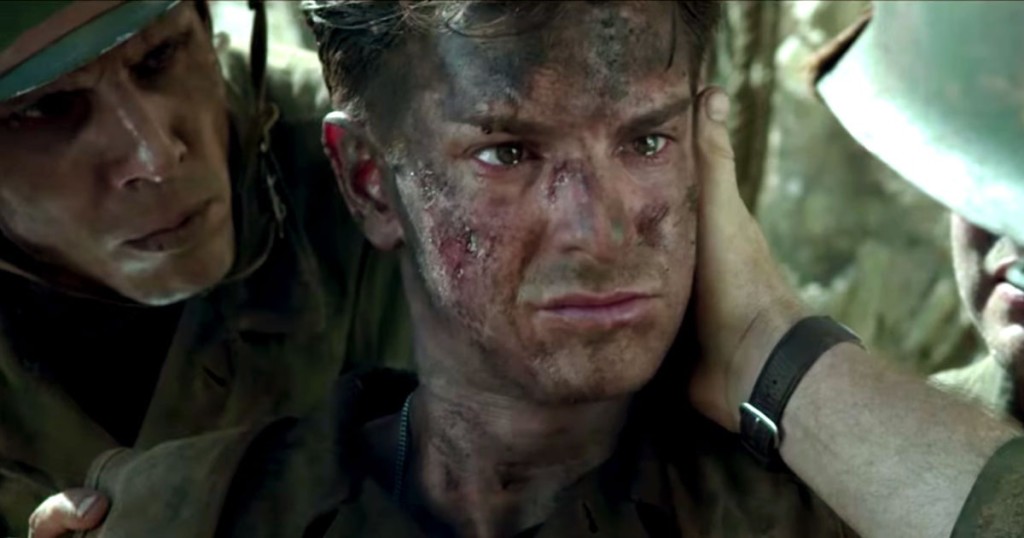
Hacksaw Ridge shows Doss (Andrew Garfield) growing up in rural Virginia as a devout Seventh Day Adventist. After Pearl Harbor, Doss feels compelled to serve his country but, as a religious pacifist, he can’t sign up for combat. So he enlists as a conscientious objector to become a combat medic. He’s thrown into a combat unit for training and endures bullying from both his officers and his fellow troops.
Doss and his unit are ordered into the Battle of Okinawa. They must climb a 350-foot cliff on cargo netting, The Americans can carry up radios, bazookas, machine guns and flamethrowers but not anything heavier than that. The Japanese are not contesting the climb up because they have set up a killing field on the ridge-top, which they have fortified with concrete pill-boxes. The Japanese have also constructed a network of tunnels, in which they can wait out the US naval artillery bombardments.
It’s a blood bath. Historically, this was an extraordinarily brutal battle – even by War in the Pacific standards. And so director Mel Gibson, who never shies away from violence, graphically depicts that violence. Of course, being Mel, he can’t resist a few completely gratuitous moments, including a hara-kiri and the very cool-looking slo-mo ejection of casings from an automatic weapon. But, generally, the movie violence is proportionate to the real-life violence.
Nevertheless, the real focus is on the bravery of the US troops, of which Doss’ is extraordinary. Their and his courage to climb the cliff a SECOND time – after learning what it is like on top – is unimaginable.
Andrew Garfield is superb as Doss, playing him with a goofy and infectious grin, whose niceness and sweetness masks formidable strong will. I’ve never see him as Spider-Man, but Garfield’s work in Red Riding, The Social Network, 99 Homes and now Hacksaw Ridge has been very impressive.
There isn’t a bad, or even mediocre performance in Hacksaw Ridge. You can’t tell that Aussies Teresa Palmer, Hugo Weaving and Rachel Griffiths (Brenda in Six Feet Under) aren’t from Blue Ridge Virginia. Sam Worthington and Vince Vaughn are especially good as Doss’ commanders.
I’ve been a fan of Hugo Weaving since he so compellingly played a blind man in the 1991 Proof (also our first look at a very young Russell Crowe). Since then, Weaving has earned iconic roles in the Matrix movies and V for Vendetta and is usually the most interesting performer in big budget movies. Here Weaving plays Doss’ father, not just as the mean drunk who terrorizes his family, but as a vet still reeling from the PTSD of his own WWI combat experience.
Hacksaw Ridge deservedly won Oscars for both film editing and sound mixing. Gibson’s directing is excellent, as is the work of cinematographer Simon Duggan (who shot Baz Luhrman’s otherwise dreadful but great-looking The Great Gatsby).
Make sure that you watch through the epilogue and closing credits to see and hear the real life folks portrayed in the film.
You can rent Hacksaw Ridge on DVD from Netflix and Redbox or stream it from Amazon, iTunes, Vudu, YouTube and Google Play and DirecTV.
[SPOILER ALERT: I have also read on the Internet about something that is NOT in the movie. Reportedly, when Doss was being evacuated by stretcher after being wounded by the grenade, he ROLLED OFF the stretcher when he passed another wounded soldier and demanded that the stretcher bearers take the other guy. Doss then CRAWLED the final 300 yards to the cargo netting to rescue himself. Again reportedly, Mel Gibson kept this out of the movie because he thought the audience just couldn’t be expected to believe that it really happened.]
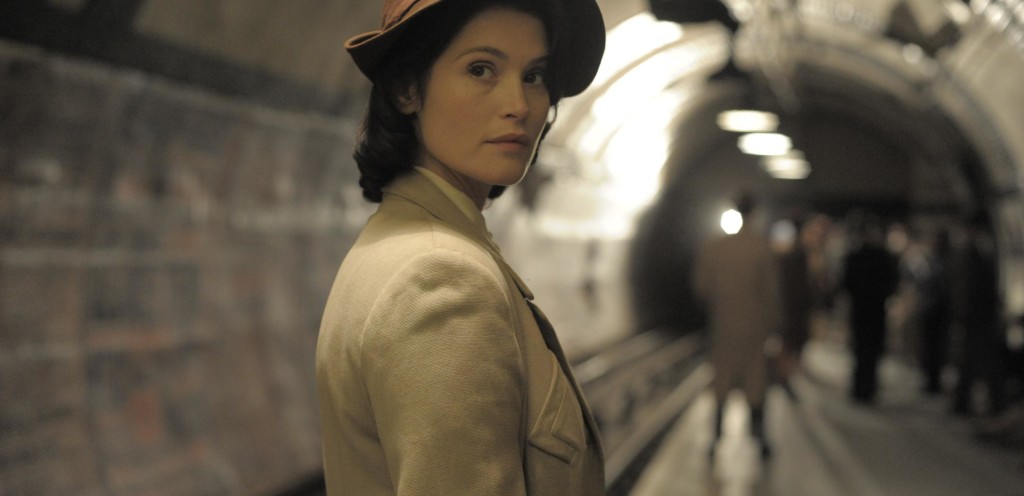
Rosie the Riveter meets Nora Ephron in Their Finest, where Gemma Arterton plays a wannabe secretary summoned to write the female dialogue in a British propaganda movie aimed at easing America into WW II. Of course, she discovers that she has a gift for screenwriting and a passion for it. As in Mad Men, there are plenty of snickers at the assumed sexism the of the era. The driven lead writer (Sam Clafton) is a contrast to her nogoodnik common law husband (Jack Huston).
Originally, the plot of the movie-within-the movie is set to be a more or less true (okay – less true) account of the Dunkirk seaborne rescue, but a hook for American audiences is required. So the filmmakers slap on a superfluous character to be played by a bonafide war hero (Jake Lacy): he’s a real hero, he’s American, he’s stunningly handsome with a gleaming smile, but he’s absolutely talentless.
One of the sound reasons to watch any movie, and this especially applies to Their Finest, is Bill Nighy. Here, he plays a vain actor sliding down the down slope of his career. Nighy, as always, is able to summon both hilarity and poignancy, from his character’s foibles and vulnerability.
I’ve always liked Gemma Arterton, and she’s good here, too. Arterton is an underappreciated actress, with winning roles in Gemma Bovary, Tamara Drewe and as the Bond Girl in Quantum of Solace.
Their Finest contains elements of the romance, comedy, historical and Girl Power genres. The romantic element might have worked had not Sam Clafton delivered such a one-note performance. Jack of some aspects and master of none, Their Finest is a harmless and appealing diversion.