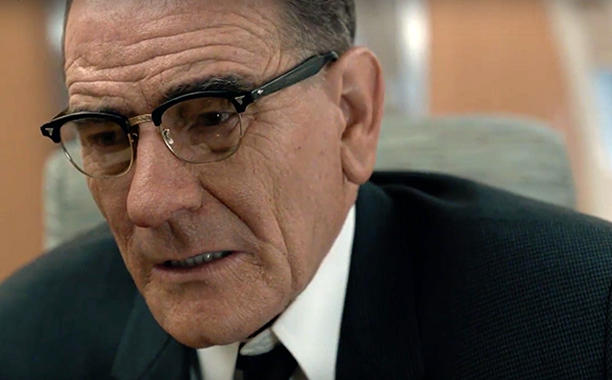
ALL THE WAY: LBJ comes alive

Bryan Cranston in ALL THE WAY

Lyndon B. Johnson, one of American history’s larger-than-life characters, finally comes alive on the screen in the HBO movie All the Way. Bryan Cranston (Breaking Bad, Trumbo) is the first actor who captures LBJ in all his facets – a man who was boring and square on television but frenetic, forceful and ever-dominating in person.  All the Way traces the first year in LBJ’s presidency, when he ended official racial segregation in America with the Civil Rights Act of 1964.

LBJ was obsessed with gaining and keeping political power, and he was utterly ruthless and amoral about the means to do that. His tools of persuasion included deceit, flattery, threats, promised benefits and horse-trading. He was equally comfortable in playing to someone’s ideals and better nature as well to one’s vanity or venality. In All the Way, we see one classic moment of what was called “the Johnson treatment”, when LBJ looms over Senator Everett Dirksen, and it becomes inevitable that Dirksen is going to be cajoled, intimidated or bought off and ultimately give LBJ what he wants.

LBJ was so notoriously insincere that one of the joys of All the Way is watching LBJ tell completely inconsistent stories to the both sides of the Civil Right battle. Both the Civil Rights proponents (Hubert Humphrey and Martin Luther King, Jr.) and the opponents (the Southern Senators led by Richard Russell) must determine whether LBJ is lying and to whom. Each of them must make this calculation and then bet his own cause on his perception of LBJ’s real intentions.

But LBJ amassed power for two reasons – he needed to have it and he needed to do something with it. Along with the LBJ’s unattractive personal selfishness and the political sausage-making that some may find distasteful, All the Way shows that Johnson did have two core beliefs that drove his political goals – revulsion in equal parts to discrimination and poverty. We hear references to the childhood poverty that led to the humiliation of his father, to the plight of the Mexican schoolchildren in Cotulla, Texas, that he mentored as a young man, and his outrage at the discriminatory treatment suffered by his African-American cook Zephyr.

Bryan Cranston brilliantly brings us the complete LBJ – crude, conniving, thin-skinned, intimidating and politically masterful. Besides Cranston’s, we also see superb performances by Melissa Leo as Lady Bird, Anthony Mackie as MLK, Bradley Whitford as Hubert Humphrey and Frank Langella as Richard Russell.

All the Way is remarkably historically accurate. It does capsulize some characters and events, but the overall depiction of 1964 in US history is essentially truthful. As did Selma, All the Way drills down to secondary characters like James Eastland and Bob Moses. We also see the would-be scandal involving LBJ’s chief of staff Walter Jenkins, a story that has receded from the popular culture. Vietnam is alluded to with a reference to the Gulf of Tonkin incident, which is fitting since Vietnam grew to become LBJ’s nemesis and the national obsession only after the 1964 election.

All the Way was adapted from a Broadway play for which Cranston won a Tony. I saw three movies in theaters last weekend and none of them were as good as All the Way. LBJ’s 1964 makes for a stirring story, and All the Way is a compelling film. Seek it out on HBO.
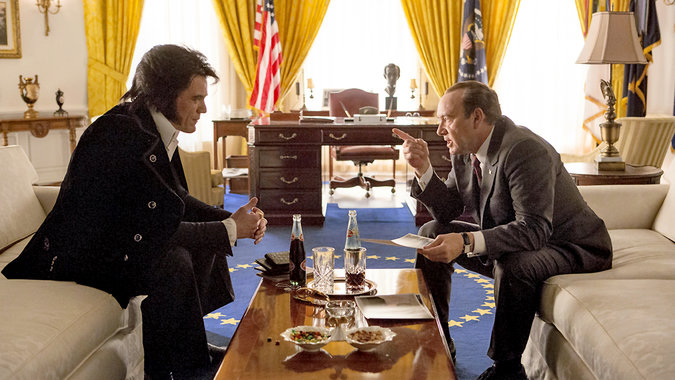
ELVIS & NIXON: the eccentric meets the quirky

Michael Shannon and Kevin Spacey in ELVIS & NIXON

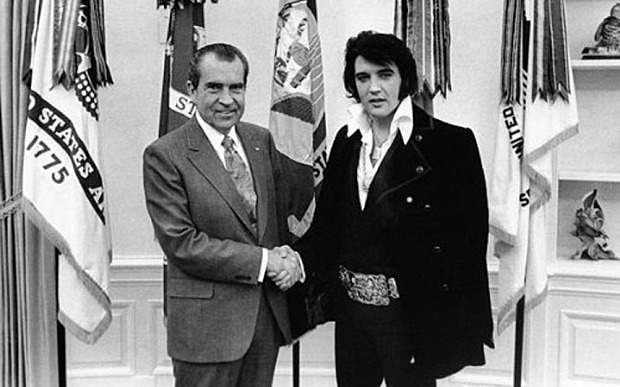
In December, 1970, an addled Elvis Presley was isolated and indulged by his hangers-on and feeling cranky enough to shoot out a TV set in Graceland.  He decided that he needed a “federal agent at large” badge, and his quest sparked an impromptu visit to the Nixon White House, resulting in the all-time most requested photo from the National Archives (below).  All this really happened, and the historical comedy Elvis & Nixon imagines the details, with the iconic characters fleshed by two of our finest screen actors, Michael Shannon (Elvis) and Kevin Spacey (Richard Nixon).

In the movies, Shannon usually projects a hulking menace, but here he uses his imposing presence to dominate and suck the oxygen out of a room.  Of course, Shannon doesn’t have the sexual energy of Elvis, but his intensity makes up for it.  As impaired and wacky as Shannon’s Elvis is, he can be a charming flatterer and knows how to make the most of his celebrity and sexual power.  He wins over Nixon by bringing up their common distaste for commies and the Beatles, and shamelessly complementing Nixon’s homely looks.

Spacey goes beyond impersonation of Nixon’s well-known mannerisms to reach the seasoned pol, the cagey and amoral tactician, the doting father,  and, above all, a man submerged in an unquenchable pool of resentfulness.  In particular, Spacey perfectly delivers one classically Nixonian chip-on-the-shoulder monologue.  And few can portray social awkwardness as well as Spacey.

In Elvis & Nixon, Nixon forces himself to keep a straight face as Elvis explains that “I want to go undercover”.  Because his movie experience has given him a mastery of disguises, Elvis continues, he can infiltrate the Rolling Stones and the Black Panthers, slipping back and forth between them with no one the wiser.   [Note: There were only five Rolling Stones – wouldn’t they have noticed a sixth one?]  The real Elvis reportedly coveted the federal badge so he could take his guns and drugs on airplanes.

The two men size each other up and probe.  Each man is using the meeting for his own ends.  The humor comes from Elvis’ eccentricities and the hopelessly square and insecure Nixon’s reactions.

Elvis & Nixon is not a guffaw fest, but it has a few LOL moments.  Otherwise unadorned, the Elvis-Nixon meeting itself is bizarre enough, but Shannon and Spacey make it especially worthwhile.

elvis nixon

Stream of the Week: TRUMBO – the personal cost of principles

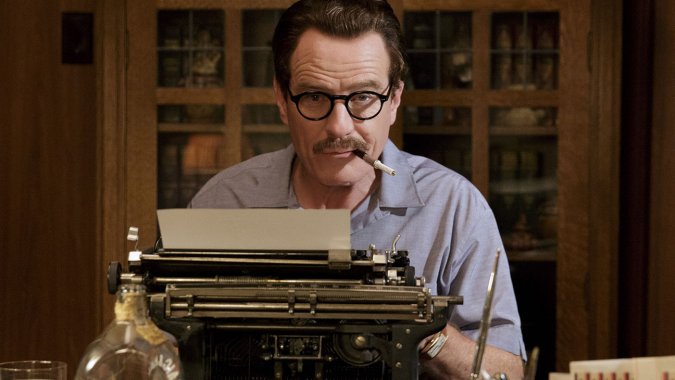
Bryan Cranston in TRUMBO

In the movies, going to jail for your principles is overrated. But in the historical drama Trumbo – about the 1950s Hollywood blacklist – we get to see the real extent of the sacrifices made by the principled man and his family.

Dalton Trumbo (Bryan Cranston) was a novelist and Hollywood screenwriter who was named as a Communist, was sent to prison for contempt of Congress and then blacklisted by the Hollywood studios. After prison, Trumbo had to earn his living by writing without credits (the credit going to other writers as “fronts” or to fictional “writers”). He received no screen credit for the Oscar-winning screenplays for Roman Holiday and The Brave One. Nor for the noir classics Gun Crazy and The Prowler. Eventually, the end of the blacklist period was signaled when Trumbo received screen credits for his work on Exodus and Spartacus.

It’s a compelling story and Trumbo was a very compelling character – flamboyant, full of himself, wily but sometimes politically naive. Cranston is really quite brilliant in capturing Trumbo’s wit, signature eccentricities and his emotional turmoil.

Families are often collateral damage, and that was the case here. We see the impact on Trumbo’s wife (Diane Lane) and daughter (Elle Fanning) – not just the financial and social hardships, but in living with a man under so much stress.

To tell the story of this historical period, some characters are compressed – but not distorted. Hedda Hopper (Helen Mirren) is portrayed as the leader of the blacklist (which would have flattered her), and John Wayne’s (David James Elliot) role is prominent. There’s a composite character who represents the other victims of the blacklist, played by Louis C.K. (another really fine performance from C.K.). Edward G. Robinson (Michael Stuhlbarg) represents the good liberals who caved under pressure and named names. Kirk Douglas (Dean O’Gorman) and Otto Preminger (Christian Berkel) are historical good guys (but not without self-interest). John Goodman has a hilarious turn as a low budget producer. The entire cast does a fine job, but Cranston, Stuhlbarg, C.K. and Fanning are extraordinary.

We see also actual file footage of Ronald Reagan, Robert Taylor and Joe McCarthy, along with some still photos of the ever-ominous Richard Nixon.

Trumbo is a very successful and insightful historical study, and Cranston’s performance was Oscar-nominated.  Trumbo is now available to stream on Amazon Video, iTunes, Vudu, YouTube, Google Play and a host of PPV outlets.

TRUMBO: the personal cost of principles

Bryan Cranston in TRUMBO

In the movies, going to jail for your principles is overrated.  But in the historical drama Trumbo – about the 1950s Hollywood blacklist – we get to see the real extent of the sacrifices made by the principled man and his family.

Dalton Trumbo (Bryan Cranston) was a novelist and Hollywood screenwriter who was named as a Communist, was sent to prison for contempt of Congress and then blacklisted by the Hollywood studios.  After prison, Trumbo had to earn his living by writing without credits (the credit going to other writers as “fronts” or to fictional “writers”).  He received no screen credit for the Oscar-winning screenplays for Roman Holiday and The Brave One.  Nor for the noir classics Gun Crazy and The Prowler.  Eventually, the end of the blacklist period was signaled when Trumbo received screen credits for his work on Exodus and Spartacus.

It’s a compelling story and Trumbo was a very compelling character – flamboyant, full of himself, wily but sometimes politically naive.  Cranston is really quite brilliant in capturing Trumbo’s wit, signature eccentricities and his emotional turmoil.

Families are often collateral damage, and that was the case here.  We see the impact on Trumbo’s wife (Diane Lane) and daughter (Elle Fanning) – not just the financial and social hardships, but in living with a man under so much stress.

To tell the story of this historical period, some characters are compressed – but not distorted.  Hedda Hopper (Helen Mirren) is portrayed as the leader of the blacklist (which would have flattered her), and John Wayne’s (David James Elliot) role is prominent.  There’s a composite character who represents the other victims of the blacklist, played by Louis C.K. (another really fine performance from C.K.).  Edward G. Robinson (Michael Stuhlbarg) represents the good liberals who caved under pressure and named names.  Kirk Douglas (Dean O’Gorman) and Otto Preminger (Christian Berkel) are historical good guys (but not without self-interest).  John Goodman has a hilarious turn as a low budget producer.  The entire cast does a fine job, but Cranston, Stuhlbarg, C.K. and Fanning are extraordinary.

We see also actual file footage of Ronald Reagan, Robert Taylor and Joe McCarthy, along with some still photos of the ever-ominous Richard Nixon.

Trumbo is a very successful and insightful historical study, and Cranston’s performance is Oscar Bait.

SPOTLIGHT: edge of the seat drama

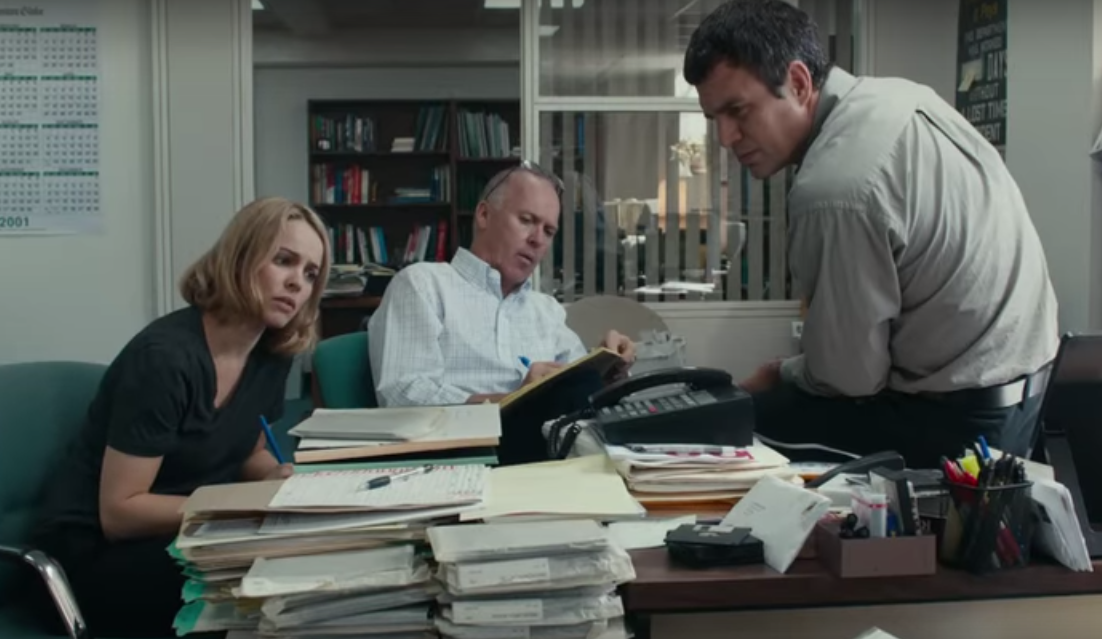
Rachel McAdams, Michael Keaton and Mark Ruffalo in SPOTLIGHT

Bolstered with some superb supporting performances, filmmaker Tom McCarthy turns a journalistic procedural into the riveting. edge-of-your-seat-drama Spotlight. The story centers on a team of Boston Globe investigative reporters (Michael Keaton, Rachel McAdams, Mark Ruffalo, Brian d’Arcy James, John Slattery and LievSchrieiber) as they untangle the sex abuse scandal in the Boston Archdiocese. Starting with the already-known Father Geoghan case, they uncover sexual abuse by two Boston priests, then four, then thirteen and soon an unthinkable magnitude, all intentionally covered up by the Church. Reminiscent of All the President’s Men, the team’s shoe leather efforts nets the Big Story.

We already are familiar with the horrible and disgusting revelations. But writer-director Tom McCarthy builds suspense and keeps us totally engaged in this brilliantly paced movie. McCarthy also wrote and directed the brilliant, character-driven fictional films The Visitor and The Station Agent.

Michael Keaton, coming off his tour de force in Birdman, is especially good here, especially in a reflective scene near the end. McAdams and Schreiber are also solid. Ruffalo has the most showy part, as a frenetic and volatile reporter.

But this most compelling acting comes from several of the supporting players, especially Michael Cyril Creighton, Jimmy LeBlanc and Anthony Paolucci as survivors of sexual abuse. The ever-reliable Jamey Sheridan is superb as a diocesan lawyer. Richard O’Rourke is affecting as an addled pedophile priest. Paul Guilfoyle, so convincing as true blue guys in CSI and Primary Colors, gets to play convincingly smarmy here. I don’t see Richard Jenkins in the credits, but the voice of an expert psychotherapist sure sounds like him.

At the end, McCarthy uses epilogue titles to effectively show the extent of the horrors revealed.

All in all, Spotlight is the first top rate movie of the Fall.

Lee Daniels’ The Butler: exploring race in America

LEE DANIELS

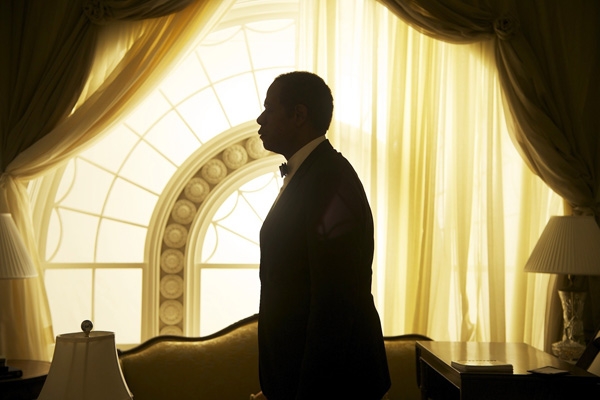
Lee Daniels’ The Butler is an entertaining and satisfying epic that explores the issue of race in America as reflected in the experiences of two men – a man who escaped a Southern cotton farm to become a butler at the White House (Forest Whitaker) and his son (David Oyelowo), who becomes engaged with the racial justice movement from the 60s through the 90s.

What The Butler gets right is the overall sweep of history, and it shines as an accessible history lesson.  We get a taste of American race relations from the 1920s onward, and we glimpse the key moments in Civil Rights history: Little Rock school desegregation, lunch counter sit-ins, Freedom Rides, the JFK and LBJ civil rights speeches and legislation, the King assassination, urban riots,  Black Power and anti-apartheid activism.  The perspectives of the two main characters mirror those of Booker T Washington and W.E.B. DuBois.

Most importantly, The Butler reveals the African-American community as not monolithic, but with different (and conflicting) personality types, political views and generational perspectives.  This is not accomplished very often in popular culture.  Indeed, The Butler is strongest in the family moments – breakfasts, parties, arguments, sending the kid off to college – that allow the cast to bring out the textures of their characters.  (And The Butler is dead-on perfect with all the periods, including the unfortunate fashions of the 1970s.)

That being said, the implausibility of the protagonists’ Zelig-like personal presence at every key historical moment is distracting.  Every time Whitaker’s character brings a cup of coffee into the Oval Office, the President du moment is deciding on sending federal troops into the South, sending a Civil Rights bill to the Hill or some-such.  Oyelowo’s character is a lunch counter sitter, a Freedom Rider, a Selma marcher, a MLK aide at the Lorraine Motel, a Black Panther, a Congressional candidate and an anti-apartheid leader.  The coincidences are so improbable that it’s too much of the audience to suspend disbelief.

Forest Whitaker is a great actor.   Here he perfectly plays a man who has strong feelings that he expresses among Blacks and that he conceals (sometimes stoically, sometimes charmingly) among Whites.  We’ve been watching Whitaker since 1982’s Fast Times at Ridgemont High and his searing Charlie Parker in 1986’s Bird, right through to his Oscar win for The Last King of Scotland.  My personal favorite Forest Whitaker performances are in The Crying Game and Ghost Dog: The Way of the Samurai.

Oyelowo is an actor who has come on strong in the past two years (The Help,The Paperboy, Lincoln),  and here delivers a perfect performance of a man with youthful strong-headedness, self-possessed whether on the right side of history or not. He’s that brave man who does dangerous things without impetuosity.

The African-American cast is a marvel.  Oprah Winfrey is outstanding as the wife/mom, and an Oscar nod is likely. Terence Howard is marvelous as the shady neighbor.  Clarence Williams III (yes, from The Mod Squad) is superb as the butler’s first mentor.  Cuba Gooding Jr and Lenny Kravitz are excellent as White House co-workers with very different personalities.  Mariah Carey, who was unbelievably good as the social worker in Daniel’s Precious, is equally good here as the butler’s tortured mother.

The cast playing the White House’s upstairs residents do not fare so well.  In the movie’s funniest turn, Liev Schreiber captures LBJ’s frenetic energy but not his imposing and sinister physicality.  John Cusack has Nixon’s creepiness but not his painful social awkwardness. Robin Williams  plays Ike without any military bearing or snap. James Marsden plays a pretty, but wimpy JFK.  And is that Alan Rickman as Ronnie?  The one impeccable performance in this category (and Daniels’ sly joke on the Reagans) is Jane Fonda as Nancy.

Overall, it’s an important, if imperfect work by director Lee Daniels (Precious, The Paperboy).  (BTW – the title is not because of his ego – but because of the silly refusal by  another movie studio to grant the title rights.)   At times profound and at times ridiculously improbable, The Butler gets the basic truths profoundly right.

Hannah Arendt: an intellectual argument now stale

HANNAH ARENDT

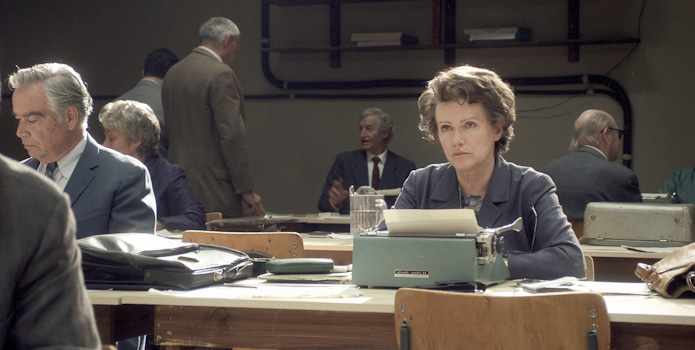
Hannah Arendt is a movie about an intellectual argument that has since been resolved in favor of the title character.  Hannah Arendt was a noted political theorist and a leading thinker on totalitarianism.  In 1961, The New Yorker assigned Arendt (a German Jew who herself avoided the Holocaust by fleeing to the US)  to cover the trail of Nazi war criminal Adolf Eichmann.  Instead of finding Eichmann to be personally monstrous, she saw him as a bureaucratic functionary who failed to think through the monstrous consequences of ordinary tasks; he took pride in successfully loading people on to a train without taking responsibility for sending them to their extermination.  Arendt made Eichmann the poster boy for she coined as “the banality of evil”.

While the banality of evil is is a concept generally accepted today, it caused a furor at the time from those who could not accept that a human catastrophe of the magnitude of the Holocaust could have been enabled by ordinary humans.  Hannah Arendt is the story of that controversy.  Unfortunately, it’s difficult to make a compelling movie about a quibble between intellectuals – and even more challenging when the argument itself has been stale for 40 years.

Arendt had achieved academic status in the 1950s that was remarkable for a woman of the time.  She was also arrogant and tone deaf to political correctness, which helped her step into the controversy.

Arendt is ably played by Barbara Sokowa.  Janice McTeer (Tumbleweeds, Albert Nobbs) gets a much flashier role as Arendt’s loyal friend, the feisty writer Mary McCarthy, and McTeer’s performance is by far the most watchable piece of the movie.

For a much more visceral exploration of the banality of evil, I recommend Blind Spot: Hitler’s Secretary, described in my 5 Essential Holocaust Films.

Hyde Park on Hudson: FDR was never so boring

FDR was our first charismatic celebrity President in the era of radio and newsreels, a man who dominated his tumultuous times and who lived among a fascinating collection of characters.  It’s hard to imagine his life as boring, but it sure is in Hyde Park on Hudson.  Bill Murray is FDR and Lara Linney is his distant cousin and one of his mistresses.  It’s set mostly during the weekend that FDR entertained the King and Queen of England at his country home.  The problem is that the woman that Linney plays was a no-drama wallflower, and that the royal visit, while interesting, was a footnote to the history of the era.  The source material for Hyde Park on Hudson would have made a mildly entertaining one-hour segment on Masterpiece Theater – it’s not worth a visit to the theater.

Argo: the first Must See this fall

Ben Affleck directs and stars in Argo, unquestionably the best Hollywood movie of the year so far.   In this true story from the Iran Hostage Crisis, a down-on-his-luck spy rescues six Americans hiding in the Canadian Ambassador’s Tehran home by pretending to make a cheesy Hollywood sci fi movie. The scenes in Tehran and Washington are pure thriller, leavened by the very funny Hollywood thread.

It’s a gripping story.  Setting up the audacious plan is only the beginning. It must be sold to risk averse government officials.  And it must be sold to the “house guests”, who clearly understand how risky it is.  The diplomats must learn their cover identities as Canadian filmmakers well enough to withstand interrogation.  And the team must be shuttled past layer upon layer of suspicious, trigger happy and completely unpredictable revolutionaries.  Helluva story, well told.

Thanks to director Affleck, editor William Goldberg and cinematographer Rodrigo Prieto, Argo is brilliantly photographed and constructed.It is economical story-telling at its best, with each shot revealing critical information – the lethal chaos in the streets of Tehran, the paralyzing fear of the house guests, the determination of Affleck’s operative.

It’s a deep cast.  John Goodman and Alan Arkin are hilarious as the movie industry guys.  Scoot McNairy and Christopher Denham are especially good as house guests.  Farshad Farahat is compelling as the commander of the final revolutionary checkpoint.  The rest of the cast is equally superb:   Bryan Cranston, Philip Baker Hall, Richard Kind, Michael Parks, Clea DuVall, Adam Arkin, Chris Messina and Victor Garber.  Watch for a bit role played by 80s horror maven Adrienne Barbeau.

This could have been jingoistic, but Affleck starts the movie with an animated historical primer to remind (or teach) the audience about why the Iranians were so angry.  And he generously included another American perspective during the end credits.  Much more nuance than the standard Hollywood movie –  good for Affleck!

Farewell, My Queen: a palace teeters on the brink

This lavishly staged  and absorbing costume drama depicts Marie Antoinette’s Versailles at the onset of the French Revolution.  The story is set during the three pivotal days following the storming of the Bastille.  We view the Upstairs Downstairs of the palace through the eyes of the Queen’s personal reader, played compellingly by Lea Seydoux.  Seydoux’s performance is key to the movies’ success.  When Upstairs, we see her flattering the Queen and observing the Queen’s intimate moments – without becoming an intimate. When Downstairs, we see her unfiltered personality and opinions.

The performance by Diane Kruger as the Queen is equally good.   Her days are designed for her entertainment, and a battalion of servants scurry about to gratify every caprice.  In the days before remote controls, the ADD monarch uses her servant to skip from whim to whim.  She is supreme, but also vulnerable because she craves another person and because she comes to realize that the monarchy itself is threatened.

Virginie Ledoyen plays the Queen’s intimate friend the charismatic social climbing Duchess of Polignac.  In a secondary but essential role, Ledoyen exudes the sexual magnetism that has captivated a queen.

The fourth star of the film is Versailles itself – the movie was shot in the actual palace.   Farewell, My Queen is directed by Benoit Jacquot, and he makes Versailles come alive as a palace, not the museum it is today.  An army of servants bustle about to serve the royals and the nobles.  Even the ostentatiously clad resident aristocrats scuttle like cockroaches for a peek at the king or queen.  It’s a real treat – even those of us who have visited the Queen’s bedroom in Versailles haven’t seen it at night, lit only by the fireplace and candles.

Unfortunately, the ending wraps up the stories of the historical figures Marie Antoinette and The Duchess of Polignac but fails to address the fate of the palace servants who we’ve been following and relating to throughout the film.  I understand that Seydoux’s character is fictional, but we want to know what happened to those vivid characters that are themselves worrying about their own lots.

You might also want to read this superb Mick LaSalle review.