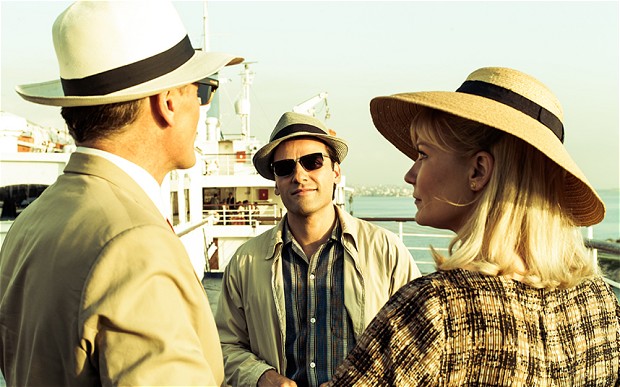
The successful period thriller The Two Faces of January, set in gloriously bright Greek tourist destinations, may not have the shadowy look of a traditional film noir, but its story is fundamentally noirish. Viggo Mortenson and Kirsten Dunst play an affluent couple vacationing in Athens in the early 1960s. They meet a handsome young American expat (Oscar Isaacs from Inside Llewyn Davis) knocking around Greece. The husband quickly and accurately sizes up the younger man as a con man – “I wouldn’t trust him to mow my lawn”. The central noir element is that NO ONE is as innocent as they seem, and the three become interlocked in a situation that becomes increasingly desperate for all three, culminating in a thrilling manhunt.
It’s the first feature directed by Hossein Amini, who adapted the screenplay for the markedly intense Drive, and he does a fine job here with a film that becomes more and more tense each time more information about the characters is revealed.
The Two Faces of January is available on DVD from Netflix and streaming on Amazon, iTunes, Vudu, YouTube, Google Play and Xbox Video.
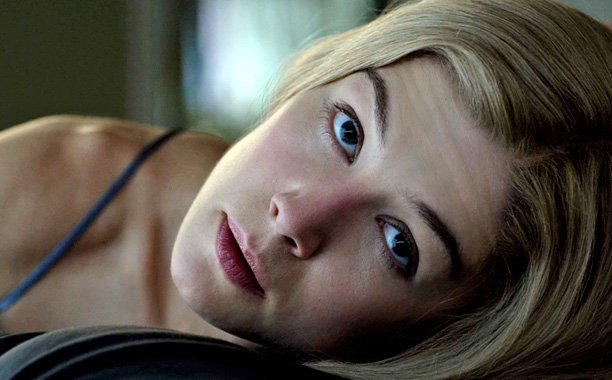
In the marvelously entertaining Gone Girl, Ben Affleck plays Nick, a good-looking lug who can turn a phrase. At a party one night, he’s on his A game, and he snags the beautiful Amy (Rosamund Pike). She’s smarter, a good rung on the ladder more attractive than he is, has parents with some money and is a second-hand celebrity to boot. Not particularly gifted and certainly not a striver, he knows he’s the Lucky One. He has married above himself, but he doesn’t have a clue HOW MUCH above until she suddenly disappears.
Based on the enormously popular novel by Gillian Flynn (who also wrote the screenplay), Gone Girl is the mystery of what has happened to Amy and what is Nick’s role in the disappearance. Plot twists abound, but you won’t get any spoilers from The Movie Gourmet.
This is Rosamund Pike’s movie. Her appearance is so elegant – she looks like a crystal champagne flute with blonde hair – that pulling her out of Victorian period romances into this thriller is inspired. And Pike responds with the performance of her career. She’s just brilliant as she makes us realize that there’s something behind her eyes that we hadn’t anticipated, and then keeps us watching what she is thinking throughout the story.
Gone Girl is directed by the contemporary master David Fincher (Fight Club, Se7en, Zodiac,The Social Network, The Girl with the Dragon Tattoo). Here, Fincher has successfully chosen to rely on Flynn’s page turner of a story and the compelling characters, so Gone Girl is the least flashy of his films, but one of the most accessible. I’ll say this for Fincher – I can’t remember a more perfectly cast movie.
Kim Dickens (Treme, Deadwood) is superb as the investigating detective – this time almost unrecognizable as a brunette. Tyler Perry is wonderfully fun as a crafty celebrity attorney. The unheralded Carrie Coon is excellent as Nick’s twin sister (I want to see more of her in the movies). Missi Pyle does such a good job as a despicable cable TV personality that I thought I was actually watching a despicable cable TV personality. And David Clennon and (especially) Lisa Banes positively gleam as Amy’s parents. (Carefully observe every behavior by the parents in this movie.)
Just like the thug in The Guard who forget whether he had been diagnosed in prison as a sociopath or a psychopath, I had the ask The Wife, who turned me on to this passage from Psychology Today. It’s useful to read this because, although you don’t realize it for forty-five minutes or so, Gone Girl is also a study of psychopathy.
Psychopaths … are unable to form emotional attachments or feel real empathy with others, although they often have disarming or even charming personalities. Psychopaths are very manipulative and can easily gain people’s trust. They learn to mimic emotions, despite their inability to actually feel them, and will appear normal to unsuspecting people. Psychopaths are often well educated and hold steady jobs. Some are so good at manipulation and mimicry that they have families and other long-term relationships without those around them ever suspecting their true nature.
When committing crimes, psychopaths carefully plan out every detail in advance and often have contingency plans in place. Unlike their sociopathic counterparts, psychopathic criminals are cool, calm, and meticulous. Their crimes, whether violent or non-violent, will be highly organized and generally offer few clues for authorities to pursue. Intelligent psychopaths make excellent white-collar criminals and “con artists” due to their calm and charismatic natures.
Gillian Flynn changed the story’s ending for the movie. The Wife, who is a big fan of the novel, didn’t mind. Gone Girl is recommended for both those who have and have not read the book. I understand that there’s more humor in the movie, as we occasionally laugh at the extremity of the behavior of one of the characters.
It all adds up into a remarkably fun movie and one that I was still mulling it over days later. Gone Girl was the best big Hollywood studio movie of 2014 (not counting releases from the prestige distribution arms of the major studios). It’s now available on DVD from Netflix and streaming on Amazon Instant, iTunes, Vudu, YouTube, Google Play, Xbox Video and Flixster.
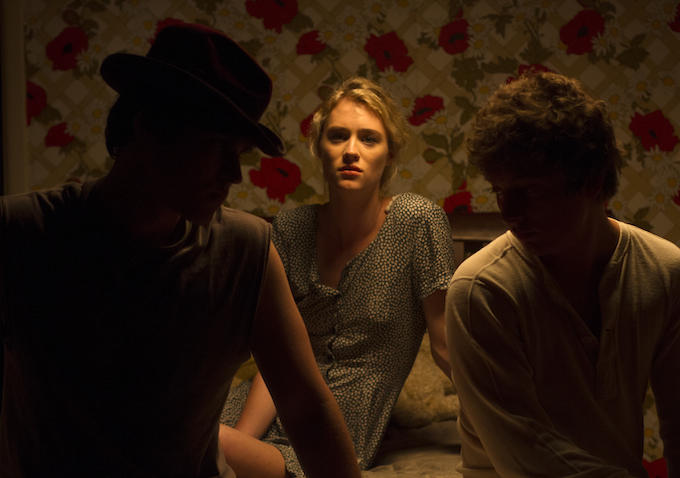
My DVD/Stream of the Weeks is a fine first feature with a GREAT title for a contemporary noir thriller: Bad Turn Worse. It’s set in a nowheresville Texas cotton gin town. Three childhood friends have just graduated from high school, and two are looking to escape to college – Bobby (Jeremy Allen White) and Sue (MacKenzie Davis). Not sharing a speck of Bobby’s and Sue’s intellectual curiosity, Sue’s longtime boyfriend B.J. (Logan Huffman) doesn’t want them to go; B.J. is dreamy and testosterone-filled, but bone-headed and weak-willed, with a gift for making impulsive, destructive choices. Bobby is sweet on Sue, and she is starting to be repelled by B.J.’s immaturity and selfishness. Sure enough, B.J. does something which entangles them all in a lethal jam.
Pretty soon there’s a double cross within a double cross, with a love triangle overlay. Nobody can trust anybody else, and somebody is gonna have to die…
The young leads are good, but two veteran TV actors sparkle in supporting turns. Mark Pellegrino plays a ruthless and crazy-scary villain that no one should cross. Jon Gries (Uncle Rico in Napoleon Dynamite) is hilariously deadpan as the corrupt Sheriff who tries to connect the dots for Bobby with metaphors – and Bobby’s dots just aren’t connecting.
Bad Turn Worse’s noir sensibility comes from 1) the amoral attitude that sometimes you gotta break the law and 2) the expectation that there can’t be a happy ending with all this treachery in play.
Bad Turn Worse is written by Dutch Southern and is the directorial debut of Simon and Zeke Hawkins. These guys have definitely proven that they can pull off a solid thriller. Bad Turn Worse is available streaming from Amazon Instant, iTunes, Vudu, YouTube, Google Play and Xbox Video.
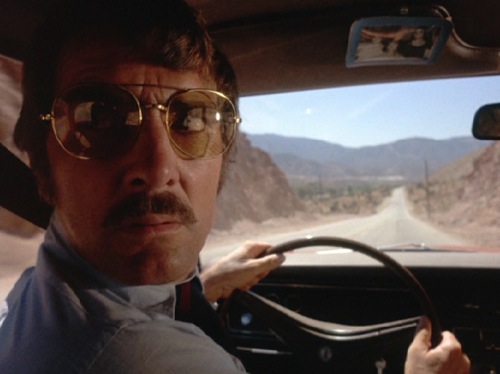
Set your DVRs for Turner Classic Movies’ November 21 airing of Duel. In 1971, some Universal exec hired 25-year-old Steven Spielberg to make some TV movies, the first of which was Duel. This low budget suspense thriller foreshadowed Jaws, Raiders of the Lost Ark and the rest of Spielberg’s masterworks.
In the pre-cell phone era, Dennis Weaver plays a traveling salesman driving through an isolated desert mountain road when he becomes embroiled in road rage to the extreme – the driver of a tanker truck starts relentlessly hunting him down. This imposing 1955 Peterbilt 281 tanker truck becomes every bit the scary monster as the Great White Shark in Jaws.
At the time, Dennis Weaver was one of America’s most familiar faces from his oft comic supporting role in TV’s iconic Gunsmoke, and he had just become a star in his own right with McCloud. He is perfect here as an Everyman – right down to his Plymouth Valiant.
I don’t know whether TCM is airing the original 74-minute (TV) or the 90-minute (theatrical) cut, but both are just about perfect. When I saw this on TV in 1971, I wasn’t thinking about who the director was, I was just riveted to the story, terrified that Dennis Weaver wasn’t going to escape his fiendish nemesis.
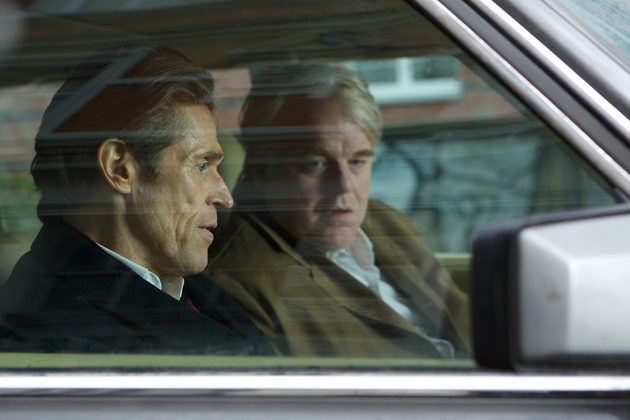
Willem Dafoe and Philip Seymour Hoffman in A MOST WANTED MAN
Espionage thrillers adapted from John le Carré novels, like A Most Wanted Man, are so good because le Carré, himself a former British intelligence operative, understand that intelligence services, riddled with bureaucratic jealousies and careerist rivalries, are not monoliths. His very human spies spend as much energy fighting each other as they do fighting the enemy. As a result, le Carré’s stories are more complex and character-driven than a standard “good-guys-hunt-down-a-terrorist” thriller plot.
That’s also the case with A Most Wanted Man, with which le Carré moves from the Cold War to the War of Terror. Philip Seymour Hoffman plays Günther, the leader of a German anti-terrorism unit in Hamburg. He must track down a possible Chechen terrorist while parrying off other German security forces, the CIA (Robin Wright), a shady banker (Willem Dafoe) and a do-gooder human rights attorney (Rachel McAdams). It’s the classic le Carré three-dimensional-chess-against-the-clock, and it works as an engrossing thriller.
But the A Most Wanted Man’s biggest asset is a searing performance by the late great Philip Seymour Hoffman. Günther is a canny and determined guy who needs to outsmart everyone else and manipulate forces beyond his control – and Hoffman nails it. His final scene is a spectacular explosion of emotion. (So soon after Hoffman’s death, it’s impossible to watch him here, with a huge belly and with his character chain-smoking and swilling whiskey, and not think of his final relapse into his ultimately fatal addiction; for this reason, A Most Wanted Man may be even more effective after a few years have passed.)
That being said, Robin Wright’s role as a duplicitous, shark-like CIA officer is under-written and doesn’t let her show her acting chops like House of Cards. Dafoe and McAdams are good in their roles. I was distracted by Grigoriy Dobrygin’s performance as the Chechen, which looked like bad Jeremy Davies without the twitches. The fine German actress Nina Hoss (Barbara) plays Hoffman’s assistant, and I hope we start to see her in more English language roles.
But the bottom line is that A Most Wanted Man is, overall, a satisfying thriller, and Philip Seymour Hoffman’s performance is reason enough to watch it. (BTW le Carré’s screen masterpiece is the 1979 series Tinker, Tailor, Soldier, Spy, which is available on DVD from Netflix.) A Most Wanted Man is available on DVD from Netflix and Redbox and streaming from Amazon, iTunes, Vudu, YouTube, Google Play and Xbox Video.
In the marvelously entertaining Gone Girl, Ben Affleck plays Nick, a good-looking lug who can turn a phrase. At a party one night, he’s on his A game, and he snags the beautiful Amy (Rosamund Pike). She’s smarter, a good rung on the ladder more attractive than he is, has parents with some money and is a second-hand celebrity to boot. Not particularly gifted and certainly not a striver, he knows he’s the Lucky One. He has married above himself, but he doesn’t have a clue HOW MUCH above until she suddenly disappears.
Based on the enormously popular novel by Gillian Flynn (who also wrote the screenplay), Gone Girl is the mystery of what has happened to Amy and what is Nick’s role in the disappearance. Plot twists abound, but you won’t get any spoilers from The Movie Gourmet.
This is Rosamund Pike’s movie. Her appearance is so elegant – she looks like a crystal champagne flute with blonde hair – that pulling her out of Victorian period romances into this thriller is inspired. And Pike responds with the performance of her career. She’s just brilliant as she makes us realize that there’s something behind her eyes that we hadn’t anticipated, and then keeps us watching what she is thinking throughout the story.
Gone Girl is directed by the contemporary master David Fincher (Fight Club, Se7en, Zodiac,The Social Network, The Girl with the Dragon Tattoo). Here, Fincher has successfully chosen to rely on Flynn’s page turner of a story and the compelling characters, so Gone Girl is the least flashy of his films, but one of the most accessible. I’ll say this for Fincher – I can’t remember a more perfectly cast movie.
Kim Dickens (Treme, Deadwood) is superb as the investigating detective – this time almost unrecognizable as a brunette. Tyler Perry is wonderfully fun as a crafty celebrity attorney. The unheralded Carrie Coon is excellent as Nick’s twin sister (I want to see more of her in the movies). Missi Pyle does such a good job as a despicable cable TV personality that I thought I was actually watching a despicable cable TV personality. And David Clennon and (especially) Lisa Banes positively gleam as Amy’s parents. (Carefully observe every behavior by the parents in this movie.)
Just like the thug in The Guard who forget whether he had been diagnosed in prison as a sociopath or a psychopath, I had the ask The Wife, who turned me on to this passage from Psychology Today. It’s useful to read this because, although you don’t realize it for forty-five minutes or so, Gone Girl is also a study of psychopathy.
Psychopaths … are unable to form emotional attachments or feel real empathy with others, although they often have disarming or even charming personalities. Psychopaths are very manipulative and can easily gain people’s trust. They learn to mimic emotions, despite their inability to actually feel them, and will appear normal to unsuspecting people. Psychopaths are often well educated and hold steady jobs. Some are so good at manipulation and mimicry that they have families and other long-term relationships without those around them ever suspecting their true nature.
When committing crimes, psychopaths carefully plan out every detail in advance and often have contingency plans in place. Unlike their sociopathic counterparts, psychopathic criminals are cool, calm, and meticulous. Their crimes, whether violent or non-violent, will be highly organized and generally offer few clues for authorities to pursue. Intelligent psychopaths make excellent white-collar criminals and “con artists” due to their calm and charismatic natures.
Gillian Flynn changed the story’s ending for the movie. The Wife, who is a big fan of the novel, didn’t mind. Gone Girl is recommended for both those who have and have not read the book. I understand that there’s more humor in the movie, as we occasionally laugh at the extremity of the behavior of one of the characters.
It all adds up into a remarkably fun movie and one that I’m still mulling over days later. Gone Girl is the best Hollywood movie of 2014 so far.
The successful period thriller The Two Faces of January, set in gloriously bright Greek tourist destinations, may not have the shadowy look of a traditional film noir, but its story is fundamentally noirish. Viggo Mortenson and Kirsten Dunst play an affluent couple vacationing in Athens in the early 1960s. They meet a handsome young American expat (Oscar Isaacs from Inside Llewyn Davis) knocking around Greece. The husband quickly and accurately sizes up the younger man as a con man – “I wouldn’t trust him to mow my lawn”. The central noir element is that NO ONE is as innocent as they seem, and the three become interlocked in a situation that becomes increasingly desperate for all three, culminating in a thrilling manhunt.
It’s the first feature directed by Hossein Amini, who adapted the screenplay for the markedly intense Drive, and he does a fine job here with a film that becomes more and more tense each time more information about the characters is revealed.
The Two Faces of January is in theaters and also available streaming on Amazon, iTunes, Vudu, YouTube, Google Play and Xbox Video.
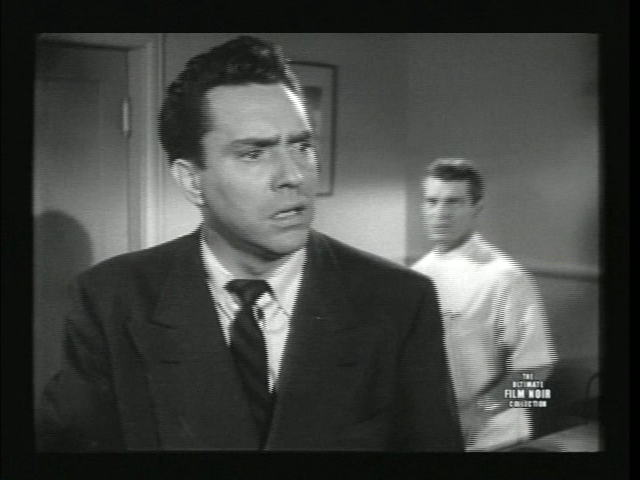
On August 27, Turner Classic Movies has the gripping film noir whodunit D.O.A., which opens with a man walking into a police station to report HIS OWN MURDER. The man (Edmond O’Brien) finds out that he has been dosed with a poison for which there is no antidote – and that he has only a few days to live. He desperately races the clock to find out who has murdered him and why – all in a taut 83 minutes. Much of D.O.A. was shot on location in San Francisco and Los Angeles, and one SF scene has one of the first cinematic glimpses into Beat culture. The little known director Rudolph Maté gave the film a great look, which shouldn’t be a surprise because Maté had been Oscar-nominated five times as a cinematographer. The next year, he followed D.O.A. with another solid noir, Union Station, with William Holden and Barry Fitzgerald.
(This 1950 version with Edmond O’Brien is the one you want to see; avoid the 1988 remake with Dennis Quaid and Meg Ryan.)
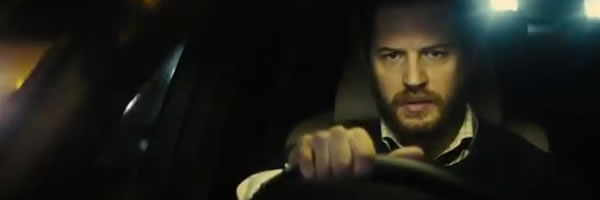
The thriller Lockeis about an extremely responsible guy (Tom Hardy) who has made one mistake – and he’s trying to make it right. But trying to do the responsible thing in one part of your life can have uncomfortable consequences in the others. The title character drives all night trying to keep aspects of his life from crashing and burning.
In fact, he never leaves the car and, for the entire duration of the movie, we only see his upper body, his eyes in the rearview mirror, the dashboard and the roadway lit by his headlights. All the other characters are voiced – he talks to them on the Bluetooth device in his BMW. Sure, that’s a gimmick – but it works because it complements the core story about the consequences of responsibility.
Locke is written and directed by Steven Knight (Dirty Pretty Things, Eastern Promises). The story is actually a domestic drama – there are no explosions to dodge, no one in peril to rescue and no bad guys to dispatch. But it’s definitely a thriller because we care about whether Locke meets the two deadlines he will face early the next morning.
It’s a masterful job of film editing by Justine Wright (Touching the Void, The Last King of Scotland). After all, her cuts help keep us on the edge of our seats, despite her working with a very finite variety of shots (Locke’s eyes, the dashboard, etc.).
Hardy, who’s known as an action star, is excellent at portraying this guy who must try to keep his family, biggest career project and self-respect from unraveling at the same time, only armed with his ability to persuade others. It’s a fine film. Locke is available on DVD from Netflix and Redbox and streaming from Amazon, iTunes, Vudu, YouTube, Google Play and Xbox Video.
Willem Dafoe and Philip Seymour Hoffman in A MOST WANTED MAN
Espionage thrillers adapted from John le Carré novels, like A Most Wanted Man, are so good because le Carré, himself a former British intelligence operative, understand that intelligence services, riddled with bureaucratic jealousies and careerist rivalries, are not monoliths. His very human spies spend as much energy fighting each other as they do fighting the enemy. As a result, le Carré’s stories are more complex and character-driven than a standard “good-guys-hunt-down-a-terrorist” thriller plot.
That’s also the case with A Most Wanted Man, with which le Carré moves from the Cold War to the War of Terror. Philip Seymour Hoffman plays Günther, the leader of a German anti-terrorism unit in Hamburg. He must track down a possible Chechen terrorist while parrying off other German security forces, the CIA (Robin Wright), a shady banker (Willem Dafoe) and a do-gooder human rights attorney (Rachel McAdams). It’s the classic le Carré three-dimensional-chess-against-the-clock, and it works as an engrossing thriller.
But the A Most Wanted Man’s biggest asset is a searing performance by the late great Philip Seymour Hoffman. Günther is a canny and determined guy who needs to outsmart everyone else and manipulate forces beyond his control – and Hoffman nails it. His final scene is a spectacular explosion of emotion. (So soon after Hoffman’s death, it’s impossible to watch him here, with a huge belly and with his character chain-smoking and swilling whiskey, and not think of his final relapse into his ultimately fatal addiction; for this reason, A Most Wanted Man may be even more effective after a few years have passed.)
That being said, Robin Wright’s role as a duplicitous, shark-like CIA officer is under-written and doesn’t let her show her acting chops like House of Cards. Dafoe and McAdams are good in their roles. I was distracted by Grigoriy Dobrygin’s performance as the Chechen, which looked like bad Jeremy Davies without the twitches. The fine German actress Nina Hoss (Barbara) plays Hoffman’s assistant, and I hope we start to see her in more English language roles.
But the bottom line is that A Most Wanted Man is, overall, a satisfying thriller, and Philip Seymour Hoffman’s performance is reason enough to catch it in the theaters. (BTW le Carré’s screen masterpiece is the 1979 series Tinker, Tailor, Soldier, Spy, which is available on DVD from Netflix.)