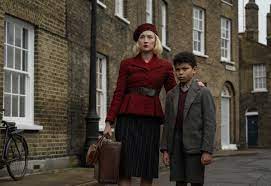
In the WW II drama Blitz, Rita (Saiorse Ronan) is a single mom who, like all Londoners, must endure The Blitz, the 8-month German terror bombing of civilian London. Over a million English city-dwellers were evacuated to the countryside, and half of them were children. Rita’s own nine-year-old son George (Elliott Heffernan) is set to be sent to safety while she remains at her job in a munitions factory.
This plan angers George, and he bolts, running amok through London. His adventures, and Rita’s terrified search for him when she finds him missing, make up the core of Blitz. It is a child-in-peril story, but not one where the adult protagonist rescues the child. Rita may be played by a big movie star, but this is George’s story and a portrait of his determination and resourcefulness.
George is multi-racial, which is hard to be in 1940 England, where he looks different that just about everyone else. As he runs a gauntlet of racist attitudes, it’s a huge relief whenever George encounters someone with even minimal kindness.
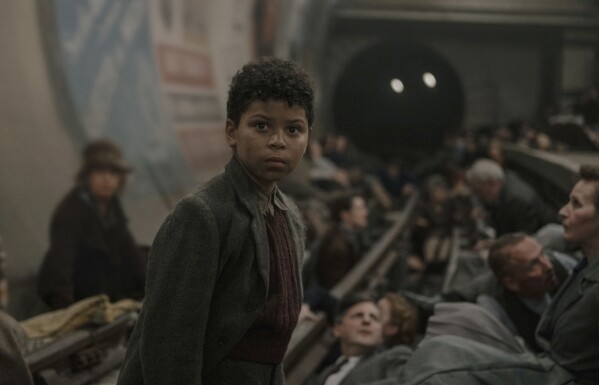
Writer-director Steve McQueen’s biggest achievement in Blitz is to tell this story so compellingly from the child’s point of view. Sometimes George isn’t scared when he should be, and sometimes he is overwhelmed by a situation any adult could handle. McQueen certainly found the right actor to play George in Heffernan, who captures George’s vulnerabilities as well as his underlying reservoir of tenacity.
McQueen also pulls off a well-paced thriller and makes the audience feel the historical context. We’ve all seen depictions of The Blitz with the air raid sirens, blackout wardens and plucky Brits sheltering in the Underground and emerging to see the rubble, carnage and fire. But not like this. McQueen’s Blitz is vivid, uncomfortable and terrifying.
There is a spectacular scene at a ritzy hotel’s nightclub, complete with a Cab Calloway-like band and an extra-long tracking shot through the kitchen, an homage to Martin Scorsese’s famous Copacabana shot in Goodfellas. I understand that McQueen would argue that this scene sets up a brief moment later in the film, but it really isn’t necessary and McQueen is just showing off his skills (and AppleTV’s budget). It’s fun, though.
What McQueen fails to deliver, though, is multi-dimensional characters (with the exception of George). Pretty much every non-George character is just one thing – officious, bigoted, evil or saintly.
The is, however, more than a glimmer of texture in a performance by one of my favorite actors, Stephen Graham, who often plays a troubled cop or a criminal psycho in British crime shows like Line of Duty and Little Boy Blue. Graham has a small role as a depraved gang leader, and he makes the character despicable and unhinged and scary and damaged. Graham has worked in US films, too, as an Italian-American mobster in Martin Scorsese’s The Irishman, Scrum in the Pirates of the Caribbean franchise, Al Capone in Boardwalk Empire and Baby Face Nelson in Michael Mann’s Public Enemies.
Blitz is a fine adventure yarn, evocative history and a visually impressive film. Blitz is now streaming on AppleTV.