
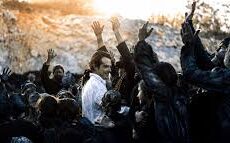
A Great Awakening has two good stories to tell, but muddles a third. In 18th century England, and then America, George Whitefield (pronounced Whitfield) founded the Methodist denomination, along with John and Charles Wesley, and became the leading public evangelist in England and America. A charismatic orator who could draw crowds of thousands, he was an important figure in the first of what America historians call the Great Awakening. The life and times of George Whitefield is the first good story.
Here’s the second good story – the unlikely friendship between Whitefield and no less an American icon than Benjamin Franklin. Whitefield was drawn to Franklin’s genius and humor, and Franklin admired Whirefield’s passion and ability to attract the masses. The two shared a close personal bond, with the science-minded Franklin resisting Whitehead’s attempts to spiritualize him, and with Franklin’s needling Whitefield about using slaves to run his orphanage.
As near as I can tell, A Great Awakening accurately depicts the life of George Whitefield and the relationship between Whitefield and Franklin. But then, the movie takes on a key moment in American political history and tries to embed a soapy religiosity. Indeed, A Great Awakening comes from Sight & Sound Films, a Christian movie studio whose mission is telling faith-based stories.
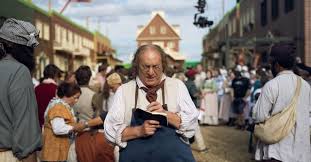
Here, A Great Awakening takes on a third story, Franklin’s participation in America’s Constitutional Convention, where the Founders battled each other to reach a compromise solution to the American nation’s framework of government. This was well after Whitefield’s death, and A Great Awakening has Franklin, remembering his old friend, and suggesting that every session of negotiations be opened with a prayer. A Great Awakening asserts that these morning prayers were instrumental in the final success of the Constitutional Convention.
Indeed, the notoriously nonreligious Franklin did propose a daily prayer. But no real historian credits the birth of the Constitution to a ritual prayer instead of the creative thinking and hard-fought compromises that finally satisfied the disparate States. Students of American government will note that this is why we have checks and balances, power divided between small States (the Senate) and populous States (the House of Representative) and a political boost to slave states (the heinous, since rescinded, three-fifths rule). So, as political history, A Great Awakening is just not credible, and is even misleading.
The cast is neither well-known or well-seasoned, with the leads sharing only seven screen credits between them. Whitefield is played by a co-writer of the movie, Jonathan Blair, who has the ringing voice and gleaming passion that Whitefield must have had. John Paul Sneed plays Franklin, as Franklin ages from his forties through his eighties.
A Great Awakening’s biggest flaw.however, is that all the actors deliver virtually every line with fervent passion. Admittedly, actual religious passion and actual political passion are important elements of these stories, but the emoting is just unrelenting. It’s like a compendium of auditions for a soap opera.
So, the hackneyed over-earnestness and the bit of Fake History sink this movie. A Great Awakening can be streamed on Amazon, AppleTV, YouTube and Fandango.