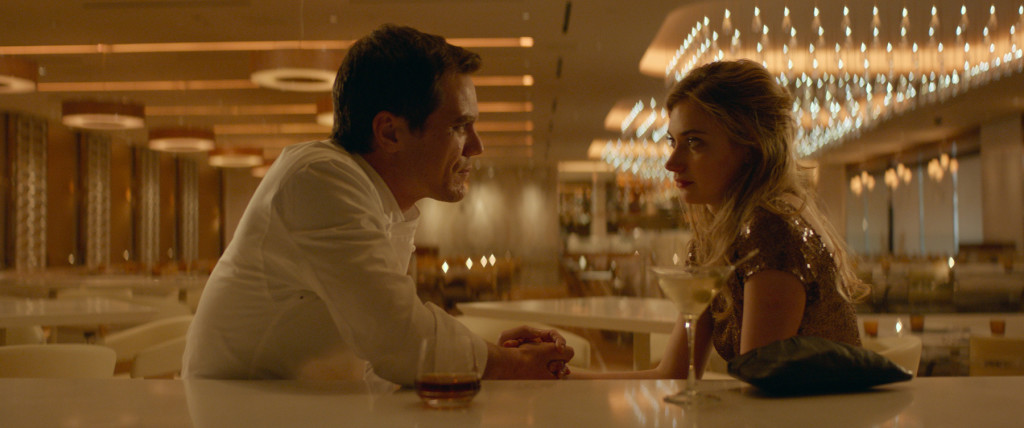
Michael Shannon and Imogen Poots in FRANK & LOLA. Photo courtesy of the San Francisco Film Society.
The absorbing neo-noir romance Frank & Lola opens with a couple lovemaking for the first time – and right away there’s a glimmer that he’s more invested than she is. Soon we’re spirited from Vegas to Paris and back again in a deadly web of jealousy.
Lola (Imogen Poots) is young and beautiful, a lively and sparkly kind of girl. Frank (the great Michael Shannon) is older but “cool” – a talented chef. He is loyal and steadfast but given to possessiveness, and he says things like, “who’s the mook?”.
In a superb debut feature, writer director Matthew Ross has invented a Lola that we (and Frank) spend the entire movie trying to figure out. Imogen Poots is brilliant in her most complex role so far. She’s an unreliable girlfriend – but the roots of her unreliability are a mystery – is she Bad or Troubled? A character describes her with “She can be very convincing”, and that’s NOT a complement. Poots keeps us on edge throughout the film, right up to her stunning final monologue.
Shannon, of course, is superb, and the entire cast is exceptional. There’s a memorable turn by Emmanuelle Devos, the off-beat French beauty with the cruel mouth. Rosanna Arquette is wonderful, as is Michael Nyqvist from the Swedish Girl With the Dragon Tattoo movies. I especially liked Justin Long as Keith Winkleman (is he a namedropping ass or something more?).
Frank & Lola has more than its share of food porn and, as befits a neo-noir, lots of depravity. But, at its heart, it’s a romance. Is Lola a Bad Girl or a Troubled Girl? If she’s bad, then love ain’t gonna prevail. But if she’s damaged, can love survive THAT either? We’re lucky enough to go along for the ride.
I saw Frank & Lola in May at the San Francisco International Film Festival. I liked it more than most and put it on my Best Movies of 2016. After a brief and tiny theatrical release in December which did not reach the Bay Area, Frank & Lola is now available to stream on Amazon Instant, iTunes, Vudu, YouTube and Google Play.
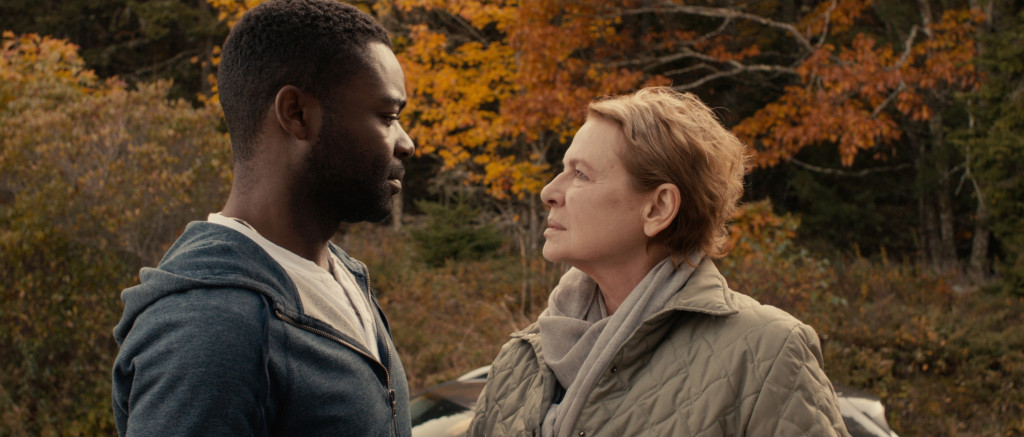
David Oyelowo and Dianne Wiest in FIVE NIGHTS IN MAINE. Photo courtesy of San Francisco Film Society
An Atlanta man (David Oyeowlo) suddenly loses his wife to an auto accident and is completely shattered by the depth and the jarring abruptness of his loss. Pushed by his sister out of his paralysis, he drives up to Maine to visit his wife’s mother (Dianne Wiest). She is a person who is generally harsh, judgemental and irritating at all times, but is more so now that her own health is failing. His experience with her becomes the antithesis of the comfort and support that one would expect. As she probes and spars with him, the two are each driven to their own catharsis. The end of Five Nights in Maine also comes abruptly, leaving us to reflect on the lessons learned by the leading characters and how their grief is resolved.
Five Nights in Maine uses a handheld camera and LOTS of close-ups. This was a conscious choice by first-time writer-director Maris Curran, who sought a “closing in” effect because “grief is claustrophobic”.
Dianne Wiest’s performance is an awards-worthy tour de force. Flashing fiery looks and shooting piercing remarks from an invariably rigid posture, she commands our attention every moment that she is on-screen. As we would expect, Oyewolo is outstanding, especially in the early scenes where he collapses into shock. Rosie Perez, not as sassy, but every bit as appealing, as usual, is rock solid in the supporting role as the mother’s nurse. As the sister, Tenoyah Parris (Chi-Raq, Dear White People, Mad Men) gives yet another flawless performance.
I saw Five Nights in Maine at the 59th San Francisco International Film Festival (SFIFF), where Director Maris Curran, producer Carly Hugo and actor David Oyelowo appeared at the screening. Curran said she was motivated to write a story about loss as her own marriage was falling apart; when the ground was pulled out from under her, she created a protagonist in that situation.
Aiming for a sensual look for an emotional film, Curran was able to snare Tunisian cinematographer Sofian El Fani, fresh from his exquisite work in from Blue Is the Warmest Color, for his first American film. Budgeted for a 19-day shoot, the crew finished in only 18.
Oyewolo, happily married for 18 years, found exploring the territory of losing his wife to be very uncomfortable. Five Nights in Maine was shot right after Selma, so his exhaustion from Selma helped him find this “hollowed-out” character. Oyewolo sees Five Nights in Maine as a fish out of water story – not just geographically but emotionally (a man not used to or prepared for grief). Oyewolo prefers women directors because he “wants to be part of stories that are emotionally challenging”.
Fortunately, Curran leavens this dark-themed story with bits of sharp humor. It’s an emotionally affecting and authentic movie. Five Nights in Maine is available to stream on Amazon Instant, Vudu, Google Play, YouTube and DirecTV.
One of the best films of the year, Chevalier is a sly and pointed exploration of male competitiveness, with the moments of drollness and absurdity that we expect in the best of contemporary Greek cinema. Chevalier is also now the Most Overlooked Movie of 2016, and I’m hoping that its popularity explodes now that it’s available on video.
In Chevalier, six guys are taking a holiday week on a yacht in the Aegean Sea. Each has his own stateroom, and the crew includes a chef. They spend their days scuba diving, jet skiing and the like. After a post-dinner game of charades, one suggests that they play Chevalier, a game about “Who is best overall?”. Of course, men tend to be competitive, and their egos are now at stake. The six guys began appraising each other, and their criteria get more and more absurd. “How many fillings do you have?”
In one especially inspired set piece, the guys race each other to construct IKEA bookcases, which results in five phallic towers on the boat’s deck (and one drooping failure). Naturally, some of the guys are obsessed with their own erections, too.
Director Athina Rachel Tsangari is obviously a keen observer of male behavior. Both men and women will enjoy laughing at male behavior taken to extreme. I sure did. Chevalier is perhaps the funniest movie of 2016, and it’s on my list of Best Movies of 2016 – So Far.
I saw Chevalier at the 59th San Francisco International Film Festival (SFIFF), where I pegged it as the Must See of the fest. (In 2011, Tsangari brought her hilariously offbeat Attenberg to SFIFF.) Unfortunately, in the Bay Area, Chevalier only got a blink-and-you’ve-missed-it release in June. Chevalier is now available to rent on DVD from Netflix and to stream from Netflix Instant, Amazon Instant, iTunes, Vudu, YouTube and Google Play.
Athina Rachel Tsangari, director of CHEVALIER . Photo courtesy of San Francisco Film Society
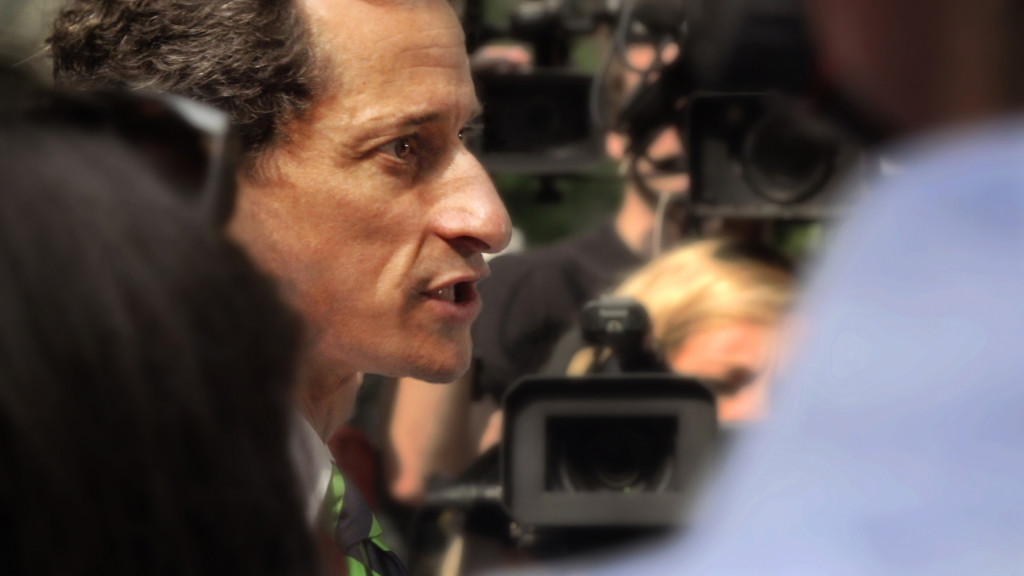
This week’s recommendation couldn’t be any timelier, given Anthony Weiner’s disgraceful collapse into yet another texting scandal, resulting his getting dumped by his wife, Hillary Clinton confidante Huma Abedin. Don’t miss the political documentary Weiner, probably the best documentary of the year. It also provokes some reflection on the media in this age. It’s on my Best Movies of 2016 – So Far.
You may remember Anthony Weiner as the politician forced out of Congress in a sexting scandal. A couple of years later, he tried to make a comeback by running for mayor of New York City. Weiner is the inside story of that campaign, which self-immolated when the sexting scandal popped up again. Weiner is a marvelously entertaining chronicle of the campaign, a character study of Anthony Weiner himself and an almost voyeuristic peek into Weiner’s marriage to another political star, Huma Abedin.
Co-director Josh Kriegman served as Weiner’s Congressional chief of staff and left politics for filmmaking. When Weiner was contemplating the run for mayor, Kriegman asked to shadow him in the campaign, and Weiner agreed. Kriegman and co-director Elyse Steinberg shot 400 hours of backstage footage and caught some searing moments of human folly, triumph and angst.
In office, eight-term New York Congressman Anthony Weiner was a firebrand, pugnacious and a master debater with a vicious sense of humor, always eager to mix it up. He is married to Huma Abedin, a close Hilary Clinton advisor often described as “Hilary’s other daughter”. Huma is as reserved as Anthony is ebullient, and her own distinguished career in politics has been behind the scenes. He lives for the limelight, but she is uncomfortable in it.
Anthony begins his comeback with brutally painful media launch. The press is in a complete feeding frenzy – all revisiting the scandal and nothing else. One of the highlights of Weiner is a montage of talking heads reviling Weiner, including Donald Trump, who bellows, “We don’t want any perverts in New York City”.
But when Anthony goes on the campaign trail, the electorate begins to really respond to his passion and feistiness. Weiner unexpectedly surges into the lead 10 weeks to go. We are treated to a first-class procedural and see what only political pros see – the banal opening of a campaign office, rehearsing speeches, shooting commercials, dialing for dollars.
But then the scandal re-opens when a publicity-seeking bimbo releases a photo of Anthony’s penis that Weiner had texted her. We see his Communications Director as the new scandal unfolds in real-time, her eyes becoming lifeless; my day job for the last thirty years has been in politics, and I have gotten some bad news, but nothing like this.
Amazingly, we see Anthony calling Huma and telling her. When the screenshot of Anthony’s penis shot goes viral, we watch as Hums see it for the first time on the Internet, and her anger builds into rage. Anthony finally kicks out the camera.
New York Post prints headlines like “Weiner: I’ll Stick It Out” and “Obama Beats Weiner”. Anthony tells his shell-shocked and pissed off staff “nobody died”, but nobody’s buying it. Anthony has masterfully redefined himself to be more than the punchline once, but the second set of revelations make him indelibly a punchline – and no one can come back from that. From behind the camera, Kriegman plaintively asks Weiner.”Why did you let me film this?”.
Anthony’s pollster gives him the bad news: “There’s no path anymore to get to a runoff” and “So this is a solo flight”. The smell of death is about the campaign at the end, but Anthony is in “never quit” phase.
Anthony’s best moment is when he is obligated to face a hostile neighborhood meeting in the Bronx neighborhood of City Island. He knows that he is doing poorly there, and there aren’t many voters out there anyway, but he keeps his head high and delivers a courageous effort.
Anthony’s worst moment may be when he is re-watching himself in a mutual evisceration of a TV host on YouTube. He is relishing the combat, but Huma, behind him, is appalled by Anthony’s Pyrrhic victory. He smugly thinks that’s he won the verbal firefight, but Huma just says, “It’s bad”. She’s right.
I saw Weiner at the 59th San Francisco International Film Festival (SFIFF) at a screening with co-directors Josh Kriegman and Elyse Steinberg. Kriegman said that he “intended to show the humanity behind the headline – the nuance that is Anthony”. Steinberg noted that “the most exposed are the least revealed”. As of the SFIFF screening on April 23, Anthony Weiner had to date declined to watch Weiner. In Weiner, Anthony looks back after the campaign and ruefully sums it up, “I lied and I had a funny name”.
Weiner has more than its share of forehead-slapping moments and is often funny and always captivating. It’s almost certainly the year’s best documentary and one of best films of 2016, period. Weiner is available on DVD from Netflix and to stream from Amazon Video, iTunes, Vudu, YouTube, Google Play and DirecTV.
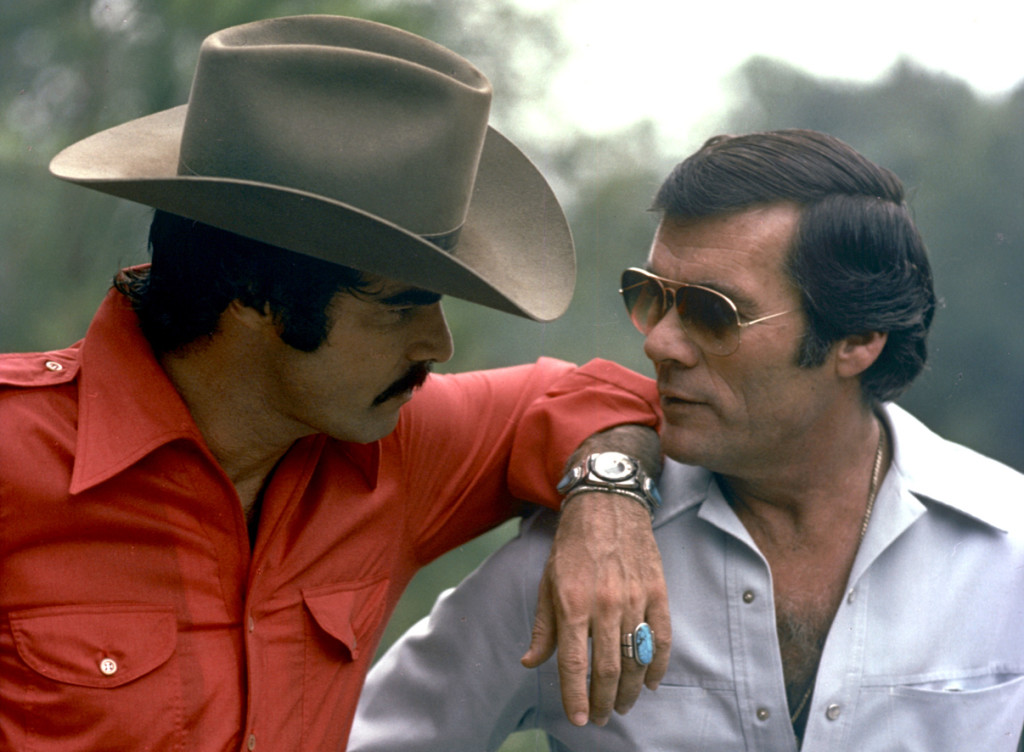
Burt Reynolds and Hal Needham in THE BANDIT. Photo courtesy of the San Francisco Film Society.
Writer-director Jesse Moss describes The Bandit as “a buddy movie about a buddy movie”, and he’s right. The buddies are mega-star Burt Reynoldsand his stuntman/friend/roommate Hal Needham, who directed the enormously successful Smokey and the Bandit franchise.
Needham, one of only two stuntmen with an Oscar, is arguably cinema’s greatest stunt performer and stunt coordinator. Reynolds did many of his own stunts, and we we see some hard, hard falls in The Bandit. But Burt did nothing to nothing to match Needham, whose FIRST career stunt was jumping off an airplane wing to tackle a rider off his horse. We see many instances where Needham became a LITERAL car crash test dummy.
One of The Bandit’s highlights is the Needham stunt that broke his back – jumping a car off a dock and onto a barge – and slamming into the barge a little short.
There’s rich source material here from Burt’s garage (Reynolds calls it “King Tut’s Tomb for documentarinans”), which stored tapes back to 1956.
For added color, Needham and Reynolds were epic partiers, who embraced and exemplified the Mad Men era. Needham was a vivid character and lived a helluva life. I strongly recommend Terry Gross’ Fresh Air interview with Needham.
Hal’s widow told Bay Area filmmaker Jesse Moss that Needham hated documentaries because they were boring, so Moss aimed to make a documentary that Hal would enjoy. Indeed, The Bandit opens with the sly Reynolds, in maroon leisure suit with flared pant legs, mocking his own image outrageously. And, it’s a hoot throughout.
(Moss’ first movie was at San Francisco’s Castro Theater in 1979, when his dad took him a double feature of Erroll Morris’ Gates of Heaven and Hardware Wars, a documentarian born!)
I saw The Bandit at its premiere at the San Francisco International Film Festival (SFFILM). It played on TV channel CMT, and now can be streamed on Amazon, Vudu, YouTube and Google Play.
UNDER THE SUN. Photo courtesy of San Francisco Film Society.
The subversive documentary Under the Sun is a searing insight into totalitarian North Korean society, all from government-approved filming that tells a different story than the wackadoodle dictatorship intended.
The North Korean regime gave filmmaker Vitaly Mansky permission to film the story of a young girl who is training to take part in one of North Korea’s ritualized propaganda spectacles – when children “join” the Korean Children’s Union on the birthday of the current Supreme Leader’s father. The script and the filming locations were all assigned by the North Korean regime and all film reviewed by their censors. But Mansky was able to conceal and preserve the outtakes – and those moments are devastatingly revelatory about life on North Korea.
What we see is a grim society, virtually devoid of vibrancy and joy. Families are posed briefly mechanically and unsmilingly for ritual family photos in front of flower-bedecked giant portraits of the Leaders. The streets are drab and empty of vehicle traffic even at rush hour. Mansky shows us surreptitious glimpses of his minders and even of boys raiding garbage cans. There’s a lot of regimentation depicted in Under the Sun and lots of people drearily filing to and fro. Sometimes it gets tiresome – but that’s the point.
Everyone is conscripted to perform and watch phony staged spectacles of the grandest scale. The rapturous crowds shown on TV contrast with the stoic crowds forced to view the televised events. North Korea must have the world’s most professional event planners per capita.
Most chillingly, we see a class where 6-year-olds are taught to hate Japanese and Americans. This appears to be a scene that the North Koreans INTENTIONALLY included in the movie.
The beautiful irony of Under the Sun is that, in trying to tell a story about the best of their society, the North Koreans actually reveal their worst. I saw Under the Sun earlier this year at the 59th San Francisco International Film Festival. Under the Sun opens July 29 at the Lee 4-Star in San Francisco.
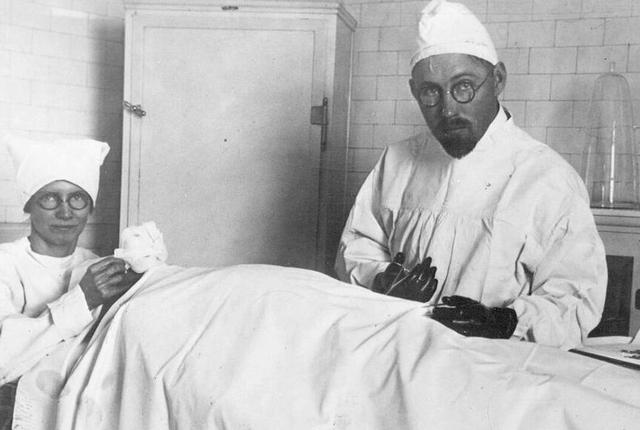
NUTS! is the persistently hilarious (and finally poignant) documentary about the rise and fall of a medical and radio empire – all built on goat testicle “implantation” surgery in gullible humans. Yes, a huckster named J.R. Brinkley really did surgically place goat testicles inside human scrota – and, more astonishingly, this actually became a craze in the 1920s. Now that’s enough of a forehead slapper, but there’s more, much more and that’s what makes NUTS! so fun.
Brinkley’s story is one that leads to celebrity mega wealth and a colossal miscalculation. Improbably, Brinkley’s wild ride touched Huey Long,William Jennings Bryan, Rudolph Valentino, Buster Keaton, June Carter Cash and Wolfman Jack. There’s a radio empire, a Gubernatorial election and a dramatic, climactic trial.
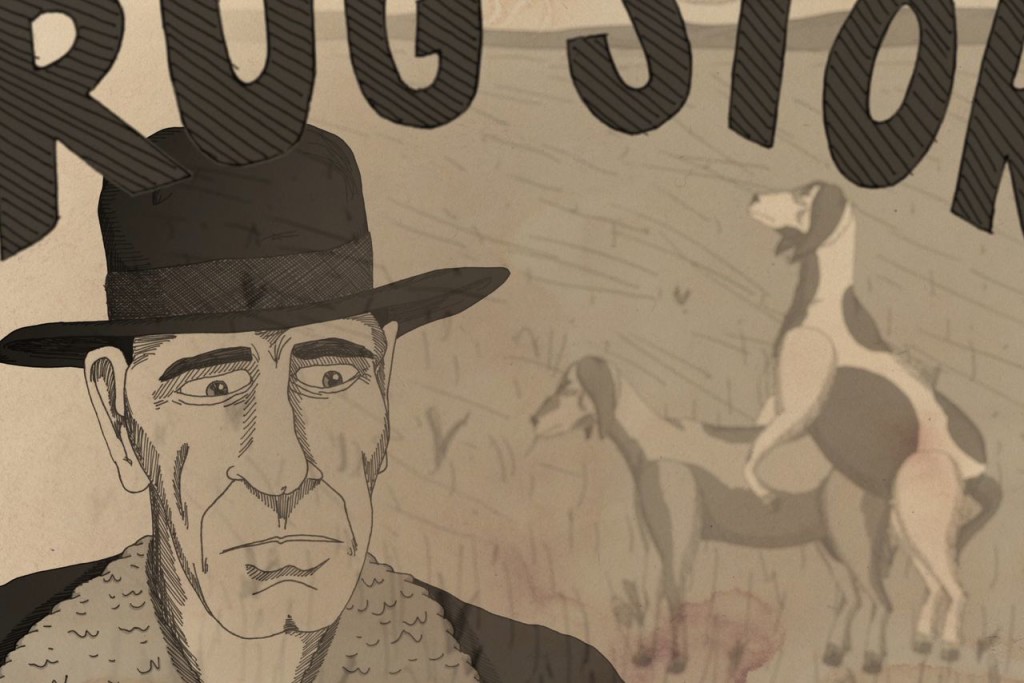
“Dr.” Brinkley at work in NUTS!
Director Penny Lane tells the story with animation (different animators for each chapter, but you can’t tell) seamlessly braided together with historical still photos, movies and a final heartbreaking recording. NUTS! tells a story that is too bizarre to be true – but really happened. It makes for a most entertaining movie.
I saw NUTS! earlier this year at the 59th San Francisco International Film Festival (SFIFF). It opens in Bay Area theaters today.
WEINER. Photo courtesy of San Francisco Film Society.
Don’t miss the political documentary Weiner, probably the best documentary of the year. It also provokes some reflection on the media in this age.
You may remember Anthony Weiner as the politician forced out of Congress in a sexting scandal. A couple of years later, he tried to make a comeback by running for mayor of New York City. Weiner is the inside story of that campaign, which self-immolated when the sexting scandal popped up again. Weiner is a marvelously entertaining chronicle of the campaign, a character study of Anthony Weiner himself and an almost voyeuristic peek into Weiner’s marriage to another political star, Huma Abedin.
Co-director Josh Kriegman served as Weiner’s Congressional chief of staff and left politics for filmmaking. When Weiner was contemplating the run for mayor, Kriegman asked to shadow him in the campaign, and Weiner agreed. Kriegman and co-director Elyse Steinberg shot 400 hours of backstage footage and caught some searing moments of human folly, triumph and angst.
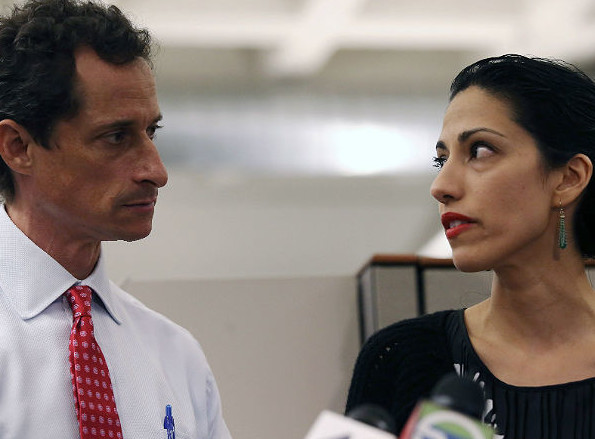
In office, eight-term New York Congressman Anthony Weiner was a firebrand, pugnacious and a master debater with a vicious sense of humor, always eager to mix it up. He is married to Huma Abedin, a close Hilary Clinton advisor often described as “Hilary’s other daughter”. Huma is as reserved as Anthony is ebullient, and her own distinguished career in politics has been behind the scenes. He lives for the limelight, but she is uncomfortable in it.
Anthony begins his comeback with brutally painful media launch. The press is in a complete feeding frenzy – all revisiting the scandal and nothing else. One of the highlights of Weiner is a montage of talking heads reviling Weiner, including Donald Trump, who bellows, “We don’t want any perverts in New York City”.
But when Anthony goes on the campaign trail, the electorate begins to really respond to his passion and feistiness. Weiner unexpectedly surges into the lead 10 weeks to go. We are treated to a first-class procedural and see what only political pros see – the banal opening of a campaign office, rehearsing speeches, shooting commercials, dialing for dollars.
But then the scandal re-opens when a publicity-seeking bimbo releases a photo of Anthony’s penis that Weiner had texted her. We see his Communications Director as the new scandal unfolds in real-time, her eyes becoming lifeless; my day job for the last thirty years has been in politics, and I have gotten some bad news, but nothing like this.
Amazingly, we see Anthony calling Huma and telling her. When the screenshot of Anthony’s penis shot goes viral, we watch as Hums see it for the first time on the Internet, and her anger builds into rage. Anthony finally kicks out the camera.
Anthony Weiner and Huma Abedin in WEINER
New York Post prints headlines like “Weiner: I’ll Stick It Out” and “Obama Beats Weiner”. Anthony tells his shell-shocked and pissed off staff “nobody died”, but nobody’s buying it. Anthony has masterfully redefined himself to be more than the punchline once, but the second set of revelations make him indelibly a punchline – and no one can come back from that. From behind the camera, Kriegman plaintively asks Weiner.”Why did you let me film this?”.
Anthony’s pollster gives him the bad news: “There’s no path anymore to get to a runoff” and “So this is a solo flight”. The smell of death is about the campaign at the end, but Anthony is in “never quit” phase.
Anthony’s best moment is when he is obligated to face a hostile neighborhood meeting in the Bronx neighborhood of City Island. He knows that he is doing poorly there, and there aren’t many voters out there anyway, but he keeps his head high and delivers a courageous effort.
Anthony’s worst moment may be when he is re-watching himself in a mutual evisceration of a TV host on YouTube. He is relishing the combat, but Huma, behind him, is appalled by Anthony’s Pyrrhic victory. He smugly thinks that’s he won the verbal firefight, but Huma just says, “It’s bad”. She’s right.
I saw Weiner at the 59th San Francisco International Film Festival (SFIFF) at a screening with co-directors Josh Kriegman and Elyse Steinberg. Kriegman said that he “intended to show the humanity behind the headline – the nuance that is Anthony”. Steinberg noted that “the most exposed are the least revealed”. As of the SFIFF screening on April 23, Anthony Weiner had to date declined to watch Weiner. In Weiner, Anthony looks back after the campaign and ruefully sums it up, “I lied and I had a funny name”.
Weiner has more than its share of forehead-slapping moments and is often funny and always captivating. It’s almost certainly the year’s best documentary and one of best films of 2016, period.
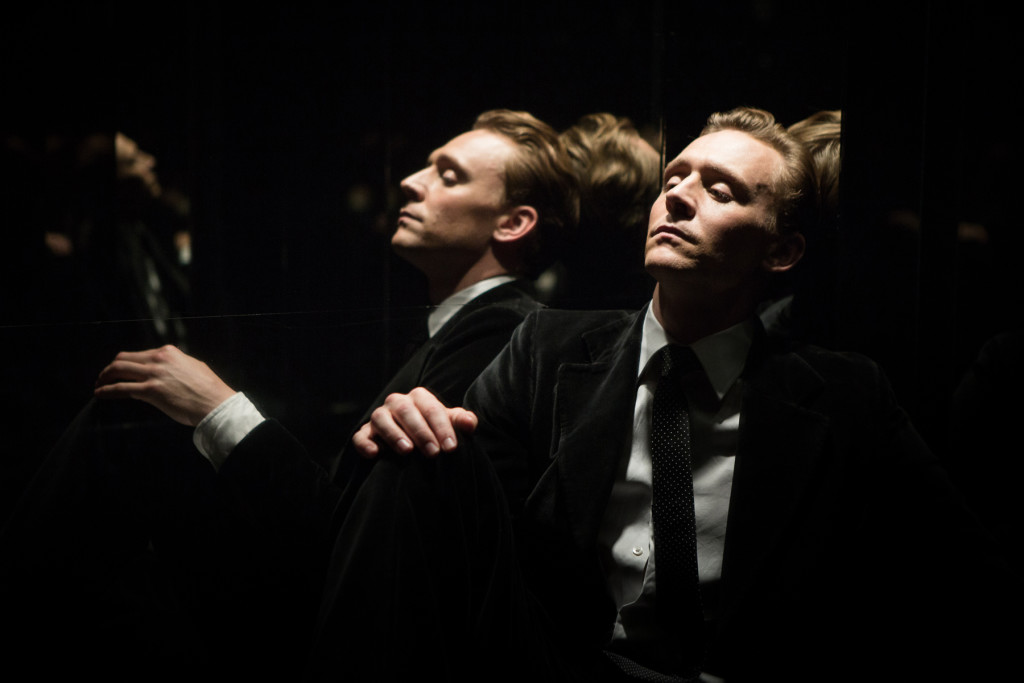
Tom Hiddleston in HIGH-RISE. Photo courtesy of the San Francisco Film Society.
The dystopian sci-fi satire High-Rise, adapted from a J.G. Ballard novel, makes a droll and cynical comment on our species. Taking place in the near future, the very wealthy live on the top floors of a self-contained high-rise, just above the middle class. Human greed and jealousy creates scarcity for the residents – not Third World-type scarcity, but scarcity of amenities like swimming pool access and power brownouts. Class competition erupts and a morbid descent into murderous chaos ensues. We plunge into this complacent, and then hellish, world from the perspective of a young middle class striver (Tom Hiddleston).
The designer of the complex of high-rises (Jeremy Irons) lives in a luxurious penthouse with a staggeringly pastoral garden. The character’s name is Royal, but he’s not the ruler. (We actually come to wish that he were benignly in charge.) And despite his trappings, Royal is not the omnipotent Bond-type villain. The villain turns out instead to be an oligarchy of the One Percent, along with the darkest aspects of every character’s humanness.
Tom Hiddleston is fine, and the rest of the cast is solid. The two standouts are Jeremy Irons as Royal and Sienna Miller, dressed in Carnaby Street retro, as a deliciously voracious man-hunter. The wonderful Elisabeth Moss is wasted in a role where she just doesn’t have much to do.
I saw High-Rise at the 59th San Francisco International Film Festival (SFIFF). It opens in Bay Area theaters tomorrow.
David Oyelowo and Dianne Wiest in FIVE NIGHTS IN MAINE. Photo courtesy of San Francisco Film Society
An Atlanta man (David Oyeowlo) suddenly loses his wife to an auto accident and is completely shattered by the depth and the jarring abruptness of his loss. Pushed by his sister out of his paralysis, he drives up to Maine to visit his wife’s mother (Dianne Wiest). She is a person who is generally harsh, judgemental and irritating at all times, but is more so now that her own health is failing. His experience becomes the antithesis of the comfort and support that one would expect. As she probes and spars with him, the two are each driven to their own catharsis. The end of Five Nights in Maine also comes abruptly, leaving us to reflect on the lessons learned by the leading characters and how their grief is resolved.
Five Nights in Maine uses a handheld camera and LOTS of close=ups. This was a conscious choice by first-time writer-director Maris Curran, who sought a “closing in” effect because “grief is claustrophobic”.
Dianne Wiest’s performance is an awards-worthy tour de force. Flashing fiery looks and shooting piercing remarks from an invariably rigid posture, she commands our attention every moment that she is on-screen. As we would expect, Oyewolo is outstanding, especially in the early scenes where he collapses into shock. Rosie Perez, not as sassy, but every bit as appealing as usual, is rock solid in the supporting role as the mother’s nurse. As the sister, Tenoyah Parris (Chi-Raq, Dear White People, Mad Men) gives yet another flawless performance.
I saw Five Nights in Maine at the 59th San Francisco International Film Festival (SFIFF), where Director Maris Curran, producer Carly Hugo and actor David Oyelowo appeared at the screening. Curran said she was motivated to write a story about as her own marriage was falling apart; when the ground was pulled out from under her, she created a protagonist in that situation.
Aiming for a sensual look to an emotional film, Curran was able to snare Tunisian cinematographer Sofian El Fani, fresh from his exquisite work in from Blue Is the Warmest Color, for his first American film. Budgeted for a 19-day shoot,the crew finished in only 18.
Oyewolo, happily married for 18 years, found exploring the territory of losing his wife to be very uncomfortable. for him. Five Nights in Maine was shot right after Selma, so his exhaustion from Selma helped him find this “hollowed-out” character. Oyewolo sees Five Nights in Maine as a fish out of water story – not just geographically but emotionally (a man not used to or prepared for grief). Oyewolo prefers women directors “wants to be part of stories that are emotionally challenging”.
Fortunately, Curran leavens this dark-themed story with bits of sharp humor. It’s an emotionally affecting and authentic movie. The U.S. theatrical release of Five Nights in Maine is expected in late summer or early fall 2016.