
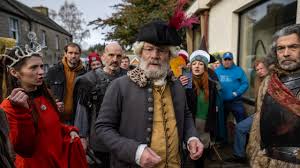
In the droll British satire The Fall of Sir Douglas Weatherford, Kenneth (Peter Mullan) works for the museum of the local country manor house, giving tours of the grounds. Kenneth is an enthusiastic interpreter of the history he has learned, and uncritically worships the manor’s 18th Century owner, Sir Douglas Weatherford. When an episodic television fantasy series, closely resembling Game of Thrones, arranges to film on the estate’s grounds, the village is deluged with its fans. Kenneth cannot understand why the mobs of fans, many of whom dress in the faux-medieval garb of the series, are obsessed with every detail of the fictional story and are devoted to its celebrity actors. He is further offender that they show no interest in the local history that is his life’s work.
Even Sir Douglas Weatherford’s present-day descendants drop Kenneth’s beloved history programming to capitalize on the fantasy craze. Kenneth’s bewilderment spins into rage, and, when he loses his job, he decompensates. Kenneth, his world turned upside down, plots an epic revenge.
There are essentially two jokes in The Fall of Sir Douglas Weatherford. The first is that Kenneth sees Sir Douglas Weatherford as a giant of the Age of Enlightenment like Isaac Newton or Edmond Burke. In fact, the achievements of Sir Douglas that Kenneth so reveres are objectively inconsequential. Furthermore, Sir Douglas’ values were exactly on the wrong-side-of-history. He was an historical figure who would get cancelled today, if anyone except Kenneth remembered him.
The second joke is in mocking today’s embrace of celebrity culture and shallow entertainment, and the prevalent lack of embarrassment at historical illiteracy. Kenneth is right about all of this, but it doesn’t surprise anyone else, and Kenneth takes it way too seriously.
Although Kenneth focues on the 1700s (and, as a re-enactor, even sometimes dresses in that way), he is really stuck in the 1980s, before the Internet Age, when there was a common national culture and people still had attention spans.
Here’s what I found funniest – the actual Weatherford descendant, who smugly fancies herself as a progressive and a radical environmentalist, is exactly the entitled awful person that Sir Douglas and his forebears must have been.
Peter Mullan is superb. A great screen actor, he imbues Kenneth with both stunned confusion and simmering fury; Kenneth is almost always outwardly stoic, even as he is raging inside.
I tend to like droll dark comedies, but The Fall of Sir Douglas Weatherford was such a slow boil that I kept losing interest. The premise is very funny, but even deadpan needs to move more quickly. The pace drained the comic impact of the absurdities.
I screened The Fall of Sir Douglas Weatherford for SFFILM, where I did not choose to recommend it. It is releasing into theaters this weekend.