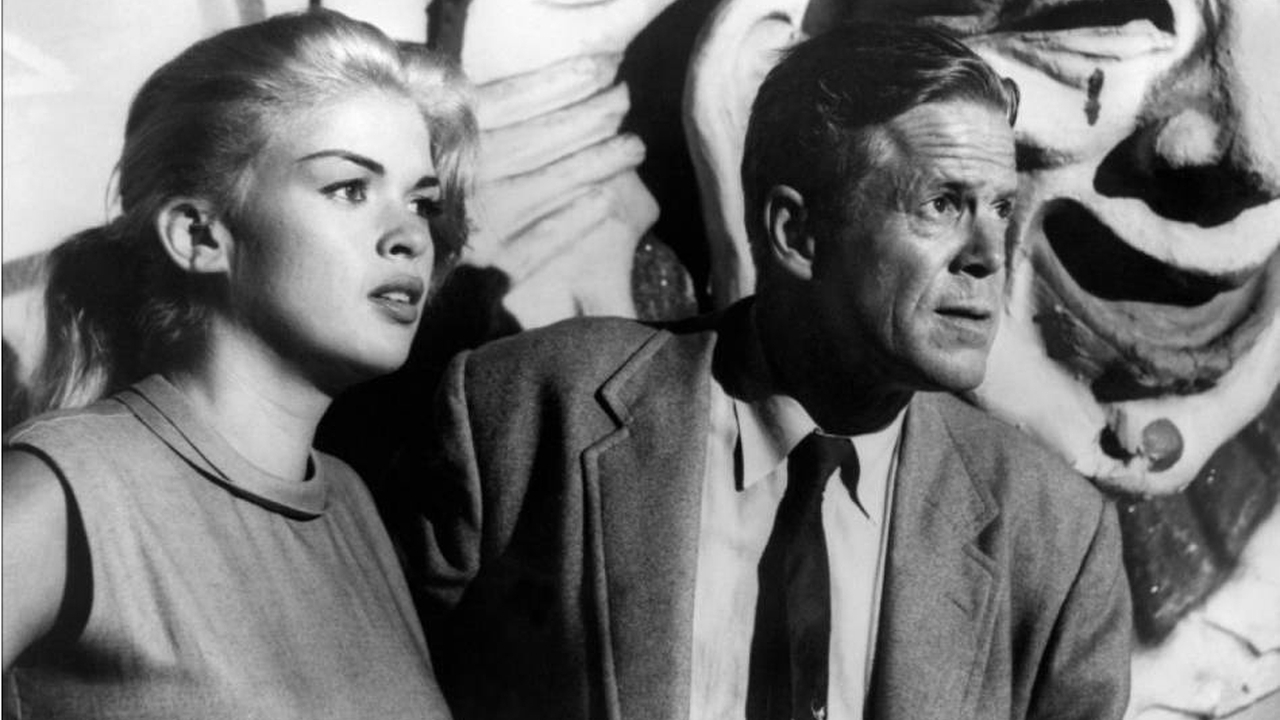
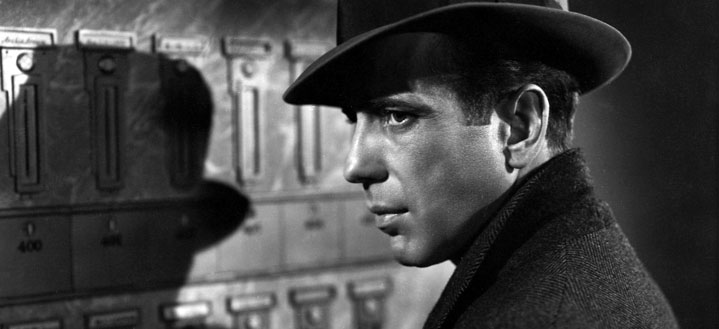
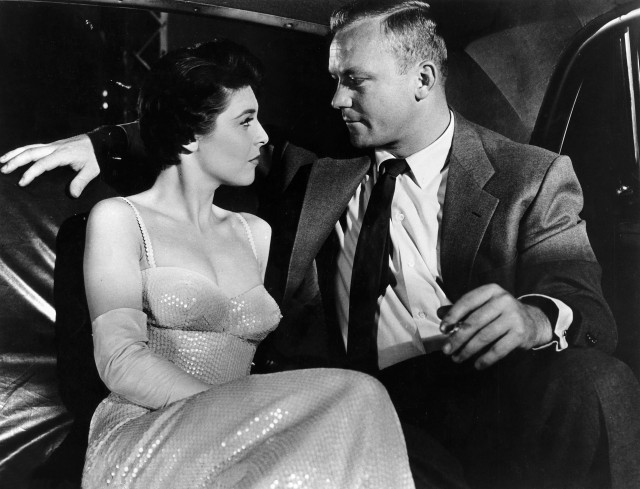
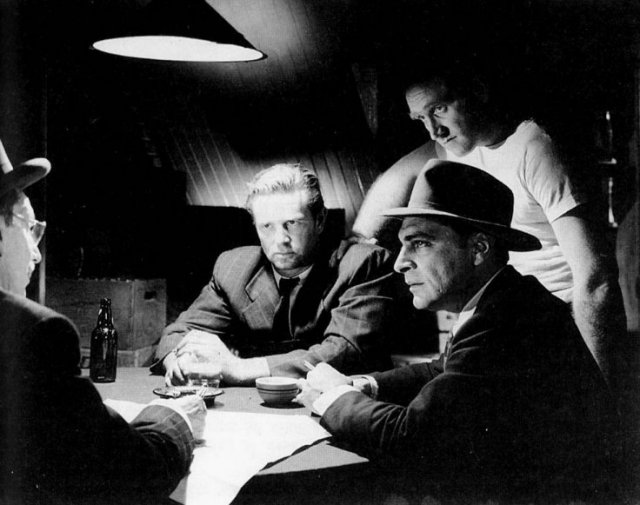
This week’s Stream of the Week comes from The Movie Gourmet’s list of Overlooked Noir. The Burglar (1957) is known primarily as the movie debut of Jayne Mansfield, but it’s a fine film noir. It starts out with a tense burglary, but once the necklace is successfully burgled, the story focuses on the heist team going stir crazy as they wait for the environment to cool down so they can safely fence the booty. They are strung so tight that even the whistle of a tea kettle is enough to startle the gang. While dodging the cops, they find that they are also being hunted by a corrupt rogue cop and his partner.
The core of The Burglar is the stellar lead performance of Dan Duryea as the chief burglar. He’s a tortured and worn-out guy – with one deep loyalty.
There are plenty of noir moments – lots of shadows, uplit faces in the darkness and amoral, grasping characters. We have not one, but two noir vixens – Jayne Mansfield and Martha Vickers. Asked at a bar by Duryea what she wants, Vickers answers “Basically, I’m out to find myself a man.” The characters in this fine film noir find themselves in Atlantic City, where the bad cop chases the protagonists through the House of Horrors and the Steel Pier, culminating in a final confrontation under the boardwalk.
The acting is excellent, other than Peter Capell, who gives over-acting a bad name while playing the most nerve-wracked member of the gang. Even Mansfield is good; (The Burglar was held in the can for two years and then released when Mansfield became a sensation with The Girl Can’t Help It).
The movie was shot on location in Philadelphia and Atlantic City. We see Independence Hall, and it’s hard not to think of Rocky when Duryea climbs the steps to the Philadelphia Museum of Art.
The Burglar plays from time to time on Turner Classic Movies and is available streaming on Amazon Instant Video, iTunes, Vudu, Xbox Video and Flixster.
[Note: The Burglar features John Facenda as his real-life role as a Philadelphia newscaster (when local TV stations aired 15-minute newscasts). Facenda later found much broader fame as “The Voice of God” for his narration for NFL Films football documentaries.]
Tomorrow night, July 24, Turner Classic Movies presents the groundbreaking French noirElevator to the Gallows. It’s one of my Overlooked Noir.
Elevator to the Gallows (1958) is such a groundbreaking film, you can argue that it’s the first of the neo-noir. It’s the debut of director Louis Malle, shot when he was only 24 years old. It’s difficult now to appreciate the originality of Elevator the Gallows; but in 1958, no one had seen a film with a Miles Davis soundtrack or one where the two romantic leads were never on-screen together.
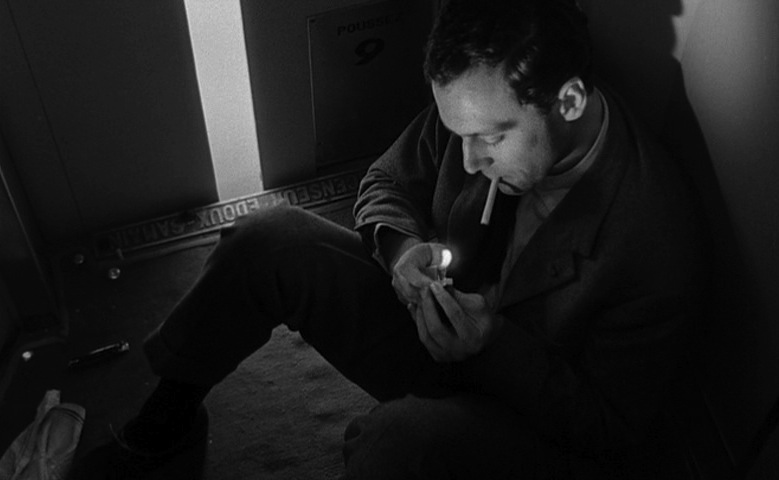
A thriller that still stands up today, Elevator to the Gallows (Ascenseur pour l’échafaud) is about the perfect crime that goes awry. The French war hero Julien (Marcel Ronet), is now working as an executive for a military supplier. He’s having an affair with Florence (Jeanne Moreau), whose husband owns the firm. Seeking to possess both his lover and his company, Julien implements an elaborately detailed plan to get away with his boss’ murder. Everything goes perfectly until he makes one oversight; then the dominoes begin to fall, and soon he is trapped in a very vulnerable situation. He is incommunicado, and he remains ignorant of the related events that transpire outside.
Almost every character makes false assumptions about what is going on. Florence mistakenly believes that Julien has run off with a young trollop. A young punk and his peppy girlfriend incorrectly assume that they are on the verge of arrest. The police pin a murder on Julien that he didn’t commit – but his alibi is the murder that he DID commit. And there’s a great scene where Julien is striding confidently into a busy cafe, unaware that he has become the most recognizable fugitive in France.
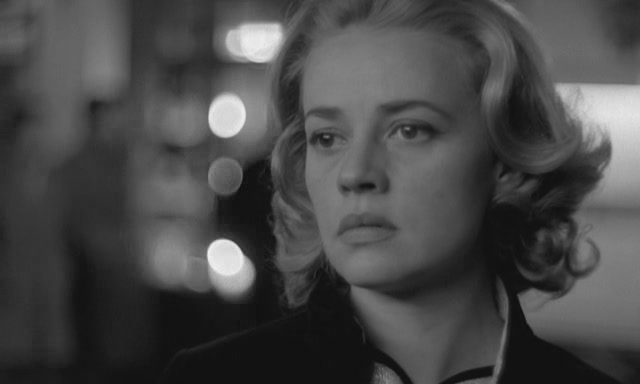
It’s a page-turner of a plot, and the acting is superb, but Malle’s choices make this film. When Florence thinks that she’s been dumped, she walks through Paris after dark. Jeanne Moreau doesn’t have any lines (although her interior thoughts are spoken in voice-over). Instead, she embodies sadness and shock through her eyes and her carriage – the effect is heartbreaking. Mile Davis’ trumpet reinforces the sadness of her midnight stroll.
The Miles Davis score is brilliant, but Malle often makes effective use of near silence, too. And he reinforces the kids’ shallowness and over-dramatizing with strings. Every audio choice is perfect.
There’s vivid verisimilitude in a Paris police station at 5 am – all grittiness with drunks sobering up, and the holding cage filled with thieves and prostitutes. The contrast in how the police treat the wealthy and influential is stark and realistic.
The young couple is completely believable. The joyride is absolutely what these characters would do. The young guy is sullen and the girl is hooked on his moodiness. And, of course, with the self-absorption of youth, they over-dramatize their own situation.
Every scene in Elevator to the Gallows is strong, but the scenes with Moreau pop off the screen. This was her star-making role, and perhaps the definitive Jeanne Moreau role (yes – even more than Jules et Jim).
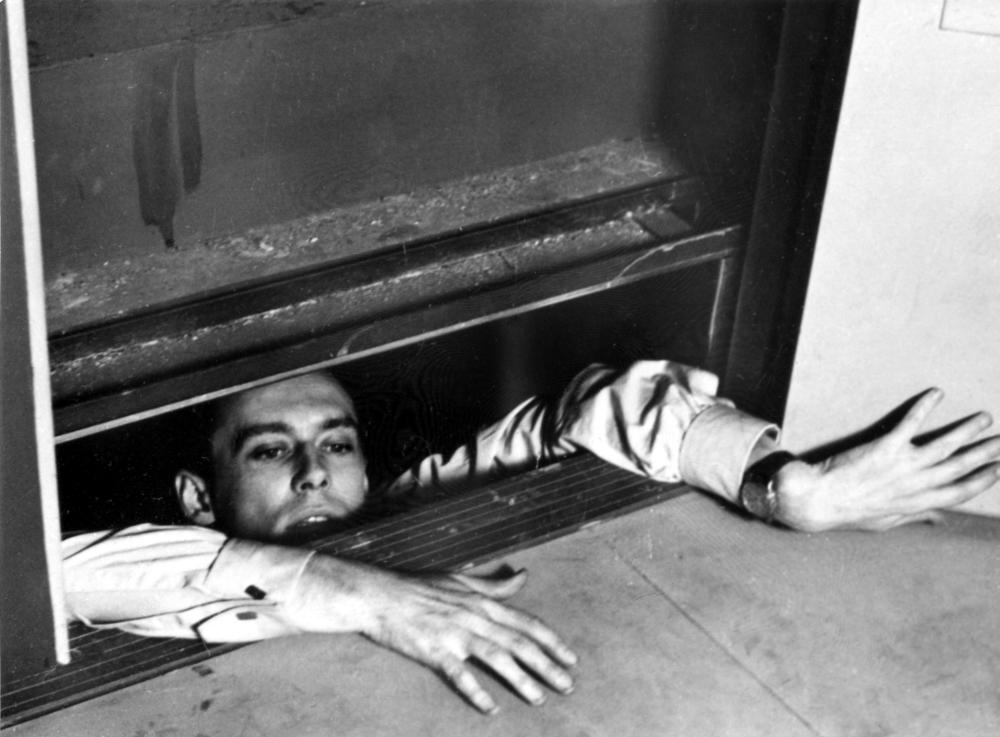
Marcel Ronet is also excellent as Julien. Julien is a guy with serious skills, and the confidence and poise to use them. When Julien is trapped in the situation that would cause most of us to freak out, he immediately starts working on an Apollo 13-like solution without any hint of panic. The harrowing scenes of Julien’s entrapment and escape fit alongside the mot suspenseful moments in the great French crime thrillers Rififi (1955) and Le trou (1960). The means of his eventual escape is one of the most ironic moments in cinema.
Marcel Ronet in ELEVATOR TO THE GALLOWS
Eventually we see the marvelous Lino Ventura as the detective captain. A former European wrestling champion, Ventura had debuted five years earlier in the great Touchez pas au grisbi and had followed that with several gangster/cop supporting roles. Immediately after Elevator to the Gallows, Ventura started getting lead roles. Ventura had an almost unique combination of charm, wit and hulking physicality; he’s one of the few actors I can envision playing Tony Soprano.
The high contrast black and white photography, the voiceovers and the city at night all scream “noir”. So does the amorality of the main characters seeking to get what they want by murder, the ironies of the miscommunications and mistaken assumptions and the profoundly cynical ending.
But the look and sound of Elevator to the Gallows is entirely new. The experience of viewing Elevator to the Gallows seems closer to the American indie triumphs of the early 1970s (The Godfather, Chinatown, The Conversation) than to the likes of The Postman Always Rings Twice or The Big Sleep. Elevator to the Gallows remains a starkly modern film that is still as fresh today as in 1958.
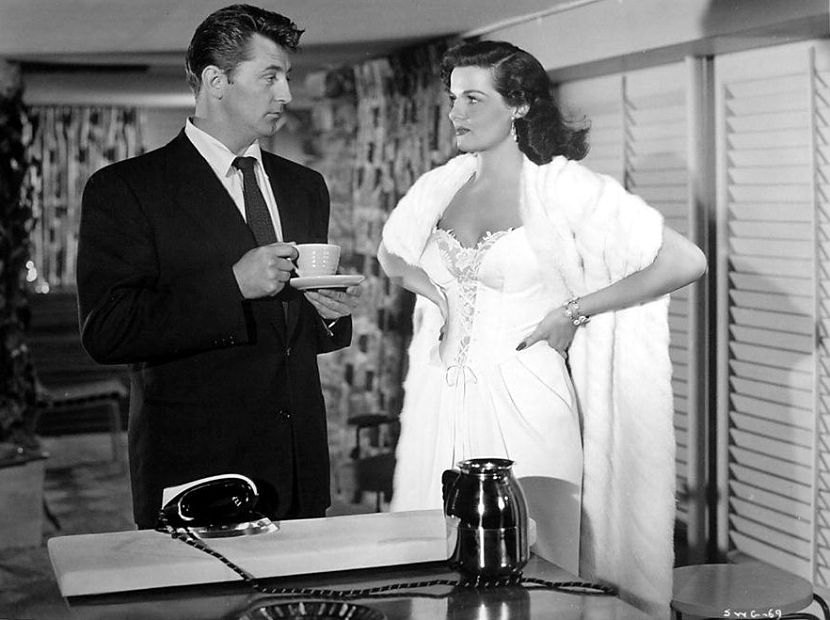
Here’s a selection from my list of Overlooked Noir – His Kind of Woman. Robert Mitchum plays a down-and-out gambler who is offered a deal that MUST be too good to be true; he’s smart enough to be suspicious and knows that he must discover the real deal before it’s too late. He meets a on-the-top-of-the-world hottie (Jane Russell), who is about to become down on her luck, too.
They are stuck in the confines of a Mexican beach resort with a full complement of shady characters, played by noir standard-carriers Charles McGraw, Jim Backus and Philip Van Zandt. And there’s the star of movie swashbucklers (Vincent Price), who is hiding out from his unhappy marriage. Tim Holt (Treasure of the Sierra Madre) shows up as another guy who isn’t what he seems. And, anchored just offshore, is the ruthless Italian crime lord (Raymond Burr at his most pitiless).
What makes this a noir classic is the complete amorality of the very sympathetic Mitchum and Russell characters. They’re not bad people, but they are playing the hands that they have been dealt. Neither questions the justice of their situations – they don’t feel sorry for themselves, they just deal with it. And they don’t worry about sleeping around or breaking a few laws if they have to. They may not be lucky, but they are determined to survive.
Reportedly, studio owner Howard Hughes fired the director John Farrow and replaced him with noir-master Richard Fleischer (Cry Danger).
His Kind of Woman plays on Turner Classic Movies and is also available on DVD from Netflix and streaming from Amazon Instant Video, iTunes, YouTube, Google Play and Flixster.
Turner Classic Movies has announced a CAN’T MISS summer film noir series. The “Summer of Darkness” will be hosted by Film Noir Foundation president Eddie Muller – the Czar of Noir. Here’s the complete schedule.
TCM will be presenting 24 hours of film noir on each Friday in June and July. Every week, Eddie Muller himself will present four movies in prime time in TCM’s “Friday Night Spotlight.” Muller has penned this introductory article.
The Film Noir Foundation performs an invaluable mission: preserving and restoring classic film noir that would otherwise be lost to us and to posterity. And Muller and the Foundation host one of my absolute film festivals every winter in San Francisco – Noir City. Noir City has been expanding into other cities. Muller is a respected film historian, and his DVD commentaries are excellent. Here’s your chance to experience the Czar of Noir on television.
I’ll be calling out specific recommendations from the Summertime of Darkness in my regular Movies to See Right Now posts on Fridays, as well as writing some special posts on my favorite Overlooked Noir, including Woman on the Run and Elevator to the Gallows. Stay tuned.
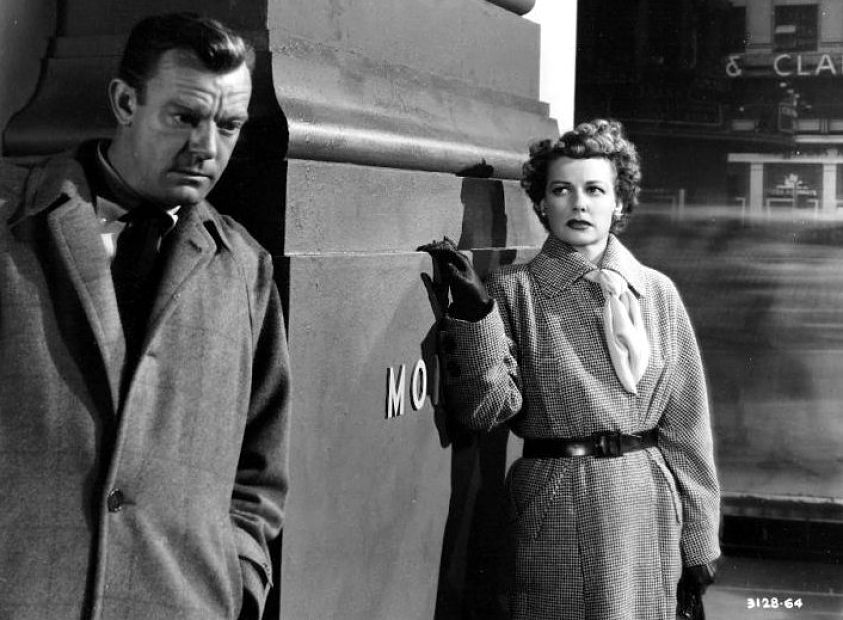
Deenis O’Keefe and Ann Sheridan in WOMAN ON THE RUN
On Friday night, June 5, Turner Classic Movies is presenting one of my Overlooked Noir, in its wonderful film noir series Summer of Darkness. The character-driven thriller Woman on the Run (1950) is notable for its San Francisco locations, making it a veritable time capsule of the post-war City By The Bay.
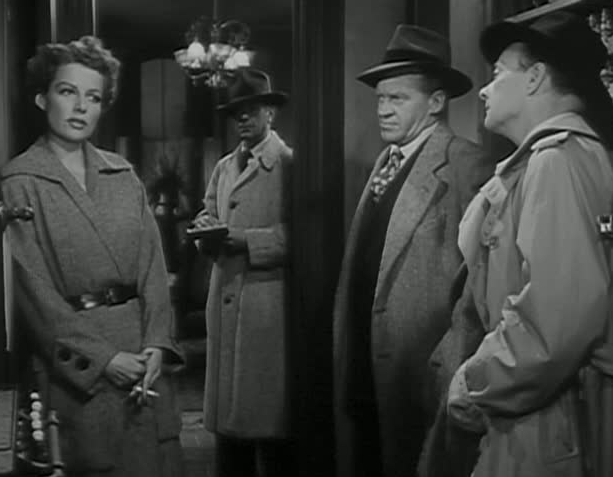
The movie opens with a murder, and the one terrified witness goes underground. When the police coming looking for him, they are surprised to find his wife (Ann Sheridan) both ignorant of his whereabouts and unconcerned. While still living in the same apartment, the couple is estranged. And the wife has a Mouth On Her, much to the dismay of the detective (Robert Keith), who keeps walking into a torrent of sass.
But soon the wife starts hunting hubbie, along with the cops, a reporter (Dennis O’Keefe) and the killer. It’s a race to see who can find him first. One character is revealed to be more dangerous than was apparent, and the audience learns this before our heroine does.
One quirky nugget – when she visits his workplace, we learn that his job is making mannikins in the basement of a large department store.
Sheridan is great in this uncharacteristically insolent role. So are O’Keefe and Keith. But the real star of Woman on the Run is San Francisco itself, from the hilly neighborhoods to the bustling streets to the dank and foreboding waterfront. Oddly, the finale is at an amusement park which seems to be Playland At the Beach (but was actually filmed at the Santa Monica Pier). (Further trivia – that Laffing Sal is the one at Santa Monica, not the one at Playland which now resides at the Santa Cruz Beach Boardwalk.) The only movie that rivals Woman on Run for its depiction of San Francisco in the 1950s is The Lineup.
The story is a taut 77 minutes of mouthy Ann Sheridan, the life-or-death manhunt and stellar period San Francisco. Woman on the Run is available on DVD from Netflix and streaming from Amazon Instant Video (free with Amazon Prime).
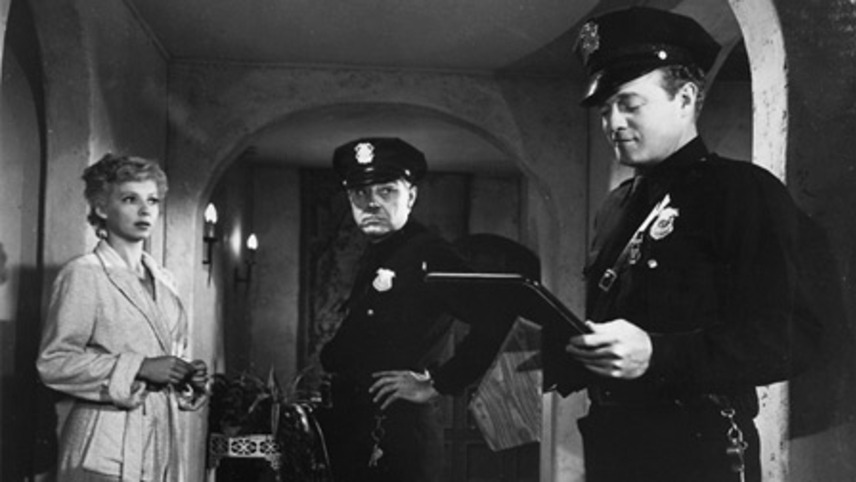
Ann Sheridan (far left) sasses Robert Keith (far right) in WOMAN ON THE RUN
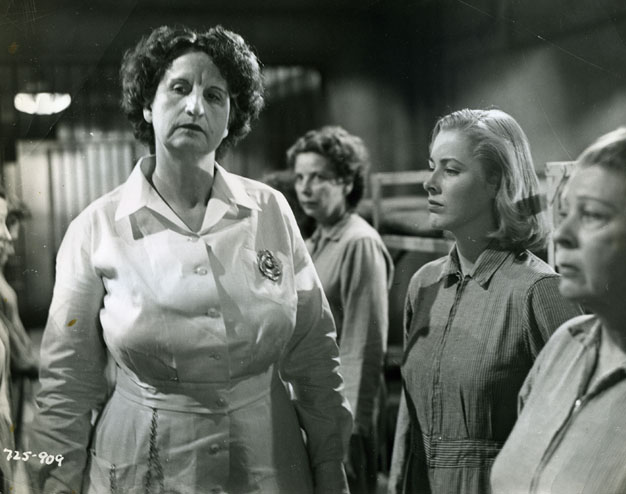
Want to see the prototype for Orange Is the New Black? On September 6, Turner Classic Movies airs the 1950 Caged. Eleanor Parker (who died last year) played the naive young woman plunged into a harsh women’s prison filled with hard-bitten fellow prisoners and compassion-free guards. Parker was nominated for an acting Oscar, but her performance pales next to that of Hope Emerson, whose electric portrayal of a hulking guard also got an Oscar nod. Caged also features the fine character actresses Thelma Moorhead, Jane Darwell (Ma Joad in The Grapes of Wrath) and Ellen Corby (Grandma Walton here as a young woman). Sixty-four years later, Caged might still be the best women’s prison movie ever.
Eva Green in the poster for FRANK MILLER’S SIN CITY: A DAME TO KILL FOR
Wow, was this ever a disappointment. I loved the first Sin City from co-directors Richard Rodriguez and Frank Miller (the graphic novelist). And I’m in Sin City’s prime target audience because I love noir sensibility, hard-boiled dialogue and stylized violence in my movies. But Frank Miller’s Sin City: A Dame to Kill For is just not engaging.
None of the three story threads is particularly thrilling. The dialogue is so consistently lurid that it’s just overblown. Powers Boothe – always a wonderful villain – snarls his menacing smile so often that we expect him to grow mustaches and twirl them. The movie violence is of the splatter variety, and the bloodbath unleashed by Rosario Dawson and Jamie Chung is just silly. The ultra-sympathetic Denis Haybert is miscast as a monstrous superthug. Jessica Alba does a convincing job as a stripper but not as an alcoholic.
The whole thing is a stunning waste of a fantastic cast, including Boothe, Haybert, Mickey Rourke, Joseph Gordon-Levitt, Josh Brolin, Ray Liotta, Juno Temple and Christopher Meloni. In particular, Meloni and Liotta are not given much to do. Temple shines as usual as a mistress-for-hire, and Christopher Lloyd sparkles as a particularly unsanitary surgeon.
One remarkable thing – Eva Green (whose character is The Dame to Kill For) plays much of the movie in full frontal (and back and side view) nudity; I can’t remember seeing the body of a major female star displayed so clinically. Now she looks really good naked, but the sheer screen time of her nudity is unusual. Of course all the women in the movie are objectified – and other than Green’s malevolent and slutty femme fatale, Alba’s stripper, and Temple’s mistress, the female characters are all prostitutes.
If you like noir, then the film looks great: almost all black-and-white except for, occasionally, cherry red cars and vivid lipstick, hair and dresses on the women. The best I can say about Sin City: A Dame to Kill For is that it’s nasty, brutish and 102 minutes short.
It’s more than a film fest, it’s a feast of film noir.
This June, Turner Classic Movies’ Friday Night Spotlight will focus on Noir Writers. The guest programmer and host will be San Francisco’s Eddie Muller, founder and president of the Film Noir Foundation. The Foundation preserves movies from the traditional noir period that would otherwise be lost. It also sponsors Noir City, an annual festival of film noir in San Francisco, which often plays newly restored films and movies not available on DVD. (My favorite part is Noir City’s Thursday evening Bad Girl Night featuring its most memorable femmes fatale.)
Muller (the Czar of Noir) has selected films from the work of noir novelists. Friday night, he kicks off with films from the novels of Dashiell Hammett: the 1931 and more famous 1941 versions of The Maltese Falcon, plus the 1936 version (Satan Met a Lady) and After the Thin Man and The Glass Key. (Muller informs us that Hammett pronounced his first name da-SHEEL.)
On June 14, Muller continues with the work of David Goodis, The Burglar, The Burglars, The Unfaithful, Shoot the Piano Player and Nightfall. (You may have seen Goodis’ Dark Passage with Bogie and Bacall.)
On June 21, we’ll see films from the novels of Jonathan Latimer (Nocturne, They Won’t Believe Me) and James M. Cain (Double Indemnity, The Postman Always Rings Twice).
TCM and the Czar of Noir wrap up on June 28 with movies from the novels of Cornell Woolrich (The Leopard Man, Deadline at Dawn) and Raymond Chandler (Murder My Sweet, The Big Sleep, Lady in the Lake, Strangers on a Train).
These two movies aren’t part of the Friday night series, but on June 11, TCM features two of the nastiest noirs: Detour and The Hitchhiker.
Set your DVR and settle in for dramatic shadows, sarcastic banter and guys in fedoras making big mistakes for love, lust and avarice.
On May 7, Turner Classic Movies is broadcasting three classics of film noir.
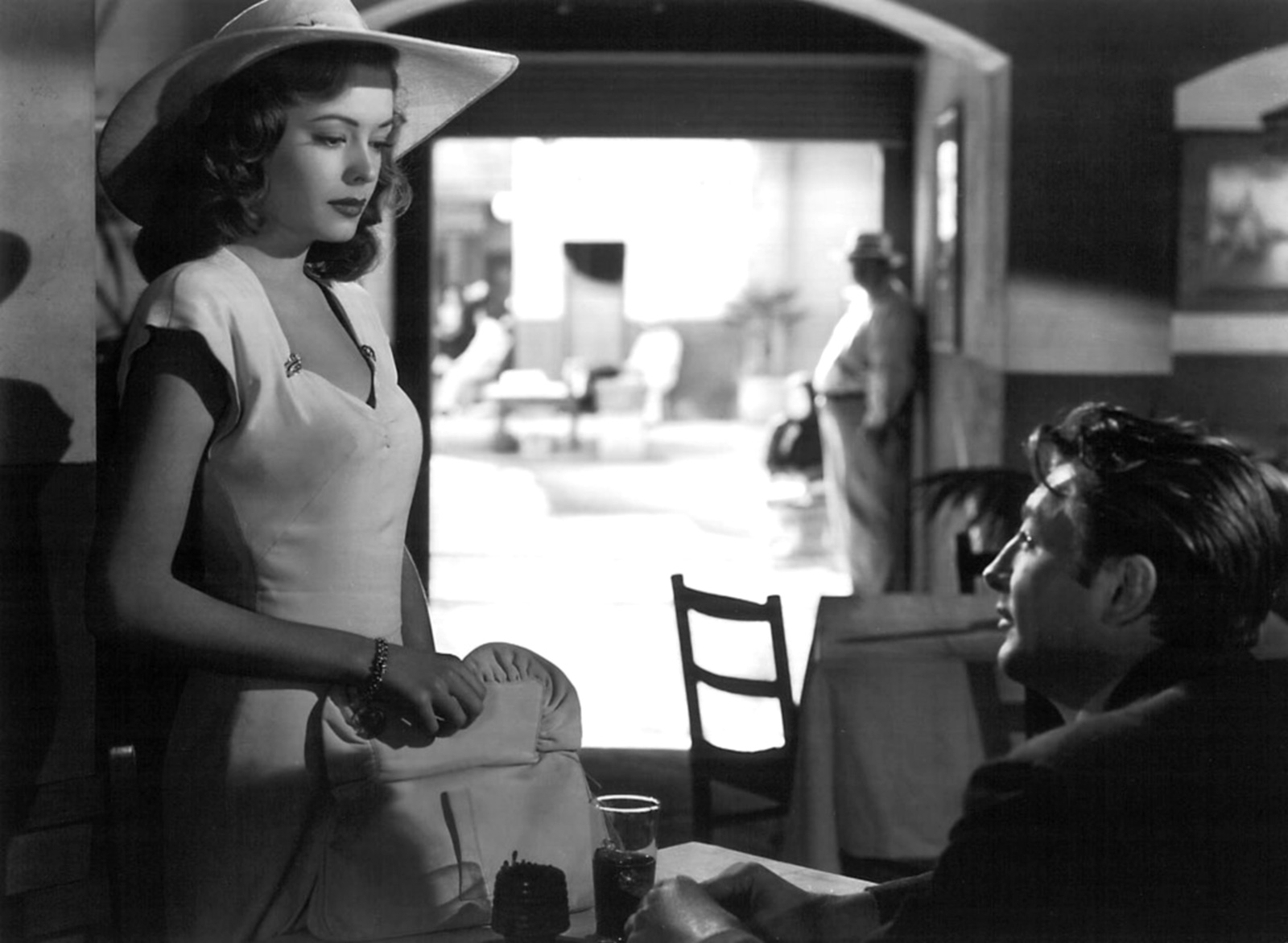
You really haven’t sampled film noir if you haven’t seen Out of the Past (1947). Perhaps the model of a film noir hero, Robert Mitchum plays a guy who is cynical, strong, smart and resourceful – but still a sap for the femme fatale…played by the irresistible Jane Greer. Greer later reported that she received this guidance from director Jacques Tourneur: “First half of the picture – good girl. Second half – bad girl.” Kirk Douglas plays The Bad Guy You Don’t Want to Mess With, emanating a mix of evil and power. With Out of the Past, Tourneur crafted one of the most dramatically lit and photographed noirs – not one puff of cigarette smoke goes uncelebrated.
THE ASPHALT JUNGLE
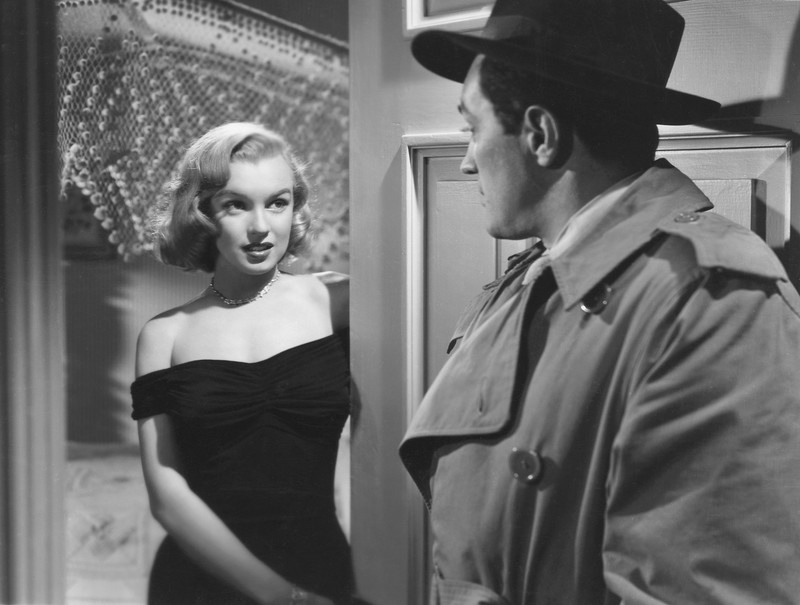
In The Asphalt Jungle (1950), the crooks assemble a team and pull off the big heist…and then things begin to go wrong. There aren’t many noirs with better casting – the crooks include Sterling Hayden, Louis Calhern, Sam Jaffe and James Whitmore. The 23-year-old Marilyn Monroe plays Calhern’s companion in her first real speaking part. How noir is it? Even the cop who breaks the case goes to jail. Directed by the great John Huston.
Every police procedural from 1948 through today’s Law and Order and CSI owes something to the prototypical The Naked City (1948). Tenacious New York City cops solve a murder amid gritty streets and shady characters. Unusual for the time, it was shot on location. Directed by noir great Jules Dassin, The Naked City won Oscars for black and white cinematography and film editing.
On April 30, Turner Classic Movies will be broadcasting the oft overlooked 1951 film noir The Prowler, starring usually sympathetic good guy Van Heflin as the twisted bad guy. Heflin is a beat cop responding to a call – a woman has reported a prowler outside her house. By the time Heflin and his partner arrive, the prowler is long gone, but Heflin is lusting after the comely woman (Evelyn Keyes), who is home alone every night because her husband works as an all-night DJ. Under the ruse of making sure that the prowler has vamoosed, Heflin returns and overcoming her reticence, seduces her. As befits a film noir, once he finds out about the husband’s insurance policy, sleeping with the guy’s wife just isn’t enough anymore.
It’s a strong screenplay, penned by the blacklisted screenwriter Dalton Trumbo (who also provides the voice of the DJ). Heflin sheds his usual decency to cast a predatory eye at another man’s wife and stuff. This isn’t the Double Indemnity film noir sap who does the bidding of the femme fatale; it’s all his idea, and she just triggers his rapaciousness. Keyes plays a woman who wants to pretend she’s on the level, but kinda knows what’s going on.
And of course, the cop has figured out how to get away with the scheme…except for one thing.
The Prowler has been restored by the Film Noir Foundation and the UCLA Film & Television Archive. It’s an underrated noir thriller.