
The convention-shattering documentary You Can See Everything is ostensibly centered on Elizabeth Holmes, who, in her early 20s, sought and attained global fame as a self-made tech billionaire, until she was exposed as a fraud. But You Can See Everything is not a recounting of the Theranos scandal. Filmmaker Nathan Fielder uses Elizabeth Holmes’ desire to tell her sanitized version of that story to explore truth, fact, lies, delusion and narrative itself. The result is an ever-surprising film that is the best movie I have yet seen in 2026.
You Can See Everything kicks off 34 days before Holmes’ 11-year prison term will begin. Holmes and her partner Billy Evans have invited filmmaker Fielder to move in with their family at a San Diego beach rental. Promising total transparency, hence the film’s title, they grant Fielder and his co-director Lance Oppenheim permission to film them 24/7.
Having been convicted of fraud in federal court after a high-profile trial, Holmes still claims to be innocent. Essentially, she says that the words in her sales pitch were misinterpreted by investors, and that the media, prosecutors, Hollywood and the public have been mean to her.
Thankfully, Fielder recognizes that Holmes’ guilt has already been litigated. The story he tells is sparked by Holmes’ insistence on her version of the narrative. Fielder is best known as a comedian, and one expects that Holmes and Evans had gauged him as a lightweight whom they could manipulate. Indeed, because Fielder is not a gotcha journalist, his curiosity leads him to unexpected insights.
As Holmes and Fielder undergo a battle of wits, she has the advantage of being unburdened by empathy. Fielder, in contrast, is empathetic and decent, but he is a smart and skeptical.
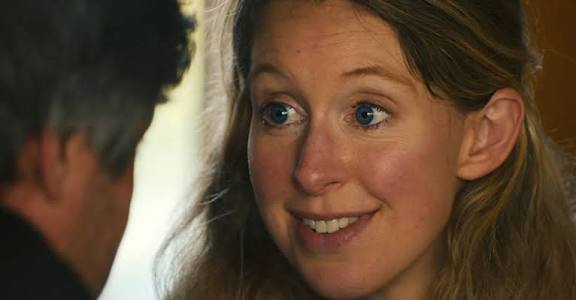
You know the game we all played as kids, staring at each other until someone blinks? When Elizabeth Holmes protests her innocence, she is wide-eyed and does not blink. Right away, we semse Fielder finding this unnatural behavior to be significant and meaningful. And when she claims to never, in her whole life, have told a lie, Fielder refuses to let that go unchallenged.
We can see Fielder asking himself whether she has deluded herself in believing her most outlandish statement, or whether she is a bald-faced liar of unbridled chutzpah.
You Can See Everything is full of surprises, the biggest of which I will not spoil. But I will say that I didn’t expect Holmes’ baby daddy Billy Evans to emerge as a central element of the film. Evans is one of those really dumb guys who thinks he is the smartest person in the room, and he exposes himself as a greedy, narcissistic bully. While Holmes tries to control the narrative by guile, Evans is only equipped to deploy blunt aggression. Fielder clearly despises Evans (and Evans gave him more than enough justification). Billy Evans is the year’s most messed up movie character, and that includes the cyclops in The Odyssey.
You Can See Everything Now is a creative triumph for Nathan Fielder. Certainly, no one but Fielder would make such ingenious use of an Abbott and Costello clip. Fielder’s gift for observation results in a memorable moment, sparking audible audience reaction, over, of all thing, the whisking of eggs. And his inclusion of actress Amanda Seyfried, who won a Primetime Emmy for an unflattering portrayal of Holmes in the Hulu miniseries The Dropout, is transformative.
Put off by my own contempt for Elizabeth Holmes and by the three-hour running time, I wasn’t going to see You Can See Everything. I changed my mind when I read rapturous reviews, news reports of sold-out screenings and awards buzz. Indeed, I had to wait three days to see You Can See Everything, because even the matinee screenings at my local theater were sold out.
What about the three-hour length? I am generally in tolerant of movies that last more than 135 minutes, but You Can See Everything flew by, because Fielder keeps finding more aspects of the story to tell.
For the facts on the Theranos scandal itself, I strongly recommend the NYT opinion piece The Elizabeth Holmes Documentary, Through the Eyes of the Reporter Who Exposed Her by John Carreyrou, who exposed the fraud in the WSJ and wrote the book Bad Blood: Secrets and Lies in a Silicon Valley Startup. Carreyrou, who has won two Pulitzer Prizes, was skeptical of Fielder’s film before he saw it, but now admires it.
I also admire You Can See Everything for its originality and for its combination of engaging entertainment and profound insight. It’s certainly one of the Best Movies of 2026 – So Far.