
Albert Nobbs: the perfomances can’t overcome the story

Glenn Close plays the title character, a woman living as a man in early 20th century Dublin; the woman makes a convincing male waiter at a small hotel.  She is repressed, obsessed with stashing a trove of tips to finance opening a shop and terrified that anyone will discover her secret.

Although Close is very good, the actress Janet McTeer gives the movie’s best performance; I will avoid a spoiler by describing her character.  Pauline Collins is excellent as the hotel’s avaricious owner.  Brendan Gleeson pops in for one of his delightful turns as the hotel’s doctor.

The fine young actress Mia Wasilkowska (The Kids Are All Right, Alice in Wonderland), however, just doesn’t seem to fit the period.  She is stuck with playing the one dimensional role of an oversexed hotel maid who could be wearing a placard that says, “Knock me up”.

The problem with Albert Nobbs is that, to buy the story, you have to accept that a 50-year-old hotel worker has no idea whatsoever about certain aspects of sexuality.  Now Albert Nobbs is asexual and traumatized from an early incident of sexual abuse, but that really doesn’t explain how she could have observed behavior of hotel guests for thirty years without even learning about some basic proclivities.

Another problem is that the visiting English elite is SO cruel to the Irish staff (not just with historically accurate cruelty, but over-the-top  cruelty), that these story elements become broad and campy, which doesn’t mesh with the rest of the movie.  Despite the best efforts of Close, McTeer, Collins and Gleeson, Albert Nobbs just doesn’t work.

[youtube:http://www.youtube.com/watch?v=66N5hjkq740]
Few big surprises in the Oscar nods

The Oscar nominations are out, and there are few of the head scratching inclusions and omissions that we frequently see.  Of the Best Picture nominations, The Artist, The Descendants, Hugo and Midnight in Paris all made my Best Movies of 2011Although they didn’t make my Best of the Year list, War Horse and Moneyball are very good movies that I recommend.  I haven’t yet seen The Help, which is, by all accounts, a fine film.  Although I hated The Tree of Life, it was the biggest art film of the year and much praised by mainstream critics.  The one jaw dropper is the critically scorned Extremely Loud and Incredibly Close, which exploits 9/11 in the pursuit of a three hankie weeper.

My biggest disappointments were the snubbing of Michael Shannon’s performance in Take Shelter and the innovative screenplay by Diablo Cody and Jason Reitman for Young Adult.

The acting categories seem a little light to me this year with the exception of Best Actress, with two performances for the ages by Michele Williams in My Week with Marilyn and Meryl Streep in The Iron Lady.

Carnage: a comic actors’ showpiece

The sons of two Brooklyn couples have tangled in a schoolboy row.  The couples meet to discuss the matter, but the personality clashes between and within the couples derails an encounter of forced politeness into comic chaos.

Carnage belongs to its actors, and the couples are played by John C. Reilly and Jodie Foster and Christoph Walz and Kate Winslet.  All are very good and very funny.  The Austrian actor Walz (Inglorious Basterds) is especially good; his eyes betray his indifference to parenting and social niceties, but finally gleam when he is spurred to conflict.

Carnage is directed by Roman Polanski, based on the popular comic play God of Carnage by the French playwright Yasmina Reza.   God of Carnage won the 2009 Tony for Best Play.

Polanski (Rosemary’s Baby, Chinatown, The Pianist) is one of the greatest living directors, and knows enough to eschew anything showy here.  He just lets the actors show their chops, which is a very good thing.  Carnage is not one of the year’s best movies, but is a smart and funny comedy.

Haywire: an action star is born

One of the first 2012 releases, Haywire is a rockem sockem spy action thriller by Steven Soderbergh, starring Gina Carano.  I was not familiar with Gina Carano, who is an accomplished star of mixed martial arts.  Haywire is a vehicle seeking to launch her as an action film star.  And why not, for she is attractive (with “real girl”, not Hollywood, looks), well-endowed and can kick ass?  She can, after all, kick ass for real, not just pretend to in a movie.

As an actor, Carano is plenty good enough.  She’s way better than Chuck Norris, Jackie Chan and the Rock, and is at least as good as Schwarzenegger.  And, when she beats up a swat team, it is believable (and fun).

Soderbergh is always interesting, as he moves between high brow/arty (sex lies and videotape, The Good German) and lowbrow/popular (Ocean’s Twelve, Contagion).  Here he takes an inexperienced leading woman and an unremarkable story and makes the most of it.  It’s a good watch.

Soderbergh delivers fast pacing and great locations (Barcelona, Dublin, New Mexico).  Soderbergh and Carano benefit from a top rate cast:  Michael Douglas, Ewan McGregor, Michael Fassbender, Antonio Banderas, Michael Angarano and Bill Paxton.  Overall, it’s good entertainment and, for once,  I’m actually looking forward to the sequels.


Hugo: Scorsese’s revelatory 3D tale

Martin Scorsese’s Hugo is both a delight and a lessons in the possibilities of 3D in the hands of a master filmmaker.  The story follows a young orphan living in the bowels of a 1920s Paris train station who strives to survive by his wits, keep his independence and solve the puzzle of an discarded automaton.

Scorsese’s use of 3D is revelatory.  We feel entirely transported to WITHIN the worlds of the station, of its industrial inner workings and Paris itself.  When the orphan walks into a bookstore, we are immersed ourselves in the many stacks of books.  Scorsese’s 3D always works to advance the story, not to distract us with assaultive gimmicks.

As an extra treat for movie lovers, the very story becomes one of movie making, film as art and film preservation.  We see the early movie magic of George Melies, especially his 1902 A Trip the Moon. We also see Lumiere’s 1896 The Arrival of a Train, and the main characters even sneak into Harold Lloyd’s 1923 Safety Last.

Sacha Baron Cohen is very, very funny as the boy’s foil, the bitter and preening station policeman.  The cast is very good, with the most pleasing turns by Emily Mortimer, Helen McCrory and Richard Griffiths.

Hugo makes my list of Best Movies of 2011.

This Week on HBO: the documentaries that freed a condemned man

Last August, three men were released from prison in Arkansas – one of them from death row. This wouldn’t have happened without two HBO documentaries, the 1996 Paradise Lost: The Child Murders at Robin Hood Hills and its 2000 sequel Paradise Lost 2: Revelations.  Every night this week, HBO is airing its third documentary Paradise Lost 3: Purgatory, which wraps up the series.  You don’t need to have watched the first two to get the full impact of Paradise Lost 3.

The men had served over eighteen years each for a horrific crime that they apparently had nothing to do with. Three second grade Cub Scouts were brutally raped, murdered and their bodies mutilated. The authorities, under understandable pressure to solve the crime, arrested three Metallica-loving teenagers and railroaded them for a supposed Satanic ritual killing. Although no physical evidence tied them to the crime, one teen with an IQ of 76 was browbeaten for twelve hours into a confession that he later recanted.

The HBO films spawned media interest and public and celebrity support for the convicted men, who became known as the West Memphis Three.

Recently processed DNA evidence was inconsistent with any of the defendants.  Facing the specter of a futile new trial, the prosecutor accepted a plea bargain that freed the men without their having to acknowledge guilt. Interestingly, the father of one of the victims has gone from the villain of the second HBO film to a supporter of the recently freed men. Here’s the New York Times coverage of the August 2011 developments.

Paradise Lost 3: Purgatory is on the short list for the Best Documentary Oscar this year.

[youtube-http://www.youtube.com/watch?v=GqQnnXTTm3w]


2011 in Movies: the year of the smart action film

SOURCE CODE

These days, explosions and chases in movies have become indicators of dumb and dumber.  But, this year, we’re seeing a welcome rebirth of the smart action film.

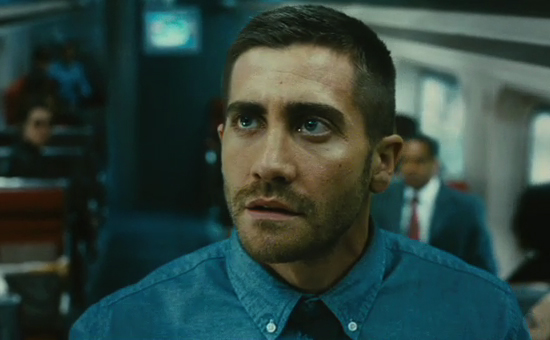
Like last year’s Inception Source Code, The Adjustment Bureau, Drive and even Hannah, brought some originality to the genre.  Drive was the most visually interesting, but Source Code combined great production values with a great hook in Ben Ripley’s screenplay:  Supersoldier Jake Gyllenhaal can inhabit the brain of a terrorism victim for the same 8 minutes – over and over again.  Each time, he has 8 minutes to seek more clues. Can he build the clues into a solution and prevent the terrorist atrocity?

The smart action movie: a welcome trend, indeed.

2011 in the Movies: most overlooked

John Sayle's AMIGO

What are 2011’s most overlooked films? The Guard and Take Shelter are on some Top Ten lists, including mine, but they still haven’t gotten the buzz that they deserve.  These are two of the very best films of the year and are not to be missed.

Kill the Irishman is a gritty crime drama with a charismatic lead performance by Ray Stevenson.

Terri is something completely new in a teen mifit movie.

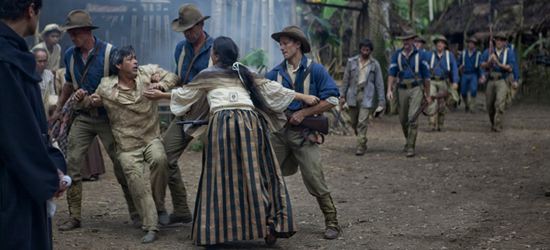
As in most films by the master director-writer-editor John Sayles, the historical drama Amigo intertwines the stories of a large ensemble cast while keeping each character recognizable, distinct and textured.

For a guilty pleasure, I will go with TrollHunter, a hilariously deadpan Norwegian take on the horror genre.

2011 in Movies: worst moviegoing experience

The Winner:  3 Backyards.  This unbearably pretentious and self-indulgent wannabe art film presents us with a petty meltdown, Elias Koteas furrowing his brow, a random mystical white poodle and caterpillars.  Did I mention the masturbating dog killer?  I hated this movie – and it is still pissing me off.

The Worst Trend:  People sitting in front of me texting and checking their email, flashing their screens and taking me out of the film.

Note: I don’t have a Worst Ten Movie list because, unlike professional critics, I don’t have to see every movie.  I do see 75-100 new movies each year, but I try REALLY, REALLY HARD to avoid the bad movies.  So my worst movie going experience is always either 1)  on an airline flight when I see a movie that I normally wouldn’t; 2) a hyped art film that disastrously falls on its face and/or really pisses me off (The White Ribbon); or 3) something I find on cable TV while channel surfing (Paul Blart: Mall Cop).  But usually, the culprit finds its way aboard a long airline flight.  Not this year.

2011 in Movies: the year’s best movies

INCENDIES

Here’s my list of the best films of 2011: 1)  Incendies, 2) Take Shelter, 3) The Artist, 4) The Descendants, 5) Poetry, 6) Midnight in Paris, 7) Beginners, 8) Source Code, 9) Young Adult, and 10) (tie) The Girl with the Dragon Tattoo and Drive.

Continuing with my list of 2011’s best films, here are my honorable mentions: The Guard,  Project Nim, Buck, Tabloid, The Adjustment Bureau, Carancho, and Potiche.

(Note:  I’m saving room for some films that I haven’t yet seen, especially Roman Polanski’s Carnage and Ralph Fiennes’ Coriolanus.)

You can watch the trailers and see my comments on all these films at Best Movies of 2011.

According to Metacritic, all of my picks (except The Adjustment Bureau) were highly rated by prominent critics.  I did disdain some art films, most notably The Tree of Life, which made lots of critics’ end-of-year lists.  See 2011 in Movies: biggest disappointments, which I’m posting on Tuesday.

(Further Note:  Incendies was nominated for the 2010 Oscar for Best Foreign Language Film, but was widely released in the US in 2011.  A Separation, which I and most folks won’t be able to see until after January 27, will contend on my 2012 list.)