
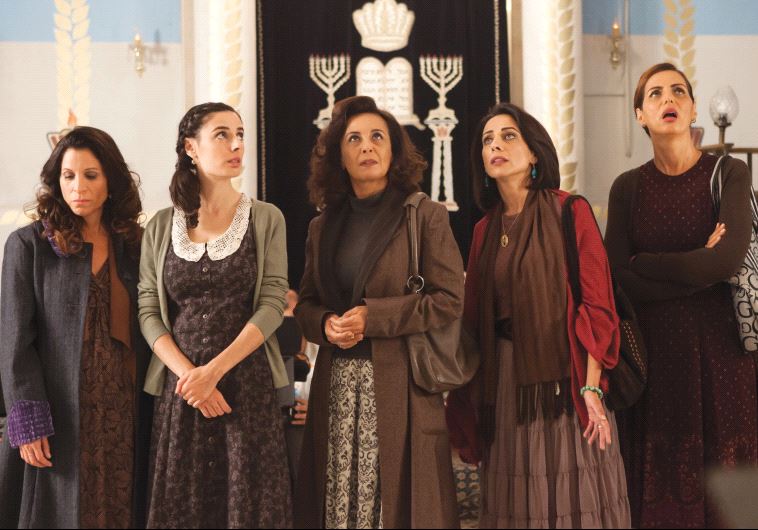
THE WOMEN’S BALCONY: a righteous man must keep his woman happy

THE WOMEN'S BALCONY
THE WOMEN’S BALCONY

A community of women in a traditional culture revolt in the delightfully smart and funny Israeli comedy The Women’s Balcony.   The balcony in a small Jerusalem synagogue  collapses, and the building is condemned.  The old rabbi’s wife is seriously injured, and he suffers a trauma-induced psychotic breakdown.  Just when it looks like the leaderless congregation will die, a young and charismatic rabbi (Avraham Aviv Alush) appears, enlivens the congregation and repairs the building.  But he rebuilds the synagogue WITHOUT the women’s section.  Profoundly disrespected, the synagogue’s women strike in protest.

The women live in a culture where males have all the power and religious authority trumps all.  The women all have their individually distinct gifts, personalities and rivalries. But they all appreciate the injustice of the situation, and they are really pissed off.  They are very creative in finding way to leverage the power that they do have, and the result is very, very funny.

This could have been a very broad comedy (and a Lysistrata knock-off).  Instead, it’s richly textured, with an examination of ethical behavior and loving relationships.  It’s also dotted with comments on the relations between Israeli Orthodox and Ultra-Orthodox and on the importance of food in this culture.  It’s the first – and very promising – feature for both director Emil Ben-Shimon and writer Shlomit Nehana.

THE WOMEN'S BALCONY
THE WOMEN’S BALCONY

There are plenty LOL moments, including a scene where one of the congregants masquerades as the demented old rabbi to secure the needed psychotropic meds.

We soon understand that the young rabbi has a very unattractive side – grossly sexist and power-hungry. But he has seduced the men and then cows them by manipulating his religious authority. He’s tearing apart a closely bound community braided together by decades of deep friendship and inter-reliance. The movie turns on whether the men can recognize when his supposed righteousness veers into what is really unethical and, in one pivotal scene with the old rabbi, indecent.

Two of the male characters, deeply in love with their women, step up and do the right thing. This overt comedy has a very a romantic core.

Most of all, The Women’s Balcony is about mature relationships. Most of these couples have been married for decades, especially the couple at the core of the story, Ettie (Evein Hagoel) and Zion (Igal Naor). Ben-Shimon and Nehana prove themselves to be keen and insightful observers of long-lasting relationships.

A righteous man must keep his woman happy. This may not be written in the Holy Scriptures, but it’s damn useful advice. (It also helps, we learn, if he can make a mean fruit salad.) The longer you’ve been married, the funnier you’ll find The Women’s Balcony.


WRESTLING JERUSALEM: it’s complicated

WRESTLING JERUSALEM
WRESTLING JERUSALEM

The Israeli-Palestinian conflict has inspired both documentary and narrative movies, but none is more imaginative than Wrestling Jerusalem. This year’s San Francisco Jewish Film Festival (SJFF36) will host Wrestling Jerusalem’s world premiere.

Wrestling Jerusalem is a one-man play written and performed by Aaron Davidman, who creates seventeen different characters, both Jews and Arabs, who each relate their own experiences of the conflict. Davidman portrays his characters without benefit of costume; he varies the accents, but mostly we can tell the characters apart from the content of their stories. Davidman’s performance is vivid and startlingly personal.

Davidman launches Wrestling Jerusalem with a montage of his characters explaining “It’s complicated” – a defining truth that most would accept. Then the characters continue by disagreeing about the conflict’s start (1946, 1947, 1967, 1973, the Hebron massacre – both of the massacres) and who is to blame for its continuation (Abbas, the settlers, the Orthodox, the terror attacks, Bibi, etc.). Then each character unspools his or her own perspective. Over a crisp 90 minutes, it’s absorbing stuff.

Thankfully, with one just guy on-screen for the entire film, the filmmakers keep Wrestling Jerusalem from being too stagey.  They place Davidman in two locations, a solitary theatrical stage and in the desert (looks like Israel/Palestine, but it’s the California Mojave).  It’s an impressive job by director Dylan Kussman, editor Erik C. Andersen and cinematographer Nicole Hirsch Whitaker.

Davidman has a point of view, but was careful not to make Wrestling Jerusalem into a screed. Instead, he’s careful to let his audience connect the dots in our own minds. Near the end, one of his characters says, “You are Israel, for you have struggled with God and with men” from Genesis 32:28, but does not does not finish the quote with “and have prevailed”.

You can experience Wrestling Jerusalem at its world premiere at this year’s San Francisco Jewish Film Festival (SJFF36), where you can see it at San Francisco’s Castro on July 27, at the Berkeley Rep’s Roda Theater on July 30, at CineArts in Palo Alto on July 28 and at the Rafael in San Rafael on August 7

https://vimeo.com/161142093

Cinequest: THE PROMISED BAND

THE PROMISED BAND
THE PROMISED BAND

The documentary The Promised Band is about a group of Israeli and Palestinian women seeking to fight through the cultural, legal, political, military and security barriers between them (by forming a girl band).   It effectively brings the audience into the Israel-Palestine border situation and the isolating effects on both Israelis and Palestinians.

Israel’s solution to the security situation has created a world in which Israelis and Palestinians do not interact and get to know each other personally.  The American filmmaker Jen Heck has friends on both sides, and sought to connect them personally – which is not easy.  In fact, it is illegal and dangerous for Israelis to visit parts of the West Bank that are designated as Area A (under complete Palestinian control).  And it’s downright impossible for Palestinian residents of Area A to enter Israel.  The women decide to form a band, with the hope that a performance in Israel can legally justify a visit by the Palestinian women.

Is this extremely naive?  Indeed, Heck herself and one of her Israeli friends seem pretty clueless about the risks…at first.  But other Israeli women had been in Palestine while serving in the Israeli Defense Forces, and the Palestinian women live with the harsh realities every day.

The most compelling subject of the documentary is the main Palestinian character, the charismatic Lina.  Lina is a rock star, and a little imbalance is created when she is matched with the other subjects of the documentary.  Lina is clearly repressed by both Israeli occupation and her own conservative culture, but she doesn’t grouse about the latter to her Israeli friends.

The Promised Band is a successful exploration of the effects of mutual isolation, as well as a  wistful personal study of the women (and a man) who come and go from the band.  Along the way, it provides a very explicit snapshot of the barriers to travel and social integration.  The Promised Band is one of the 129 woman-directed films at this year’s Cinequest.

The Promised Band’s World premiere will be on March 4 at Cinequest, with additional screenings on March 6 and 12.

THE GO-GO BOYS: THE INSIDE STORY OF CANNON FILMS: an improbable, wild ride

The Go-Go Boys: The Inside Story of Cannon Films

The two Israeli filmmakers Menahem Golan and Yoram Globus had a very wild ride, and the documentary The Go-Go Boys: The Inside Story of Cannon Films is their improbable story.  Golan began as a director of Israeli films and his cousin Globus (twelve years younger) became his partner; Golan was the idea man and hands-on producer and Globus secured the financing and handled the business deals.  Together, they produced over 150 movies.

In the early 1960s, they were very successful in Israel, producing many Israeli hits, including the Oscar-nominated Sallah, which won the Golden Globe.  Ambitious, they moved to Hollywood and set up shop with a Roger Cormanesque business model – make lots of cheap exploitation movies.  They hurtled to the top of the action movie genre with movies like Death Wish II, American Ninja and The Delta Force.  Along the way, they introduced us to movie ninjas, Claude Van Dam and Chuck Norris.  The Cannon Group’s signature was the simple revenge story, adorned by naked breasts and vivid explosions.  Soon the Cannon Group was making more movies each year than all the Hollywood major studios combined.

What happened? As Icarus, the ever-aspirational Golan began to seek more mainstream credibility by producing art films and big-budget Hollywood fare.  Cannon paid Sylvester Stallone twice his usual fee to star in their arm wrestling movie Over the Top.  Generally, when a company abandons its tried and true business model…Well, you can guess what happened.

I saw The Go-Go Boys: The Inside Story of Cannon Films at the San Francisco Jewish Film Festival.  It doesn’t yet have an US theatrical release date, but I’ll try to let you all know when it’s in theaters or available on DVD or streaming.  Be sure to keep watching The Go-Go Boys right through the ending credits.

THE GATEKEEPERS: winning tactics make for a losing strategy

The Gatekeepers: This Israeli documentary is centered around interviews with all six surviving former chiefs of Shin Bet, Israel’s super-secret internal security force.   We get their inside take on the past thirty years of Israeli-Palestinian history.  What is revelatory however, is their assessment of Israel’s war on terror.  These are hard ass guys who went to the office every morning to kill terrorists.  But upon reflection, they conclude that winning tactics make for a losing strategy.

Filmmaker Dror Moreh also makes file footage pop off the screen with 3D effects, and shows us the night vision helmet cam view of an Israeli military raid on a houseful of terrified Palestinians.  It’s powerful stuff, and a Must See for anyone with an interest in the Israeli-Palestinian conflict or the American War on Terror.

The Gatekeepers is available to rent on DVD from Netflix and for streaming on Amazon Instant, iTunes, Vudu, YouTube, Google Play and Flixster.

The Matchmaker: a character-driven gem from Israel

Fascinating characters make good stories and good movies, and the Israeli gem The Matchmaker has them aplenty.   A middle class teenager falls into a very unusual summer job – the “spy guy” for a matchmaker based in a Haifa neighborhood where prostitutes and smugglers ply their trades.  His job is to shadow prospective brides and grooms to verify their suitability for a match.  The kid is a pretty normal teen with an affection for detective fiction and an emerging talent for writing, and we see the other characters through his prism.

The Matchmaker is set in 1968, when many Israeli adults were Holocaust survivors who refused to talk about the Holocaust.  Ironically, the adult conspiracy of silence means that the teen characters know less about the Holocaust than do other kids around the world.  Almost all the adult characters are emotionally scarred in ways the kids really can’t understand.

The matchmaker himself is a shambling, secretive and somewhat shady guy, with unexplained facial scars.  He is an uncanny, but not always perfect, judge of human foibles.  He advises his clients, “I find you what you need, not what you want”.  It turns out that matchmaking is his passion, but he makes his living from another, less legal business.

The matchmaker himself pines for a charming but extremely emotionally fragile woman who works with him.  There’s also a kind, beautiful and lovelorn woman who owns a theater and is a dwarf.  We also have an obsessive librarian who is even more tightly wound than we see at first.  Oh, and the kid’s best friend’s American cousin comes for a visit, and she’s smokin’ hot.

So The Matchmaker is a coming of age movie, but one unlike any you have seen because of the singular characters.  Credit goes to Director Avi Lesher, who adapted the screenplay from a novel by Amir Gutfreund.

Footnote: a comedy of awkwardness reveals two guys choosing misery

A rising Talmudic scholar sees his career-topping prize accidentally awarded to his grumpy father.  This potentially comic situation reveals a character study of the two men.  At the beginning, we see the father as bitterly sullen.  As the story peels back the onion, we see the pomposity and narcissism in both men.

As you would think from watching the trailer, the first two-thirds of the film is very funny.  In fact, the scene of an academic meeting in a cramped office is one of the funniest moments you’ll see in any movie this year.  However, once the father makes a discovery, the movie darkens as the two men miss every chance to grasp selflessness.

As the end of the movie nears, the filmmakers create tension that makes the ending too abrupt for me, with too little payoff.  I think that the filmmakers of A Separation, by winding down the end of the movie, created a much successful ambiguous ending.

I admired Footnote more than I liked it, and, indeed, the critical consensus warmed to the film more than I.  Footnote won the screenplay award at Cannes and was nominated for the Best Foreign Language Oscar.

Capturing the essence of the film perfectly, Roger Ebert wrote, “The Talmud provides guidance to Jews about how to lead their lives, but these two Jews have learned nothing that helps them when they find themselves in an impossible situation.”