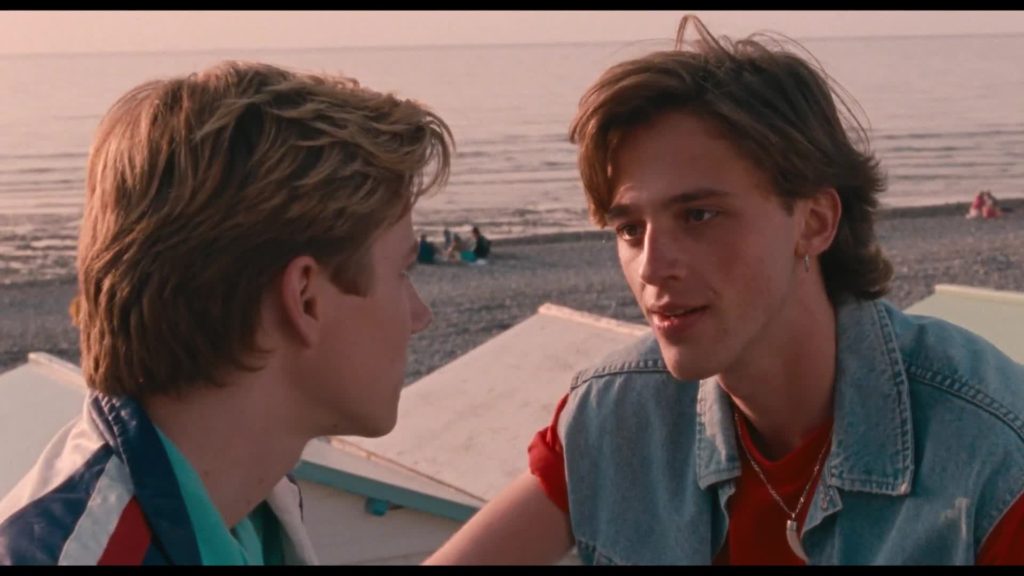
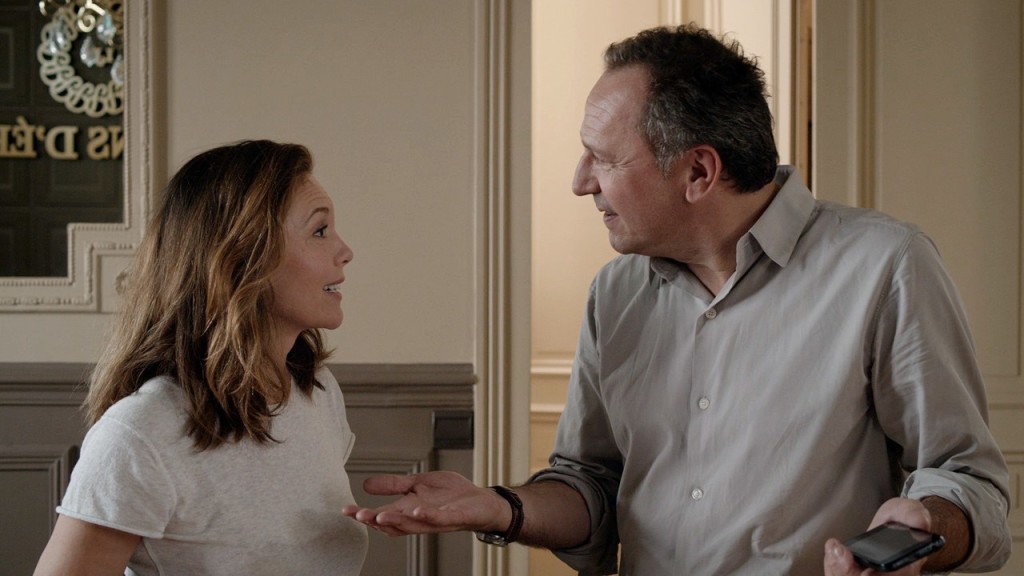
Photo caption: Félix Lefebvre and Benjamin Voisin in SUMMER OF 85
In Summer of 85, writer-director François Ozon pours on the romance and nostalgia. This is a dreamy tale of first love leading to obsession and, finally, a tragedy. Ozon tricks us into thinking that this story is much, much darker than it turns out to be.
In a Northern French beach town. two teen boys meet cute via a capsized watercraft. Alexis (Félix Lefebvre) doesn’t know his way around the locale (or a lot of things), and is fascinated by David (Benjamin Voisin). whose mom (Valeria Bruni Tedeschi) runs the local fishing supply store. Alexis is utterly captivated, and the two become inseparable…until one of them is distracted by a bright shiny thing.
Ozon (Swimming Pool, Potiche) adapted the screenplay from an Aidan Chambers novel. Summer of 85 is a teen coming of age story embedded in Ozon’s reflection on how we remember our youth. Remember that teenagers tend to look at everything on their lives as momentous, and they magnify the drama.
Summer of 85 has garnered an astonishing 12 César nominations (the French Oscar equivalent). Some viewers will not be satisfied by the ending of this well-crafted film.
Summer of 85 opens tomorrow, June 18, in Bay Area theaters, including the Landmark chain.
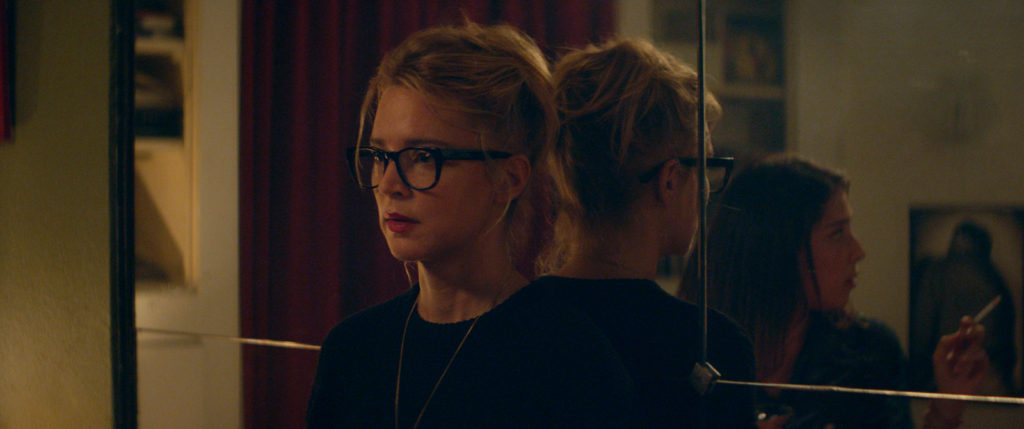
In director Justine Triet’s sex-filled (and sometimes darkly funny) melodrama Sibyl, the psychotherapist Sibyl (Virginie Efira) decides to phase out her practice and return to her primary obsession – novel writing. Sibyl is changing the trajectory of her own life, and she reflects on the one true love in her past (Niels Schneider), her sobriety, her parenting and the family of her sister (Laure Calamy).
While off-loading most of her patients, Sibyl picks up a new one – a needy young actress (Adèle Exarchopoulos from Blue Is the Warmest Color). The actress is about to jump start her movie career, but she’s having an affair with the other lead actor (Gaspar Ulliel), who is inconveniently married to the director Sandra Hüller (Toni Erdmann).
Each of these threads is its own melodrama, and Triet braids them together into an always entertaining story. We are our choices – and we can be our impulses.
Sibyl may be a psychotherapist, but she hasn’t mastered the concept of boundaries. Most egregiously, she doesn’t hesitate to use the personal secrets of her patients as fodder for her novels. Yikes! And she doesn’t resist rampant boundary-crossing by the actress, the actor and the director, either, and she’s used by all of them.
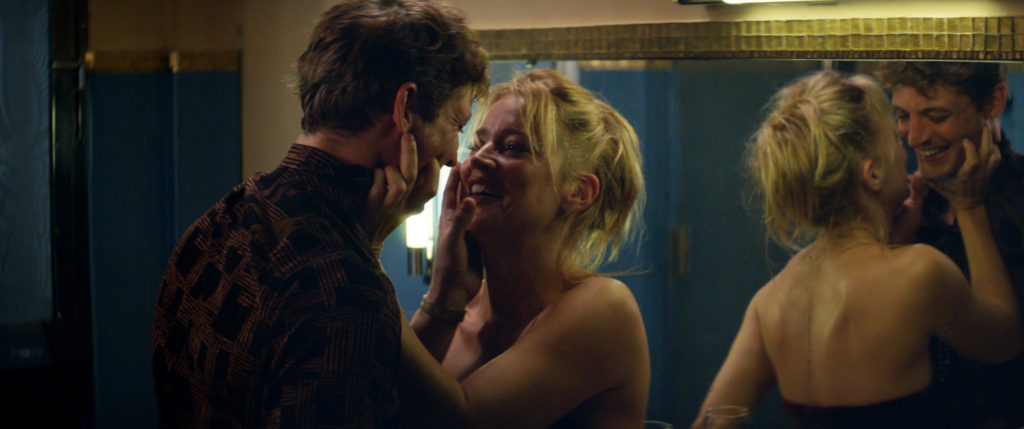
The characters, especially Sibyl, fill the camera lens with passionate sex – on the floor, up against a door, on the beach, on an apartment bathroom’s sink, on the deck of a boat, but not, to the best of my recollection, on a bed.
Niels Schneider and Virginie Efira in SIBYL
There’s lots of sly, dark humor, beginning with the over-intellectualized mansplaining in the very first scene. The sister is hilarious, especially when she coaches her niece on how to manipulate her mother. At one point, the director of the film-within-the-film responds to a lover’s meltdown on the set: “Guys, let’s keep the drama fictional if you don’t mind.“
The scene where the director first meets the actress who has just been impregnated by the director’s husband is another comic masterpiece from Hüller.
Many of us so revere French cinema that we forget that one of the things French filmmakers do well is trashy. And Sibyl is every bit as trashy as Fifty Shades of Grey. However, the editing (Laurent Sénéchal) and the acting are so exquisite that it masks the trashiness of the story.
Sibyl is streaming on Virtual Cinema; I watched it at the Laemmle.
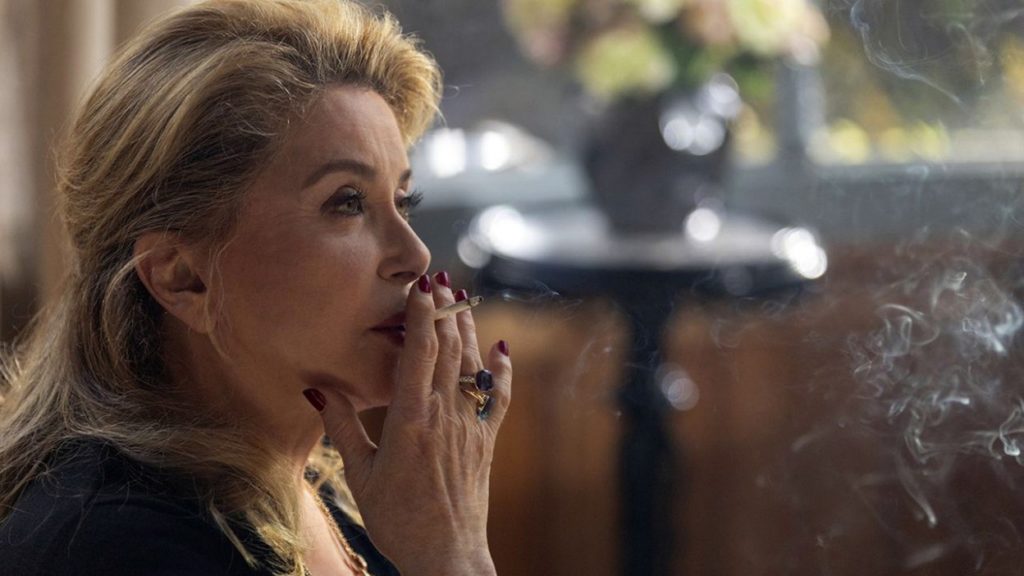
Catherine Denueve in THE TRUTH. Photo courtesy of IFC Films.
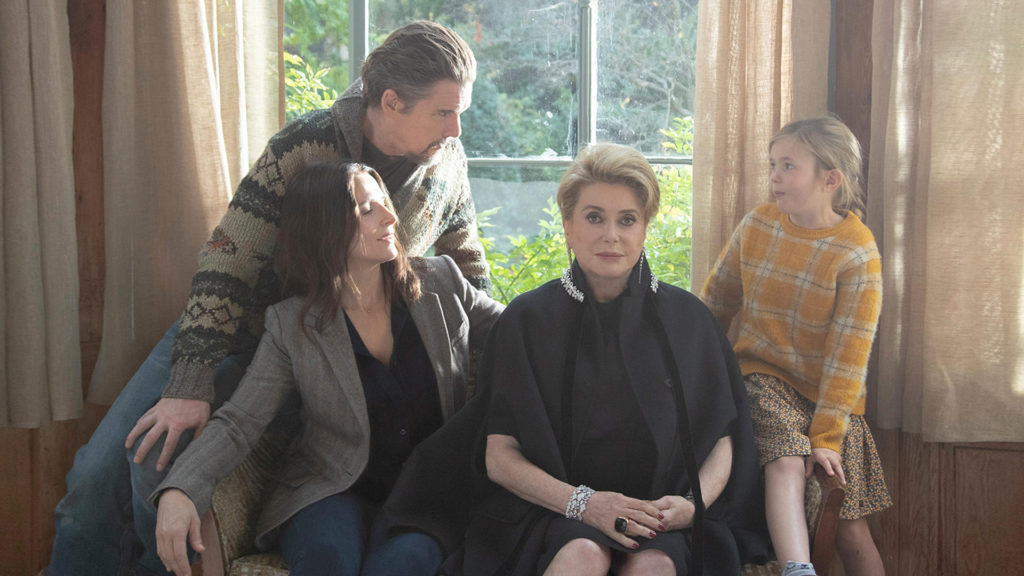
In The Truth, writer-director Hirozaki Koreeda’s latest wry and authentic exploration of human behavior, Catherine Deneuve plays Fabienne, one of France’s most iconic living actresses. Her daughter Lumir (Juliette Binoche), a screenwriter living in New York, brings her family to Paris for a visit to celebrate the publication of Fabienne’s memoir.
As the film opens, an imperious Fabienne is being interviewed by a journalist so mediocre that he’s not ashamed of plagiarizing his questions – and Fabienne doesn’t suffer fools.
Fabienne is a diva who demands to be doted upon, and she is a Real Piece of Work. Fabienne has been so career-focused that she sacrificed an emotional attachment to Lumir, who received maternal nurturing from Sarah, a now-deceased peer of Fabienne’s who Fabienne had screwed out of a career-making role.
Her self-worshipful memoir is ridiculously also entitled The Truth. The book falsely paints Fabienne as an attentive, model mother, doesn’t even mention her longtime assistant and inaccurately claims that Lumir’s father is dead.
Lumir’s resentments quickly bubble to the surface, the two probe and spar throughout he movie. Each sees her own experience as a “truth”. The Truth is about their journeys to accept the other’s point of view and on what terms. It’s very funny, and, thanks to Hirokeeda’s touch, remarkably genuine.
Juliette Binoche, Ethan Hawke, Catherine Deneuve and Clémentine Grenier in THE TRUTH. Photo courtesy of IFC Films.
Fabienne is now shooting a movie where she plays the mother of a much younger French film star (Manon Clavel), and the ever-competitive Fabienne has manufactured a one-sided rivalry with her, as she had with Sarah. (The film-within-a-film is a sci fi exploration of mother-daughter angst which I think I would hate if it were a real movie).
I’ve seen four of Koreeda’s movies and they’re all brilliant: Still Walking, Our Little Sister, The Third Murder and The Shoplifters. I rated The Shoplifters among the four best movies of 2018. The Truth is Koreeda’s first film made outside Japan and in languages (French and English) other than Japanese.
Deneuve and Binoche are superb. All of the cast is excellent, including Ethan Hawke, who is a good enough sport to play Lumir’s tag-along husband, a good-hearted but modestly talented American TV actor. The firecracker child actress Clémentine Grenier, in her first film, soars as Lumir and Hank’s daughter Charlotte; Charlotte wants to become an actress like her grandma, and Clémentine just might attain that herself.
The Truth also benefits from the beautiful work of cinematographer Eric Gautier (Ash Is Purest White, The Motorcycle Diaries, Summer Hours).
The Truth may not be Koreeda’s very best, but it’s plenty good. Hirokeeda, such an insightful observer of behavior, can cut to the core his characters’ profound humanity. The Truth is streaming on Amazon, Vudu, YouTube and Google Play.
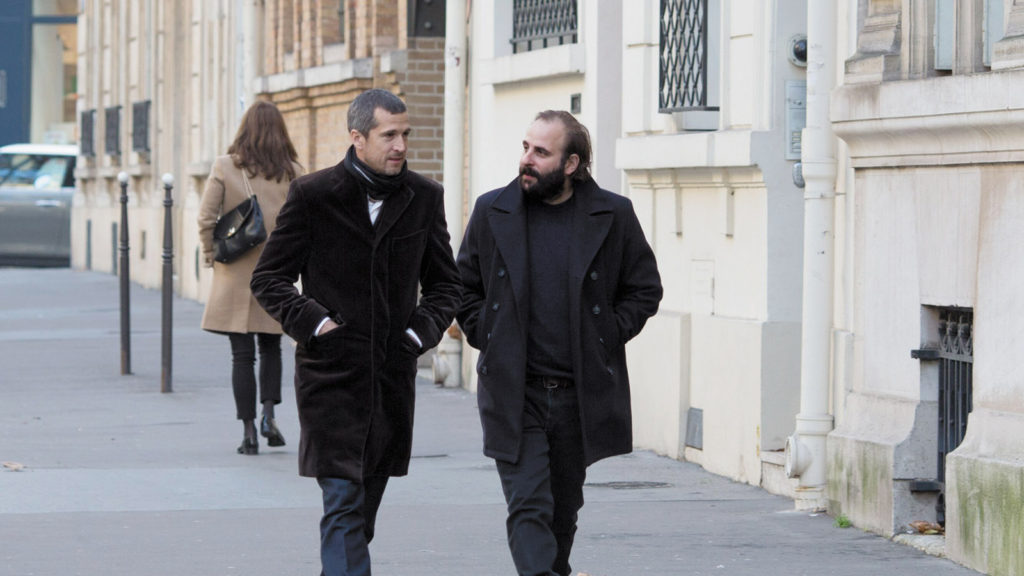
Guillaume Canet (left) and Vincent Macaigne in NON-FICTION
I finally got around to watching writer-director Olivier Assayas’ Non-Fiction. I had been eager to see it because I generally find the French actor Vincent Macaigne hilarious, and I will pretty much watch Juliette Binoche in anything. My conclusion: Olivier Assayas has wasted too many hours of my life, and I am over his films.
Non-Fiction is a comedy of manners that revolves around the once-successful novelist Leonard, whose books are very lightly disguised re-tellings of his own sordid romantic life, and Leonard’s publisher Alain (Guillaume Canet). Alain is married to Selena (Juliette Binoche), an actress in TV cop shows. Everybody sleeps with somebody else’s partner, and everyone wrings their hands over e-books, audio books, blogs and the impending death of the book industry. That’s about it. None of it is engaging.
In 2006, Assayas, a veteran screenwriter, wrote and directed an okay segment (the one with Maggie Gyllenhaal as an actress pining for her drug dealer) in the delightful anthology Paris, je t’aime. He followed it in 2008 with the fine family drama Summer Hours. And then, in 2011, he did the excellent true crime mini-series Carlos. This was a promising start, and he developed a fan base of admiring critics.
But since then, Assayas has wasted brilliant performances by Binoche and Kristen Stewart in the Clouds of Sils Maria and Personal Shopper – two muddled messes that masquerade as cinema. And now, the off-putting Non-Fiction. I am over this guy.
SPOILER: There is one funny moment in Non-Fiction, which I shall now spoil for you, so you won’t need to watch the movie. In the last quarter of the film, the characters decide to publish an audio book read by a celebrity, and they aspire to get Juliette Binoche (who is, of course, in this scene playing her character). I’ll concede that this is a genuinely witty moment, if self-referential.
Non-Fiction is now streaming on Amazon and other platforms.
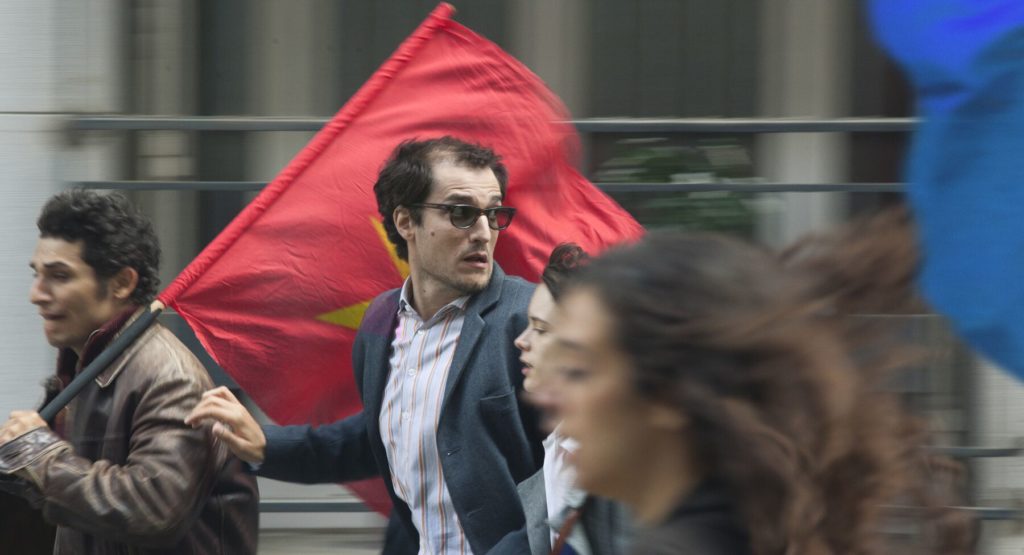
Louis Garrel in a scene from Michel Hazanavicious’s GODARD, MON AMOUR, playing at the 2018 San Francisco International Film Festival, April 4 – 17, 2018. Courtesy of SFFILM.
Godard, Mon Amouris a bitingly funny portrait of flawed genius. Michel Hazanavicius (The Artist) pays tribute to the genius of filmmaker Jean-Luc Godard’s early career while satirizing Godard’s personal excesses.
Godard, Mon Amour traces the three pivotal years after Godard married Anne Wiazemsky, the 19-year-old star of his La Chinoise. Godard (Louis Garrel) is age 37. In the preceding seven years he has helped revolutionize cinema as a leader of the French New Wave. He has made three masterpieces: Breathless, Contempt and Band of Outsiders. This is the Godard of “All you need to make a movie is a girl and a gun.”
But now Godard has become a doctrinaire Maoist and rejects his past work. He sees himself as a thought leader of revolutionary politics – but that is a delusion. He’s just a political amateur, a poseur, a tourist.
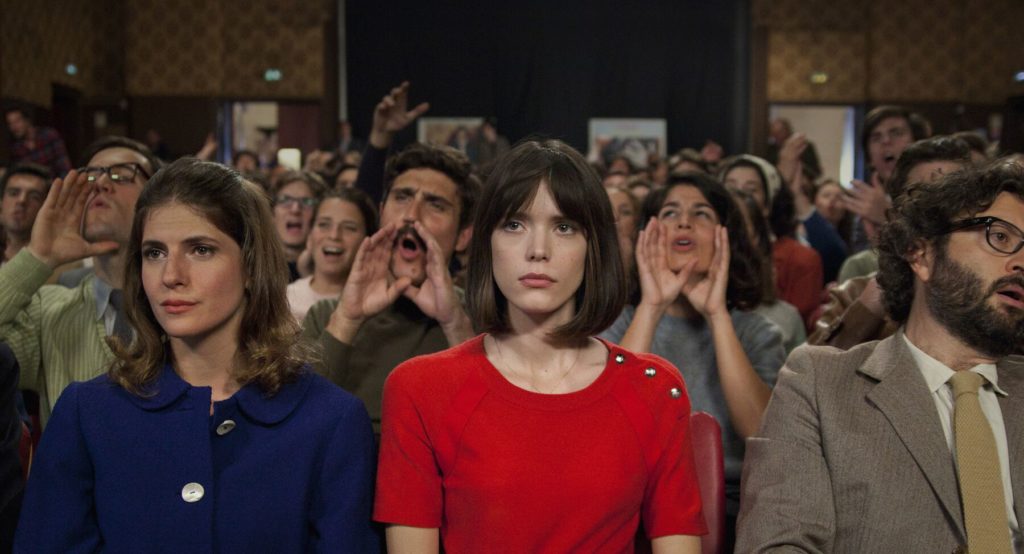
Stacy Martin (center) in a scene from Michel Hazanavicious’s GODARD, MON AMOUR, playing at the 2018 San Francisco International Film Festival, April 4 – 17, 2018. Courtesy of SFFILM.
“Godard is dead”, Godard declaims. But young Anne (Stacy Martin) has hitched her star to the old Godard, the master of cinematic innovation and rock star, not this new dogmatic Godard.
This is also a snapshot of 1967, when many on the French Left believed that revolution in France was around the corner. By 1969, it was apparent to virtually everyone that this had been a mirage, that revolution was not going to happen. To everyone but Godard, who stubbornly stuck with his dogma.
Louis Garrel, his dreamboat looks glammed down with Godard’s bald spot, is often very funny as he deadpans his way through Godard’s pretensions. In Godard, Mon Amour, Godard’s thinking has become so devoid of humor, nuance, texture and ambiguity that his art has become one-dimensional and boring. Indeed, I have found all of the Godard films since 1967’s Weekend to range from disappointing to completely unwatchable. Godard is alive at age 87 and still making movies today – and they all suck.
In his very biting send-up of Godard’s personal failings, Michel Hazanavicius pays tribute to Godard’s groundbreaking cinematic techniques. We see jump cuts, breaking the fourth wall, shifting between color and negative imagery, subtitling the characters’ interior thoughts over their spoken dialogue and references to earlier movies. It’s all very witty.
There’s even a motif of repeatedly broken spectacles as an homage to Woody Allen’s Take the Money and Run. In one of the more obvious jokes, Godard and Anne debate whether either would choose to appear nude in a movie while they walk around their room in complete, full-frontal nudity.
The more of Godard’s films you have seen, the more enjoyable you will find Godard, Mon Amour. If you don’t get the allusions to Godard’s filmmaking, you may find the protagonist of Godard, Mon Amour to be miserably tedious. I saw Godard, Mon Amour at the 2018 San Francisco International Film Festival (SFFILM). It opens this Friday in the Bay Area.
Here’s an entertaining piece of fluff. In Paris Can Wait, Diane Lane plays Anne, the neglected wife of movie mogul Michael (Alec Baldwin). A show biz emergency has short-circuited their European vacation in Cannes, and the Michael’s French partner Jacques (Arnaud Viard) offers to drive Anne to Paris. It should be a seven-hour drive, but Jacques stretches it out to take in as many fine dining experiences as he can pack in.
The flirtatious but gentlemanly Jacques is an expert gourmand and a militant epicurean. And he has resolved to make Anne feel special in ways that her husband doesn’t, at least anymore. Anne enjoys the attention, but she is anything but naive. She and the audience are expecting Jacques to make a pass at any moment.
As the closing credits rolled, most of the women in my audience applauded. Above all, Paris Can Wait is a fantasy from a woman’s point of view. That woman is director Eleanor Coppola, who, at the age of 81, has made her first fiction film. Coppola had previously made what is perhaps the best ever “making of” documentary, the 1991 Hearts of Darkness: A Filmmaker’s Apocalypse, which chronicled the making of her husband Francis Ford Coppola’s Apocalypse Now!. Eleanor and Francis have been married since 1963, and their daughter Sofia just won Best Director at the 2017 Cannes Film Festival for her remake of The Beguiled.
The great and underutilized Diane Lane is such a masterful and magnetic actor. Anne is an unchallenging role, but it’s still hard to imagine anyone better. In the 1980s, Lane started her run of The Outsiders, Rumble Fish, The Cotton Club and as Paulette Goddard in Chaplin. Her most unforgettable role was probably as Lorie in the 1989 classic miniseries Lonesome Dove. My own favorite Diane Lane performance was the one for which she was Oscar-nominated, in 2002’s Unfaithful. I’ll watch her in anything.
Arnaud Viard, a French actor whose work, mainly on French TV, I wasn’t familiar with, is perfect as the debonair but vulnerable Jacques. As we would expect, Alec Baldwin is excellent as the self-absorbed blowhard Michael.
Paris Can Wait is probably even more of a travelogue than a romantic comedy. France is a beautiful country, and Jacques and Anne get to drive and picnic through the most scenic parts. And then there’s the food – serious food porn! This is by no means an excellent movie, but if you enjoy France, and if you enjoy eating anywhere, this is a harmlessly fun 90 minutes.
[NOTE: The Wife disputes a) that this is a widespread female fantasy and b) that is was the women clapping in the theater, and she finds my “female fantasy” characterization to be offensive. On the first point, she says that the story here is NOT something that would appeal to all or most women. I remain convinced that a story in which a woman is found desirable by a non-threatening man who lavishes attention on her does appeal to women, at least more than to men (who I believe prefer non-platonic screen relationships). On the second point, it is true, as she points out, that I always have us sit in the very front of the theater, and, with our backs to the rest of the audience, I did not actually see who was applauding.]