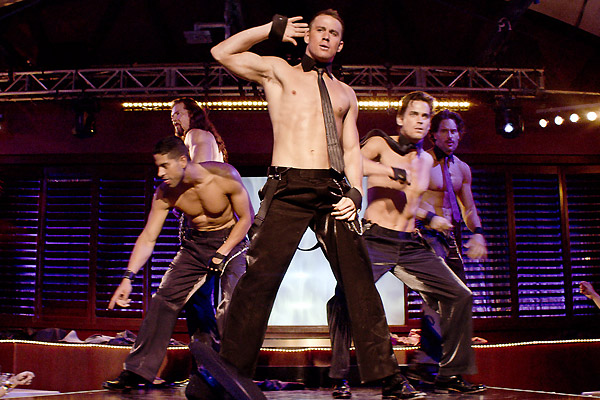
Magic Mike is about watching male strippers, period. There are a couple lame plot threads, but it’s about the stripping. The star, Channing Tatum, is winning and impressively athletic. Matthew McConaughey helps re-brand his career with a funny performance as a sleazeball strip club owner – and shows off his body, too.
Director Steven Soderbergh is known for his prestige pictures but still relishes making B movies. Good for him – he brought something special to the B picture Haywire last year (which co-starred Tatum). But there’s no magic in Magic Mike. And, at 110 minutes, it’s too long.
Doug Glatt is not very smart and he knows it. He struggles to find the right word in every situation. Because his only talent is the ability to knock others unconscious, he is only in demand as a bar bouncer. But Doug is not a brute – he is goodhearted and loyal, and yearns to be part of something. By chance, Doug gets hired by a minor league hockey team to become its thuggish enforcer – despite his inability to ice skate.
We get lots of funny hockey violence a la the Hanson Brothers in Slap Shot. It’s very funny when Doug mangles his every attempt at cogent conversation. The comedy also comes from Doug’s innocent fish out of water in the cynical, sleazy and cutthroat world of minor league hockey. (He’s even reverential about the team logo on the locker room floor.)
There are lots of nice comic touches. For example, when Doug becomes a sensation, one of his fans in the stands holds up a sign reading “Doug 3:69” (Doug wears jersey number 69); we glimpse the sign for only a second, but I appreciate the filmmakers planting such nuggets in the movie. Doug is also that rarity – a Jewish hockey goon, with parents horrified that he isn’t following his brother to med school.
Although plenty raunchy, Goon is a rung above the normal gross-out guy comedy because Doug is such a fundamentally good and well-meaning person. As Doug, Seann William Scott (Stifler in American Pie) plays a naive simpleton, but one fiercely committed to his core values. It’s got to be hard to play that combination, and Scott’s performance is special.
The cast is excellent. Co-writer Jay Baruchel plays Doug’s sophomoric friend. Alison Pill (Milk, Midnight in Paris) is the troubled smart girl who can’t figure out why she’s attracted to a word-fumbling hockey goon. Liev Schreiber, excellent as always, dons a Fu Manchu and a mullet to play the league’s toughest goon. Kim Coates, who almost stole A Little Help as the personal injury attorney, plays the coach.
Alma is pushing 16 and lives in rural Norway, in a tiny community so remote that her mom works in a turnip factory. Her hormones have been unleashed, and she can think of nothing but sex. She spends her free time having poignantly innocent (and incomplete) sexual fantasies, masturbating and running up phone sex bills. Her schoolmates misinterpret her encounter with a boy and ostracize her as the village slut. So begins this wise, sympathetic and funny Norwegian coming of age comedy.
The humor comes from the film’s knowing view of human nature and, especially, of teenagers. One of Alma’s pals aspires to move to Texas and end capital punishment by raising awareness. For another, no amount of lip gloss can be enough. None of them can figure out how to pilot their budding urges without embarrassing awkwardness. And all the while, Alma’s beleaguered mom tries to figure out what to do with her.
The laughs are mostly chuckles instead of guffaws. Turn Me On, Dammit! is only 76 minutes of long, which is just the right length for this story. It’s a good-hearted and funny movie.
The title says it all – To Rome with Love is Woody Allen’s affectionate missive to Rome, more amusing than the average greeting card but no more substantial. It’s not great Woody, nor is it bad Woody. But minor Woody (like To Rome with Love) is still funny and smart, even wise sometimes.
Allen cuts between four unrelated and more or less simultaneous stories. In the first, a comedy of manners, Woody and Judy Davis play an American couple in Rome to meet their daughter’s (Alison Pil) Roman beau and his family. There’s a culture clash and the impulses of Woody’s character create comic havoc.
In the second (and best) tale, Alec Baldwin plays a man in his fifties who is recalling the Roman adventure of his twenties, this time imparting his life wisdom to his younger self (Jesse Eisenberg). What mature man wouldn’t want to relive his single days knowing what he now knows about women? In this case, Eisenberg’s girlfriend introduces him to her alluring but surely unreliable gal pal, played by Ellen Page. Baldwin’s sage is warning him off, but the younger man can’t help but become entranced with a woman who strews relationship carnage behind her. When Eisenberg thinks that he is seducing Page, Baldwin cynically points out that Page has just popped a Tic-Tac to be ready for a kiss. When Woody has him “melt” Page’s actress with a line about her being deep enough to play Strindberg’s Miss Julie, we recall that the real Woody has dated the likes of Louise Lasser, Diane Keaton, Stacy Nelkin and Mia Farrow. It’s good stuff.
The third story, and least successful, is a farce in which a young Italian bridegroom must impress his uptight relations despite some contrived mistaken identity.
The fourth story is an allegory on today’s culture of silly and unearned celebrity. Roberto Benigni is perfect as an ordinary Giuseppe plucked out of his hum drum routine and made an instant celebrity. No comic can play befuddlement or nouveau entitlement like Benigni.
To Rome With Love stars the usual splendiferous Woody cast. Judy Davis, Penelope Cruz, Alison Pil, Alec Baldwin and a host of Italian actors are all just fine, but don’t have to stretch; (this also applies to 2012’s annoyingly ever-present Greta Gerwig). But Woody himself is outstanding, as are Ellen Page, Jesse Eisenberg and Roberto Benigni.
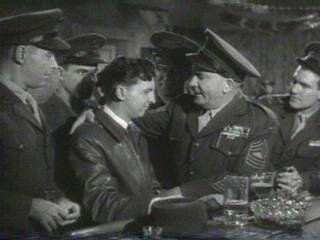
William Demarest and fellow Marines comfort Eddie Bracken in HAIL THE CONQUERING HERO
On June 30, Turner Classic Movies is broadcasting six classic comedies by the great writer-director Preston Sturges. Sturges’ masterpiece, of course, is Sullivan’s Travels, a fast-paced and cynical comedy about a pretentious movie director who goes out on the road to be inspired by The Average Man – and gets more of an adventure than he expects.
The brilliantly funny Hail the Conquering Hero is one of Sturges’ less well-known great comedies. Eddie Bracken plays a would-be soldier discharged for hay fever – but his hometown mistakenly thinks that he is sent home a war hero. Hilarity ensues. All the funnier when you realize that this film was made in 1944 amid our nation’s most culturally patriotic period.
TCM’s other Sturges choices are thigh slappers, too: The Lady Eve, The Palm Beach Story, The Great McGinty and Christmas in July.
The Intouchables is the second most popular movie of all time in France – and it’s easy to see why. It’s an odd couple comedy that’s a real crowd pleaser.
A very, very rich French aristocrat has become a quadriplegic due to a hang gliding accident and hires a Senegalese good-for-nothing street hood as his caregiver. The plot, really just a series of set pieces, mines familiar territory as the poor guy learns about living in a mansion (see Down and Out in Beverly Hills) and revitalizes the rich guy’s zest for living. But it’s really well done and very funny.
The rich guy is played by the great Francois Cluzet (Tell No One), who gives a tremendous performance using only his head and neck. Omar Sy plays the poor guy and actually edged out The Artist‘s Jean Dujardin for France’s top acting award last year; that’s hard to figure, but Sy is very funny in The Intouchables. Overall, it’s a very satisfying comedy.
Somehow, this comedy gem never earned a theatrical release, despite winning the low budget award at Sundance. A decent guy is serving out his drug sentence and has a day job as a locksmith on work release. He is determined to keep his nose clean and not get in any more trouble. He meets a kooky gal, who – despite his resistance – introduces all kinds of chaos into his life. The Locksmith was originally titled Homewrecker.
If it had been released into theaters, I think that this working class comedy would have become a real crowd pleaser. Fortunately, it’s now available from Netflix.
Hysteria is a breezy, feminist lark. Victorian doctors are befuddled by all manner of female complaints, which they lump together into the diagnosis of hysteria. One physician becomes popular when he pioneers pelvic massage as treatment. Who knew that rubbing their clitorises (clitorii?) made them happy?
Thankfully, director Tanya Wexler keeps the whole thing light. Maggie Gyllenhaal stars as a proto-feminist and High Dancy plays the doc who invented a proto-vibrator. Rising star Felicity Jone (Like Crazy) pulls off a secondary role.
Christians and Muslims live together in a very isolated Lebanese village. The men, none too bright, flare any perceived grievance into testosterone-fueled tribal fury. Knowing that any trivial incident can spark an escalation to sectarian slaughter, the women, aided by the imam and the priest, work tirelessly to extinguish every possible provocation. The women will stop at nothing, including sabotaging the village’s only TV, faking a miracle, medicating the pastries and even hiring a van full of Ukrainian strippers.
This story could have been played broadly like Lysistrata. There are many funny moments, but Where Do We Go Now? is more than farce. To these women, war is not theoretical. We can tell from their language, which references men crouching in the attics and looking under beds, that they have survived past sectarian violence. And we see the village cemetery, filled with the headstones of young men. The women and the clerics have seen war, and they are desperate to avoid it. That desperation adds a sting to the comedy, and makes Where Do We Go Now? a pretty good movie.
Ever seen a movie where the outlaw rides into town and sticks up for the little guys against the local bully of a crime boss? Well, maybe so, but you probably haven’t seen a movie like Let the Bullets Fly (Rang Zidan Fei), which is set in southeastern China in the Chinese warlord period around 1919.
For one thing, it’s an unusually exuberant film that’s extremely funny for an action western.
For another, it’s a deeply cynical assessment of government corruption. It quickly becomes apparent that the professional bandit is more honest and reliable than any of the local institutions. (That subtext is not lost on the Chinese public.)
And the Chinese movie fans have embraced Let the Bullets Fly. It’s the highest-grossing Chinese language movie ever, and is the all-time #2 most popular movie in China (behind Avatar).
Writer-director Wen Jiang plays the stalwart bandit hero who substitutes himself for the newly arriving appointed Governor (played by You Ge as a hilariously unabashed sleazeball). Jiang’s bandit comes up against the local baddie (Chow Yun Fat), who doesn’t want to relinquish any of his power or ill-gotten gains. As the two match wits, a fast, funny and utterly rambunctious ride ensues.
In this case, 1.3 billion Chinese are correct – this is one fun movie.