DVD of the Week: Ruby Sparks

The inventive Ruby Sparks is about romance and it’s very, very funny, but it transcends the genre of romantic comedy.  A shy writer who has produced a great novel at an early age is now drifting,  his writing is blocked and he has isolated himself into a lonely existence.  He imagines his perfect love object, and he can suddenly write in torrents about her until…she becomes real.  Yes, suddenly he has a real life girlfriend of his own design.

This is everyone’s fantasy of a perfect partner – but what are the limits of a partner that you have designed yourself?  Because he can tweak her behavior by rewriting it, this brings up the adage “Be careful what you ask for”.  When he is threatened by her independence, he changes her personality on the page and she becomes unattractively clinging and needy.  Can his realized fantasy make him happy?

Paul Dano is outstanding as the writer and screenwriter Zoe Kazan (granddaughter of Elia Kazan) dazzles as his creation.   (Off screen, Kazan and Dano are a couple.)  Chris Messina is dead on perfect as the writer’s brother, and the film benefits from an especially strong cast:  Annette Bening, Antonio Banderas, Steve Coogan, Aasif Mandvi and Elliot Gould.  Ruby Sparks is ably directed by Jonathan Dayton and Valerie Faris, the co-directors of another exceptional indie comedy, Little Miss Sunshine.

The biggest star in Ruby Sparks is Zoe Kazan’s ingenious screenplay.  It’s funny without being silly, profound without being pretentious, bright without being precious.  Every moment is authentic.  It’s clear that Kazan is a major talent as a screenwriter.
Movies to See Right Now

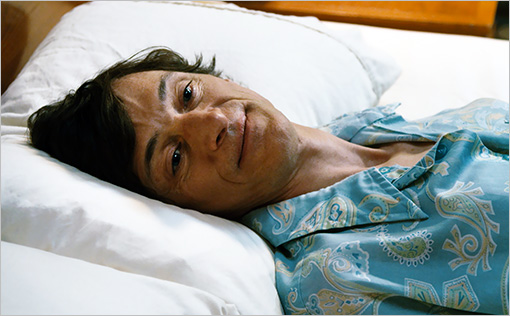
John Hawkes in THE SESSIONS

The best bet is still Argo, Ben Affleck’s brilliant thriller based on a true story from the Iran Hostage Crisis. It’s unquestionably the best Hollywood movie of the year so far.

But there are some other excellent choices. The Sessions is an uncommonly evocative, funny and thoughtful film about sex leading to unexpected emotional intimacy. The Paperboy is a deliciously pulpy crime drama, enhanced by a trashy Nicole Kidman and a canny Macy Gray.  I also liked the thinking person’s sci fi movie, LooperPerks of Being a Wallflower is an authentic coming of age story. I also recommend the indie alcoholism drama Smashed.

Cloud Atlas delivers six fast paced stories set across six centuries with lots of movie stars playing multiple roles; it’s fun to watch, but it’s not as good a film as the ones listed above.

Paul Williams Still Alive, an affecting documentary about the songwriter, omnipresent in the 70s, but not now, is available on Video On Demand.  The poignant French geezer comedy All Together is also available on Video On Demand.  History buffs will appreciate Ethel, the documentary on Ethel Kennedy by her daughter Rory Kennedy, still playing on HBO.

The dark crime comedy Seven Psychopaths is well-acted by a very deep team of my favorite actors and is embedded with belly laughs, but, as a whole, it’s just not that satisfying.  The Master is a visual and acting masterpiece, but the story fizzles out.  You can skip HBO’s dreary The Girl.

I haven’t yet seen the Denzel Washington blockbuster thriller Flight, which opens this weekend.  You can read descriptions and view trailers of upcoming films at Movies I’m Looking Forward To.

My DVD pick this week is Elena, a superbly crafted film that vividly peeks into a dark, very dark contemporary Russia.   Elena makes my list of Best Movies of 2012 – So Far.

Cloud Atlas: more may not be better, but more is fun

The filmmakers of Cloud Atlas clearly believe that more is better.  They give us not one, not two – but six stories spanning six centuries. They give us lots of movie stars: Tom Hanks, Halle Berry, Jim Broadbent, Hugo Weaving, Jim Sturgess, Susan Sarandon, Hugh Grant and more.  The actors each play multiple roles, with Hanks, Berry, Weaving and Sturgess playing at least six each – sometimes playing characters of different genders and different races.  There are costume dramas on the high seas of the 1840s and in 1930s England, plus two sci-fi settings – one recalling the high-tech, high-speed Tron and also a post-apocalyptic tribal future.   There are even two references to the sci-fi cult classic Soylent GreenCloud Atlas even had three directors.

Whew.

The six story lines are threaded together so we follow them until all six climax in the final hectic thirty minutes.  The six stories are each a series of cliff hangers.  As a character in one story falls into peril, the screenplay jumps to another thread, and on and on.

As it manically jumps from story to story, Cloud Atlas touches upon some Big Themes (good and evil, kindness and control, freedom, reincarnation), and we get the brush strokes of a New Agey theology (as if the world needs another theology).  This is where Cloud Atlas gets fuzzy.   Fortunately, the movie is so rapidly paced, that it never gets pretentious as we jump from story to story.

Is Cloud Atlas fun to watch?  Yes, there’s just too much fast-paced action going on, too much eye candy and too many engaging actors for Cloud Atlas to fail the fun test.  Is Cloud Atlas a great movie?  No, there just isn’t enough coherent substance in there to hook us emotionally.  Is it a Must See?  No.  Would I see it again?  No, but I’m glad I saw it once.

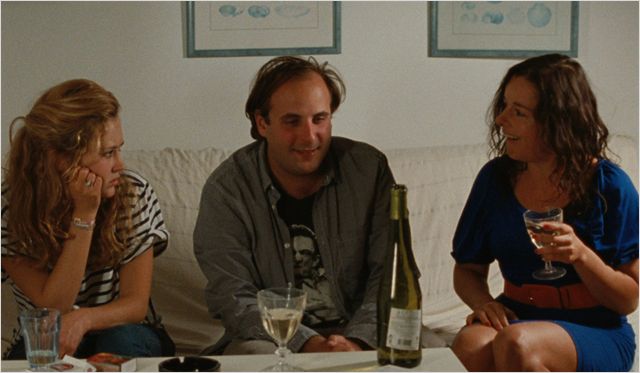
A World Without Women: an amusingly awkward but vulnerable guy

A WORLD WITHOUT WOMEN

In the French film A World Without Women (Un monde sans femmes), Vincent Macaigne plays a lovable loser who manages holiday rentals in a northern French beach town.  He is amiable and good-hearted, but lonely and painfully socially inept.  A good timing single mom brings her college age daughter for a week on the beach and teases him out of his protective shell and into a position of maximum vulnerability.

Macaigne’s characterization is outstanding.  We really care for him and don’t want him to get hurt.  But Macaigne brilliantly employs little touches to illustrate his character’s utter lack of savoir-faire.  For example, at one point he and the mom are leaning shoulder to shoulder against a fence.  She has her arms crossed, and she’s leading him on.  He grasps her her nearest hand with his nearest hand.  But since he’s now holding her left hand with his left, he has pinned her left arm awkwardly across her body like a pretzel, which drains all of the sexual spark out of the situation.  And he can’t put his arm around her because he’s already using that arm to hold her hand.  It’s such a simple action, yet so meaningful.

Laure Calamy is also very good as the fortyish gal who dresses too young and flirts with every available man, leaving male carnage in her wake.

Writer-director Guillaume Brac shows a real command of characters and dialogue in this film.  I’m looking forward to his first feature.  A World Without Women is only 56 minutes long, and plays with Brac’s 24 minute Stranded, which also stars Macaigne as essentially the same character  The two films played together in Paris to surprising popularity.  Fortunately, Brac decided not to bloat the two screenplays into two bad 90-minute features.  Good for him.

I saw both Stranded and A World Without Women at the San Francisco Film Society’s French Cinema Now series.  A World Without Women is not available now on any platform (DVD, Stream, VOD) that I can find, but when it is, I’ll make it a Stream of the Week.  This trailer is in French without subtitles.

DVD of the Week: Elena

Elena is a superbly crafted film that vividly peeks into a dark, very dark contemporary Russia.  Directed and co-written by Andre Zvyagintsev (The Return), Elena is the triumph of drama over melodrama.  There is an absolute minimum of on-screen action and no histrionics at all, yet the story simmers throughout. It’s on my list of Best Movies of 2012 – So Far.

Zvyagintsev builds the story upon his characters.  It is set in a toney apartment in a quiet upscale Moscow neighborhood, home of Vladimir and Elena.  Vladimir is pushing 70 and rich.  I doubt that any softies got rich in post-Soviet Russia, and Vladimir is a hard man, devoid of sentimentality except for his estranged daughter.   Late in life, he has married the working class Elena, his one-time nurse, now in her 50s.  They have a comfortable, frank, affectionate and practical relationship.

Both have adult children from previous marriages.  Vladimir’s daughter Katerina has no use for her father, but he subsidizes her lifestyle of perpetual partying.  Vladimir and Katerina finally share a moment, bonding over their shared cynicism.

Elena’s nogoodnik son Sergey lives in a hard scrabble suburb and embraces his chronic unemployment with alarming indolence.  His equally lazy and selfish teenage son, having an indifferent high school career, is now facing the dreaded Army unless someone can bribe his way into a college.

Elena is desperate to rescue her grandson from his self-inflicted predicament, but only Vladimir’s money can help, and Vladimir despises Elena’s trashy and shiftless family.  The movie is built on this conflict, and it is Elena’s story.   As Elena, the actress Nadezhda Markina reveals Elena’s affection, desperation and determination with her eyes, face and movements.  Perfectly framing Markina’s outstanding performance by isolating it, Zvyagintsev delivers the film in a series of long shots, with terse dialogue and a spare soundtrack. There is no expository dialogue explaining the plot or swelling music manipulating our reaction.

Elena is a dark movie that asks its audience to invest patience, thought and energy – so it’s not for everybody.  Elena is also one of the year’s best films, and an extraordinary example of a very pure breed of filmmaking.

Mobile Home: another tale of immature slackers

MOBILE HOME

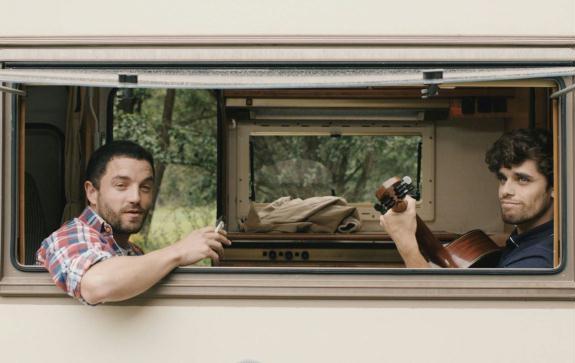
In the Belgian comedy Mobile Home, two underachievers in their late 20s, decide to move away from their parents.  They move into a Fiat version of a Winnebago so they can tour the world.  But their big move isn’t really that independent because they park the new home on wheels within an easy drive of their parents.  The question in Mobile Home is whether either of them will catch even a whiff of adult responsibility or whether they will continue denying that it is time to get a real job.

This Belgian story is smarter than most Hollywood bromances, but nothing we haven’t seen before.  A nice little festival film.

I saw Mobile Home at the San Francisco Film Society’s French Cinema Now series.  The trailer is in French without subtitles.

All Together: the elderly resisting aging

ALL TOGETHER

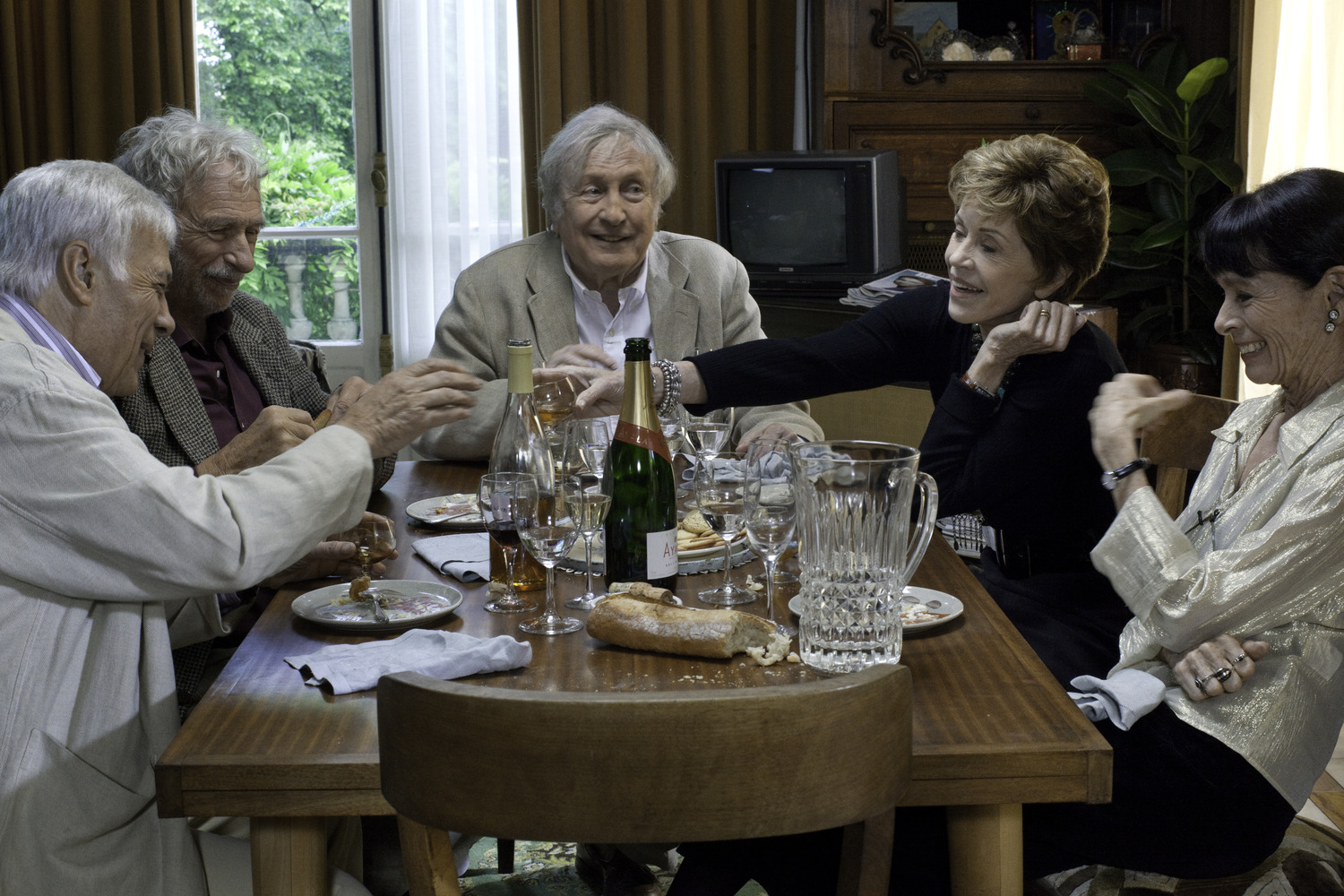
All Together (Et si on vivait tous ensemble?)  is a poignant French comedy about five septuagenarian friends who decide to eschew the nursing home and live communally.  They hire an anthropology grad student as a caregiver, and he changes his thesis topic to study the social and sexual behavior of the European elderly.

The comedy comes as they resist the insults of age.  One elderly activist, bullhorn in hand, is dismissed as an impotent, harmless crank when the cops refuse to arrest him at a demonstration even when he hits a cop in the helmet with a bottle.

The excellent cast includes Jane Fonda (acting for the first time in fluent French in thirty years).  Geraldine Chaplin, who has acted in French, Spanish, Italian and German films over the years, is impressively spry.   The great French comic actor Pierre Richard (The Man with the One Brown Shoe?) is brilliant as a man terrified by his increasing loss of memory.

Although it covers similar territory as this year’s indie hit The Best Exotic Marigold Hotel (a slightly better film), they are different movies, with All Together more focused on mortality and the infirmities that come with age.

I saw All Together at the San Francisco Film Society’s French Cinema Now series.  All Together is now available in the US on Video On Demand, including Amazon Instant Video.

Movies to See Right Now

Nicole Kidman in THE PAPERBOY

The best bet is still Argo, Ben Affleck’s brilliant thriller based on a true story from the Iran Hostage Crisis.  It’s unquestionably the best Hollywood movie of the year so far.

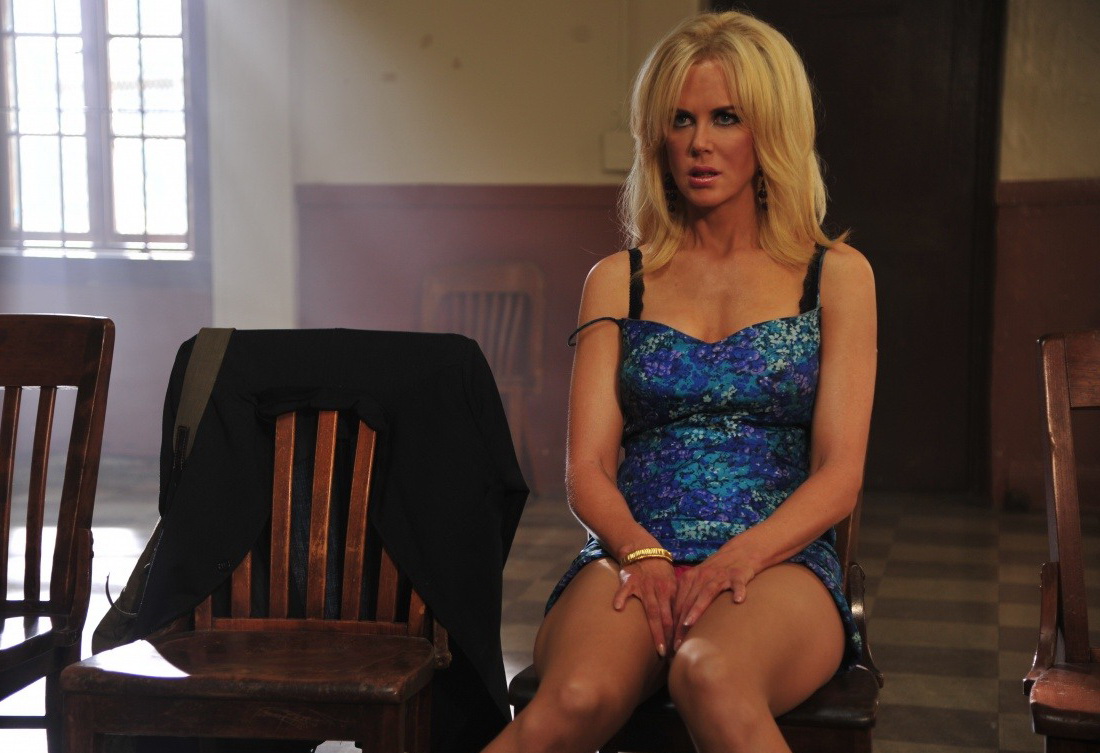
But there are some other excellent choices.  The Sessions is an uncommonly evocative, funny and thoughtful film about sex leading to unexpected emotional intimacy.   The Paperboy is a deliciously pulpy crime drama, enhanced by a trashy Nicole Kidman and a canny Macy Gray. You can still find End of Watch, a thrilling cop movie that rises above the genre. I also liked the thinking person’s sci fi movie, LooperPerks of Being a Wallflower is an authentic coming of age story. I also recommend the realistic indie alcoholism drama Smashed.

Two lower profile films are continuing their long runs. The zany French odd couple comedy The Intouchables is a crowd pleaser – and an attendance record breaker in France. Another good choice is the compelling documentary Searching for Sugar Man, about the hunt to uncover the secret fate of an artist who didn’t know that he was a rock star.

Paul Williams Still Alive, an affecting documentary about the songwriter, omnipresent in the 70s, but not now, is available on Video On Demand.  History buffs will appreciate Ethel, the documentary on Ethel Kennedy by her daughter Rory Kennedy, still playing on HBO.  You can skip HBO’s dreary The Girl.

The dark crime comedy Seven Psychopaths is well-acted by a very deep team of my favorite actors and is embedded with belly laughs, but, as a whole, it’s just not that satisfying. The Master is a visual and acting masterpiece, but the story fizzles out.

I haven’t yet seen the blockbuster sci fi epic Cloud Atlas, which opens this weekend. You can read descriptions and view trailers of upcoming films at Movies I’m Looking Forward To.

My DVD pick this week is the most overlooked film of the year, Sarah Polley’s brilliant Take This Waltz.   It’s a woman’s movie, but in the best possible way. It’s not a shallow chick flick and there’s no wedding scene. Instead, it’s an exploration of attraction and fulfillment from a woman’s perspective. Take This Waltz makes my list of Best Movies of 2012 – So Far.

Smashed: life is better when sober, but still messy

In this indie drama, a couple navigates life while drunk.  Can they stay together and flourish when she sobers up?  Smashed is a remarkably realistic portrayal of the drinking life and the challenges of recovery and relapse, informed by the personal experience of co-writer Susan Burke.

The best thing about Smashed is the performance of Mary Elizabeth Winstead as the wife.  Winstead realistically takes her character through the carelessness, denial, humiliation and self-degradation of drinking and the fears and determination that co-exist in her recovery.  It’s a stellar performance, and I’ll be looking for Winstead in bigger roles.

Also very good are Nick Offerman as the wife’s colleague, Megan Mullally, unrecognizable as the wife’s boss, and the always delightful Octavia Spencer.

As The Wife pointed out, the amount of time that director and co-writer James Ponsoldt spent on the drinking part of the story means that lots of plot points whiz by in the final ten minutes.  Still, Smashed is very watchable and benefits from the breakthrough performance by Winstead.

The Sessions: sex leading to emotional intimacy

We usually think of sex as the culminating manifestation of lust and/or romantic love.  The Sessions is an exploration of sex (first) leading to emotional intimacy.

John Hawkes plays a man in an iron lung seeking to lose his virginity to his sex surrogate (Helen Hunt).  The premise may seem farfetched, but it’s based on the life of Mark O’Brien, who survived childhood polio to graduate from UC Berkeley and become a poet and journalist. The kernel of this screenplay was O’Brien’s magazine essay “On Seeing a Sex Surrogate”, and O’Brien was the subject of Jessica Yu’s Oscar-winning Breathing Lessons: The Life and Work of Mark O’Brien.

As I’ve written before, I particularly loathe “disease of the week” movies, but The Sessions is completely untainted by this maudlin genre.  The credit goes to writer-director Ben Lewin, himself a polio survivor, who has made The Sessions more than a movie about sex and a disability.  Lewin has embedded lots of humor, along with genuine emotions.

Hawkes and Hunt will receive Oscar nominations for the kind of performances that the Academy especially loves and rewards.  Hawkes spends the entire movie horizontal on a gurney with his spine contorted by a device the filmmakers labeled “the Torture Ball”.  Equally courageously, Hunt is often naked (really, really naked), frankly leading the couple through simulated sexual acts.

But don’t be put off by the showy aspects of the performances, which are authentic and riveting.  Hawkes, who is best known for his scary and creepy roles in Winter’s Bone and Martha Marcy May Marlene, embodies a witty man who has overcome more than most, but who fears the depths of his own vulnerabilities.  Likewise, Hunt goes very deep to express emotions that take her by surprise.

Beyond Hawkes and Hunt, The Sessions is uniformly well-acted.  I especially enjoyed the performances of William H. Macy as a goofily sympathetic Berkeley parish priest, Moon Bloodgood as a poker-faced but playful caregiver and Ming Lo as an amusingly dense hotel clerk.

Lewin, Hawkes and Hunt have combined to make an uncommonly evocative, funny and thoughtful film.  The Sessions was an audience fave at the Sundance and Toronto film fests.  (Plus it’s a great date movie.)