Beyond the Hills: a bleak tragedy by a masterful filmmaker

The two lead characters in Beyond the Hills grew up together in a Romanian orphanage where they were subjected to privation and worse – and where they became lifelong soulmates.  They aged out of the orphanage, and, now 24, Alina has been working menial jobs in Germany while Voichita has joined a local monastery.  The monastery is a small rural compound with a rigidly dogmatic provincial priest, a compassionate but simple mother superior and a dozen nuns who run the gamut from devout to superstitious.

Alina craves Voichita’s companionship and viisits the monastery to convince Voichita to leave and join her in Germany.  Voichita resists, and tries to get Alina to join the religious order.  They’re both emotionally damaged from childhood experiences.  There’s a strong bond between the two, and each is unable to let the other go.  But each is strong willed and stubborn.

Then Alina suffers a psychotic breakdown.  Now, since the worst place to treat such a condition would be a community of religious fanatics that is intentionally devoid of modernity, bad things happen. The priest and nuns are not monsters, but ill-equipped to avoid making a series of monstrous choices.  We can only watch as the story moves unrelentingly to its awful conclusion. Sadly, the story is based on actual events at a Moldavian monastery a decade ago.

Beyond the Hills is compelling, in an oft excruciating and uncomfortable way.  But those who commit to its 2 1/2 hours will see some remarkable film artistry from its real star – director Christian Mungiu.  Munghiu’s thriller 4 Months, Three Weeks, 2 Days won the top prize at the Cannes Film Festival (and made #3 on my Best Movies of 2007).   Beyond the Hills won Canne’s screenwriting award.

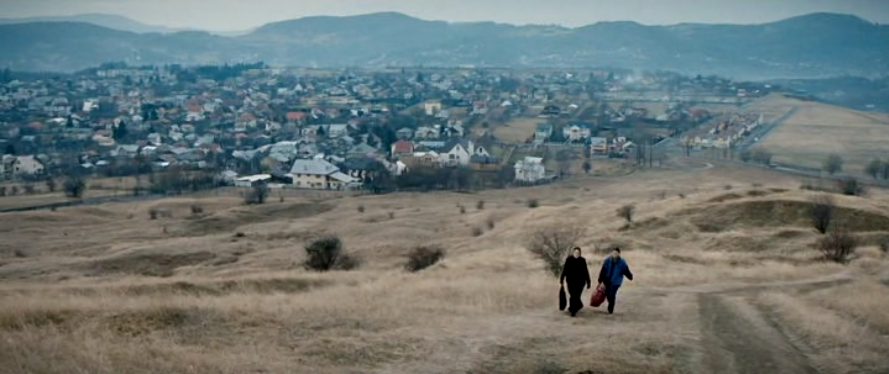
Munghiu fills Beyond the Hills will one dramatic shot after another.  Early in the film, we see Voichita and Alina hike up a hillside in the Romanian countryside (see photo at top); when they reach the top, the camera swings behind them, and we see the monastery on the next rise.  At the climax, the camera stays fixed on a crowd of characters (see photo below); the action and dialogue is between the two men in the foreground, but our attention is on the reactions of Voichita in the background.  The length and patience of the shot allow our attention to settle on Voichita, and her eyes tell us what she has concluded.  It’s an absolutely gripping moment.
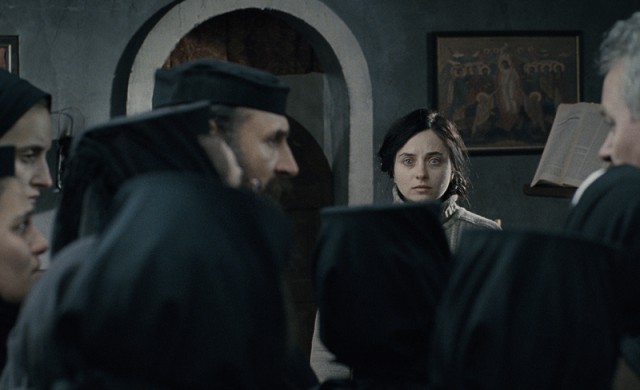
Beyond the Hills is a tough movie by a major film artist.
DVD of the Week: the campy 1994 Oblivion

There’s a big budget Hollywood movie named Oblivion opening this week.  I really enjoyed the original version, the sci fi spoof 1994 Oblivion, now available on DVD.    It is set in the year 3030 on the planet Oblivion, which strongly resembles a frontier town from a spaghetti Western, peppered with the occasional cyborg, ray gun and ATM machine.

Oblivion is intentionally campy, has a silly plot and lots of tongue-in-cheek dialogue.  The scene where the funeral is interrupted by the weekly bingo game upstairs is especially funny.  The cast seems to be having lots of fun with the material. Musetta Vander as the  rawhide whip-wielding dominatrix Lash and Carel Struycken as the death-forboding undertaker Gaunt are especially over-the-top good.  In addition, Julie Newmar plays a cougarish saloon proprietor, and Star Trek’s George Takei is the Jim Beam-swilling town doc.  Amazingly, Oblivion rated a 1996 sequel, Oblivion 2:  Backlash, in which most of the cast returned.

Ebert’s favorite lines

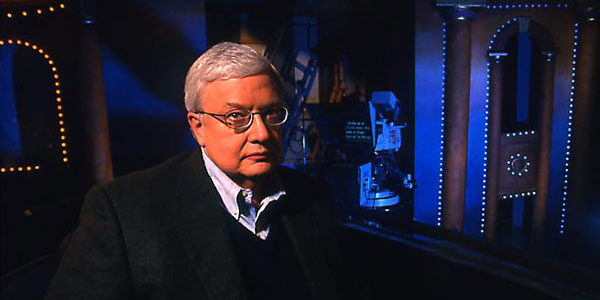
Roger Ebert was never snarky unless a movie deserved it – and then he was masterful.  In 2011, he published Roger Ebert’s Favorite Lines From Movie Reviews, which quickly made my own list of Other People’s Great Movie Lists.

Here are some examples from Ebert’s reviews:

Pearl Harbor is a two-hour movie squeezed into three hours, about how on Dec. 7, 1941, the Japanese staged a surprise attack on an American love triangle.”

Heaven’s Gate is the most scandalous cinematic waste I have ever seen, and remember, I’ve seen Paint Your Wagon.”

“I know full well I’m expected to Suspend My Disbelief. Unfortunately, my disbelief is very heavy, and during Ocean’s Thirteen, the suspension cable snapped.”

“Keanu Reeves is often low-key in his roles, but in this movie, his piano has no keys at all. He is so solemn, detached and uninvolved he makes Mr. Spock look like Hunter S. Thompson at closing time.” — The Day the Earth Stood Still

“She and Daredevil are powerfully attracted to each other, and even share some PG-13 sex, which is a relief, because when superheroes have sex at the R level, I am always afraid someone will get hurt.” — Daredevil

“I am informed that 5,000 cockroaches were used in the filming of Joe’s Apartment. That depresses me, but not as much as the news that none of them were harmed during the production.”

Movies to See Right Now

THE SAPPHIRES

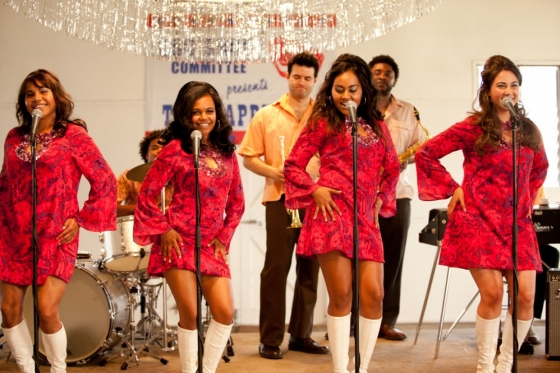
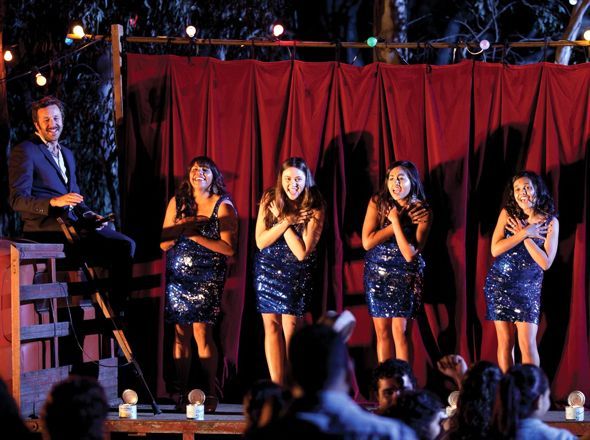
This week’s top recommendation is pretty obvious – the absolutely winning The Sapphires, a charmer about Australian Aboriginal teens forming a girl group to entertain troops in the Vietnam War.

I still love two indies on Video on Demand:

  • Letters from the Big Man: a beautifully looking and sounding fable about a prickly woman with a guy and a Bigfoot competing for her affections.
  • Electrick Children: an entirely unique teen coming of age story with fundamentalist Mormon teens in Las Vegas.

The other best choices in theaters:

  • No: Gael Garcia Bernal stars as the regular guy who brainstormed the guerrilla advertising campaign that dethroned Chilean dictator Pinochet.
  • The Incredible Burt Wonderstone: a pleasant comedy and a showcase for Jim Carrey.
  • Side Effects: Steven Soderbergh’s psychological thriller starring Rooney Mara, Jude Law and Catherine Zeta-Jones.
  • Quartet: a pleasant lark of a geezer comedy with four fine performances.

Music fans will enjoy the bio-documentary Beware of Mr. Baker, available on VOD.

Emperor, with Tommy Lee Jones as Gen. Douglas MacArthur leading the American occupation of Japan, is historical but plodding. On the Road is the faithful but ultimately unsuccessful adaptation of the seminal Jack Kerouac novel, with surprisingly little energy. The HBO movie Phil Spector is really just a freak show.

You may still be able to catch the fine PBS documentary Philip Roth: Unmasked.  Roth himself gets lots of screen time to explain his career and his creative process.

I haven’t yet seen the bleak Romanian drama Beyond the HillsYou can read descriptions and view trailers of upcoming films at Movies I’m Looking Forward To.

My DVD of the week is the superbly acted drama A Late Quartet.

On April 7, Turner Classic Movies has the film noir masterpiece Double Indemnity.  But, if you like noir,  don’t miss the underrated The Set-Up on April 10; for more on The Set-Up, scroll down to #5 on my 10 Best Boxing Movies.

Thank you, Roger Ebert

Roger Ebert has died.  It’s a particularly somber moment for me because the Siskel & Ebert television show was one of the two essential triggers for my love of movies (along with my college History of Film class).

I first set up my massive 1982 VCR to record his and Siskel’s Sneak Previews.  In the early 2000s, Ebert’s was the first blog that I checked every day.  The reason that I signed up for Twitter was to follow Roger Ebert.

Roger Ebert was first a great film critic, period.  He was also the most effective popularizer of movie criticism.  Most importantly, especially for me starting in the late 1970s, he was the leading evangelist for independent and foreign cinema in the US.  Without Siskel & Ebert, I wouldn’t have known to seek out a French film like La cage aux folles or the debut features of indie directors John Sayles (Return of the Secaucus Seven) and Spike Lee (She’s Gotta Have It). 

In taking a “leave of presence” yesterday, Roger Ebert wrote, “On this day of reflection I say again, thank you for going on this journey with me.  I’ll see you at the movies.”

The Sapphires: irresistible

TTHE SAPPHIRES

The Sapphires is  a triumph of a Feel Good Movie.  Set in the 1960s, a singing group from an Australian Aboriginal family faces racial obstacles at home, but blossoms when the girls learn Motown hits to entertain US troops in Vietnam.  Remarkably, Tony Briggs based the screenplay on his mother’s real experience – make sure you stay for the Where Are They Now end credits.

The ever amiable Chris O’Dowd (one of the best things about Bridesmaids)  is funny and charming as the girls’ dissolute manager.  Jessica Mauboy, who plays the lead singer, has a great voice for soul music.  A surprisingly beautiful song by the girls’ mom, played by veteran actress Kylie Belling, is an especially touching moment.

The Sapphires is not a deep movie, but it is a satisfying one.  It’s predictable and manipulative, but I can’t think of anyone who wouldn’t enjoy it.  I saw it at this year’s Cinequest, and predict that it will become a word-of-mouth hit.   The Sapphires is a guaranteed good time at the movies.

DVD of the Week: A Late Quartet

A Late Quartet is a compelling character-driven drama about the individuals that make up an elite and successful classical string quartet.  After twenty-five years, the cellist and leader develops Parkinson’s and must consider retirement.  This development takes the lid off an array of long-simmering issues and triggers personal and interpersonal crises.

What makes A Late Quartet so gripping is the level of performance – not surprising considering the top shelf cast.  Christopher Walken plays a man of uncommon dignity and stateliness, without the creepiness or even the eccentricity that his characters are usually imbued.  Philip Seymour Hoffman is superb as a man who unleashes deeply buried resentments and vulnerabilities.  Catherine Keener is also striking as a woman who cannot answer the question, “Do you love me?”.  Mark Ivanir (who I didn’t remember from Schindler’s List and who often plays Russian gangsters) is excellent as a callous perfectionist brought literally to his knees by something he never expected.  Imogen Poots (Solitary Man) also shines as the prodigy daughter whose drops her youthful playfulness when it’s time to settle a score with her mother.

One more note:  I relished the delightful homage to Dinner with Andre when we suddenly see Wallace Shawn holding forth in a New York restaurant.

We aren’t surprised by any of the plot points, but we are continually surprised by the reactions of the characters, so masterfully delivered by the actors.

Ginger & Rosa: a friendship faces a fork in the road

Alice Englert and Elle Fanning in GINGER & ROSA

The title characters in Ginger & Rosa are 17-year-old best friends in 1962 London.  Through each stage of childhood, they have been inseparable companions and are now, as teens, fierce allies against their mothers. But at 17, Ginger’s intellectualism and Rosa’s romanticism are becoming more pronounced.  Ginger is obsessed with the British nuclear disarmament movement and Rosa is boy crazy. Ginger & Rosa is a solid dramatic snapshot of the moment when this friendship plunges into crisis.

Another important character is Ginger’s unreliable dad (Alessandro Nivola), a political pamphleteer once jailed for his pacifism who justifies his anarchic lifestyle as resistance to authority.  This is political statement, conveniently, serves as a rationale for doing whatever he wants to do, whatever the impact upon others.

The truth tellers in the story are the most constant adults in Ginger’s life,  gay couple and their arch friend played by Timothy Spall, Oliver Platt and Annette Bening.  These three actors are always welcome in a movie, and are outstanding in Ginger & Rosa.

The American actress Elle Fanning is excellent as the always-observant Ginger.  Her performance here marks her as someone who could have an extraordinary career.  Remarkably, Fanning played this 17-year-old character when she was only 14.  The less demanding role of Rosa is well-played by director Sally Potter’s daughter Alice Englert.

Potter gets the period exactly right – from the girls’ ironing their hair to their discovery of turtleneck sweaters.  But, along with Fanning’s stellar performance, is that enough for a satisfying movie?  At the end of the day, it’s a well-crafted, character-driven little movie – but not a Must See.

Movies to See Right Now

LETTERS FROM THE BIG MAN

This week’s best two movies can be found on Video on Demand (I saw them on Amazon Instant), and both feature magical realism:

  • Letters from the Big Man: a beautifully looking and sounding fable about a prickly woman with a guy and a Bigfoot competing for her affections.
  • Electrick Children: an entirely unique teen coming of age story with fundamentalist Mormon teens in Las Vegas.

The best bets in theaters:  

  • No: Gael Garcia Bernal stars as the regular guy who brainstormed the guerrilla advertising campaign that dethroned Chilean dictator Pinochet.
  • The Incredible Burt Wonderstone: a pleasant comedy and a showcase for Jim Carrey.
  • Side Effects: Steven Soderbergh’s psychological thriller starring Rooney Mara, Jude Law and Catherine Zeta-Jones.
  • Quartet: a pleasant lark of a geezer comedy with four fine performances.

Music fans will enjoy the bio-documentary Beware of Mr. Baker, available on VOD.

Emperor, with Tommy Lee Jones as Gen. Douglas MacArthur leading the American occupation of Japan, is historical but plodding.  On the Road is the faithful but ultimately unsuccessful adaptation of the seminal Jack Kerouac novel, with surprisingly little energy.  The HBO movie Phil Spector is really just a freak show.

 I haven’t yet seen the upcoming PBS documentary Philip Roth: Unmasked. You can read descriptions and view trailers of upcoming films at Movies I’m Looking Forward To.

My DVD of the week is the smart, actress-written romantic comedy Celeste and Jesse Forever.

On Easter Sunday, Turner Classic Movies offers a Jesusathon of Sword and Sandal movies: Ben-Hur, The Robe and Barabbas. Ben-Hur has the thrilling chariot race around that phenomenal set – one of the greatest sets in movie history. In Barabbas, Anthony Quinn sees Charlton Hestons’s galley slavery and raises it by a tour in the sulpher mines, a stint as a gladiator and the witnessing of the burning of Rome, all culminating in a Christian martyrdom.

Letters from the Big Man: Sasquatch is her stalker

Employing magical realism like Electrick Children, Letters from the Big Man is a completely original movie.  A young woman of fierce independence has left a career with the US Forest Service to do art.  Upended by a bad breakup, she takes an assignment from her former employer that conveniently requires her to do what she really needs to do – make a solo backpacking trip deep into the southern Oregon forests.

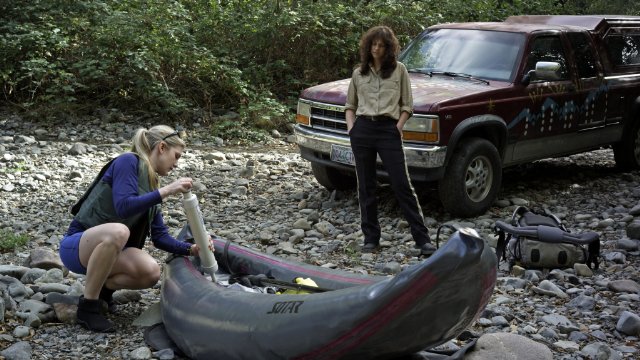
The opening quarter of the movie establishes two things.  First, the ancient Oregon forest is awesomely beautiful and inspires reflection.  Second, this woman’s wilderness skills are beyond impressive – she hikes, kayaks, chops wood, makes camp and kindles fire with great ease.  It’s clear that she is extremely experienced in the wild, and she exudes confidence.  She recognizes every plant species, snorkels to count the horns on a sturgeon and wades into streams to measure the siltation. And she can handle a handgun, too.  Wow. (Later in the movie, we see her matter-of-factually rig her bike to recharge her laptop battery with pedal power.)  She comes to realize that someone/something is following her, a thought that may terrify the audience (especially at night), but which only annoys and intrigues her.

As the young woman, Lily Rabe carries the film with her physicality and strength of will.  (Rabe is the daughter of the late Jill Clayburgh.)  Her character is also prickly, which keeps us from warming to her right away.  But she attracts the attention of two males.  The first is another backpacker, who turns out to be an environmental activist at odds with the Forest Service and ready for female company.  The second is a Bigfoot, who rages against logging in his forest, but who melts at the sight of our heroine and leaves her piles of twigs as tokens of his affection (this is the magical realism).  The movie turns on her response to her two suitors.

Writer-director Christopher Munch has created a movie of uncommon beauty, and he has the balls to include a lovelorn Bigfoot.  The magical realism works because he presents it absolutely straight, as if having a Sasquatch in the story is as normal as a squirrel.  Most of the rest of the story is extremely realistic, especially the interactions between officials of the Forest Service, environmentalist activists and loggers.  The one exception is an unnecessarily farfetched conspiracy theory about military intelligence.

Letters from the Big Man is one of the best looking and best sounding movies of the year.  Visually, it’s like trekking through wilderness (but without the insects).  And the sound track is exquisite, centered on the natural sounds of rushing water and animal calls, occasionally augmented with an ensemble’s reverential music.

Will Sasquatch get the girl?  It’s worth finding out.  Letters from the Big Man is available on VOD, including on Amazon Instant.