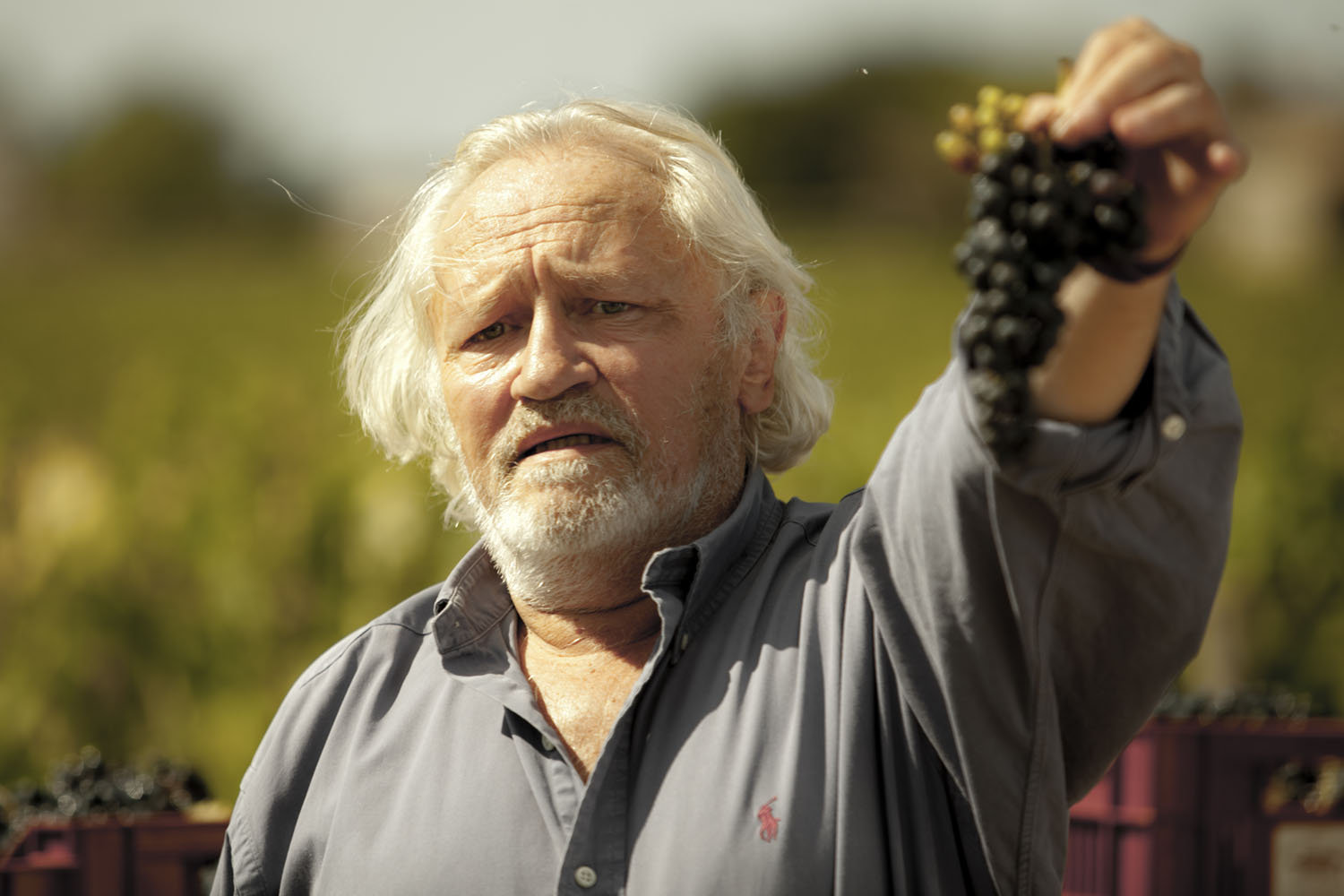
Niels Arestrup (A Prophet, War Horse) stars as the owner of French wine estate who places impossible expectations on his son, with lethal results. The poor son has gotten a degree in winemaking, has worked his ass off on his father’s estate for years and has even married well – but it’s just not enough for his old man. The father’s interactions with the son range from dismissive to deeply cruel.
The father’s best friend is his longtime estate manager, whose health is faltering. The son is the natural choice for a successor, but the owner openly prefers the son’s boyhood friend, the son of the manager. The first half of You Will Be My Son focuses on the estate owner’s nastiness toward his son, which smolders throughout the film. But then the relationship between the sons turns from old buddies to that of the usurper and the usurped. And, finally, things come down to the decades-long relationship between the two old men.
Deep into the movie, we learn something about the father that colors his view of his son. And then, there’s a startling development that makes for a thrilling and operatic ending.
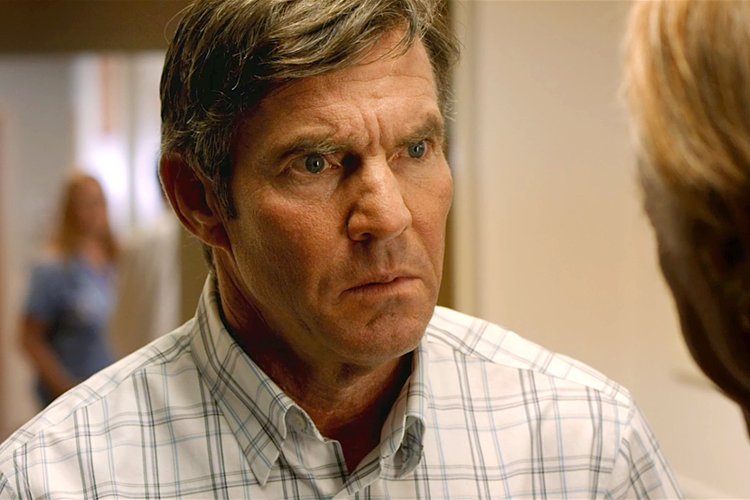
At Any Price is – at long last – a movie about today’s Farm Belt that farmers will recognize. American cinema has been romanticizing the small family farm for at least a quarter century since, to survive, US farmers have moved on to industrial scale agribusiness (with all its tradeoffs). The corporate farmer at the center of At Any Price is Henry Whipple (Dennis Quaid). Henry is a driven man, consumed by a need to have the biggest farm and to sell the most genetically modified corn seeds in southern Iowa. Henry is also stupendously selfish, utterly tone-deaf to the needs of anyone else.
Despite Henry’s dream to hand the business to one of his two sons, they despise him. The older son has avoided conflict by escaping to a vagabond life in international mountain climbing. The younger son, Dean (Zac Efron), plans his escape as a NASCAR driver and seems well on his path. Stuck on the farm for now, he can barely tolerate his father’s incessant grasping. But he’s small town royalty, he’s got a pretty girlfriend (Maika Monroe) and he’s as good-looking as Zac Efron, so life isn’t unbearable.
But Henry’s smug perch on top of the haystack is not as impregnable as it would seem. Along the way, he has cut some corners and stepped on other people, and it catches up to him. Henry’s empire threatens to topple, Dean clutches at his big career chance, and the two men – each and together – must react to developments that they never saw coming. Writer-director Ramin Bahrani spins a deeply authentic psychological drama as each man is forced into some uncomfortable self-examination.
It’s interesting that such a realistic exploration of New Agriculture in Middle America comes from Bahrani. Himself North Carolina-born, he has used nonprofessional actors to make three brilliant movies about struggling immigrants in America: Chop Shop, Man Push Cart and Goodbye, Solo. Goodbye, Solo was #5 on my list of Best Movies of 2009. Here’s a recent interview with Bahrani in the New York Times touching on At Any Price.
One of Bahrani’s insights is that the impacts of today’s capitalism aren’t necessarily from the malevolently rapacious (like Henry F. Potter in It’s a Wonderful Life), but from the indifference of the selfish. With almost every step that he takes, Henry Whipple screws other folks, but he’s convinced himself that he’s a prince of a guy.
At Any Price is a showcase for Quaid and Efron. Quaid’s portrayal of Henry is brilliantly textured, projecting a self-righteous bluster which barely masks the desperation threatening to erupt through his pores. And I’ve come to always look forward to seeing Efron, who, in Me and Orson Welles,The Paperboy and Liberal Arts, has proven that he is more than just the pretty boy of High School Musical.
Bahrani’s actors have taken full advantage of his screenplay. The character of Dean’s girlfriend is especially well-written. Beginning as a simple teen from a broken family looking for some fun, her journey takes several surprising turns. The actress Maika Monroe pulls it off with a memorable performance. In many ways, the story is anchored by Kim Dickens (Deadwood, Treme) as Henry’s wife and Zac’s mom, resolutely dragging her men out of their self-created sinkholes. Veteran character actor Clancy Brown (the guy has 209 acting credits on IMDb) is superb as Henry’s chief rival.
We are left with two men who finally must appreciate who they really are, whether we like them or whether they like themselves. After seeing At Any Price, I didn’t leave the theater thrilled, but that’s probably because a brilliant examination of two ambiguous men is more thought-provoking than stirring. And there’s nothing wrong with that.
At Any Price is available on DVD from Netflix and Redbox and streaming from Amazon, iTunes, Vudu, Xbox Video, YouTube and Google Play.
In the engrossing documentary Finding Vivian Maier, we go on journey to discover why one of the great 20th Century photographers kept her own work a secret.
The Unknown Known, master documentarian Errol Morris’ exploration of Donald Rumsfeld’s self-certainty, is a Must See for those who follow current events. Like all Wes Anderson movies, The Grand Budapest Hotel is wry and imaginative, but it’s not one of his most engaging. Dom Hemingway is a fun and profane romp. In the most bizarro movie of the year so far, Under the Skin, Scarlett Johansson plays an alien who lures men with her sensuality and then harvests their bodies; it’s trippy, but I found it ultimately unsatisfying.
I liked Run & Jump, now available streaming on Amazon, iTunes, Google Play, YouTube and Xbox Video. It’s successful as a romance, a family drama and a promising first feature.
My DVD/Stream of the Week is the emotionally satisfying gem Philomena. Philomena is available on DVD from Netflix and streaming from Amazon, iTunes, Vudu, YouTube, Google Play and Xbox Video.
Sam Fuller is one of my favorite directors, and Turner Classic Movies is offering a Fullerathon on April 29. Fuller started out as a tabloid reporter and never missed a chance to shamelessly sensationalize a subject (except for war, which he insisted on treating realistically). Two of Fuller’s trashterpieces are Naked Kissand Shock Corridor. His masterpiece is probably the Korean War film I Shot Jesse James, The Baron of Arizona ; the WWII movie Merrill’s Maraudersis more conventional, but a solid WWII movie. TCM is also showing I Shot Jesse James, The Baron of Arizona and Verboten!. The only stinker of the group is The Run of the Arrow, with a hopelessly miscast and scenery-chewing Rod Steiger in buckskins.
In The Naked Kiss, a prostitute opens the movie by beating her pimp to a pulp, and then moves to a new town, seeking a new beginning in the straight world. She gets a job as a nurse at the clinic for disabled children, and becomes engaged to the town’s leading philanthropist. She thinks that everything will be great unless someone reveals her tawdry past. But, instead, she discovers that her Mr. Perfect is molesting the crippled kids! (Only Sam Fuller could pull this off!) Here’s the trailer.
The title character in Philomena, is an Irish woman who was shipped off to the nuns as a pregnant teen and whose toddler was adopted without her genuine consent. Now over forty years later, she wants to find what has happened to her son. Philomena (Judi Dench) is a simple woman, whose deep faith has been unable to resolve her sense of loss. She enlists a British journalist (Coogan) to help her in the investigation. The journalist takes them on a journey that finds her answers – and some of those answers are wholly unexpected.
The nuns in the 1950s flashback are cartoonishly nasty, contrasted with their modern counterparts – just as evil but with slickly modern PR skills. Philomena’s faith enables her victimhood, but then an act of transcendence reveals her to be the most Christian character.
Of course, Dench is always excellent, but Coogan’s performance shows an unexpected range. His character has just had his high-flying career derailed and has lost the smug confidence that Coogan’s characters usually impart.
Director Stephen Frears (High Fidelity, Dirty Pretty Things, The Queen) has a big success with Philomena, a nice rebound from his most recent efforts (Tamara Drewe, Lay the Favorite). Philomena is an emotionally satisfying success.
Philomena is available on DVD from Netflix and streaming from Amazon, iTunes, Vudu, YouTube, Google Play and Xbox Video.
The engrossing documentary Finding Vivian Maier begins with the death of a Chicago woman so obscure that none of her neighbors knew her name. She was a standoffish hoarder, and when a box of her junk is acquired at an estate auction, the buyer, a picker named John Maloof, finds lots and lots of photographs. He posts some of them on the Internet, and it turns out that the woman was, hitherto undiscovered, one of the great 20th Century photographers. So Maloof acquires the other boxes from the auction and embarks on a quest to find out who she was, why she took over 100,000 images and why she never showed them. Fortunately, we get to come along.
We quickly learn that her name was Vivian Maier, and that she worked as a nanny. As Maloof’s journey of discovery takes us to another city and then to another country, we begin to piece together her life. Because Maier lived with families to raise their children, we meet some of her former charges. We are able to construct what she looked and sounded like, how she dressed and walked and about her array of eccentricities. We learn about a very disturbing dark side.
But Maier remained secretive even inside the families’ homes, so some of the puzzle pieces remain undiscovered. We can infer that a pivotal event happened during her childhood. We conclusively find out that she was obsessively private, but we can only guess why.
Vivian Maier is no longer obscure. Her work is now shown widely in museums and galleries. As a photographer, she had an uncommon gift to connect personally with her subjects and to document the humor and tragedy of the most human moments. In the guise of a detective story, Finding Vivian Maier does her justice.
I like the dark and violent Joe with Nicholas Cage and young Tye Sheridan of Mud. The Unknown Known, master documentarian Errol Morris’ exploration of Donald Rumsfeld’s self-certainty, is a Must See for those who follow current events.
You can still find Jake Gyllenhaal’s brilliant performance in two roles in the psychological thriller Enemy. Like all Wes Anderson movies, The Grand Budapest Hotel is wry and imaginative, but it’s not one of his most engaging. Dom Hemingway is a fun and profane romp. In the most bizarro movie of the year so far, Under the Skin, Scarlett Johansson plays an alien who lures men with her sensuality and then harvests their bodies; it’s trippy, but I found it ultimately unsatisfying.
I liked Run & Jump, now available streaming on Amazon, iTunes, Google Play, YouTube and Xbox Video. It’s successful as a romance, a family drama and a promising first feature.
My DVD/Stream of the Week is Martin Scorsese’s funniest film, The Wolf of Wall Street, in which the sales meetings make the toga party in Animal House look like an Amish barn-raising. The Wolf of Wall Street is available on DVD from Netflix and Redbox and streaming from Amazon, iTunes, Vudu, YouTube, Google Play and Xbox Video.
This week Turner Classic Movies is showing one of my all-time favorites, the noir mystery Laura, with the detective (Dana Andrews) falling in love with the murder victim he has never met (the lustrous Gene Tierney); Clifton Webb steals the show with a brilliantly eccentric supporting turn. TCM is also showing perhaps the greatest Western movie, The Man Who Shot Liberty Valance, a mature John Ford’s contemplation of all those shoot ’em ups from earlier in his career; it features James Stewart and John Wayne, along with Andy Devine, Woody Strode, Vera Mills, Edmond O’Brien and Lee Marvin. And speaking of the Duke, in The Shootist, he plays an aged gunslinger dying of cancer at the end of the Old West; poignantly, Wayne himself was fighting cancer himself and The Shootist was his final film.
In the indie Run & Jump, a rare type of stroke has changed the personality of an Irish furniture maker; he has survived, but now prone to rages and catatonia, he is never going to be the same as before. He is returned to his family, led by his firecracker wife (Maxine Peake). Along comes an American medical researcher (Will Forte from Saturday Night Live and Nebraska), who moves with the family so he can continually film his patient’s symptoms.
The family initially resents the constant filming, although they desperately need the income from the research stipend. The researcher is so socially awkward that he’s almost catatonic himself, but he is able to provide the adult male presence that the family now misses, and they are eventually drawn to his kindness. Although he tries to maintain clinical distance, he is inevitably attracted to the vitality of the wife – a real live wire. But this isn’t going where you might expect…
Run & Jump succeeds both as a romance and as a family drama. The primary credit goes to co-writer and director Steph Green. A Bay Area filmmaker who now works in Ireland, Green was Oscar nominated for a live action short. Run & Jump is her first feature.
Maxine Peake’s affecting performance as the wife drives the film; Run & Jump is really the story of the wife’s struggles as she fights to keep her family afloat while making a near impossible adjustment.
Run & Jump is available streaming on Amazon, iTunes, Google Play, YouTube and Xbox Video.
Under the Skin is the most bizarro movie of the year so far – by a long shot. A space alien in the form of a human woman attracts men sexually and then harvests their bodies. As each man steps forward, entranced in lust, he doesn’t notice that he is sinking into an ever deeper black pool until he vanishes. Later, we learn that he is suspended in the viscous liquid until, suddenly, his body is deflated like a popped balloon, leaving just the latex-like skin, while a red pulp (presumably pulverized human bone and tissue) heads up on a conveyor belt to the aliens for their use. This lurid story is set in the gloomy dank of Scotland and yo-yos between the gritty streets of Glasgow and a highly stylized sci-fi world a la Solaris.
Scarlett Johansson, who puts the lure in allure, plays the alien who any heterosexual man would crawl on his knees across broken glass for. Scarlett is a helluva good sport. Johansson is that rare A-list movie star who doesn’t take herself too seriously and has VERY good taste. You can’t criticize her for picking up a paycheck in the occasional comic book movie when you consider a body of top-tier work that is remarkable for a 29-year-old: Ghost World, Lost in Translation, Girl with a Pearl Earring, Match Point, Vicky Christina Barcelona, Her. Here, she is suitably sensual and perfectly nails the alien’s changing degree of emotional detachment/attachment, which is really the core of the movie (I think). And she gets naked several times.
Director Jonathan Glazer (Sexy Beast) co-wrote the screenplay with Walter Campbell from a Michael Faber novel. This is NOT a movie for those who need to know what is going on at all times. And, to connect the dots the best we can, we have to sit through some VERY repetitive action.
Again and again, the alien drives around Glasgow, scanning hundreds of men, asking the ones with the most unintelligible accents for directions and picking up the single ones. This happens a lot. She has an alien handler in the form of a human man dressed in motorcycle gear, who strides around with aggressive purposefulness and speeds around the Scottish back roads on his bike and never speaks. This happens a lot, too.
Under the Skin is getting critical praise (currently a Metacritic score of 77), which I attribute to its novel look and overall trippiness and to its being the first movie in three months that challenges the audience. But overall, the payoff isn’t really worth watching the repetition, trying to figure out what’s going on and why.
SPOILER ALERT: As an alien people-harvester, she is initially emotionally uninvolved with humans. She has no reaction to a family beach tragedy that would highly disturb a human. Dragged into a disco, she is disoriented until some poor guy chats her up and she can lapse into the role she was trained/programmed for.
But then she picks up an Elephant Man for harvesting; she is touched by his longing for companionship and sex – and ends up letting him go. Another man shows her kindness and she tries out humanity, tapping her fingers to human music, trying a bite of chocolate cake (and spitting it out, gagging). She attaches to the kind man but finds herself biologically unequipped to take the relationship to a new level.
And there are some holes in the story. If this alien race is so advanced, why can’t her handler find her with some GPS-like capacity? Why don’t the aliens harvest more people, and why do they just pick the solitary loners? Why don’t they consume the skin? But that’s just thinking too much about Under the Skin.
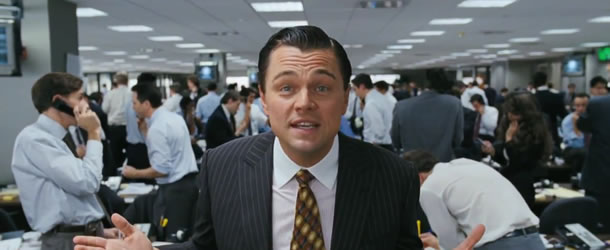
What do you get when testosterone-fueled and morally challenged stock salesmen discover how to make piles of easy money by defrauding investors? Well, when Martin Scorsese tells the tale, we get three hours of full throttle, hilariously bad behavior. The Wolf of Wall Street is the story of a (real life) guy who found out how to make a fortune scamming middle class investors – and then a bigger fortune scamming rich investors – on penny stocks and shady IPOs. It’s a wild ride that is destined to end in a perp walk, propelled by enormous amounts of recreational drug use. In fact, the movie is really about excess – the sales meetings here make the toga party in Animal House look like an Amish barn-raising.
This is not economic story-telling. Scorsese indulgently lets his scenes run on and on – not so we lose interest, but just so he can milk out every drop of spectacle. Although he could have told the story in two hours instead of three, he just couldn’t resist supplying three hours of exhilaration. Fine by me.
I had never thought of Leonardo DiCaprio as a comic actor, but he does a fine job in the lead role – driving what is essentially a comedy. Speaking of comic actors, this may be Jonah Hill’s finest performance – he plays the top henchman, a character who wears horn-rimmed glasses (without corrective lenses) just to look more WASPish; no one can play schlubby desperation or drug-impaired overreaching better than Hill. There is a huge cast, and some of the year’s best acting gems include:
Kyle Chandler (Friday Night Lights and so brilliant in The Spectacular Now) as the FBI agent targeting DiCaprio. In particular, Chandler performs an exceptional scene on a yacht, where the agent lets the con artist (and the audience) think that his con is working – for just a bit. Top notch stuff.
Matthew McConaughey, at the height of his new-found acting powers, as our hero’s first mentor in amorality;
Rob Reiner (!) as the hero’s emotionally explosive but common sensical dad;
the stunning blonde Australian actress Margot Robbie as the Brooklyn-bred trophy wife; and
Joanna Lumley (a top model in London’s 60s Mod scene and popularizer of the Purdey bob hairstyle) as the trophy wife’s conveniently European aunt.
I’m certainly going to add this to my Best Drug Movies. Multiple scenes make this the best Quaalude movie ever, and one extended ‘lude scene with DiCaprio and Hill had the audience howling for several minutes.
Is this one of Scorsese’s best films? No – but it is one of the most entertaining and certainly the funniest. The Wolf of Wall Street is available on DVD from Netflix and Redbox and streaming from Amazon, iTunes, Vudu, YouTube, Google Play and Xbox Video.
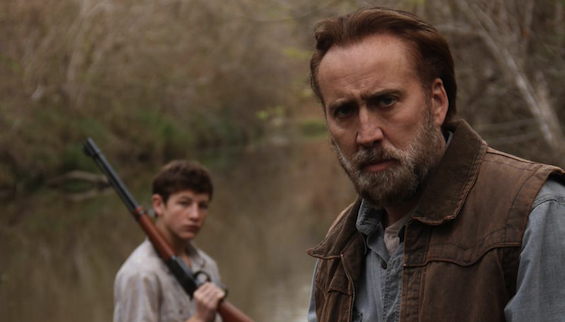
In Joe, Nicholas Cage plays the title character, who lives a solitary life in backwoods Texas – self-isolated by problems with anger management and booze that long ago estranged his family and cost him some time in the state pen. Somehow Joe has stayed out of trouble for years, but he’s always on a slow simmer, seemingly close to boiling over. Joe meets Gary (Tye Sheridan of Mud), a boy who belongs to a family of drifters led by a father who beats them and takes all their money to spend on cheap likker. Joe bonds with Gary, and ultimately finds redemption in a sacrifice he makes for the boy. Dark and violent, Joe is ultimately successful as a gripping drama.
Indie writer-director David Gordon Green excels at authentic character-driven Southern dramas (George Washington, All the Real Girls and Undertow). Here he brings us to a world of nasty chained-up dogs, where everyone smokes cigarettes and eats canned food, and nobody has heard of espresso or the Internet.
Cage’s performance is excellent – never over-the-top and much more modulated and realistic than we’ve come to expect from him.
Sheridan, so good in Mud, might be even better here; he smolders at the abuse and neglect the family suffers at the hands of his father. He’s become a strapping kid who came employ violence against an adult, but the father-son tie keeps him from unleashing it on his despicable father. Sheridan is especially brilliant in an early scene where he playfully banters with his drunken dad and in another where Joe teaches him how to fake a pained smile to attract girls.
The biggest revelation in Joe is a searing performance by non-actor Gary Poulter as the drunken father who may shamble like a zombie, but is always cruising like a shark, on the hunt for someone to manipulate or rob. It’s stirring portrait of final stage alcoholism, where there is no moral filter anymore – he will resort to ANY conduct for some three dollar wine. There is nothing left but evil borne of desperation for a drink. Although Poulter was a reliable member of the filmmaking team, within two months after the conclusion of photography, he had resorted to his previous self-destructive lifestyle and died. Thanks to Green, he leaves one great cinematic performance as his legacy.