
DVD/Stream of the Week: The Unknown Known

Rumsfeld: unruffled by the Errol Morris documentary treatmentErrol Morris is a master documentarian (Gates of Heaven, The Thin Blue Line, Standard Operating Procedure), so he is the perfect guy to explore the personality and career – and, above all, the self-certainty – of Donald Rumsfeld, architect of the American wars in Afghanistan and Iraq. For most of the film, Rumsfeld himself is on-screen talking to Morris’ camera. Rumsfeld is apparently completely immune from self-doubt, but ultimately reveals more about himself than he would like.

The title of the picture comes from a Rumsfeld memo that describes a policy maker’s “unknown known” as that which you thought you know but it turns out that you didn’t. Of course, the classic “unknown known” is the certainty that the Iraq War would be justified and would turn out well.

In contrast, the “unknown unknown” is something that you don’t know that you don’t know and that Rumsfeld says that you have to imagine (such as the Pearl Harbor and 9/11 attacks). Of course, the imagining of all kinds of such attacks drives the neo-conservative theory of preemptive war – to strike at those who can be IMAGINED to threaten you.

Rumsfeld is remarkably glib and very effective at selling his own version of reality. Morris takes this on early in the documentary by getting Rumsfeld to deny linking Saddam with Al Qaeda and then shows him doing exactly that in a pre-Iraq War news conference. Indeed, Morris himself is an effective off-screen participant throughout, sparring with Rumsfeld, with each guy winning his share of verbal tussles.

When Rumsfeld thinks that he’s won a point, he grins the infuriating grin in the image above. The one time he loses his smile is when Morris mentions a moment when Rumsfeld almost became Reagan’s Vice-President (and then future President), and Rumsfeld acknowledges that, yes, this was possible. The film is brilliantly edited, and Morris knows EXACTLY how long to extend a shot to catch Rumsfeld in moments of reflection.

The movie traces Rumsfeld’s remarkable life and career from his marriage and early start as a young Congressman thru his roles in the Nixon and Ford administrations with the end of Watergate, the fall of Saigon, his salesmanship for defense spending increases in the 1970s and his service as Reagan’s Middle East envoy. After a time in the wilderness during Bush I, of course, he came to his greatest power during Bush II. He gives a stirring first-person account of the 9/11 attack of the Pentagon, relating what the scene was like even before the first responders arrived. But the core of the film is about the Rumsfeld decisions about Iraq.

Unusual for a current events documentary, there’s also some top shelf music from Danny Elfman, Oscar nominated for Good Will Hunting and Milk.

You can find The Unknown Known on DVD from Netflix and streaming on Amazon, iTunes, YouTube, Google Play and Xbox Video.
Life Itself: an additional personal thought

Yesterday I commented on the Roger Ebert documentary Life Itself.  Today I’m reflecting on Roger Ebert as the main reason that my love of cinema grew, as did my passion for sharing under appreciated and overlooked movies. In other words, I wouldn’t be writing this blog if not for Ebert.

My college History of Film class and the groundbreaking movies of the 70s (The Godfather, Chinatown, Five Easy Pieces) had awakened my interest in movies.  But Roger Ebert was the leading evangelist for independent and foreign cinema in the US. Without the Siskel & Ebert TV shows, I wouldn’t have known to seek out a French film like La cage aux folles or the debut features of indie directors John Sayles (Return of the Secaucus Seven) and Spike Lee (She’s Gotta Have It).  Heck, I just looked at my list of 50 Greatest Movies of All Time, and, without Ebert’s guidance, I never would have seen The Seven Up series, Blue/White/Red, Secrets and Lies, and, probably, Do the Right Thing.

Along the way (and from technology to technology), I made it a point to seek out Ebert’s movie recommendations.  The first show that I set up my massive 1982 VCR to record was Siskel & Ebert’s Sneak Previews. In the early 2000s, Roger Ebert’s was the first blog that I checked every day. The reason that I signed up for Twitter was to follow Roger Ebert.

So, thanks, Roger.  Thanks from The Movie Gourmet.

Life Itself: Roger Ebert’s truth

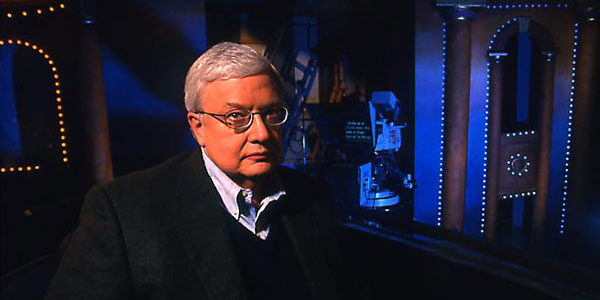
Roger Ebert in LIFE ITSELF

Life Itself is the affectionate but not worshipful documentary on movie critic Roger Ebert’s groundbreaking career, courageous battle against disease and uncommonly graceful death.  Ebert popularized movie criticism and evangelized for the lesser known foreign films, documentaries and indies that I love.  In a 2002 cancer treatment, Ebert lost his lower jaw and, with it, his ability to talk or eat.  Astonishingly, this didn’t slow him down; he replaced his television show with a pioneering blog and Twitter account – and remained just as productive and influential as ever.

Filmmaker Steve James set out to make a movie of Ebert’s memoir of the same name, but – just as the project started – Ebert’s cancer returned.  So the story includes Ebert’s final illness and death.  Ebert retained the joy in his life far longer than could most in his situation – it’s a marvel and a model for the rest of us.

James is one of the deserving filmmakers whose art was boosted by Ebert, who picked James’ obscure documentary Hoop Dreams as the best film of the year. Ebert similarly helped directors from Spike Lee in the 1980s to Raman Bahrani in the 2000s. In Life Itself, Errol Morris says that he would have had no career without Ebert and Siskel, and Martin Scorsese says that they saved his career.

But the primary theme of Life Itself is truth.  In his work, Ebert demanded truth from himself and from the cinema that he reviewed.  In this film, Ebert insisted on showing the person he was at the end – with his infirmities on full display.  There are moments of frustration where he is not so lovable and stories about his personal flaws.  We are all packages of virtues and weaknesses; seeing Roger’s weaknesses just adds credibility to his strengths and accomplishments.

Life Itself is a Must See for fans of Roger Ebert and for people musing on their own mortality.  People with less of an interest in Ebert may find the movie a little too long.  But the human story of a life – challenged and then ending – is very strong.

Movies to See Right Now

Matthew McConaughey in TRUE DETECTIVE

My top picks:

  • Ranging from wry to hilarious, the German dark comedy A Coffee in Berlin hits every note perfectly. I love this little movie, and it may only be in theaters for another week, so see it while you can.
  • It’s not up to Clint Eastwood’s usual standard, but Jersey Boys, is mostly fun – and features another jaunty performance by Christopher Walken.
  • If you look for it in theaters, you can still find my top movie of the year so far, the transcendent Polish drama Ida.

Among other movies out now:

My DVD/Stream of the week – perfect for binge-viewing on the holiday weekend – is the eight one-hour episodes of HBO’s True Detective. It’s a dark tale of two mismatched detectives – each tormented by his own demons – obsessed by a whodunit in contemporary back bayou Lousiana. Wood Harrelson is very good, and Matthew McConaughey’s performance may have been the best on TV this year. True Detective is available on DVD from Netflix and streaming from HBO GO.

Turner Classic Movies also offers a pretty appetizing movie smorgasbord this week, starting with The Big Steal (1949) on July 8  – Robert Mitchum and Jane Greer are chased all over Mexico by William Bendix.  Then on July 10, we have three great documentaries:

  • The 1968 Salesman – as good of a depiction of the sales life as Glengarry Glen Ross);
  • Harlan County, U.S.A, the 1979 Oscar-winner Filmmaker Barbara Kopple embedded herself among the striking coal miners and got amazing footage – including of herself threatened and shot at.  Also one of my 5 Great Hillbilly Movies.
  • The Times of Harvey Milk  – the Oscar winner from 1984.  The real story behind Milk with the original witnesses.  One of the best political movies ever.

Whitey: United States of America v. James J. Bulger: mildly interesting

WHITEY: THE UNITED STATES OF AMERICAN V. JAMES J. BULGER

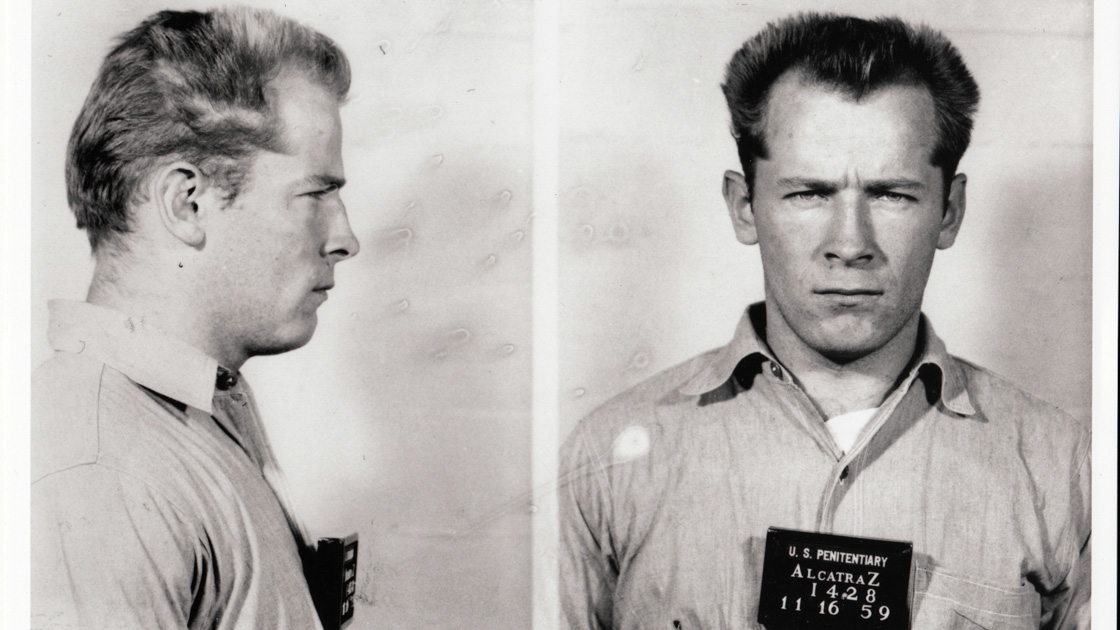
The documentary Whitey: United States of America v. James J. Bulger is about the trial of Whitey Bulger, the Irish mob boss who ruled the Boston crime scene for 25 years until he went on the lam in 1994 and evaded the FBI until 2011.  It turns out that he had been protected from arrest because he had been an informant to corrupt local FBI agents.  In his 2013 trial, he was convicted of 11 murders.

The Whitey Bulger saga has been most notable for the protection by the FBI, the long manhunt and his dramatic capture in Santa Monica.  This documentary focuses on the trial and Bulger’s odd defense.  Bulger was perfectly willing to admit to murderous crimes, but demanded a chance to deny that he had been an FBI snitch (which was totally irrelevant to whether he had committed the crimes that he was charged with).  Equally oddly, the prosecution was intent on proving Bulger’s snitchdom (although not needed for his conviction).

We hear from some of the people who Bulger victimized, and we get a sense of the lives that Bulger ruined, not just the cops and robbers aspect of his story.  We also hear Bulger himself on phone calls to his lawyers.

It’s an interesting story, but the filmmaking has look and feel of cable TV non-fiction shows, repeating over and over the same shots of black SUV’s hauling Whitey to trail and helicopter sweeps across Boston harbor, aerial shots of the Boston federal courthouse,  and the like.  On the whole, I didn’t find Whitey very compelling.

Whitey: United States of America v. James J. Bulger is available streaming on iTunes, Vudu, YouTube, Google Play and Xbox Video.
My favorite Paul Mazursky movie

DOWN AND OUT IN BEVERLY HILLS

The director Paul Mazursky, a master of the social satire and the topical movie, has died.  He’s chiefly (and rightly) being remembered for his cinematic social landmarks: Bob & Carol & Ted & Alice, An Unmarried Woman and Harry and Tonto.

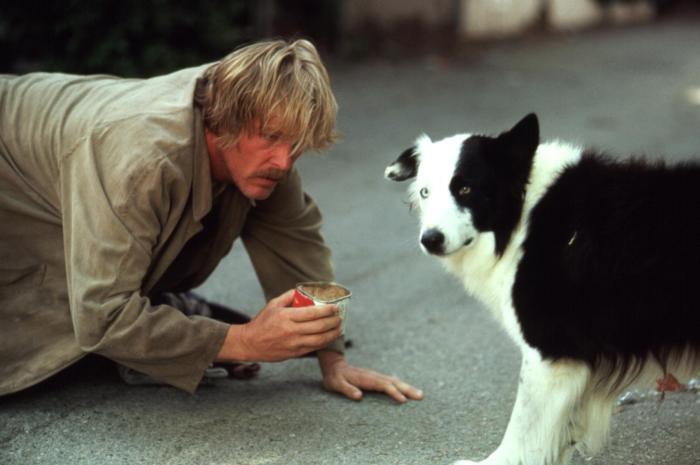
But my favorite Mazursky film is the 1986 comedy Down and Out in Beverly Hills. Mazursky directed and co-adapted the screenplay.   Richard Dreyfuss and Bette Midler play a rich and very unfulfilled couple.  Through circumstance, they invite a homeless guy (Nick Nolte) to stay in their Beverly Hills mansion.  This fish-out-of-water exposes the shallowness of their lifestyle, and he personally touches – and awakens – each member of the household.  And there are PLENTY of LOL moments.  It’s a 28-year-old movie that stands up very well today.  Watch for the fine actress Elizabeth Pena as Carmen the maid in her first highly visible role.  Down and Out in Beverly Hills is available streaming on Netflix Instant, iTunes, Amazon and Vudu.

My friend Steve also loves Mazursky’s most overlooked film, Moon Over Parador, in which Dreyfuss plays a down-on-his-luck actor who gets trapped into impersonating a dead Latin American dictator.  It’s very funny.  Moon Over Parador is available on DVD from Netflix and streaming from Amazon, iTunes, Vudu and Xbox Video.

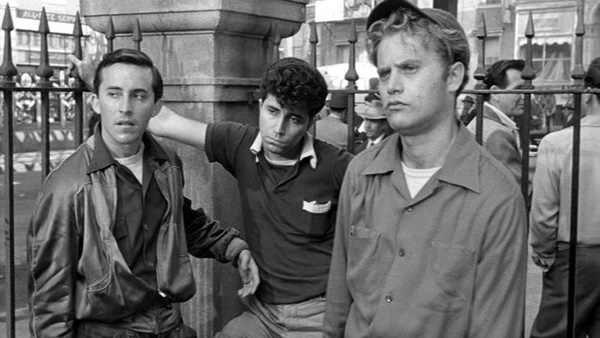
Tidbit: Although his major contribution was as a director, Mazursky started out as an actor, amassing 76 screen credits through 2011.  In one of his first roles, he played a hard case teen in the troubled urban school saga Blackboard Jungle.

Paul Mazursky (left), some other guy and Vic Morrow in BLACKBOARD JUNGLE

DVD/Stream of the Week: True Detective

true detective
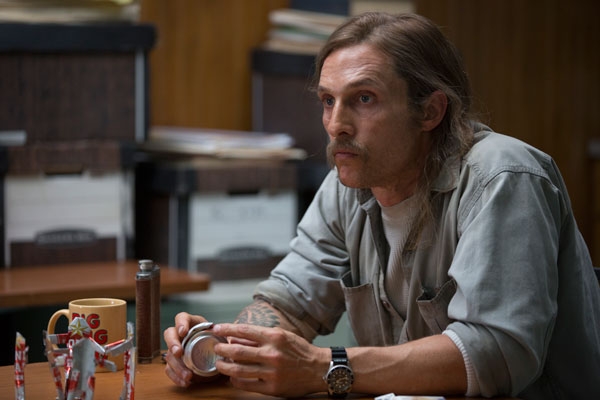
My DVD/Stream of the week – perfect for binge-viewing on the holiday weekend – is the eight one-hour episodes of HBO’s True Detective. It’s a dark tale of two mismatched detectives – each tormented by his own demons – obsessed by a whodunit in contemporary back bayou Lousiana. Woody Harrelson is very good – but Matthew McConaughey’s performance may have been the best on TV this year.

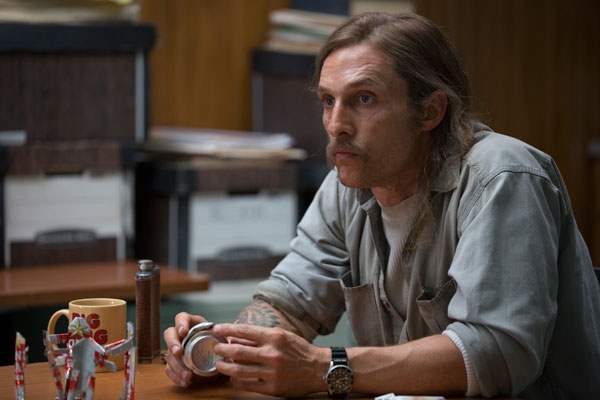
The two detectives are shown pursuing a case together in 1995 and then being interviewed separately about it in 2012.  In the 2012 scenes, McConaughey sits at a table, his eyes dead but occasionally flashing, behind a coffee mug and an increasing lineup of empty beer cans.  He chain smokes and stares down his interrogators – doing very little with frightening intensity.  McConaughey has recently delivered brilliant performances in excellent movies (Mud, Bernie, The Paperboy, Killer Joe, The Wolf of Wall Street, Dallas Buyers Club) – and this may be his best.  McConaughey is reason enough to watch True Detective.

True Detective is available on DVD from Netflix and streaming from HBO GO.

Movies to See Right Now

A COFFEE IN BERLIN (OH BOY)

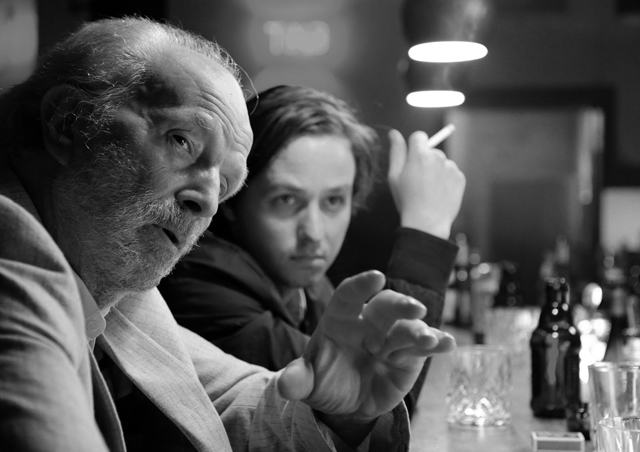
Ranging from wry to hilarious, the German dark comedy A Coffee in Berlin hits every note perfectly.  I love this little movie, and it may only be in theaters for another week, so see it while you can.

It’s not up to Clint Eastwood’s usual standard, but Jersey Boys, is mostly fun – and features another jaunty performance by Christopher Walken.

Among other movies in theaters now:

  • I found the political documentary Citizen Koch to be righteous but lame.
  • I wasn’t a big fan of the bleak and hyperviolent The Rover, either;watch writer-director David Michôd’s Animal Kingdom instead.

My DVD/Stream of the week is the Backwoods thriller Joe, starring an unusually retrained Nicholas Cage and featuring two other great performances from lesser knowns. Joe is available on DVD from Netflix and streaming from Amazon, iTunes, Vudu, YouTube, Google Play and Xbox Video.
This week Turner Classic Movies is airing a very fun heist movie – the original 1969 The Italian Job with Michael Caine.  Another good choice is the WW II spy thriller The Fallen Sparrow with John Garfield and a 22-year-old Maureen O’Hara.

Citizen Koch: righteous but lame

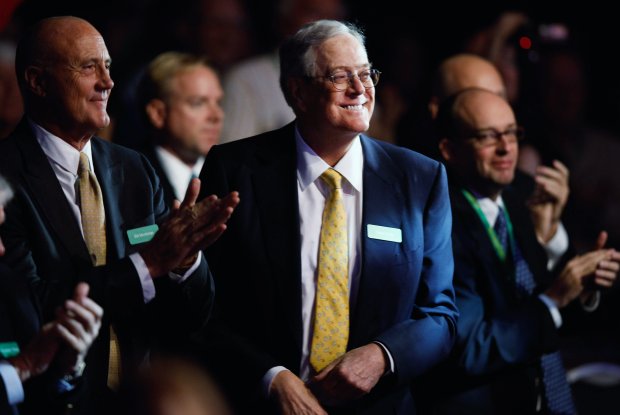
xxx Koch (center)  in CITIZEN KOCH
David Koch (center) in CITIZEN KOCH

The advocacy documentary Citizen Koch exposes the terrible effects of the US Supreme Court’s Citizens United decision, which allows the right-wing billionaire Koch brothers to anonymously spend unlimited treasure to promote political candidates, measures and legislation that I (The Movie Gourmet) abhor.  Filmmakers Carl Deal and Tia Lessin, who have worked with Michael Moore, share Moore’s use of documentary to persuade by observation: here are the facts that will lead you to agree with us.

The very best aspect of Citizen Koch is the core story of Governor Scott Walker’s assault on public employees and their unions in Wisconsin.   Citizen Koch meticulously connects the dots between the Koch Brothers’ strategy of degrading the Democratic Party’s strength by weakening public employee unions and Walker’s machinations.  It’s a conspiracy in plain sight.  Citizen Koch is at its best when this thread is told from the perspective of a few Wisconsin public employees – who are themselves Republicans.

Unfortunately, what could have been a superb film on the political conflict in Wisconsin gets flabby and diluted with threads about Citizens United and Charles and David Koch.  The worst part is a fourth thread about Buddy Roemer, a sleazy opportunist who has changed political parties three times but is held up as some sort of beacon of good government; it’s outrageously naive and potentially discredits the rest of the film.

And here’s a little controversy that is illustrative of the Koch Brothers political power.  PBS was going to air Citizen Koch on its documentary series POV, but chickened out because David Koch sits on the board of PBS’ NYC affiliate WNET and is a huge contributor to PBS products like Nova.

Jersey Boys: evocative pop and a dash of Christopher Walken

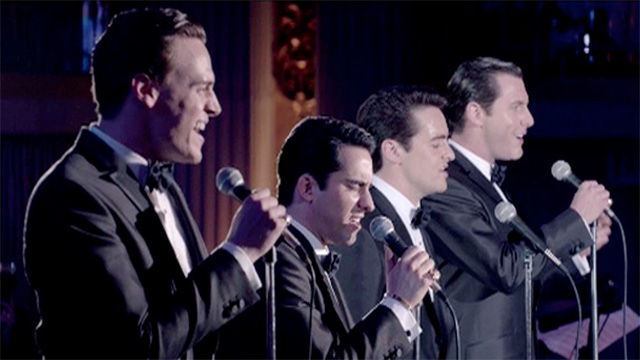
Erich Bergen, John Lloyd Young, Vincent Piazza and Michael Lomenda in JERSEY BOYS

Jersey Boys, while not great cinema, is definitely a fun time at the movies.  We might have expected great cinema because this is Clint Eastwood’s version of the Broadway musical, itself a show biz bio of Frankie Valli and the Four Seasons.  The acting is a little uneven, the female parts are underwritten and some parts drag.  But what Jersey Boys does offer – the Four Season’s evocative pop hits, a couple charismatic performances and a dash of Christopher Walken – is worth the trip to the theater.

The story’s arc is a familiar one – after paying their dues with years of bottom-scraping gigs, a bunch of nobodies achieve overnight fame and wealth and then destruct.  Three things are a little different about these guys.  First, the core of the group is mobbed up (and you can see how the real Frankie Valli could later play a mobster so well in The Sopranos).  Second, their catalyst is the pop music-writing genius Bob Gaudio, a suburban teen who joins the hardscrabble threesome from a tough neighborhood and serves them their hits: Sherry, Big Girls Don’t Cry, Walk Like a Man, Rag Doll, Dawn (Go Away) and Can’t Take My Eyes Off You.  Finally, the cause of the group’s downfall is neither external (e.g., crooked business manager or evil record company) nor pervasive substance abuse.

Eastwood tells the story in four segments – each from the perspective of one of the guys – and this works pretty well.  He gets a big boost from the performances of Vincent Piazza as the cocky group leader, Erich Bergen as the creative mastermind Gaudio and Mike Doyle as their flamboyant producer.  John Lloyd Young reprises his Broadway role as the group’s big star, lead singer Frankie Valli.  Young can do Valli’s very distinctive voice, but has a very limited emotional range.  And it turns out that Valli, because he’s a pretty square guy, has the least interesting story of the group.  When Valli does have relationship angst, the story gets bogged down.  Michael Lomenda plays the fourth guy and get to ask the plaintive question, “What if you’re Ringo?”

Jersey Boys also contains yet another delightful turn by Christopher Walken, this time as the Four Seasons’ mobster mentor.  Walken himself started out as a chorus boy, and it’s fun to see him holding his own in the grand musical finale.  And remember the young and dreamy Christopher Walken belting out The Four Seasons’s Can’t Take My Eyes Off You in The Deer Hunter’s great bar scene?  It’s near the beginning of this trailer.