
5 TO 7: what does she see in him?

Bérénice Marlohe and Anton Yelchin in 5 TO 7

Let me start by saying that I’m apparently not the audience for the romance 5 to 7; I didn’t like it, but my female companions all enjoyed it.

A struggling Manhattan writer in his late twenties meets a ravishingly beautiful married Frenchwoman who is ten years older.  As we all know, the French are more open-minded about sex than are Americans.  She invites him to conduct a discreet affair – discreet because the romance is restricted to the two hours between 5 PM and 7 PM, the hours that she is not with her family.  He is played by Anton Yelchin (Chekov in most recent Star Trek , Like Crazy).  She is played by the stunning French actress Bérénice Marlohe (Skyfall).

And here’s the problem – the woman is rich and privileged and she’s played by Bérénice Marlohe.  This character can have any man she wants (Marlohe even could snare James Bond himself in Skyfall.) Why is she interested in this callow loser?  We just can’t connect the dots.

I blame writer-director Victor Levin (creator of Mad About You and one of the team behind Mad Men) for writing that is contrived – at a higher level than network sitcoms, for sure, but still contrived.   5 to 7 does has its moments.  When the young guys finds himself at an intimidating dinner party at his lover’s apartment, he finds that the other guests are Julian Bond (!),  famous maestro and an iconic chef – the real guys in celebrity cameos.  And New Yorker editor David Remnick plays himself in another cameo – all very witty.  Glenn Close and Frank Langella show up mid-movie as his parents, and hilarity ensues for ten minutes or so.   But then Yelchin’s loser man-boy comes back on-screen, and I just couldn’t suspend disbelief.

There’s a suitably sentimental ending.  I suspect that there’s a gender divide on this movie.  Women seem to enjoy it, while men seem to be disgusted by it.

[SPOILER ALERT:  In the epilogue, the two main characters run into each other years later with their families.  His  new wife doesn’t have a clue that her hubby had been involved with this woman.  In real life, no way THAT happens.]

IT FOLLOWS: scary…because you haven’t seen this before

IT FOLLOWS
IT FOLLOWS

The Movie Gourmet doesn’t watch many horror movies, but I really liked the inventive, scary and non-gory It Follows.  19-year-old Jay (Maika Monroe) has sex with a guy who then tells her that he has passed on to her a kind of supernatural infection – a monster will follow her and kill her if she doesn’t pass it on to someone else.  The monster shambles along at zombie speed and takes the form of a different human being each time.   It’s terrifying – there’s a constant sense of dread and a convulsive shock every time It appears.

Writer-director David Robert Mitchell has created a very scary horror film with an excellent soundtrack and a minimum of makeup, special effects and hardly any blood.  It’s even more frightening that she’s being stalked by something that usually looks normal.

Before the screening, I had to sit through several trailers from the horror genre.  There was NOTHING in those trailers that I hadn’t seen before in The Shining, The Exorcist or a multitude of less elevated films.  I have to note the contrast with It Follows, which is definitely something that you haven’t seen before.

The very talented actress Maika Monroe is almost always on-screen and she proves that she can carry a movie.   I first noticed her in At Any Price , where she played the son ‘s girlfriend. That role was especially well-written – beginning as a simple teen from a broken family looking for some fun, her journey takes several surprising turn – and Monroe’s performance was memorable. Until fairly recently, Monroe was pursuing a professional career in freestyle kite surfing.

All the acting is good in It Follows, but Keir Gilchrist is especially good at portraying the ACHING sexual frustration of a teenage boy.

It Follows has a wonderful sense of place.  It is set and was shot in the Detroit suburbs, the rural lakefront and the decaying inner city.  The extraordinary High Lift Building in Detroit’s Water Works Park serves as the exterior for the climactic set piece.

But the key to It Follows is its originality –  without expensive f/x or disgusting gore – it’s likely the best horror movie of the year.

GOING CLEAR: THE PRISON OF BELIEF: a devastating expose

GOING CLEAR: THE PRISON OF BELIEF

HBO is airing Going Clear: The Prison of Belief, documentarian Alex Gibney’s devastating expose of Scientology.  The indictment of Scientology as dangerous cult is stunning.  Gibney is sunshining an amazingly rich reservoir of source material: we hear from several  former Scientologists, including the former chief spokesperson, the former top deputy to the Chairman of the Board, along with former believer director Paul Haggis and the John Travolta’s original Scientology handler.

Gibney begins by tracing the journey of Scientology’s founder, L. Ron Hubbard and reviewing the organization’s history.  Now I knew about the science fiction writer Hubbard, his book Dianetics and even the E-meter.  But I sure didn’t know about the Sea Org with its billion-year employment contracts, the Scientology Navy and the bizarro theology with invisible Thetans, volcanos and H-bombs.  Nor had I seen the North Korea-style cult-of-personality spectacles featuring Chairman of the Board David McCavige.  And I hadn’t heard about the church’s opposition to same-sex marriage.

Then come the really scary stuff.  We hear from former Scientology officials who testify that they have been incarcerated in the Rehabilitation Project Force –  a concentration camp on a top floor of the Scientology’s Los Angeles HQ and in what is essentially a prison camp in Florida to “re-educate” suspected heretics and backsliders.  And there is testimony about the prisoners being separated from their children, who are shunted off to Cadet Org.  One official offers personal testimony of his assignment to break up Nicole Kidman’s marriage to Tom Cruise and to alienate her children from her.  It’s horrifying stuff.  And it’s a riveting viewing experience.

Alex Gibney is one our very, very best documentarians.  He won an Oscar for Taxi to the Dark Side, and he made the superb Casino Jack: The United States of Money, Enron: The Smartest Guys in the Room, Client 9: The Rise and Fall of Elliot Spitzer and Mea Maxima Culpa: Silence in the House of God.  (He can’t seem to pass up a really long movie title – but Going Clear etc., came from a book title.)

If you’re asking “How can smart, able people fall into this stuff?”, then I recommend finding a film that I reviewed at Cinequest 2015 – The Center.  Upon its release, The Center should become the perfect narrative fiction companion to Going Clear.

DVD/Stream of the Week: THE THEORY OF EVERYTHING – things gets complicated for Mr. and Mrs. Genius

Felicity Jones and Eddie Redmayne in THE THEORY OF EVERYTHING

The Theory of Everything is based on the book by the woman who married Stephen Hawking – and this is important. While the story of Stephen Hawking – a generational genius who becomes physically disabled but continues his groundbreaking work – is pretty amazing, the story of the two of them facing this journey together brings more depth and texture to the tale. And, since everybody is somewhat familiar with the arc of Stephen Hawking’s career, the added focus on Jane Hawking brings some unpredictability to the plot.

The role of Stephen is one that many actors would kill for, and Eddie Redmayne delivers an exceptionally good performance. You may remember Redmayne’s solid turn in a good movie, My Week with Marilyn, and that he was one of the few highlights in the otherwise dreadful Les Miserables.

Felicity Jones’s performance as Jane stands up to Redmayne’s. She masks her profound inner strength with adorability. She was very good in Like Crazy, a romance that I really liked, although NONE of my readers did.

It’s worth mentioning that The Theory of Everything was directed by James Marsh, because he’s on a helluva storytelling run: the acclaimed documentaries Man on a Wire and Project Nim and last year’s overlooked thriller Shadow Dancer.

All told, The Theory of Everything has a compelling story with two fine performances, which adds up to a satisfying moviegoing experience.  It’s available on DVD from Netflix and streaming from Amazon Instant Video, iTunes, YouTube, Google Play and Xbox Video.

’71: keeping the thrill in thriller

'71
’71

The title of the harrowing thriller ’71 refers to the tumultuous year 1971 in Northern Ireland’s Troubles.  An ill-prepared unit of British soldiers gets their first taste of action in Belfast, and the rookie Private Gary Hook (Jack O’Connell) gets inadvertently left behind in hostile territory.  Private Hook races around an unfamiliar and dangerous city at night.   He is being hunted by his own regular troops, a shadowy and sketchy military intelligence unit, the regular IRA,  the hotheaded Provisional IRA and Ulster paramilitaries – all with their own conflicting agendas.  Any civilian who helps him will be at direct and lethal risk from the partisans.

In their feature debuts, director Jann Demange and cinematographer Tat Ratcliffe take us on a Wild Ride, with just a couple of chances for the audience to catch its collective breath.  Importantly, the way Private Hook gets left behind amid the escalating chaos is very believable.  Then there’s an exhilarating footrace through the alleys and over brick walls.  Every encounter with another person is fraught with tension.  Finally, there’s a long and thrilling climactic set piece in a Belfast apartment block.

O’Connell is in 90% of the shots and carries it off very well.  All of the acting in ’71 is excellent.  Corey McKinley is special as the toughest and most confident ten-year-old you’ll ever meet.   Barry Keoghan takes the impassive stone face to a new level.  And I always enjoy David Wilmot (so hilarious in The Guard).

I thank the casting and the direction for making it easy for us to tell all of these pale, ginger characters apart.  To the credit of writer Gregory Burke, the beginning of the film economically sets up Private Hook as having the fitness and stamina to survive what befalls him throughout the night.

With all the different sides playing each other, the action (and the action is compelling) is set in an especially treacherous version of three-dimensional chess.  Some of the double- and triple-crossing at the end is breathtaking.  But what ’71 does best is putting the thrill in a thriller –  keeping the audience on the edge of our seats for all 99 minutes.

THE WRECKING CREW: the soundtrack of the 60s

THE WRECKING CREW
THE WRECKING CREW

You have heard these guys play without knowing their names – The Wrecking Crew profiles the legendary Hollywood studio band that played on (perhaps literally half of) the pop music of the 60s.  These musicians were extremely skilled and creative – and they were fast, too, which put their services at a premium among music producers with limited studio time.  As a result they played on the recordings of Frank Sinatra (and Dino and Sammy), the Beach Boys, the Mamas and the Papas, Herb Alpert and the Tijuana Brass, Sonny and Cher, Gary Lewis and the Playboys, ad infinitum.   Plus the Hawaii Five-O theme.

You already know about The Monkees not playing their own instruments, but The Association didn’t play on a single track of their first two albums – those were all played by the Wrecking Crew.  And Roger McGuinn was the only Bird to play on Mr. Tambourine Man, with the Wrecking Crew knocking out two tracks in three hours; the Birds themselves played on Turn, Turn, Turn, but it took them 77 takes.

Filmmaker Danny Tedesco, made this film to salute his dad, Wrecking Crew guitarist Tommy Tedesco.  Glen Campbell and Leon Russell were members of the band (and we get to see a rare photo of the early 1960s Leon without long hair, beard, hat and tinted glasses).  Surprisingly, the electric bass player was female – Carol Kaye.  In The Wrecking Crew we get to hear the backstories of the standup bass intro in These Boots Were Made for Walking, the El Paso guitar lick in Something Stupid, the bass drum intro for The taste of Honey and the sax part in the Pink Panther Theme.

The Wrecking Crew isn’t a Must See, but I recommend it for those with an interest in the music of the 1960.  The Wrecking Crew is now in theaters and is also streaming on Amazon Instant Video, iTunes, YouTube, Google Play and Xbox Video. If you like The Wrecking Crew, I’d also recommend these recent films about other unknown musicians:

  • Twenty Feet from Stardom (Netflix DVD, Redbox, Netflix Streaming, Amazon, YouTube and Google Play);
  • Muscle Shoals (Netflix DVD, Netflix Streaming, Amazon Instant Video, iTunes, YouTube, Google Play, Xbox Video); and
  • Standing in the Shadows of Motown Netflix DVD, Amazon Instant Video, iTunes, YouTube, Google Play, Xbox Video).

Movies to See Right Now

THREE HEARTS
THREE HEARTS

If you haven’t seen it yet, run out and watch the hilariously dark Argentine comedy Wild Tales, a series of individual stories about revenge fantasies becoming actualized.  I also really like the Belgian romance Three Hearts – the leading man has a weak heart in more ways than one.

I did see Insurgent, from the Divergent franchise, and it is what it is – young adult sci-fi with some cool f/x.  Magician: The Astonishing Life and Work of Orson Welles is a satisfying bio-doc that features lots of clips of the great Orson himself.

My DVD/Stream of the Week is the dark, feminist Western The Homesman.  It is available on DVD from Netflix and streaming from Amazon Instant Video, iTunes, Vudu, YouTube, Google Play, Xbox Video and Flixster.

You can’t get any more surreal than the Luis Buñuel- directed and Salvador Dali co-written Un Chien Andalou from 1929. And you can’t film anything more cringe worthy than the slicing of a human eyeball. Un Chien Andalou is LITERALLY textbook surrealism and airs on Turner Classic Movies on March 29.

On March 30, TCM brings us an overlooked film noir, While the City Sleeps (1956). When a zillionaire dies and leaves his media empire to his feckless playboy son (Vincent Price), the scion cruelly dangles the CEO job in front of the company’s top talent, plunging them into a ruthless competition. Whoever solves the Lipstick Killer Murders will win the prize, and plenty of backstabbing in the board room ensues.

While the City Sleeps benefits from a killer cast. Star columnist Dana Andrews (and the audience) weighs in on the side of old school Thomas Mitchell – but it’s going to a tough fight against arrogant George Sanders and oleaginous James Craig (here even more slippery than Sanders). One of these guys is having an affair with their new boss’ trophy wife (Rhonda Fleming). Ida Lupino is a cynical free agent. And Andrews his using his own girlfriend (Sally Forrest) as bait for the serial killer! A tragic figure in real life, John Drew Barrymore, has a small but important role. The cast is so deep that noir leading man Howard Duff is stuck playing the cop.

While the City Sleeps is directed by one of the giants of cinema, Fritz Lang, the German auteur of Metropolis and M. After WWII, Lang had an productive noir period in Hollywood, churning out Moontide, Scarlet Street, House by the River, The Blue Dahlia, The Big Heat, Human Desire (my favorite Lang noir) and Beyond a Reasonable Doubt.

WHILE THE CITY SLEEPS

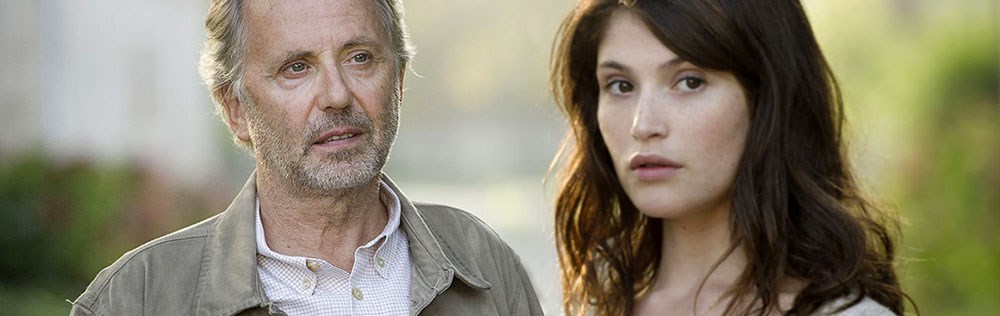
THREE HEARTS: a man with a weak heart

Benoît Poelvoorde and Chiara Mastroianni in THREE HEARTS

The Belgian romantic drama Three Hearts centers on the singular character of Marc, a Parisian tax auditor who has a fondness for the ladies – and they for him. He also is very conflict-averse and handles stress very badly, which has contributed to a sometimes disabling heart condition. On a business trip to a provincial town, Marc misses his train, and becomes romantically involved with a local woman. Because of circumstance, that relationship doesn’t move forward, which clears him to begin a relationship with a second woman in that town. Once he is irrevocably entangled, he learns that the two women are intimates.

In what I think is a really compelling performance, Marc is played by Benoît Poelvoorde. Marc finds himself trapped in an excruciating situation, and the only way out requires courage that he just doesn’t have. Poelvoorde is completely believable as a guy who chats up women, settles into domesticity and then is paralyzed by terror and dread. Plus, Poelvoorde has a gangly walk and often slips into outright goofiness, which effectively lightens the dramatic tension.

Now, some critics do not agree with me. Poelvoorde is not a conventionally good-looking guy. Ordinarily, you wouldn’t expect a guy like this to be able to attract a woman who looks like Chiara Mastroianni or Charlotte Gainsbourg. If you can’t jump this, you’re not gonna buy into the movie, but it worked for me. Marc does seem to one of those rugged guys who has a knack with the ladies, and the two woman characters are in windows of extreme vulnerability and are ripe to experiment outside their own relationships.

Charlotte Gainsbourg and Chiara Mastroianni are excellent as the two women. Their personalities are starkly different but they each have an immediate need that they hope Marc can fill. With the regal serenity that she can muster, Catherine Deneuve plays the character who intuits what is going on long before the others.

Three Hearts is directed and co-written by Benoit Jaquot, who recently gave us the lavishly staged and absorbing costume drama Farewell, My Queen.

One more thing – the potential for upcoming confrontation is signaled by Big Music – ominous cello notes that sound like the theme from Jaws played backwards. I saw this as wry self-mocking of the drama, and I found this device to be amusing. It’s just a little part of the movie, but people that I saw Three Hearts with found it to be off-putting.

The bottom line is that Three Hearts worked for me, and I recommend it with the caveat that some willing suspension of disbelief is required.

DVD/Stream of the Week: THE HOMESMAN

Hilary Swank and Tommy Lee Jones in THE HOMESMAN

Tommy Lee Jones co-wrote, directs and stars in the dark Western (I love Westerns!) The Homesman. Hilary Swank plays a single woman in bleak frontier Nebraska who volunteers to take three madwomen to respite, a hard five weeks wagon ride to the east in civilized Iowa. She conscripts an irascible reprobate (Tommy Lee Jones) to help her. About Jones’ character, A.O. Scott of the New York Times wrote “It’s as if Yosemite Sam had turned up in the pages of a Willa Cather novel.” As in any odyssey or road trip story, they face obstacles that make it an adventure – and, in a Western, we expect those to include harsh natural conditions, hostile Indians and bad gunmen.

Like Clint Eastwood’s Unforgiven, The Homesman doesn’t romanticize the Wild West. The three passengers have suffered mental breakdowns. Each of them has clung to sanity through almost the unbearable hardships of frontier life, and then has been broken by a distinct trauma.

The Homesman has been labeled a “feminist Western”, and this is accurate. Swank’s character is independent, industrious and earnest and responsible to a fault. She’s a great catch for any guy post-1900, but her very independence repels any hope for male companionship in the mid-19th Century Old West, where the local yokels travel all the way Back East for women that are suitably submissive. As to the three broken passengers, really bad things have happened to the women, and the fact that they’ve been isolated with patriarchal and, in some cases abusive, men, has made it that much more unbearable.

Jones directs with a steady hand, and as in his exemplary Three Burials of Melquiades Estrada, proves to have a special gift with a western setting and in getting good performances. Here, he and Swank are just as good as we would expect, which is pretty damn good. The cast is dotted by the likes of John Lithgow and even Meryl Streep, but the standout, most memorable performances are the supporting turns by Tim Blake Nelson, James Spader and Hailee Steinfeld.

Unless you’re on a date or looking for an escapist lark, The Homesman is a fine movie on all counts; but be prepared for unrelenting grimness in this starkly, dark tale. It is available on DVD from Netflix and streaming from Amazon Instant Video, iTunes, Vudu, YouTube, Google Play, Xbox Video and Flixster.

Movies to See Right Now

WILD TALES
WILD TALES

There are two Must Sees in theaters now, and both were nominated for this year’s Best Foreign Language Picture Oscar:

  • The hilariously dark Argentine comedy Wild Tales, a series of individual stories about revenge fantasies becoming actualized.
  • The Job-like Russian drama Leviathan, a searing expose of post-Soviet Russian society.

Magician: The Astonishing Life and Work of Orson Welles is a satisfying bio-doc that features lots of clips of the great Orson himself.  Queen and Country is director John Boorman’s (Deliverance) well-crafted and moderately entertaining look back at his year as a British Army conscript in the 50s.

My DVD/Stream of the Week is Whiplash, the drama about the line between motivation and abuse and the line between ambition and obsession. J.K. Simmons just won an acting Oscar for his dominating performance. Whiplash is available on DVD from Netflix and Redbox and streaming from Amazon Instant Video, iTunes, Vudu, YouTube, Google Play, Xbox Video and Flixster.

If you haven’t seen the hilarious gender bender comedy Victor Victoria in a while, catch it again on March 20 on Turner Classic Movies. I think that’s it’s director Blake Edwards’ best comedy – and that’s saying something after all the Pink Panther movies. Along with the alcoholism drama Days of Wine and Roses, this is Edwards’ masterpiece. Julie Andrews (Mrs. Blake Edwards) and James Garner give perfect performances, and there’s a memorable supporting turn by Alex Karras. Victor Victoria is over thirty years old, but stands up just as well today as in 1981.