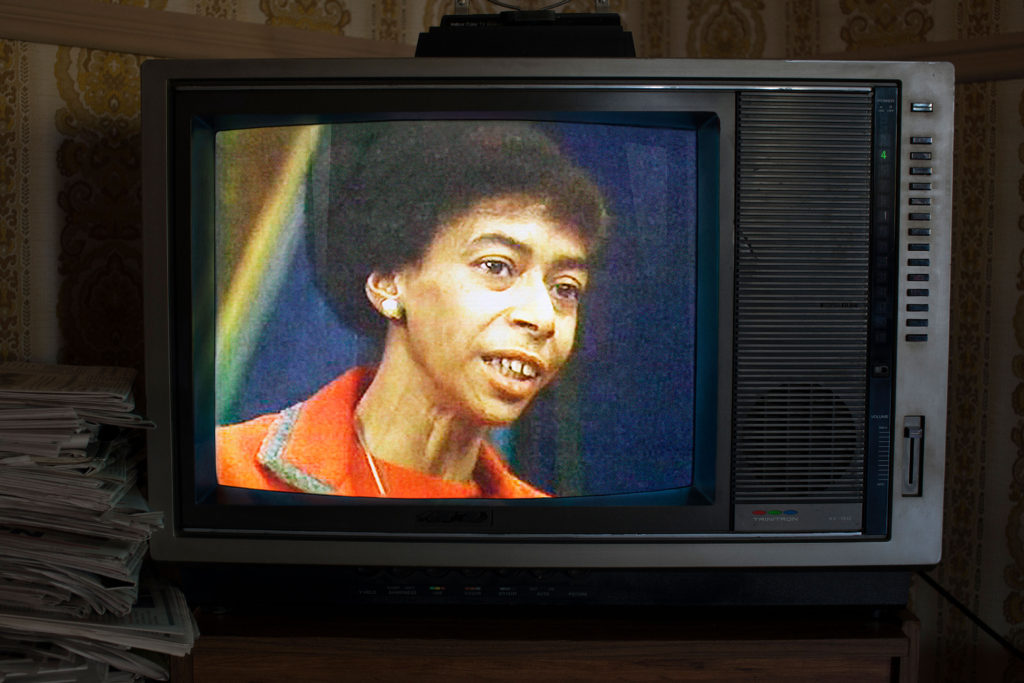
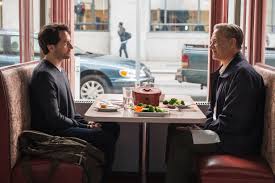
. Marion Stokes in RECORDER: THE MARION STOKES PROJECT, directed by Matt Wolf. Photo credit: Eileen Emond and courtesy of Zeitgeist Films.
The excellent documentary Recorder: The Marion Stokes Project, is about an eccentric woman who did something that seemed crazy, but turned out to be be important. For over 30 years, 24 hours per day, on multiple channels, Marion Stokes everything that was on TV – local news, commercials, network shows – the whole enchilada. She left a collection of 70,000 videotapes, Recorder explains the How and the Why.
It turns out that, before digital technology, TV stations did not preserve what they broadcast. So, what Stokes compiled is essential and irreplaceable – a unique archive of broadcasting and of American culture as it has been reflected by television.
Now, this was – and had to be – the project of an obsessive. Stokes’ son sagely observes that the difference between collecting and hoarding is the perceived value of the objects.
Stokes was one of those people whose cause was so important to them that it is prioritized above, for example, family relationships. I found the testimony from Stokes’ household staff – essentially her chosen family – most insightful and touching.
It’s a fascinating story. Stokes was that rare radical activist who both understood the power of media and had the financial means of recording and storing all of these broadcasts. She was an early adopter (her first tapings were on Betamax!), and became an Apple enthusiast.
Director Matt Wolf unspools this story perfectly. He is the son of Cinequest documentary screener Sandy Wolf; in this recent profile of Sandy, I also highlight Matt Wolf’s career (scroll down).
Recorder: The Marion Stokes Project is streamable on Amazon, iTunes, Vudu, YouTube and Google Play.
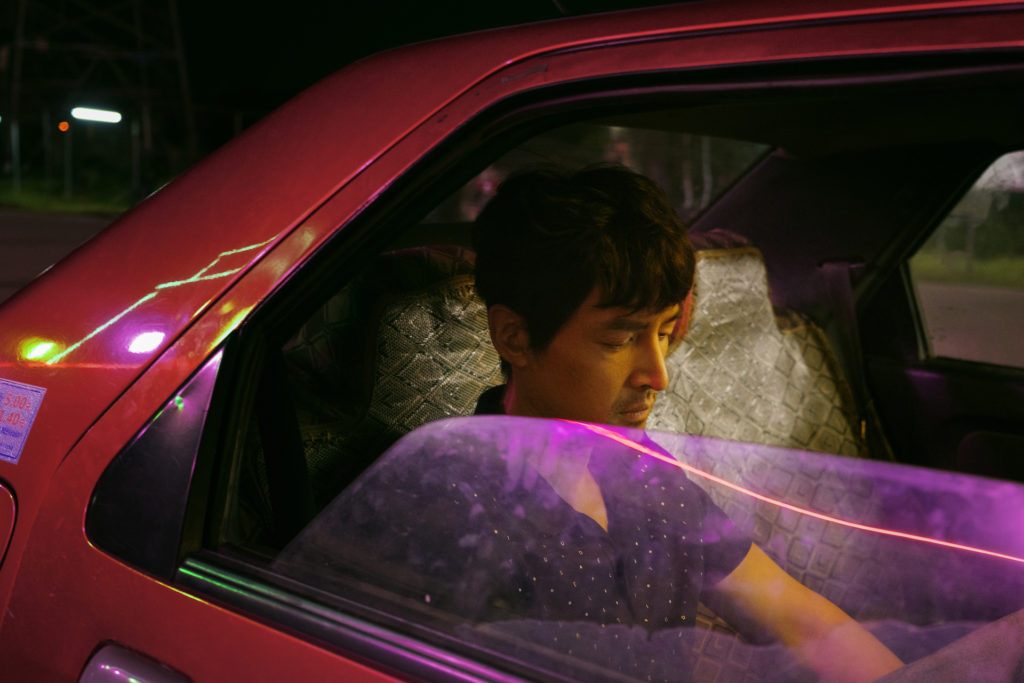
THE WILD GOOSE LAKE. Photo courtesy of Film Movement.
In the atmospheric neo-noir The Wild Goose Lake, Zenong Zhou (Ge Hu) is a small time hood who unintentionally kills a cop. He goes on the run in a downscale lakeside resort known as a lawless no mans zone. Not only is he hunted by hundreds of police, the local criminal gangs are chasing him, too, to collect the price on his head. A mysterious woman, Aiai Liu (Lun-mei Kwei), shows up and purports that she has been sent by his gang to help him escape.
As the double crosses mount, and Aiai Liu confesses that she has really been assigned to betray him, we wonder if she will. The two of them slink around the resort area, trying to lay low, until the gangs and the police converge for a climactic scene just before the satisfying epilogue.
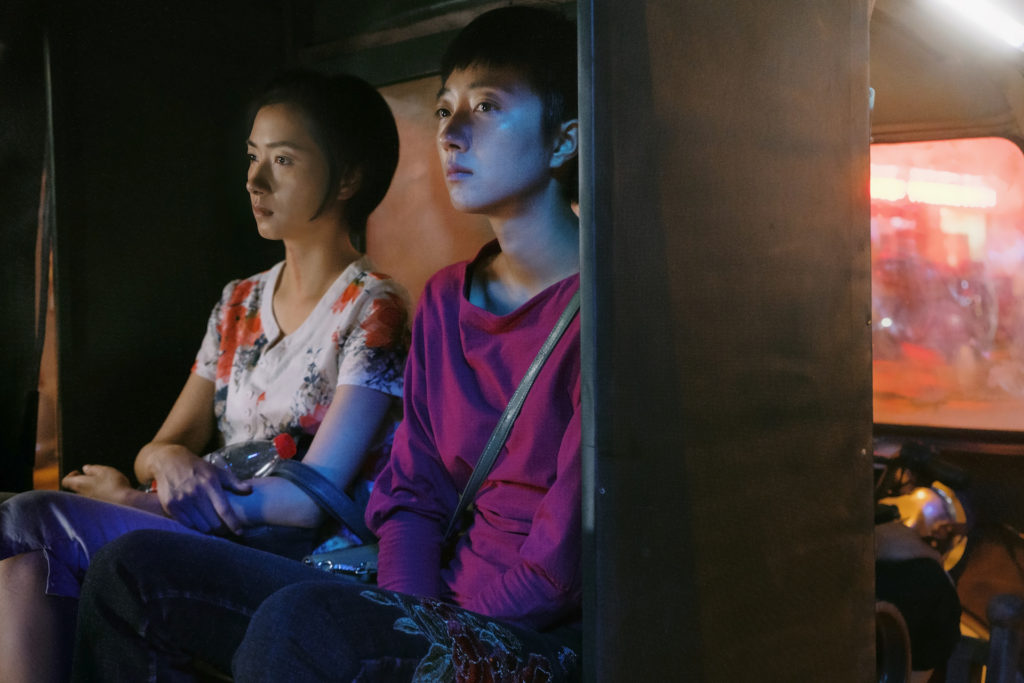
THE WILD GOOSE LAKE. Photo courtesy of Film Movement.
Director Yi’nan Dian has delivered a beautifully and inventively shot film. We first see the femme fatale thru a plastic umbrella. Much of the action is at night, and the colors in those nighttime scenes are vivid, even sometimes breathtaking. I especially liked a brief shot of the locals line dancing with glow-in-the-dark shoes.
Visually, The Wild Goose Lake reminded me of Long Day’s Journey into Night, a Chinese film that made my Best Movies of 2019 along with Ash Is Purest White. Overall, The Wild Goose Lake‘s screenplay and performances keep it from being as good as those films, but its cinematography by Jingsong Dong matches up.
Liao Fan (Ash is Purest White) plays the cop commanding the man hunt. Fan doesn’t have much to do for most of the film except to calmly issue orders, but we’re glad he’s around for the final scene.
Even before the hunters close in on their prey, The Wild Goose Lake contains some very effective set pieces, including an in-service training for gang members on how to steal motorbikes and then a contest billed as the “Olympic games of theft“.
More of an art movie than a crime thriller, The Wild Goose Lake is a beautifully shot fable from China’s underworld. You can support San Francisco’s Roxie Theater by buying a ticket to stream The Wild Goose Lake from the Roxie Virtual Cinema.
Buck is a documentary about real-life horse whisperer Buck Brannaman, an exceedingly grounded and gentle man who knows everything about horse behavior. But the movie is more about human behavior, about the disturbing crucible that formed Buck, and about what we can learn about people from their handling of horses.
Fortunately, Director Cindy Meehl realized that she had a great story and got out of the way. The understated guitar-based score never becomes melodramatic. And Meehl never lets the admiring talking heads elevate Buck to more than what he is, which is remarkable enough. This movie could have easily been painfully corny or pretentious and is neither. I’d happily view it again today.
Buck’s own background is so nasty that it would totally unremarkable for him to have emerged mean or emotionally crippled – and he is the farthest from either. With some help from loving people, Buck has chosen to become something different from his apparent fate. In this way, Buck could be a companion piece to Mike Leigh’s Another Year.
Buck was shortlisted for the Best Documentary Oscar. You can rent Buck from Amazon, YouTube and Google Play or buy it from iTunes.
Here’s a new set of shelter-in-place recommendations to stream or watch on TV.
ON VIDEO
The surprising fierceness underlying Mr. Rogers’ gentle affect is the subject of the emotionally satisfying fictional narrative A Beautiful Day in the Neighborhood and the even better biodoc Won’t You Be My Neighbor? Streaming Won’t You Be My Neighbor? is included with subscriptions to HBO and DirecTV, and the stream can be purchased for $14.99 from all major streaming platforms. A Beautiful Day in the Neighborhood is available to stream from all the usual outlets; I paid Amazon $2.99. Have a box of Kleenex handy.
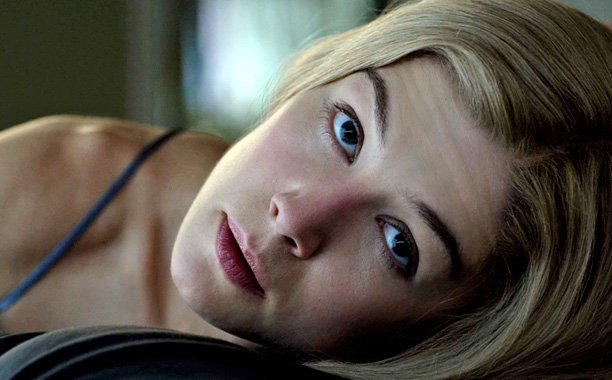
Rosamund Pike in GONE GIRL
2014’s best Hollywood movie was the marvelously entertaining Gone Girl, Rosamund Pike shines in David Fincher’s gripping study of psychopathy. It’s now available to stream on Amazon, iTunes, Vudu, YouTube, Google Play and Redbox.
ON TV
On April 1, Turner Classic Movies will present a host of films from the great Akira Kurosawa. Since we tend to think first of Kurusawa’s historic samurai classics, I am recommending his noir-stained contemporary crime films Drunken Angel, Stray Dog and High and Low. TCM is presenting them with seven other Kurosawa films. Kurosawa and actor Toshiro Mifune team up in all three of these decidedly non-samurai stories.
Drunken Angel (1948) was Kurusawa’s first major film and his first with Mifune, two years before their first samurai masterpiece Rashomon. Mifune plays a young Yazuka hood, who works with some very bad people, so there are some double crosses and a suitable dark ending.
In the police procedural Stray Dog (1949), Mifune plays a detective tracking down a gun that was used in a crime. The trail leads through Tokyo’s gritty underworld during a heat wave and even into a sold-out pro baseball game.
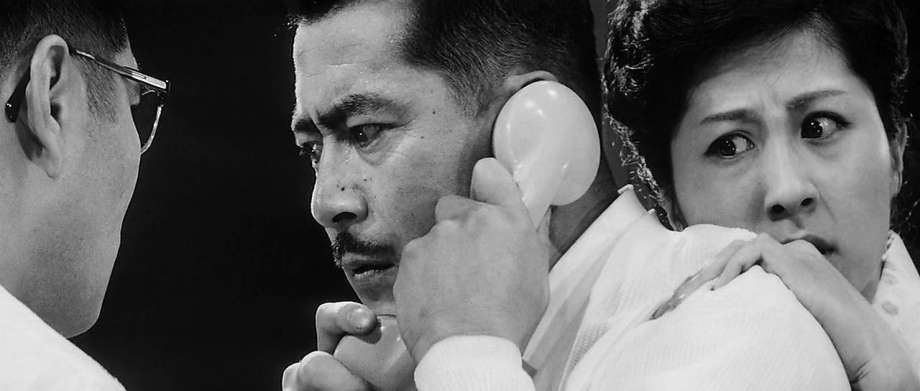
My favorite of these three is the 1963 neo-noir pressure cooker High and Low, with Mifune as the CEO of a major shoe manufacturer. In an attempt to kidnap his son, the crooks accidentally grab his chauffeur’s son. The CEO still wants to ransom the kid, but the price is ruinous, and all of this is happening as the CEO is being targeted himself for corporate backstabbing.
Toshiro Mifune (center) in HIGH AND LOW
REMEMBRANCE
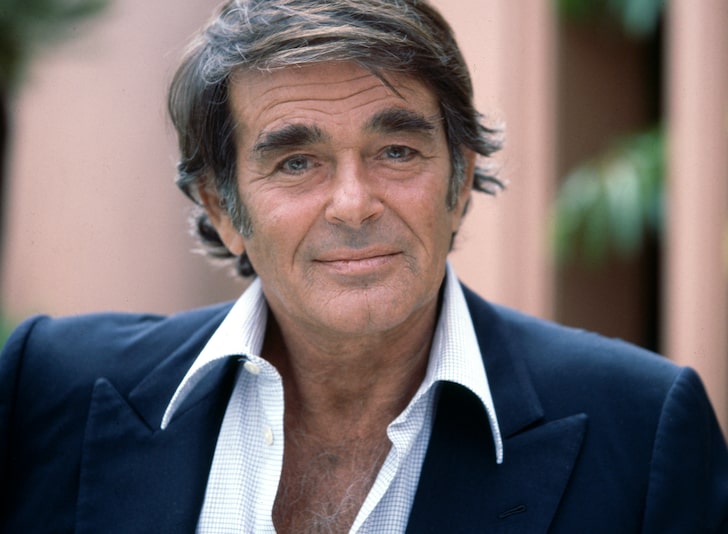
The prolific actor Stuart Whitman has died. Strikingly manly and relatable, Whitman also had the gift of imbuing strong-and-silent characters with emotional texture. Indeed, he was nominated for the Best Actor Oscar for a 1961 film that I haven’t seen – The Mark, in which he played a guy seeking a normal life after being imprisoned for attempted child molestation. I remember Whitman for his performances in The Longest Day and the offbeat Convicts 4. He would not wish to be remembered for the giant carnivorous rabbit chiller Night of the Lepus.
In the marvelously entertaining Gone Girl, Ben Affleck plays Nick, a good-looking lug who can turn a phrase. At a party one night, he’s on his A game, and he snags the beautiful Amy (Rosamund Pike). She’s smarter, a good rung on the ladder more attractive than he is, has parents with some money and is a second-hand celebrity to boot. Not particularly gifted and certainly not a striver, he knows he’s the Lucky One. He has married above himself, but he doesn’t have a clue HOW MUCH above until she suddenly disappears.
Based on the enormously popular novel by Gillian Flynn (who also wrote the screenplay), Gone Girl is the mystery of what has happened to Amy and what is Nick’s role in the disappearance. Plot twists abound, but you won’t get any spoilers from The Movie Gourmet.
This is Rosamund Pike’s movie. Her appearance is so elegant – she looks like a crystal champagne flute with blonde hair – that pulling her out of the Victorian period romances that she was known for and into this thriller was inspired. And Pike responds with the performance of her career. She’s just brilliant as she makes us realize that there’s something behind her eyes that we hadn’t anticipated, and then keeps us watching what she is thinking throughout the story.
Gone Girl is directed by the contemporary master David Fincher (Fight Club, Se7en, Zodiac,The Social Network, The Girl with the Dragon Tattoo). Here, Fincher has successfully chosen to rely on Flynn’s page turner of a story and the compelling characters, so Gone Girl
is the least flashy of his films, but one of the most accessible. I’ll
say this for Fincher – I can’t remember a more perfectly cast movie.
Kim Dickens (Treme, Deadwood) is superb as the investigating detective – this time almost unrecognizable as a brunette. Tyler Perry is wonderfully fun as a crafty celebrity attorney. The previously unheralded Carrie Coon is excellent as Nick’s twin sister (she’s gone on to cash in on the Avengers franchise). Missi Pyle does such a good job as a despicable cable TV personality that I thought I was actually watching a despicable cable TV personality. And David Clennon and (especially) Lisa Banes positively gleam as Amy’s parents. (Carefully observe every behavior by the parents in this movie.)
Just like the thug in The Guard who forgets whether he had been diagnosed in prison as a sociopath or a psychopath, I had the ask The Wife, who turned me on to this passage from Psychology Today. It’s useful to read this because, although you don’t realize it for forty-five minutes or so, Gone Girl is also a study of psychopathy.
Psychopaths … are unable to form emotional attachments or feel real empathy with others, although they often have disarming or even charming personalities. Psychopaths are very manipulative and can easily gain people’s trust. They learn to mimic emotions, despite their inability to actually feel them, and will appear normal to unsuspecting people. Psychopaths are often well educated and hold steady jobs. Some are so good at manipulation and mimicry that they have families and other long-term relationships without those around them ever suspecting their true nature.
When committing crimes, psychopaths carefully plan out every detail in advance and often have contingency plans in place. Unlike their sociopathic counterparts, psychopathic criminals are cool, calm, and meticulous. Their crimes, whether violent or non-violent, will be highly organized and generally offer few clues for authorities to pursue. Intelligent psychopaths make excellent white-collar criminals and “con artists” due to their calm and charismatic natures.
Gillian Flynn changed the story’s ending for the movie. The Wife, who is a big fan of the novel, didn’t mind. Gone Girl is recommended for both those who have and have not read the book. I understand that there’s more humor in the movie, as we occasionally laugh at the extremity of the behavior of one of the characters.
It all adds up into a remarkably fun movie and one that I was still mulling over days later. Gone Girl was the best big Hollywood studio movie of 2014 (not counting releases from the prestige distribution arms of the major studios). It’s now available to stream on Amazon, iTunes, Vudu, YouTube, Google Play and Redbox.
Sandy also publishes the weekly e-newsletter This Week on TCM, in which he reviews the most significant choices on Turner Classic Movies. He doesn’t write about every movie on TCM, but he touches on several each day. And this is not a quick scan of the weekly classic film menu – each email runs to up to 6,000 words.
Every Sunday morning, while The Wife pours over the New York Times, I’m scanning Sandy’s email to see if TCM is featuring a film I had overlooked or need to revisit. For example, I DVRed the 1937 They Won’t Forget, which I had never seen, only because of Sandy’s description of Lana Turner’s entrance. Worth it.
Earlier this year, I finally got around to the 1936 classic Dodsworth, only because Sandy recommended it. Dodsworth rewarded me with remarkable performances from Walter Huston, Mary Astor and Ruth Chatterton. (Familiarity with Dodsworth is also central to understanding the documentary Scandal: The Trial of Mary Astor, because Astor channeled her Dodsworth character during her testimony at the notorious child custody trial.)
Sandy’s regular readers always wait for the weekly use of the word “oeuvre ” and the mention of the “ubiquitous Michael Curtiz”. Sandy is the kind of film writer who can use the word “mendacity” about a movie (All About Eve) OTHER than Cat on a Hot Tin Roof.
It’s difficult to decide which is the biggest value add in This Week on TCM – Sandy’s usually perfect movie taste or his capsulized commentary, enlivened with Grouchoesque quips. Here’s a taste:
Story of Seabiscuit: This does not remotely resemble the true story of Seabiscuit; in fact, it should be entitled Nothing Like the True Story of Seabiscuit.
Manchurian Candidate: A ludicrous premise: the Russians want to put a puppet in the White House, whom they can maneuver and control – hey, wait a minute.
Gaslight: Joseph Cotton is an old friend who senses something rotten in the state of Denmark (which means he has a strong sense of smell, since this takes place in Victorian era England).
The Searchers: John Ford’s magnum opus and the apogee (or apotheosis if you prefer an even more pretentious “ap” word) of his Western genre films.
Doctor Zhivago : My least favorite of Lean’s well known films, which I find ponderous and unwieldy (or if you prefer, slow and boring). I came to CA to get away from snow, so why spend over 3 hours looking at it. Then again, you can spend all that time looking at Julie Christie, which almost makes it worth it. This film was a huge hit and mine is a minority opinion, but is there anyone in America who isn’t sick of Lara’s Theme?
Detour: Talk about femme fatales – Ann Savage (no name better fit an actress) is the fataliest of all femmes. Ms. Savage more than makes up for the flimsy sets and if she doesn’t give you nightmares, nobody will (whenever I wake up screaming in the night soaked in sweat, and Harriet asks what’s wrong I just say “Ann Savage”).
Ingmar Bergman’s Passion of Anna: Moving and powerful, under no circumstances should you watch this film unless you are prepared to hit the emotional depths of human existence (I’m not sure what that means, but don’t have a bottle of pills nearby when you are watching).
Buffalo Bill and the Indians or Sitting Bull’s History Lesson: (Paul) Newman and director Robert Altman were at the height of their respective powers when they teamed up to make this can’t miss film. But miss it did and by miles.
The Window: Young Bobby Driscoll goes out on the fire escape to sleep on a sweltering NYC summer night and through a neighbor’s window witnesses a murder. Bobby is proverbial boy who cried Sandy Wolf (I use that line every time this movie airs and can’t help myself).
Scarlet Pimpernel: Whenever I see this title, I think of pumpernickel bread, which you can’t get in Northern CA (at least I have never seen it).
The Longest Day: BTW, an astute and erudite reader correctly informed me that the “D” in D-Day stands for “Day”. How stupid is that – what does Day Day mean? I would call it T-Day for The Day or even I-Day for Invasion Day.
Henry V: All I know about Henry V is that he came after Henry IV (not sure where O Henry came from – and I’m talking about the candy bar and not the author).
Red Badge of Courage: This was deemed an utter failure upon its release and caused director John Huston grief (or as much grief he could sustain between cavorting and carousing) .
Lolita: Shelley Winters, as Lolita’s Mom, is as annoying as ever (which is as annoying as any human being can possibly be) but she is in fact somewhat empathetic and plays her role well (Shelley could do annoying in her sleep and I’m sure she was annoying even when she was asleep).
Sandy’s taste in exceptional, but not perfect. We differ on the fourth and fifth greatest Hitchcock films, and I’m about to set him straight on his under appreciation of Peckinpah’s The Getaway.
Sandy is also the father of filmmaker Matt Wolf, the accomplished documentarian behind:
Wild Combination, the critically praised biodoc of the influential musician Arthur Russell. (Included with Amazon Prime.)
Teenage, an especially insightful look at the emergence of teenage culture, surprisingly recent in American culture. Teenage aired on PBS. (Included with Amazon Prime.)
Bayard and Me, the undertold story of Bayard Russell’s key role in the Civil Rights movement as a gay man in the 50s and 60s.
Recorder: The Marion Stokes Project, about a woman who recorded 30 years of TV, 24 hours per day, and left a 70,000 videotape tape-archive of American culture reflected by television. (Streamable on Amazon and iTunes.)
Spaceship Earth, the soon to be released 2020 Sundance hit about Biosphere 2, the 1991 scientic and social experiment where a team moved into a model replica of our planet’s ecosystem.
Matt Wolf was already an NYU film school grad when Sandy started his role at Cinequest, but Sandy takes some credit for some of Matt’s love of movies. Back in the VCR era, Sandy recorded classic films one at a time, and then played the collection at family movie nights.
On the red carpet of the Tribeca Film Festival for one of Matt’s premieres, Sandy Wolf heard a publicist summoning “Mr. Wolf, over here, please.” Sandy’s proudest moment came when he realized they were calling Matt.
How does Cinequest fill its slate of documentary features each year? For the past two decades, Sandy Wolf, a now-retired attorney, has been volunteering to find the documentaries that premiere at Cinequest.
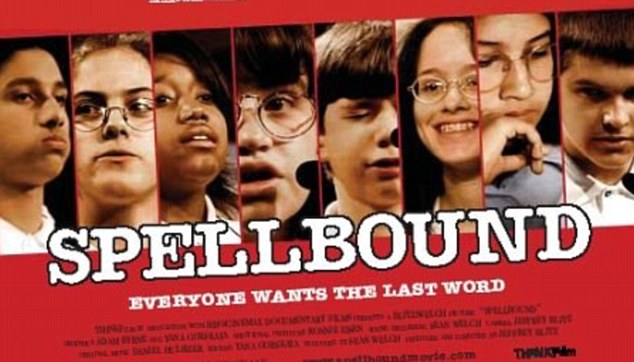
Back in 2002, Wolf’s recommendation gotSpellbound into the festival. The story of eight teenagers competing for the national spelling bee championship, Spellbound went on to become a national art house hit, and Wolf earned some major cred.
Each year, Wolf screens the 250 documentary features that have been submitted to Cinequest by filmmakers. Wolf then submits a top ten and a second twenty recommendations, along with his comments, to Cinequest Director of Programming and Associate Director Mike Rabehl. (Rabehl himself screens every Cinequest submission, including documentaries,) Rabehl has the final say, but he agrees with most of Wolf’s recommendations.
“You rarely see a bad documentary,” says Wolf. “Although there are a lot of mediocre ones.”
How does one actually watch 250 movies? From each July though November, Wolf watches movies in the morning, until he takes a break for lunch. After a visit to the neighborhood coffee joint, he resumes until dinnertime. But he reserves the evening for his own movie choices, not festival screeners.
“Mike Rabehl tells me not to make it a job”, but Wolf thinks its goes best with this regimen.
The slate of documentaries at Cinequest is usually quite rich. Here are some of my favorites from recent Cinequests, all of which are are now available to stream:
The Brainwashing of My Dad: When TV changes not just opinions, but mood and personality, too. Amazon, Vudu, YouTube, Google Play.
Meet the Hitlers: Wouldn’t you change YOUR name? Amazon, iTunes, Vudu.
There Will Be No Stay: In a society with capital punishment, someone must perform the executions. iTunes, Vudu, YouTube, Google Play.
Wolf saved me from a big mistake at the 2019 Cinequest. I had decided to pass on screening Clownvets because it looked too sappy for my notoriously jaded taste. But I watched it on Wolf’s recommendation, and I’m very glad that I did. Clownvets turned out to be well-constructed and surprisingly powerful.
This year Wolf tipped me off to The Quicksilver Chronicles, which is also my own favorite of the 2020 Cinequest documentaries.
Matthew Rhys and Tom Hanks in A BEAUTIFUL DAY IN THE NEIGHBORHOOD
The Wife and I finally got around to streaming the pleasantly entertaining A Beautiful Day in the Neighborhood, with Tom Hanks as Mr. Rogers. I had already seen the recent documentary Won’t You Be My Neighbor?, which I’ll touch on a few paragraphs later.
In A Beautiful Day in the Neighborhood, the investigative journalist Lloyd Vogel (Matthew Rhys) is a notch-on-his-belt guy, who revels in bringing down the famous. When the subjects of his profiles read his articles about them, it’s the worst day of their lives. Despite his professional success, a smart and sexy wife (Susan Kelechi Watson) and a new baby, he’s profoundly unhappy. We learn that much of this stems from unresolved anger at his father (Chris Cooper).
To his disgust, Vogel is assigned to write a brief puff piece on that icon of niceness, Mr. Rogers. The movie is about Mr. Rogers trying to disarm Vogel’s cynicism by excavating Vogel’s daddy issues.
As written, Vogel’s emotional journey is a little too predictable for A Beautiful Day in the Neighborhood to be a great movie, but it’s emotionally satisfying.
Of course, Tom Hanks is a perfect Mr. Rogers. Rhys is okay.
If you want to appreciate a great actor’s work, watch the very first time we see Chris Cooper. He signals that he is intoxicated with a slightly unsteady step backwards, and goes on to a perfectly realistic drunk performance, without ever lapsing into a Foster Brooks broadness,
Susan Kelechi Watson is very winning as Vogel’s wife, not a particularly complex part, but her charisma makes me want to see more of her.
This is the best work so far from director Marielle Heller (Diary of a Teenage Girl, Can You Ever Forgive Me?). She adds just the perfect dashes of magical realism (dropping Vogel into the sets and among the characters of the TV show), which is a difficult thing to get right.
We get to meet the real Fred Rogers in the recent biodoc Won’t You Be My Neighbor? What is so surprising is that Rogers’ sometimes laughably gentle affect sprang from such internal ferocity. It turns that Rogers was a man who hated, hated, hated the moral emptiness and materialism of commercial children’s television.
In theaters, Won’t You Be My Neighbor submerged audiences in their hankies. I did choke up three times during A Beautiful Day in the Neighborhood, but Won’t You Be My Neighbor? was pretty much one long ugly cry for me.
Streaming Won’t You Be My Neighbor? is included with subscriptions to HBO and DirecTV, and the stream can be purchased for $14.99 from all major streaming platforms. A Beautiful Day in the Neighborhood is available to stream from all the usual outlets; I paid Amazon $2.99.
Because of the COVID-19 pandemic, no one should be going to movie theaters right now. The San Francisco International Film Festival (SFFILM) made the right decision and cancelled, as did the famed Cannes Festival. So, there will be no “OUT NOW” recommendations from me for a while, but I’ll try to double up on movies to WATCH AT HOME.
ON VIDEO
My video pick this week – for St. Paddy’s Week – is the warmly funny The Commitments (1991), the affectionate tale of an unlikely aspiration and an unnecessary fiasco. The Commitments can be streamed from Amazon, iTunes, YouTube and Google Play, usually for less than the cost of a pint of Guinness.
Here are my comments on the Best Movies of 2019, all of which are now available to stream.
ON TV
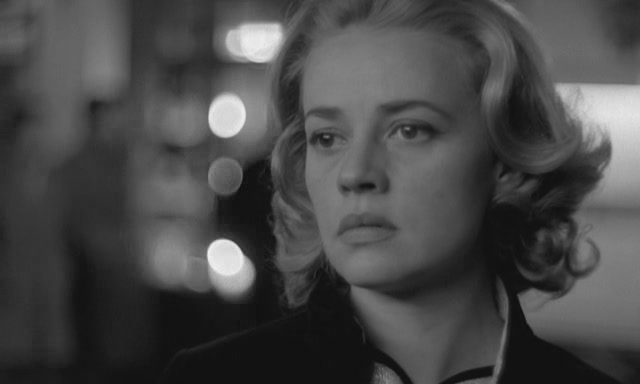
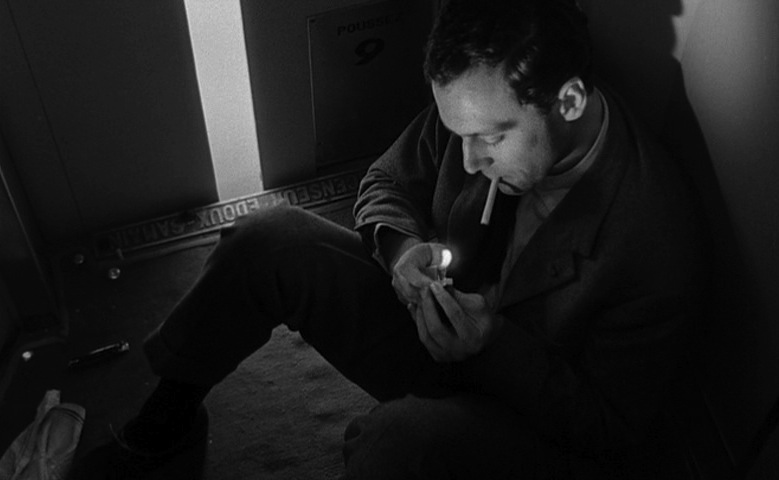
On March 21 and 22, Turner Classic Movies will present one of my Overlooked Noir, Elevator to the Gallows– such a groundbreaking film that you can argue that it’s the first of the neo-noir. It’s the debut of director Louis Malle, shot when he was only 24 years old. It’s more difficult now to appreciate the originality of Elevator the Gallows; but in 1958, no one had seen a film with a Miles Davis soundtrack or one where the two romantic leads were never on-screen together. The Czar of Noir, Eddie Muller, will provide his famous intro and outro,
There’s a rich assortment of movies about Ireland that you can watch on St. Patrick’s Day: Waking Ned Devine, Brooklyn, Finian’s Rainbow, Once, Ryan’s Daughter, Widow’s Peak and The Guard. (Or you can go dark and pick from my Best Films About the Troubles.)
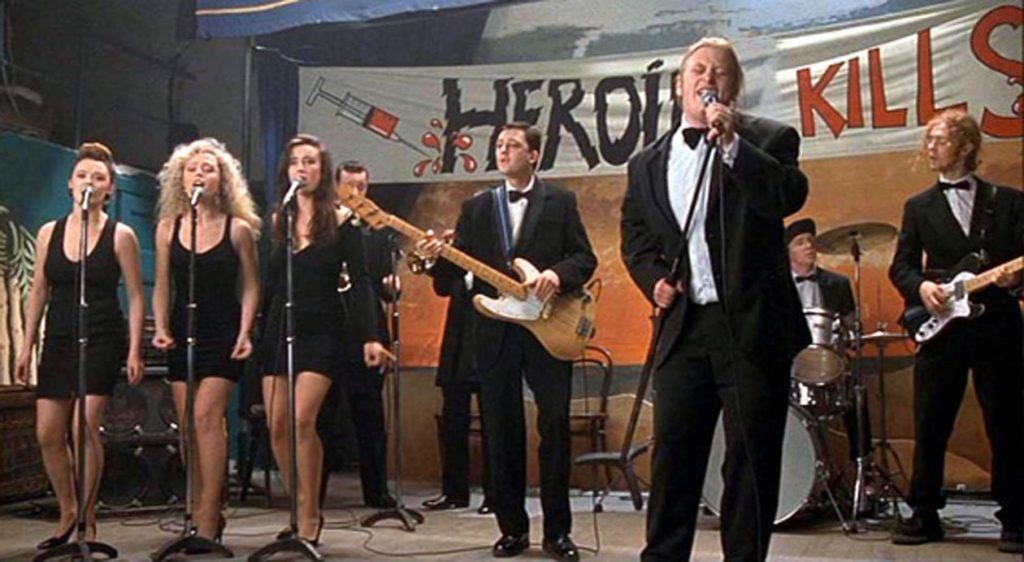
But my choice is the warmly funny The Commitments(1991), the affectionate tale of an unlikely aspiration and an unnecessary fiasco. Not content to wallow in generational poverty, a young lad, Jimmy Rabbitte (Robert Arkins) decides to gather a motley crew of his fellow North Dublin young folks and to form them into a soul band.
Now, North Dublin may be the most melanin-deprived place on the planet. So, why soul music? Jimmy, a natural leader, says:
“Do you not get it, lads? The Irish are the blacks of Europe. And Dubliners are the blacks of Ireland. And the Northside Dubliners are the blacks of Dublin. So say it once, say it loud: I’m black and I’m proud. ”
With the guidance of an older musician who has worked in the US, they improve, and even start to catch on. Unfortunately, these folks have never experienced success and are totally ill-equipped to handle it. Soon, the band is hanging together by a thread. If only Wilson Pickett, touring across town, can show up and help them with publicity…
The Commitments is adapted from a Roddy Doyle novel steeped in working class Irish verisimilitude. Director Alan Parker looked to local Dublin musicians and came up with a cast of first-time actors. Ironically, the one experienced actor and non-musician in the cast was Johnny Murphy as Joey “The Lips” Fagan.
The cast performed a 20-year reunion show. What have they been doing since they made this movie?
Andrew Strong, who played the immensely gifted but thuggish lead singer Deco Cuffe, has spent decades as a rock singer within Europe, mostly with his band the Bone Yard Boys.
Angeline Ball, who played the big-haired tart, Imelda Quirke, swept the Irish equivalent of Oscar/Emmy for best actress in a film and best actress in a TV drama in the same year, 2003.
Maria Doyle Kennedy, another backup singer, went on to a significant musical career in Ireland where she is a renowned singer-songwriter. She also played Catherine of Aragon in The Tudors and Vera Bates in Downton Abbey.
Glen Hansard, who played the busking guitarist, had some recording success as a solo artist and with his band The Frames. He also starred in an even better movie than The Commitments – the singer-songwriter romance Once.
Colm Meany, who played the Elvis-worshiping dad, went on to a career in major films ranging from The Last of the Mohicans to Star Trek: The Next Generation. Meany also starred in two more movies stories based on Roddy Doyle stories The Snapper and The Van; neither film was bad, but neither was as magical as The Commitments.
Alan Parker also directed the musicals Fame and Pink Floyd: The Wall. He was nominated for the best directing Oscar for Midnight Express and Mississippi Burning. (The Academy overlooked his lurid and trashy Angel Heart.)
The Commitments can be streamed from Amazon, iTunes, YouTube and Google Play, usually for less than the cost of a pint of Guinness.