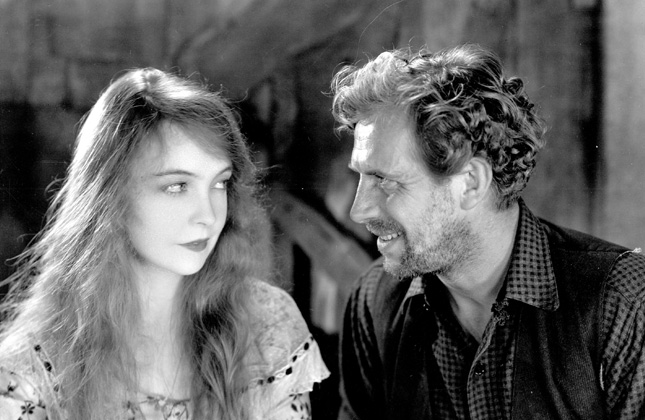
The Wind is usually named as Lillian Gish’s top silent film performance. Gish plays a young pioneer woman who is stranded in a vast sparsely populated Western desert. She marries one of her several suitors and takes up housekeeping in an isolated cabin, with only the perpetually howling wind for company. She has to “wash” her dishes in sand. Unsurprisingly, she can’t take it and is driven to desperate measures.
Fortunately, I got the chance to see The Wind at Cinequest on the big screen of a period movie palace, the California Theatre, accompanied by world-renowned Dennis James on the Mighty Wurlitzer organ.
Dennis James traveled with Lillian Gish as accompanist when she would present movies. For The Wind he added two colleagues on wind machines. Before the film, James read a florid movie mag account of a visit to the set of The Wind in the Mojave. I recommend Sal Pizarro’s excellent profile of Dennis James in the Mercury News.
James’ organ accompaniment and the large audience made all the difference. I had watched The Wind by myself on tv and started using the fast forward on the remote. But there’s lots of humor embedded in The Wind which is activated by the laughing of audience members.
It’s easy to appreciate how Gish rose to stardom. Her slight, delicate frame is offset by her spirited charisma. She’s great when three men propose to her on the same evening and she’s not feelin’ it. Gish, Dennis James’ Wurlitzer and the California Theatre made for a wonderful cinema experience.
Donald Sutherland and Helen Mirren in THE LEISURE SEEKER, Photo courtesy of Sony Pictures Classics.
In The Leisure Seeker, a strong-willed suburban retiree (Helen Mirren) finds her longtime husband (Donald Sutherland) sinking into Alzheimer’s. Having been a teacher who has found the greatest joy in his recall of literature, the impact of the memory disease will be very specific. Facing a health issue of her own, she decides to take him on a road trip all the way down the Eastern Seaboard to Ernest Hemingway’s house in Key West. Off they go in their trusty Winnebago and adventures ensue.
There’s plenty of humor here, and this is not a particularly heartbreaking Alzheimer’s movie. Mirren and Sutherland are both just so good in their roles. Sutherland’s hubby is good-natured as long as he can pilot his 20-foot RV and get a decent hamburger without having to learn a restaurant server’s first name; he slips into a literary revelry at the slightest provocation. Mirren is the social navigator, now faced with corralling somebody who now dips into another reality.
It’s the first American film for the accomplished Italian director Paolo Virzi (Like Crazy). Unfortunately, there’s just something about the iconic American road trip and, perhaps, America itself that Virzi just doesn’t get, and The Leisure Seeker never quite ascends to greatness.
I was amused more than thrilled or moved by The Leisure Seeker. Yet the performances of Helen Mirren and Donald Sutherland can justify catching the movie.
Marguerite Moreau and Hus Miller in YOU CAN’T SAY NO
In the indie romantic comedy You Can’t Say Know, Alex (Marguerite Moreau) and Hank (Hus Miller) are at the end of a 14-year-old marriage. Their relationship has never been communication-rich, things have gotten stale and a Hank affair has brought down the curtain. Just before they sign the divorce papers, they send the kids off to camp and take individual road trips. Coincidentally, they meet up on the road, and they play a game, taking turns to order the other to do something that he/she cannot refuse. Comic situations, raw emotions and redemption ensue.
Moreau is especially good as the wife who needs to express her anger but still believes that she will be happiest choosing an improved marriage over divorce. Alex is trying to find her path, and she’s definitely not a doormat. Moreau brings spunk and likeable charm to the role.
Peter Fonda is wonderful as Hank’s eccentric winemaking dad Buck. Hamish Linklater is sometimes hilarious as Buck’s wacky protegé. Ingrid Vollset brings spirit and sympathy as the free-spirited vagabond Allison.
Hus Miller wrote the screenplay in his feature debut as a writer. Unfortunately, You Can’t Say No doesn’t harvest its comic potential. The scenes are often a few counts too long, and the direction and editing tend to be clunky.
You Can’t Say No had its world premiere at Cinequest.
Bombshell: The Hedy Lamarr Storyis the riveting biopic of a glamorous movie star who invented and patented the precursor to wireless technology; that’s amazing enough, but Bombshell delves deeply into how Lamarr’s stunning face, her Jewish heritage, and mid-century gender roles shaped her career, marriages and parenting. Top notch.
In the last few years, one totally unexpected aspect of Lamarr’s life has become more well-known. She was a tinkerer/inventor who co-invented a radio guidance system for submarine torpedos, which she donated to the US military. The US Navy used this technology in WW II. Modern blue tooth technology stems directly from her innovation. Today her patent would be worth billions.
Bombshell adds layer upon layer to this tale of beauty and brains, as it traces Lamarr’s remarkable life. Hedy Lamarr had no control over being born a woman, being born to Jewish parents and being born to be a beauty. These three accidents of birth set the parameters of her journey – granting her access to some professional opportunities and stunting others, even threatening her life.
She burst into celebrity – and notoriety – at age 19, as the star of the film Ecstasy. Not only was Hedy the first actress filmed in full frontal nudity, she was the first screen actress to portray female orgasms. She was soon the young trophy wife of an Austrian industrialist, a formidable and fearsome supplier of munitions to Hitler. Hedy’s life seemed headed along the Bimbo Track, but she realized that her husband was powerful enough to keep her trapped in the marriage, but not powerful enough to protect her from the Nazis. At this point, she orchestrated an international escape that is the stuff of thrillers.
At age 24, often nominated as the most beautiful woman in the world, she launched a Hollywood career. Professional ups and downs, marriages and affairs and children followed, along with her work in technology.
Her beauty was often a blessing and sometimes a curse, but always affected her trajectory. Someone that beautiful is just different – the rest of us can’t help our reactions to her. But how many times can you be a trophy wife?
She was a person who survived troubling times, which left scars on her. How Hedy handled her Jewishness, how she raised her kids and how she was treated by the military are unsettling. Documentarian Alexandra Dean, Bombshell’s writer-director brings us witnesses, including Hedy’s children, to deliver an inside peek at a real life that would not be believable as a work of fiction.
I saw Bombshell: The Hedy Lamarr Story this summer at the 2017 San Francisco Jewish Film Festival (SJFF). It’s coming to Bay Area theaters this weekend.
Dustin Cohen’s gentle documentary Flin Flon: A Hockey Town, without even a hint of condescension, paints a meticulous and revealing portrait of a remote Canadian hamlet and its beloved junior hockey team.
Flin Flon is a town of five thousand on the Manitoba-Saskatchewan border. The closest place that most of us have heard of is Saskatoon, Saskatchewan, and that’s a six-and-a-half hour drive from Flin Flon. There’s a mine in Flin Flon and a junior hockey team, and that’s about it.
As the movie opens, the morning radio station announces a high temperature of minus 19. Proud locals call their home “a great place to raise kids”, which is what locals say about every place that nobody else even wants to visit. For decades, the residents have bonded with their beloved hockey team, the Bombers.
18-20 year old hockey players come to Flin Flon, live in the homes of local families (“billeting”) and work hard, physical day jobs off-season. They are here to concentrate on hockey, although only 1-2 from each Bomber team are likely to significantly advance in the sport. However, over 40 NHL players have been Flin Flon Bombers, including Hall of Famers Bobby Clarke and Reggie Leach. Writer-director Dustin Cohen grew up in San Jose as a Sharks Fan. He stumbled on Flin Flon as he researched Canadian hockey. He needed more than just a small town for his subject, and he chose Flin Flon because of its hockey heritage.
Flin Flon is “the only city in the world named after a science fiction character (Josiah Flintabbatey Flonatin in J.E. Preston Muddock’s The Sunless City). At Bomber games, the fans like to throw moose legs on to the ice. This could have been one of those documentaries that make us laugh at the quirky subjects. Or it could have been about unhealthily obsessed sports fans.
Instead, Flin Flon: A Hockey Town is an insightful and sympathetic study of the town and the kids on the team. Cohen is very observant, and he shows us seemingly mundane details – driving the bus, prepping the ice, cutting wood – that reveal much about the internal lives of the people in the film.
Cohen only lets us directly watch the hockey in snippets. Most of the time, we see it reflected through the reactions of teammates and the crowd. The photography (Soren Nielsen, Christine Ng) and the editing (Kathy Gatto) are superb.
The more I think about Flin Flon: A Hockey Town, the more I admire it. This is a very humane film.
In the ridiculous drama The Ashram, a sullen guy seeks his missing girlfriend and follows her trail to an ominous cult in a Himalayan ashram. When we finally meet the ancient guru, he turns out to be a real miracle-maker (as demonstrated by the cheesiest of special effects).
Here’s the biggest problem with The Ashram – it is populated by one-dimensional characters that we care little about. As an Ashram resident, Kal Penn is sympathetic, but it’s clear that his character’s only raison de etre is to be the Nice Guy. The leading man is Sam Keeley, who scowls his way through this story, occasionally adding in a furrowed brow.
The disappeared girlfriend shows up in flashbacks, played by the remarkably uncharismatic Hera Hilmar. Last year, Hilmar helped sink the execrable The Ottoman Lieutenant, proving to be boring even while losing her virginity to Michiel Huisman; she only sparked interest from the audience with unintentionally funny line misreadings. I left The Ashram thinking that Hilmar must have the worst showbiz agent to get her in such horrible films; but then I realized that she must have Hollywood’s BEST agent. Think about it.
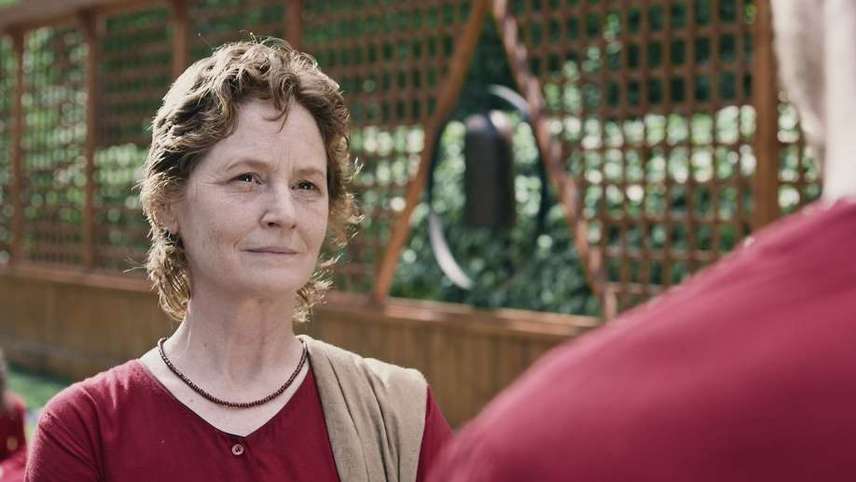
But the worst thing about The Ashram is its misuse of the great Melissa Leo, who plays the guru’s gatekeeper and chief operating officer. Leo’s character ranges from unctuously evil to snarlingly evil,. Her performance brought to my mind the Disney villainesses Cruella Deville and the Evil Queen. Absent any hint of nuance, Leo is left to twirl her non-existent mustaches.
Director Ben Rekhi (from San Jose) gets two things right in The Ashram – the two perfectly evocative locations. The first is the city of Rishikesh, “Spiritualism Ground Zero” since the Beatles visited their guru there. Bisected by a river with a long pedestrian bridge, Rishikesh is filled with seekers searching for spiritual bless and lots of “holy men” willing to sell it to them. The Lourdes of the Indian subcontinent, it just screams “money changers in the temple”.
The second is the setting of the ashram, in a lush mountain valley at the confluence of two dramatic rivers. The guru’s cliff-side cave overlooks the ashram in the valley, and there are spectacular Himalayan landscapes in every direction.
The dark whodunit story here might work as Young Adult fiction with better special effects. But still, The Ashram is a wretched movie. I attended the world premiere of The Ashram at Cinequest. It is now available to stream from several platforms.
In the astonishingly brilliant Bikini Moon, actress Condola Rashad’s blazing performance ignites Milcho Manchevski’s provocative story, resulting in the Must See indie at Cinequest. A fictional movie crew discovers the potential star of their documentary project. That star is a mentally ill homeless women named Bikini. She says that she’s a military veteran and that she has a daughter. The documentarians see that her emotional volatility, with its sudden and extreme outbursts, makes for great drama. She’s also an enthralling raconteur with a gifted turn of phrase – and she’s beautiful.
Bikini is played by Condola Rashad in a performance so charismatic that it’s easy to see how the crew is seduced by her mesmerizing presence. These folks are way out of their depth with Bikini. They think she is their subject, but will she pull them, one by one, into her madness?
It turns out that Bikini really is a vet, and she has serious PTSD and, possibly, Military Sexual Trauma. She is suffering from a raging, unmedicated bipolar disorder. It seems like Bikini’s one predictable quality is the impulse to act inappropriately.
Will Janowitz, Sarah Goldberg and Condola Rashad in BIKINI MOON
Bikini Moon explores the natural tension between a documentary telling a subject’s story and a documentary exploiting a subject. Here, the crew members have mixed motivations. The director Trevor (Will Janowitz) doesn’t have any compunctions about exploiting his subject. His girlfriend/bankroll Kate (Sarah Goldberg) appears to be much more nurturing and well-intentioned, as does Krishna (Sathya Sridharan).
Unforgiveably, Trevor takes Bikini and the crew into a situation can only further traumatize Bikini and looks to be dangerous to other innocent folks, too. At first, we see Trevor, consumed by selfishness and a disregard for others, to be a jerk. He may be way more functional than Bikini but his narcissism might rate him as unhealthy as she is.
Bikini has no social boundaries because she’s crazy. Kate, on the other hand, seems like a conflict-averse doormat, and she has boundary issues, too. She may intrude the most deeply into Bikini’s life. Kate may take what she wants from Bikini through manipulation, all behind the guise of do-gooding.
Krishna is the least strong-willed and the most benign crew member. Yet he may be the one who can make the film tell Bikini’s story by adopting her perspective, however mad and feral that perspective is. That makes for a jaw-dropper of an ending to Bikini Moon.
Condola Rashad in BIKINI MOON
The core of Bikini Moon is Condola Rashad’s remarkable performance. Her big, expressive eyes and sudden, charming smiles intoxicate both the documentarians and Bikini Moon’s audience. As captivating as she is during Bikini’s outbursts, Rashad might be even more compelling in quieter moments, especially a moment of stillness on the courthouse steps late in the film; those around her are assured because she’s not flailing around but we can see something very unsettling in Bikini’s eyes. There’s also a remarkable solitary dance captured on the nanny cam. She’s an actress seemingly created for the closeup, and the camera loves her. An accomplished stage performer, Rashad was nominated for Tony Awards for her performances in Stick Fly, The Trip to Bountiful and A Doll’s House, Part 2. She currently can be seen on television in Billions.
Bikini Moon is co-written and directed by Milcho Manchevski from his own story. Manchevski was Oscar-nominated for his acclaimed 1994 Macedonian feature Before the Rain. That Manchevski debut won the Golden Lion at Venice and was singled out as a masterpiece by Roger Ebert and The New York Times. Since then, he has directed three European features and an episode of The Wire. Manchevski has been teaching in New York, and Bikini Moon is his first American feature.
All of Bikini Moon is photographed as part of the film-within-the-film documentary footage or as candid iPhone video or video from a security cam. The cinematography by Joshua Z Weinstein is remarkably urgent and authentic, and shooting in the cramped spaces of apartment corridors must have been especially challenging. (His Twitter handle, by the way, is “@WeinsteinFilm”, clarified as “Joshua Z Weinstein – No Relation”.)
This is the entirely fresh and original work of a master filmmaker. Condola Rashad’s performance is stunning. Bikini Moon’s US premiere is the Must See indie at this year’s Cinequest.
The talented actress Rusty Schwimmer plays Gabby, that rebellious oldest daughter whose bad choices have left her, at age 49, in a puddle of low self-esteem and underachievement. Having caught her loser boyfriend cheating, she’s now back living with her hypercritical mom and working out of the bedroom as a phone sex operator. She connects with an unusually empathetic and reflective customer, and decides to travel across the country to try to meet him.
Schwimmer does as much as possible with the material, and there’s a very appealing performance by Timothy Omundson as her favorite mystery caller. There’s also a moment at a taco truck, the funniest and only original moment in Wild Honey, when the Gabby and her sister (Stephnie Weir) two sisters slide into a gibberish language from their childhood. But there’s not much else we haven’t seen before in Wild Honey, a clunky, predictable and disappointing film.
Wild Honey premiered at the Austin Film Festival and plays Cinequest 2018.
The proto-feminist war movie Voevoda is set in the Bulgarian resistance against the Ottoman Empire. This epic tells the historical life of Roumena, a Bulgarian woman who led insurgent ambushes and nighttime kidnapping raids against the occupying Turks. In Eastern Europe, the word voevoda generally means warlord; in the 19th Century Bulgarian context it means leader of a guerilla band.
19th Century Bulgaria is not the first place we would expect to find a woman warrior, and that’s what’s singular about Voevoda. Motivated by Ottoman atrocities, she leads the local men into violent rebellion and most of them accept her leadership.
Bulgaria under Ottoman repression was a harsh time and place. This is the first time that I’ve seen the Turkish torture of being hung upside by the feet and having the entire village marched by to spit on your exposed buttocks. Roumena was one tough cookie, however, and that’s exemplified in one fairly alarming standing childbirth scene.
Writer-director Zornitsa Sophia is a seasoned director. She stars here as Roumena in her first screen acting credit, and is believable as the strong-willed and hardened leader. Sophia’s real 12-year-old daughter plays the young Roumena in flashbacks. Valen Yordanov turns in a fine performance as Stoyan, Roumena’s longtime lover and stalwart.
Voevoda is a well-crafted epic film and succeeds in creating the veneer of historical authenticity. Cinequest hosts Voevoda’s US premiere.
In the appealing Canadian transgender dramedy Venus, Sid (Debargo Sanyal) is at a personal crossroads. Single after things didn’t work out with his closeted boyfriend Daniel (Pierre-Yves Cardinal), Sid has just begun to dress like a woman in public and to take hormones for his transition. Then, he is shocked to learn that he has a 14-year-old son Ralph (Jamie Myers). The boy thinks that having a transgender dad with Indian heritage is very cool and, unbeknownst to his mom, starts spending more and more time with Sid. Sid has to deal with this, along with the reactions of his more traditional Indian parents and a chance meeting with Daniel.
In her first narrative feature, writer-director Eisha Marjara has crafted a funny, touching and genuine story. Venus is successful largely because of Debargo Sanyal’s performance. Eschewing flamboyance, Sanyal’s Sid is a man driven to keep his dignity in the most inescapably awkward situations. It helps that Sanyal is a master of the comic take; Sid’s reactions to his mother’s and Ralph’s intrusiveness are very funny.
Cinequest hosts the US premiere of Venus, and I expect it to become one of the most popular indies at the festival.