LAMB: dark fable of karma

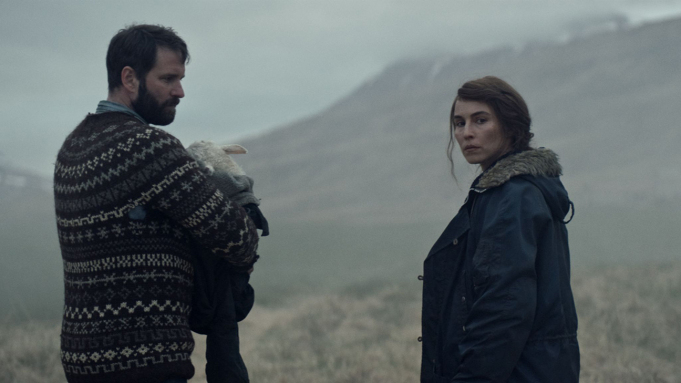
Photo caption: Ingvar Hilmir Snær and Noomi Rapace in LAMB. Courtesy of A24.

The very quiet drama Lamb is one of the most gripping films of the year, and one of the most unsettling. I’ve seen Lamb described as a horror film, but it is very unlike most of today’s horror films. I would rather label it as a dark, cautionary fable of karma with some supernatural elements.

It’s difficult to imagine a more pastoral setting than Lamb’s remote Icelandic sheep farm. Maria (Noomi Rapace) and Ingvar (Hilmir Snær Guðnason) run the farm with studied competence, caring for the sheep and maintaining their tractor. No neighbors are in sight. Neither the routine nor the isolation burdens them; they are comfortable with and enjoy each other’s company.

One of their routine tasks is birthing lambs. We see that Maria and Ingvar have an established division of labor and confidence. We think we know what to expect until a lamb is birthed and Maria and Ingvar’s reaction shows that this newborn is anything but normal.

It’s remarkable that the two never debate what to do or consult experts. They both immediately fall into behaving in complete alignment. But we suspect that they are not behaving as most people would.

Writer-director Valdimar Jóhannsson is such an able story-teller, that he doesn’t show us the lamb’s body right away, and we have to surmise what’s going on by the reactions of the characters. When Ingvar’s nogoodnik bother Petur (Björn Hlynur Haraldsson) shows up uninvited, he brings with fresh eyes and asks WTF?

Jóhannsson uses the starkly beautiful but menacing Icelandic landscape to fill us with foreboding. Something is not right here. And there will come a reckoning.

Lamb drove me to the dictionary to review the meanings of the word monster. In Lamb, there is a creature who fits under the definition, but which is pure and sweet. Another creature is the terrifying kind of monster. And a human takes an action that is normal from a human point of view, but from a monster’s perspective is, well, monstrous.

The cast (and this is really a three-hander) is excellent. You may recognize Rapace as the pierced-and-inked Lisbeth Salander in the Swedish Girl with the Dragon Tattoo franchise.

Lamb is the first feature for Valdimar Jóhannsson – and it is a superb debut. You haven’t seen anything like this movie before.
NO TIME TO DIE: went to a James Bond movie and a romance broke out

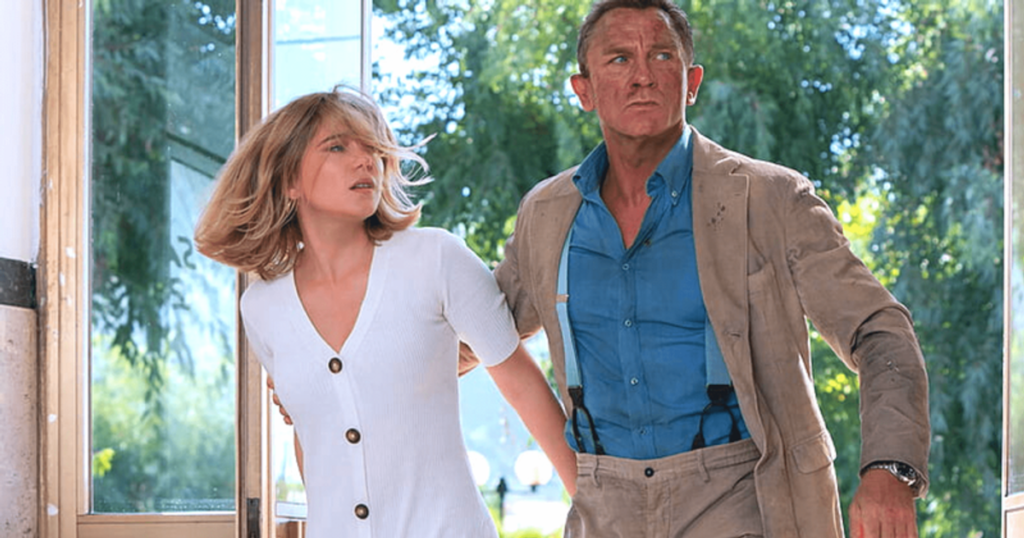
Léa Seydoux and Daniel Craig in NO TIME TO DIE. Photo credit: Nicola Dove © 2020 DANJAQ, LLC AND MGM.

I went to a James Bond movie and a romance broke out. No Time to Die, a fitting farewell to Daniel Craig’s reign as James Bond, has all the action set pieces, fantastic gizmos and exotic locations that you would want in a Bond film; it all just comes down to his profound love for a woman.

Remember when the Bond formula was impossibly sexy woman beds James Bond and then tries to kill him; repeat. In No Time to Die, however, there are no disposable women.

Bond, retired from the British MI6, is living in domestic bliss in Southern Italy with his girlfriend Madeleine Swann (Léa Seydoux) from the previous Bond movie, Spectre. Bond is also grieving for the redeemed double agent of past Bond films, Vesper Lynd (most recently played by Eva Green); on the suggestion of Madeleine, who is a psychiatrist, he visits Vesper’s grave – but an assassination attempt kicks off the action in No Time to Die.

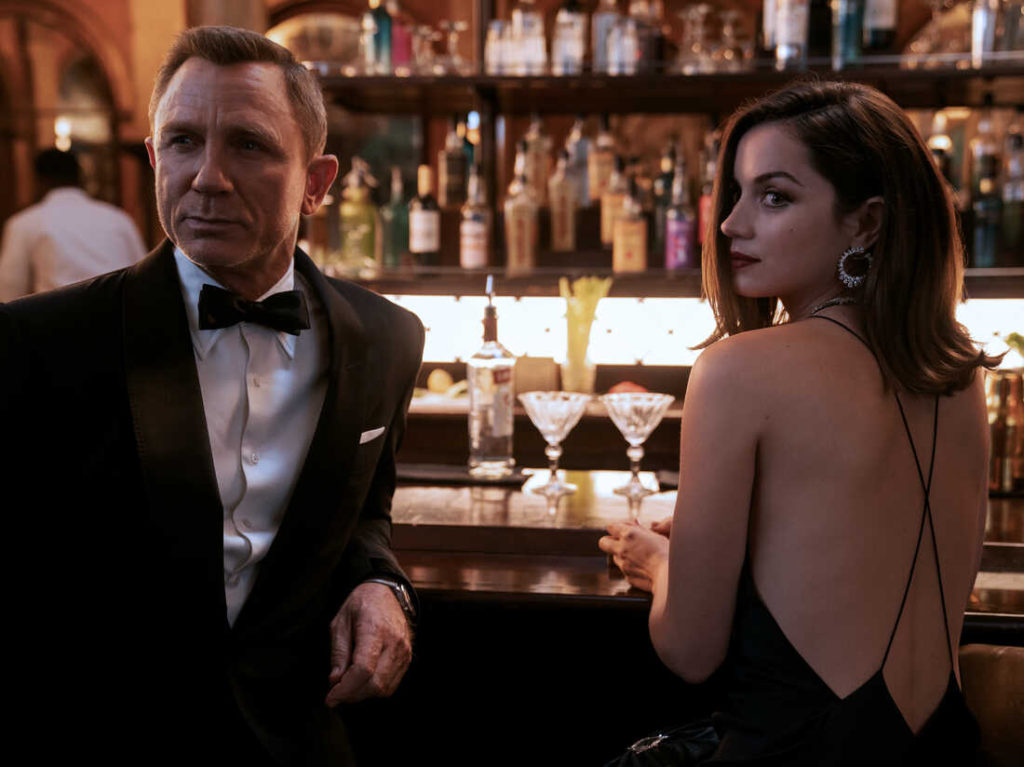
Besides Madeleine and Vesper, Bond faces another woman, his own replacement in MI6’s new Agent 007 Lashana Lynch. 007 is talented and cocky, and Bond and 007 slide effortlessly into comradeship. Ana de Armas is very funny as the supposedly inexperienced agent Paloma in a set piece (in de Armas’ native Cuba) – lethal in a stunning Bond Girl dress.

Daniel Craig and Ana de Armas in NO TIME TO DIE. Photo credit: Nicola Dove © 2020 DANJAQ, LLC AND MGM.

But No Time to Die revolves around Bond’s relationship with Madeleine. Madeleine’s father was also a hunter of super villains, and she has as many secrets as Bond. So, Madeleine’s reliability comes into question, and the oft-betrayed Bond certainly has justification for his trust issues. Bond once ruefully mutters, “No – I don’t know her at all.” Can Bond summon the trust that is requisite to love?

Don’t worry – the action set pieces are spectacular, particularly the once before the opening titles. That one features perhaps the most impressive deployment ever of the Bondmobile.

There’s also a super villain (Rami Malek) with a biological weapon of mass destruction. There’s a lot of blah blah about how this weapon works, and then more blah blah between the supervillain and Madeleine. And then Bond has a face-to-face with the previous supervillain, Blofeld (Cristolph Waltz) with more blah blah. I started to doze during this part of No Time to Die, but soon we were plunging back into another thrilling action.

Neither supervillain is as entertaining as the traitorous agent Logan Ash (Billy Magnussen), an ever smiling bro boy so white bread that he is referred to as “Book of Mormon”.

Daniel Craig in NO TIME TO DIE. Photo credit: Nicola Dove © 2020 DANJAQ, LLC AND MGM.

IMO Sean Connery was essential to the Bond franchise by creating a studly character so arrogant yet sympathetic – the guy who men want to be and women want to be with. Movie James Bonds have come and gone; (Pierce Brosnan was good, I never saw the Timothy Dalton Bond movies, and my least favorite Bond was the brattily insouciant Roger Moore.) To me, Daniel Craig is every bit as good as Connery. Craig has the requisite physicality, confidence and sex appeal, while off-loading a Connery’s hint of brutishness and adding a sad tint of world-weariness.

The Bond franchise itself is remarkable. Mick LaSalle recently wrote:

…The key to its resiliency is that it has changed with the times, yet never so much that it fully lost contact with what initially made it popular. This amazing balancing act has played out for 59 long years. (To give you a sense of how long that is in movie time, 59 years before the first Bond movie, “Dr. No,” it was 1903.)

No Time to Die is ably directed by the Bay Area’s own Cary Joji Fukunaga (Sin Nombre, Beasts of No Nation, True Detective). No Time to Die is epic and is the keystone to Daniel Craig’s run as James Bond.

THE MANY SAINTS OF NEWARK: Tony Soprano’s origin story

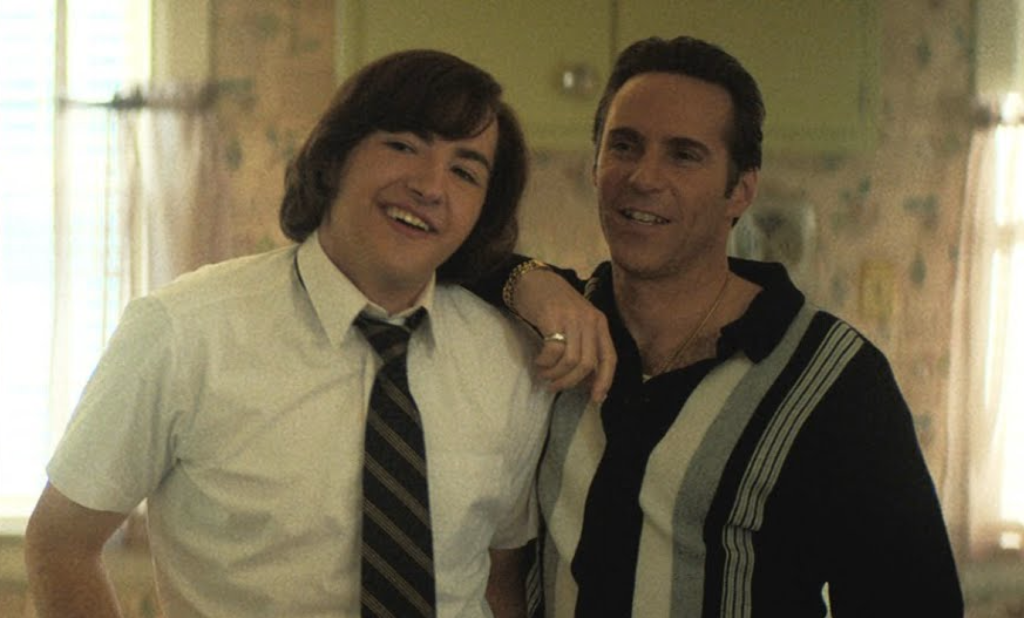
Michael Gandolfini and Alessandro Nivola in THE MANY SAINTS OF NEWARK

In the The Many Saints of Newark, David Chase’s prequel to The Sopranos, we get a peek inside the world that formed Tony Soprano. It’s pretty good.

Set when Tony Soprano was a high schooler, The Many Saints of Newark centers on Tony’s favorite “uncle”, mobster Dickie Moltisanti (and moltisanti is Italian for Many Saints). Dickie is played by Alessandro Nivola, who has had important, but supporting, roles in plenty of good movies (Junebug, Ginger & Rosa, American Hustle, A Most Violent Year, Selma). Here, he plays the story’s protagonist, charming and smarter than the average goon, and also capable of sudden, irrevocable violence.

Dickie and Tony are not really related, but, while Tony’s dad is incarcerated, his mob colleague Dickie is looking after his family. When we meet Tony’s sulking brute of a dad (Jon Bernthal) and his nightmare of a mom (Vera Farmiga), it’s clear why Dickie is young Tony’s role model.

Michael Gandolfini, James Gandolfini’s son, plays the young Tony. Beyond the resemblance to James Gandolfini’s adult Tony, the kid can act. He’s good, but the lead is Nivola.

Ray Liotta plays Dickie Moltisanti’s dad, Hollywood Dick Moltisanti. I don’t personally KNOW Ray Liotta, so I will refrain from saying that he can play mobsters effortlessly or that’s he’s a natural. Let’s just say that Liotta makes his mobster performances LOOK effortless. Here, his Hollywood Dick, returning home from an Italian holiday with a trophy bride, is filled with gusto. There’s also a bonus Liotta performance as a related, but much different, second character.

There’s enough in The Many Saints of Newark to show us how Silvio Dante, Big Pussy and Paulie Walnuts, all a few years older than Tony Soprano, would come to accept Tony as he crew leader. And there’s a big reveal about the extent of Uncle Junior’s (Corey Stoll) vindictiveness.

The Many Saints of Newark includes a depiction of the 1967 Newark riots, rising Black consciousness and the changing demographics of Newark and its suburbs,

Has there ever been better episodic television than The Sopranos? Breaking Bad and The Wire can stake their claims, but it’s clear that The Sopranos sets the standard.

The David Chase-crafted story of Dickie Moltisanti would allow The Many Saints of Newark to stand on its own as entertainment. For fans of The Sopranos, however, it’s even more insightful and evocative.

The Many Saints of Newark is in theaters and streaming on HBO Max.

OLD HENRY: too late for redemption

This image has an empty alt attribute; its file name is old-henry-1024x381.jpeg
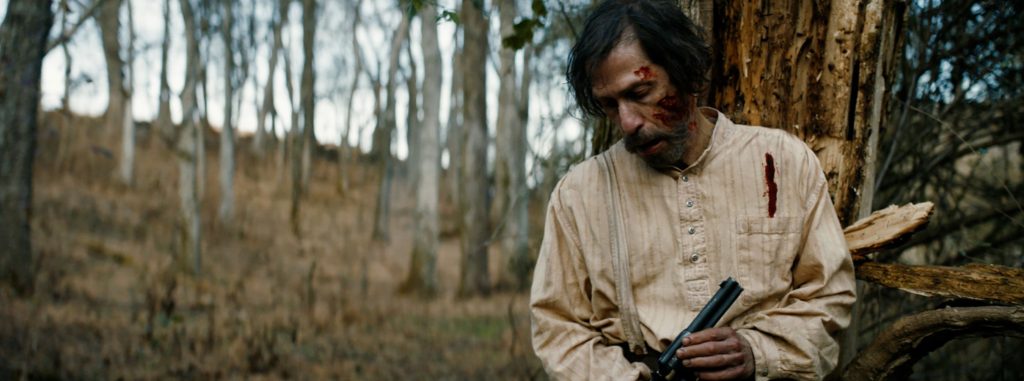
Photo caption: Tim Blake Nelson in OLD HENRY. Courtesy of Shout! Factory.

The fine western Old Henry is centered on Henry (Tim Blake Nelson), a widowed settler in the wilds of 1906 Oklahoma.  Henry is content with being a solitary sod buster, but he has serious skills from a violent past, and both the past and the skills are unknown to his teen son (Gavin Lewis).  The son is brash and impulsive, and desperate to escape the drudgery and isolation of the homestead.

A man badly wounded by a gunshot (Scott Haze) turns up with a satchel full of cash ( (obviously contraband).  Henry nurses him, and chooses to hide him when three armed men show up, led by Ketchum ( Stephen Dorff), who claims to be a sheriff.  Ketchum knows that his target is in Henry’s cabin, and he recognizes that Henry is more than a dirt farmer.  When Ketchum returns with reinforcements, a climactic gun battle is inevitable.

One wild card is the wounded man, with his uncertain identity and motives.  Another is the son, rigorously sheltered by Henry and ignorant of the cost of real violence.  He’s spoiling to get into a fight  – and that is not helpful.

Tim Blake Nelson, with nary a wasted word or action, commands the screen as the ever steely Henry. I saw Old Henry in personat the Nashville Film Festival,  where Nelson revealed that his performance was informed by “restraint and stillness” because, for Henry, “any exposure means vulnerability”.  So, Blake made Henry “laconic in actions as well as words”.  

Nelson is a magnificent actor, who has elevated many a character role (Oh Brother, Where Art Thou?).  Here he gets the lead role in a movie that premiered at the Venice Film Festival. Good for him.

Old Henry is the the first feature written and directed by Potsy Ponciroli. And it’s a well-crafted film.  The filmmakers get the period right.  The art direction and the production design are flawless, and the weapons have the necessary heft.  Old Henry was filmed on a cattle farm in Tennessee, but it sure looks like Oklahoma. 

If you appreciate a good western, then Old Henry is your movie.  The big shootout is thrilling, and Tim Blake Nelson is so good as a man who knows he can’t have redemption and only seeks some solace. Old Henry is now playing nationally, including for one-week run at San Francisco’s Roxie.

TITANE: demented, excessive and icky

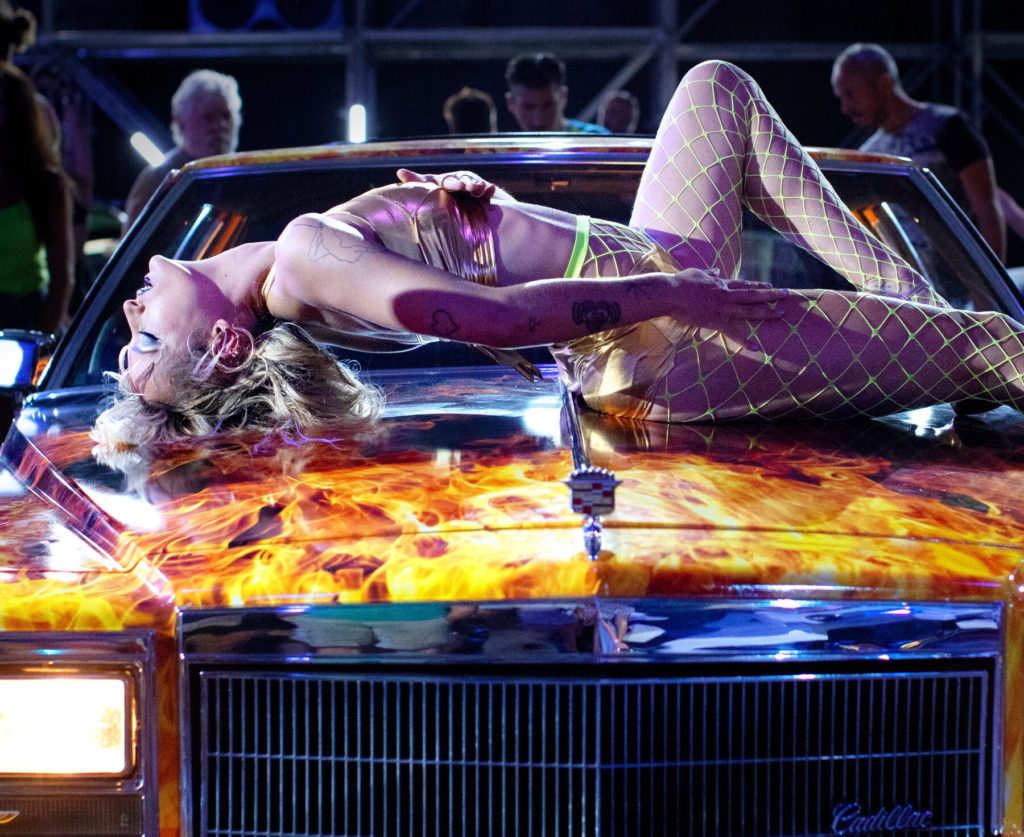
Photo caption: Agathe Rousselle and Caddy in TITANE. Courtesy of NEON.

I don’t think I’ve ever before described a movie-going experience as “punishing”, but here goes.  After being assaulted by the French sci fi horror film Titane, which purports to be two portraits of abnormal psychology, I felt beaten, even tortured.

The headstrong child Alexia causes an auto accident and gets a platinum plate in her skull.  She grows into a stripper at car shows (Agathe Rousselle), and has a serious automobile fetish.  In Titanes most notorious scene, Alexia gives a new meaning to auto-eroticism by having sex with, and becoming impregnated by, a Cadillac.  

Alexia is also a serial killer, and her second signature fetish is impaling her victims.  She keeps a spike in her hair for this purpose, but a bar stool will suffice, too. One victim gets away and indemnified her, so Alexia changed her appearance and goes underground as a young man. Here, she happens on a beefy fire captain (Vincent Lindon), who is grieving for a son who disappeared ten years ago, and adopts Alexia as his long lost, now recovered, son.

Through much of Titane, we are asking WTF is going on? Writer-diretor Julia Ducournau keeps surprising us by piling on segments that are SO twisted and bizarre, that most of us could not imagine them.

Most of Titane is intentionally unpleasant to watch.  Characters bleed blood, unless they bleed motor oil.  Bones crunch, mouths froth and bellies are picked open. The murders are gory, and Alexia self mutilates as her pregnancy progresses, right up to an excruciating birth scene.

Oh, and let me be very clear about this, Titane is NOT a date movie.

The character of Alexia is just a bad seed, a feral maniac. The character of the troubled fire captain is also bizarre, but he’s more psychologically interesting.  He insists that everyone else accept what is clearly a delusion.  Does he understand that this is not his son?

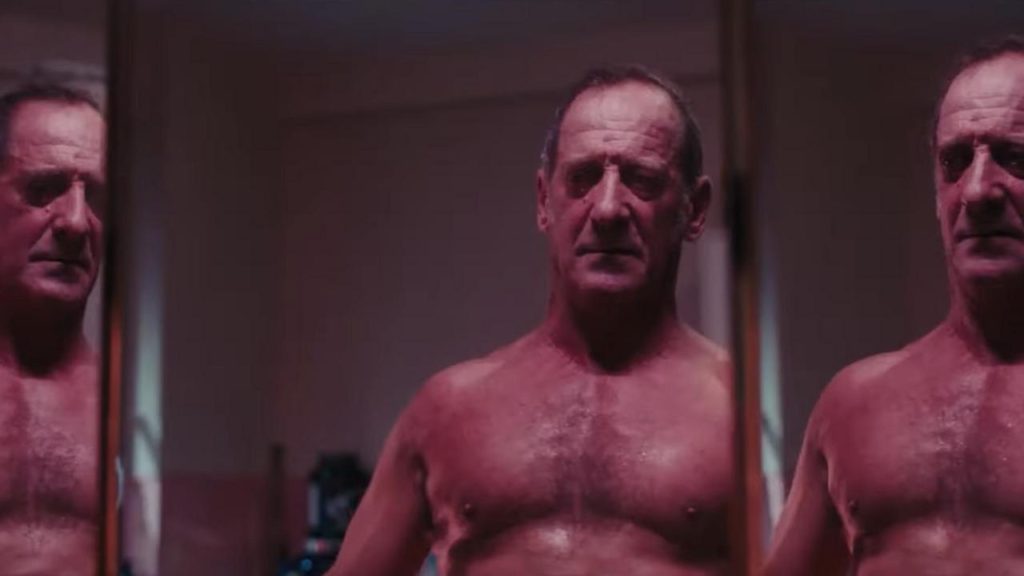
Vincent Lindon in TITANE. Courtesy of NEON.

Lindon (who muscled up for the role) is superb in this crazy role, which requires him to exude command authority and also the deepest vulnerability. It’s a very brave performance, and it works, for example, in his solo dance to She’s Not There

Myriem Akheddiou is also excellent in a brief scene as the mother of the fire captain’s missing child.

I know my share of American firefighters.  They would be surprised by Titane’s French firefighters, who let off steam by getting high and holding raves in the firehouse, all hypnotically dancing to electronica.

Notably, Titane won the Palme d’Or at the 2021 Cannes Film Festival. While one of the two most prestigious prizes in cinema (along with the Best Picture Oscar), the Palme d’Or is no guarantee that a movie is great – or even watchable. On the positive side, recent winners have included the superb Parasite, Shoplifters, Amour, Blue Is the Warmest Color and 4 Months, 3 Weeks and 2 Days. On the unfathomably bad side, cinematic excrement like The White Ribbon, The Tree of Life, Dancer in the Dark, and now Titane – has also won.

The critical consensus is far too kind to Titane.  Many critics correctly label what had come out of  Julia Ducournau’s mind as “demented” and then credit her for the visual excess in telling an unbearably icky story.  It’s just demented, excessive and icky.

THE NOWHERE INN: watch a St. Vincent performance instead

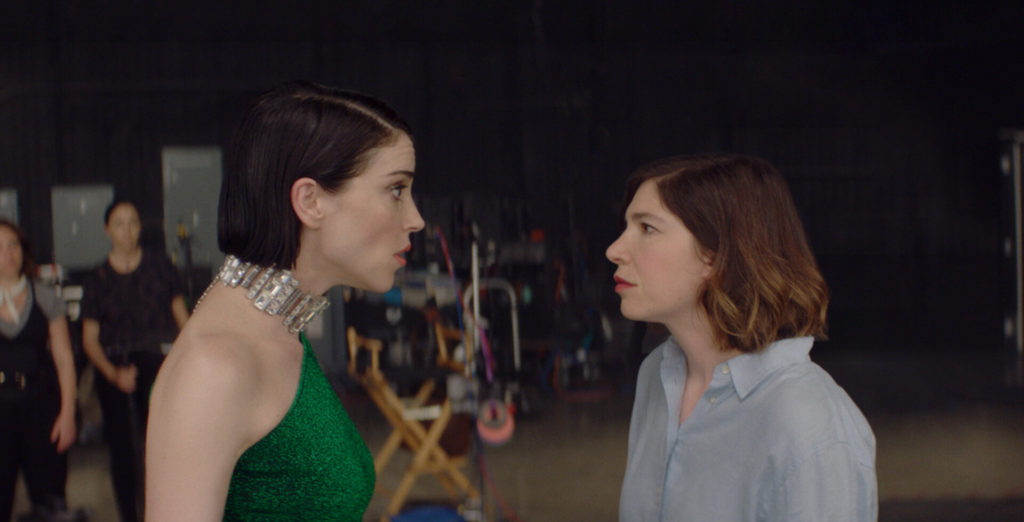
Photo caption: Annie Clark (St. Vincent) and Carrie Brownstein in THE NOWHERE INN. Courtesy of IFC Films.

The Nowhere Inn is a comedy about the making of a fictional showbiz documentary.   Carrie Brownstein (Portlandia) plays herself directing a documentary about her real life friend, the avant-garde musician Annie Clark, who performs as St. Vincent.  (Bill Benz is the actual director of The Nowhere Inn.)

Now here’s the best part of The Nowhere Inn.  We see snippets of St. Vincent’s dazzling performances.  And, even when off stage, the camera loves Annie Clark and her magnetism

In The Nowhere Inn, Annie Clark sees herself, when not “on” as St. Vincent,  as an introvert who gets pleasure from mundane pursuits like eating radishes. That creates tension with Brownstein, who needs more interesting back stage content for the doc.  The two get increasingly annoyed with each other until Brownstein ambushes Clark with a situation that is too emotionally raw. 

This is witty and all mildly amusing. And then The Nowhere Inn gets sillier, as Clark and a famous sexpot actress show up in black lingerie (the actress deadpans “Annie turned me gay”) and force Brownstein to film their amorous play.  Then there’s a Texas segment which looks like a late night comedy sketch shoehorned in – which it is.

These are two smart and talented women, and the movie is maybe half as funny as they are.  If you need a dose of St. Vincent’s sexy vibrancy, then watch her perform instead.

Under the radar at the Nashville Film Festival

POSER. Courtesy of Nashville Film Festival.

The Nashville Film Festival, opening today, has its share of high-profile movies (notably Spencer), but don’t miss the gems that are screening under the radar. Here are my picks, including the festival’s Must See film, Poser. These movies are why we go to film festivals.

POSER. Courtesy of Nashville Film Festival.

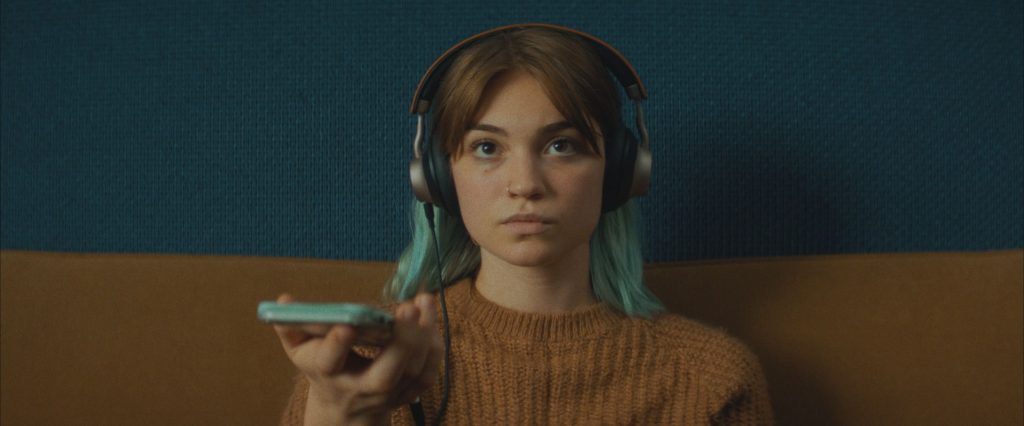
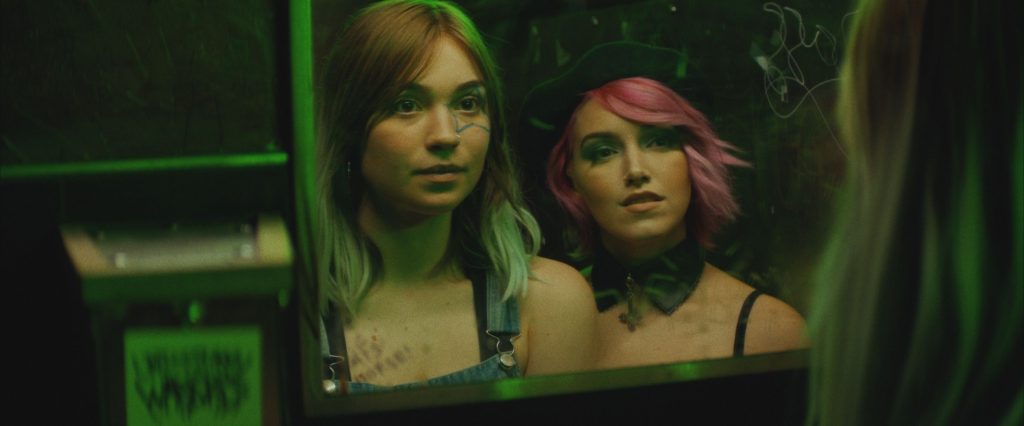
Poser: This deeply psychological portrait of an artistic wannabe among real artists is the Must See at this year’s Nashville Film Festival. Lennon (Sylvie Mix) reveres the underground music scene of Columbus, Ohio’s Old North (which she compares to Renaissance Florence). Her entrée is a podcast, which allows her to meet a panoply of local artists, including Bobbi Kitten, the charismatic front woman of the real life band Damn the Witch Siren. At first, we chuckle and cringe at Lennon, until it becomes apparent that a much darker personal plagiarism is afoot and Poser evolves into a thriller. A shot of the recording of a train’s sounds is indelibly chilling. Be prepared to be creeped out by Mix’s performance and to be dazzled by Bobbi Kitten. Poser is the first narrative feature for directors Ori Segev and Noah Dixon (Dixon wrote the screenplay), Mix, Kitten and damn near the entire cast and crew, and it’s packed with original music. Must See.

THE TALE OF KING CRAB. Courtesy of Nashville Film Festival.

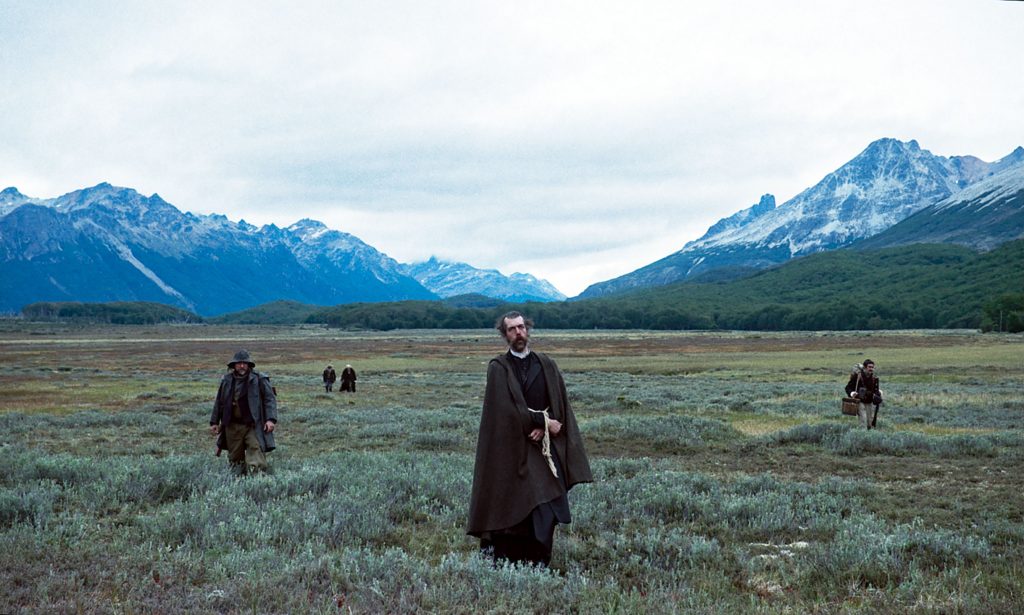
The Tale of King Crab, a story-telling masterpiece from Italy, begins with old Italian guys rehashing a legend, correcting each other on the details. That story concerns Luciano (Gabriele Silli), the town’s smartest and most interesting man – and also the local drunk. Luciano fixates on a grievance – the closing of a shortcut for shepherds. In spite of his own anti-social bent (and matted beard), Luciano he falls into a romance. The grievance, the romance and his alcoholism combine to precipitate an accidental tragedy. We next see a sober and guilt-ridden Luciano searching for buried treasure at the barren tip of South America. This is an operatic fable, exquisitely told. The Tale of King Crab is the first narrative feature for writer-directors Alessio Rigo de Righi and Matteo Zoppis and for cinematographer Simone D’Arcangelo. D’Arcangelo’s work, in vibrant Lazio and desolate Tierra del Fuego, is stunning.

FAYE. Courtesy of Nashville Film Festival.

Faye: Filmmakers Kd Amond and Sarah Zanotti have ingeniously braided horror elements into an unexpectedly funny grief movie. Faye (Zanotti) is a best-selling author who is paralyzed by grief. She holes up at her editor’s vacation house in a Louisiana bayou to get herself writing again – her own personal Overlook Hotel. So, we have a woman isolated in a swamp, and she can hear things go bump in the night and the neighbors’ chainsaws. The first thing we notice about Faye is that she is talking to someone who isn’t there – her dead husband. As we listen to Faye (ironically, a self-help author) talking herself though the stages of grief, her sanity goes on a roller coaster and Faye takes on the look and feel of a horror movie. That idea, the exquisite editing and Zanotti’s’s performance makes spending 83 minutes with a neurotic woman eminently watchable.

CLEAN SLATE. Courtesy of Nashville Film Festival.

Clean Slate: In this clear-eyed documentary, Cassidy and Josh are living in a faith-based recovery program – the kind you need to avoid incarceration. They are working to make a short film about the program. It’s stressful enough to make an indie film – finding a no-budget cast and crew, braving torrential downpours while shooting exteriors, and wrangling a roadkill armadillo. But more than a movie is at stake with these guys – they’re both hanging on to their sobriety by their fingernails. Like living with an addict, Clean Slate has its heartbreaking moments. Over 23 million Americans are living in long-term recovery from addiction. Clean Slate is the rare film that explores the connection between relapse and recovery – and it’s a cliff hanger.

Here’s how to find these nuggets:

  • The Tale of King Crab is screening in-person at Nash Fest.
  • Poser and Faye are screening in-person and streaming within the Southeastern United States (Tennessee, Alabama, Georgia, Florida, Arkansas, Louisiana, Mississippi, North Carolina, and South Carolina).
  • Clean Slate is screening in-person and streaming within the United States.

Check out the program and buy tickets at the festival’s Film Guide. Watch this space for Nashville Film Festival recommendations (both in-person and on-line) and follow me on Twitter for the latest.

WITHOUT GETTING KILLED OR CAUGHT: her soul and her heart

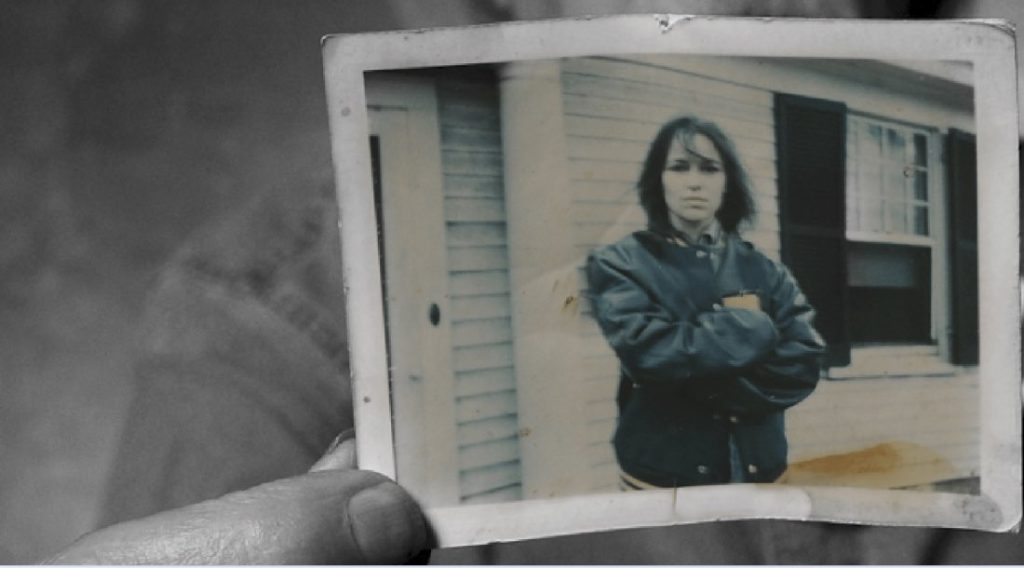
Guy Clark holds his favorite photo of Susanna Clark in WITHOUT GETTING KILLED OR CAUGHT

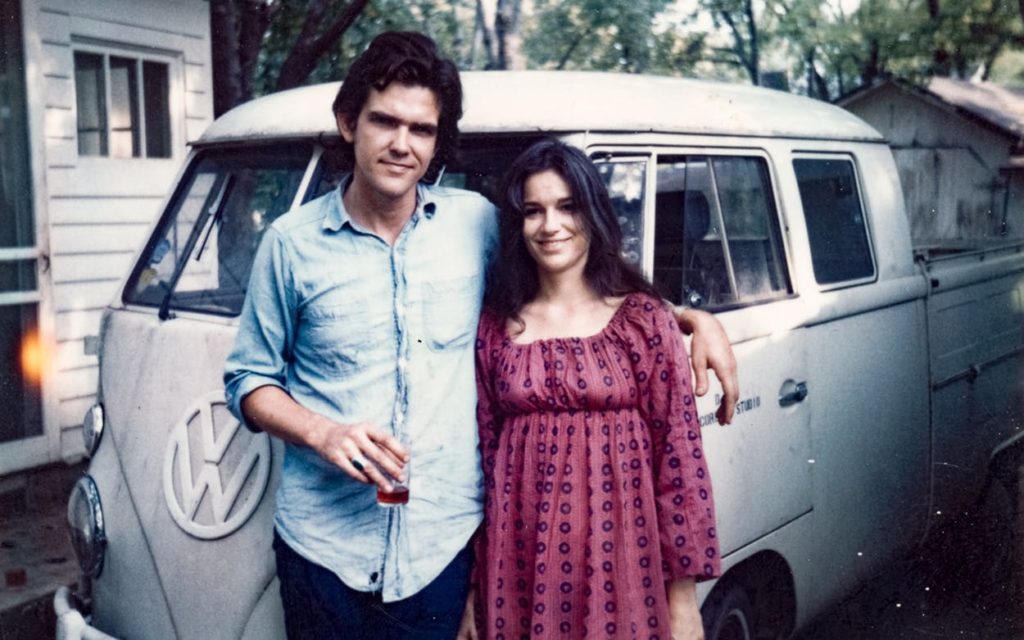
The lyrical documentary Without Getting Killed or Caught is centered on the life of seminal singer-songwriter Guy Clark, a poetic giant of Americana and folk music. That would be enough grist for a fine doc, but Without Getting Killed or Caught also focuses on Clark’s wife, Susanna Clark, a talented painter (album covers for Willie Nelson and Emmylou Harris) and songwriter herself (#1 hit I’ll Be Your San Antone Rose). What’s more, Guy’s best friend, the troubled songwriter Townes Van Zandt, and Susanna revered each other. Van Zandt periodically lived with the Clarks – that’s a lot of creativity in that house – and a lots of strong feelings.

Susanna Clark said it thus, “one is my soul and the other is my heart.”

The three held a salon in their Nashville home, and mentored the likes of Rodney Crowell and Steve Earle. You can the flavor of the salon in the 1976 documentary Heartworn Highways (AppleTV, Vudu and YouTube). It features Townes Van Zandt’s rendition of his Waitin’ Round to Die. (Susanna was also a muse for Rodney Crowell, who, after her death, wrote the angry song Life Without Susanna.)

Documentarians Tamara Saviano and Paul Whitfield, have unearthed a great story, primarily sourced by Susanna’s diaries; Sissy Spacek voices Susanna’s words. These were artsy folks so there are plenty of exquisite photos of the subjects, too. It all adds up to a beautiful film, spinning the story of these storytellers.

Guy and Susanna Clark in WITHOUT GETTING KILLED OR CAUGHT

I loved this movie, but I’m having trouble projecting its appeal to a general audience, because I am so emotionally engaged with the subject material. I’m guessing that the unusual web of relationships and the exploration of the creative process is universal enough for any audience, even if you’re not a fanboy like me.

The title comes from Guy’s song LA Freeway, a hit for Jerry Jeff Walker:

I can just get off of this L.A. freeway

Without gettin’ killed or caught

There is plenty for us Guy Clarkophiles:

  • the back story for Desperados Waiting for a Train;
  • the identity of LA Freeway’s Skinny Dennis;
  • Guy’s final return from touring, with the declaration “let’s recap”.

There’s also the story of Guy’s ashes; the final resolution is not explicit in the movie but you can figure it out; here’s the story.

Without Getting Killed or Caught is in very limited theatrical run; I saw at the Balboa in its last Bay Area screening.

WILDLAND: giving family ties a bad name

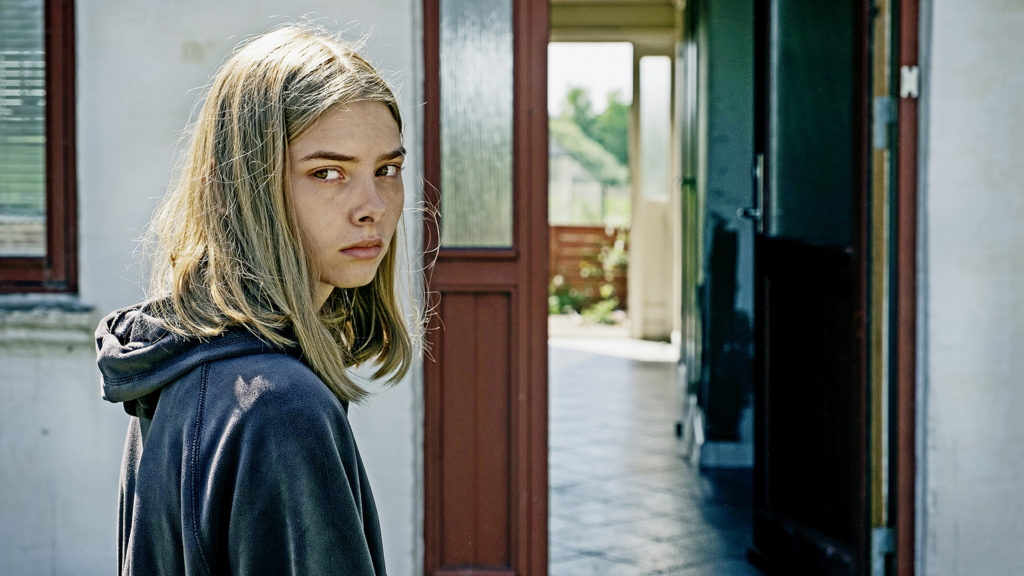
Photo caption: Sandra Guldberg Kampp in WILDLAND. Photo courtesy of BAC Films.

In the remarkable Danish neo-noir Wildland, teenage Ida (Sandra Guldberg Kampp) is orphaned and is placed with relatives that she doesn’t really know. She gradually learns that the family, headed by her mom’s estranged sister (Sidse Babett Knudsen) is a ruthless criminal enterprise.

Will Ida become entangled in a life of crime? Can she escape? Wildland simmers and evolves into a nail biter right up to its noir-stained epilogue.

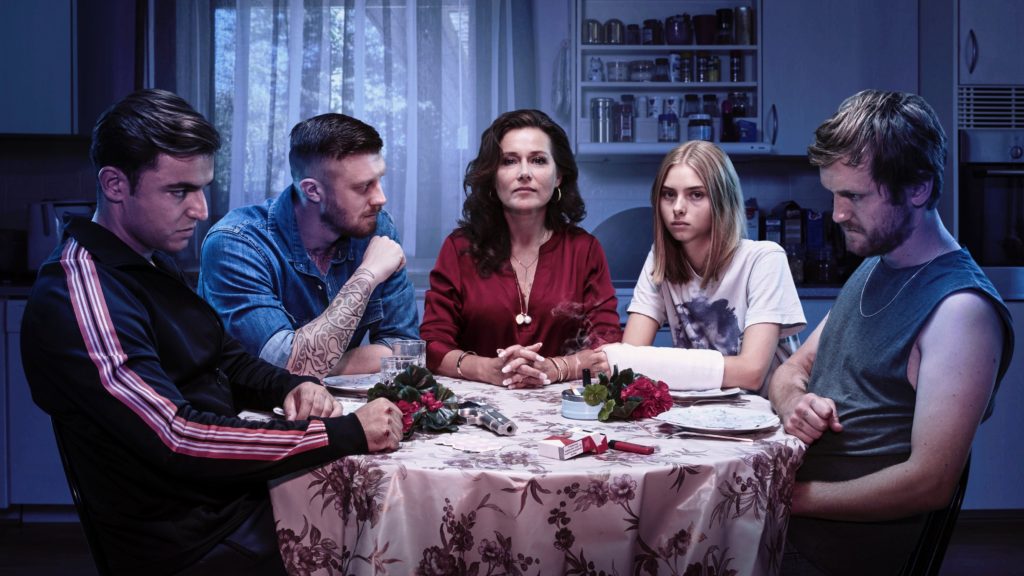
WILDLAND. Photo courtesy of Snowglobe.

Wildland is a study in both study in teen psychology (why doesn’t she report these criminals?) and in dysfunctional family dynamics. The aunt is the indisputable matriarch, and not only runs the crime crew like Tony Soprano, but also seeks to control the personal lives of her adult sons. She infantilizes them, keeps them all living on her house and expects to pick their romantic partners. Jonas (Joachim Fjelstrup), the oldest and most functional-appearing son, is always affable and seems in control – until his mother has a conflicting whim.

Sidse Babett Knudsen was Mads Mikkelsen’s co-star in Susanne Bier’s After the Wedding, which I pegged as the second-best movie of its year. Playing a prime minister, she was the lead in the political drama series Borgen, a huge, 30-episode hit in Denmark and the UK. Here, Knudson goes downscale as a trashy, middle-aged mom, still with a saucy walk; she’s always in control – until she isn’t.

Sandra Guldberg Kampp, with her watchful and ever-observant demeanor is perfect as Ida. This is a breakthrough, possibly star-making, performance.

Wildland is the first feature for director Jeanette Nordahl, who also had the idea for the story. The movie’s original Danish title Kød & Blod literally translates as Flesh and Blood.

Wildland has been compared to the Aussie neo-noir Animal Kingdom, which garnered Jacki Weaver an Oscar nod as the ever-ebullient grandma who puts out a hit on her own grandson. Animal Kingdom also featured the crime matriarch with a set of thuggish sons and lots of suspense, but it featured more action than does Wildland – fence-jumping escapes and a shooting at the finale. Wildland is more deeply psychological.

Wildland is streaming on Virtual Cinema at Laemmle.

Previewing the Nashville Film Festival

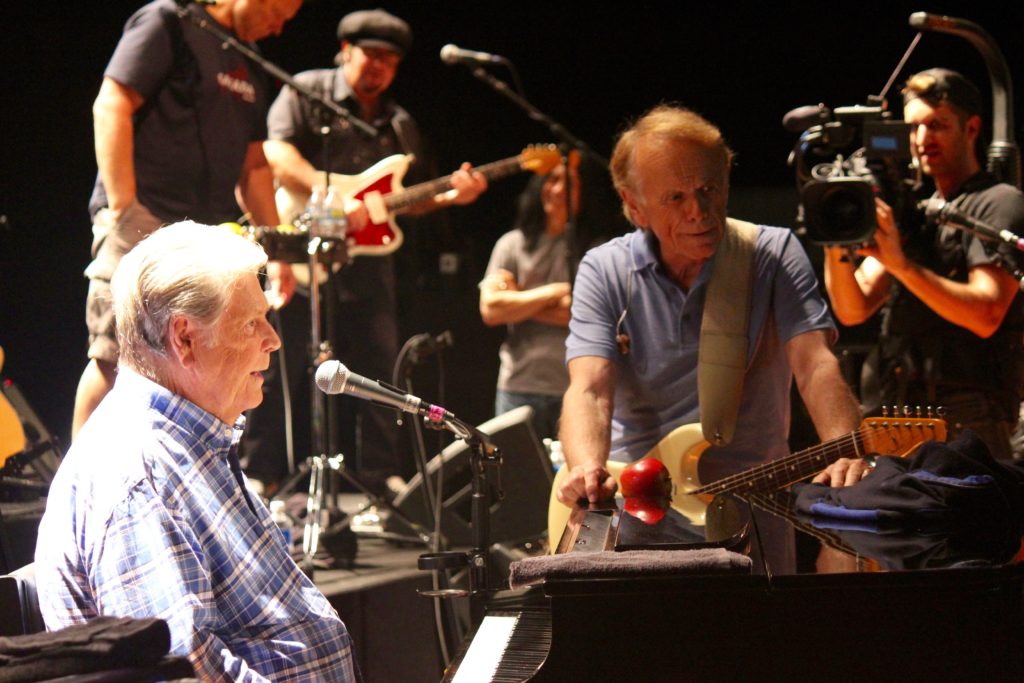
Brian Wilson in BRIAN WILSON: LONG PROMISED ROAD. Photo courtesy of Nashville Film Festival

The Nashville Film Festival opens on Thursday, September 30 and runs through October 6 with a diverse menu of cinema, available both in-person and on-line. I have already seen over a dozen films in the program, and I’m impressed so far. I’m am heading back to Nashville for my first in-person film festival coverage since March 2020.

The Nashville Film Festival is the oldest running film festival in the South and is an Academy Award qualifying festival. The program includes a mix of indies, docs and international cinema, including world and North American premieres.

This year’s fest opens strong with the in-person screening of Brian Wilson: Long Promised Road, an unusual documentary about an unusual man.  The Beach Boys’ songwriting and arranging genius weighs in on his life and work.  The extremely terse Brian Wilson would not be the ideal subject for a conventional interview documentary.  Instead, the filmmakers have Wilson’s old and trusted friend, rock journalist Jason Fine, drive him around important places in Wilson’s life; it’s the format of Comedians in Cars Drinking Coffee, and it pays off in with emotional revelations.  It turns out that Wilson is remarkably open about his travails and his creative process – and we get to see which of his songs that Brian himself listens to when he is feeling grief or nostalgia.   

The fest closes with The Humans, Stephen Karam’s film version of his Tony Award-winning play. It’s a family drama with Steven Yuen, Beanie Feldstein, Richard Jenkins, Amy Shumer and June Squibb. I haven’t seen it, but it got promising buzz at Toronto and is slated for a theatrical release by A24.

Lauren Ponto, Nashville Film Festival’s Director of Programming, says, “The 2021 Nashville Film Festival will be a different experience than our audiences are historically accustomed to and our team is excited for the community to be a part of it. The reimagined 52nd Festival will include 150 films ranging in categories from narratives, documentaries, new twists on horror, US Indies, eclectically bold Music Documentaries and much more.

Ponto continues, “It’s been invigorating to program the Festival this year, knowing that we will be able to showcase a select group of films in person. The content is stronger than ever and very intentional.

The Nashville Film Festival embraces its home in Music City and emphasizes films about music. Besides Brian Wilson: Long Promised Road, the program includes

  • Fanny: The Right to Rock documents the first all-female rock band to get signed by a major record label and churn out five albums. Fifty years ago, the band Fanny was breaking ground for women musicians – and for lesbians and Filipinas. These women can still really rock in their 70s, and they’re a hoot.
  • Poser (my favorite film in the festival) is set in the underground music scene of Columbus, Ohio’s Old North and is packed with original music. It’s a dark psychological portrait of an artistic wannabe among real artists.
  • Fable of a Song (a film that I haven’t seen yet) is a documentary about the writing of a song; this film was originally intended to document the creative process, but real life intervenes both to stagger the artists and to impact the very meaning of the song’s lyrics.
  • Hard Luck Love Song (another film that I haven’t seen yet) is a portrait of a troubled, self-sabotaging musician. Inspired by singer-songwriter Todd Snider’s song Just Like Old Times.

See it here first: Old Henry, Hard Luck Love Song, Luzzu, Beta Test, Flee, The Humans, Clara Sola, The Tale of King Crab and Poser have all secured distribution and will be available to theater and/or watch-at-home audiences. Before just anybody can watch them, you can get your personal preview at the Nashville Film Festival.

Check out the program and buy tickets at the festival’s Film Guide. Watch this space for Nashville Film Festival recommendations (both in-person and on-line) and follow me on Twitter for the latest.

Sylvie Mix and Bobbi Kitchen in POSER. Photo courtesy of Nashville Film Festival.