War Horse is a sweeping epic that traces the journey of an especially spirited horse and its series of owners before and during World War I. It’s not a critical spoiler to let you know that the horse survives, although its various handlers are all savaged by war.
It’s a movie that we could have seen in the 1950s – but a very, very good 1950s movie. The story is sentimental, but neither simple nor dully plotted. The movie is beautifully composed and shot, and many scenes recall John Ford’s use of landscapes and action. The silhouettes and sky in the final shot are lit as in the similar climax of Gone With the Wind.
War Horse is also one of the better movies about World War I, of which the central fact was its massive, brutally stupid waste of lives on a thereto unimagined scale. Along the way we see clear and accurate depictions of trench warfare, No Man’s Land, foraging, and the relative utility of cavalry, infantry, artillery, machine guns, and tanks. Spielberg doesn’t distract us from the overall horror with unnecessary gore.
Meryl Streep is the finest actress of our lifetimes, a fact reemphasized by her performance in The Iron Lady. Streep plays two Margaret Thatchers. In flashbacks, she plays Thatcher in her prime – seizing power and wielding it with complete confidence and absolutely without a nano whit of mercy. She also plays today’s elderly Thatcher, doddering on the verge of dementia. Streep is magnificent, which might be enough reason to see the movie.
It’s also always a pleasure to watch Jim Broadbent, and he teams with Streep as Thatcher’s hubbie. Alexandra Roach plays a third and younger Thatcher – forming herself in her early twenties. The fine actor Nicholas Farrell is also quite good as one of Thatcher’s mentors.
My problem is with the story. Now I’m no expert on Thatcher, although I have loathed her from afar for decades. To me, the most interesting aspect of Thatcher was her certitude – the absolutely deep and profound belief that she was always right and the will to impose her direction on everyone else. When her actions were creating widespread pain and she was hated (really, really hated) by a large percentage of her own people, why did she not doubt herself for a moment? The Iron Lady explains her conservatism as coming from her father, but leaves her certitude unexamined.
Instead, The Iron Lady‘s screenplay chooses to focus on her feminism, battling to make her way in an arena filled with men especially eager not to relinquish any power to her. (Her feminism seems to be entirely in practice, not theory, as she battles for HER due, but not to make the way easier for other women, whom she probably expects to pull themselves up by their own pumps.)
A lot of screen time is also devoted to her aged decline, which gives good fodder to Streep, but is not very important to understanding her career.
On the other hand, The Iron Lady does depict the very personal impact of the IRA’s campaign against her, with an assassination attempt and the killing of a close colleague. It also gives us an unsparing look at her bullying of friends and allies, which, of course, does not encourage loyalty. And there are telling glimpses into her family life, especially her longtime marriage.
But on the whole, The Iron Lady is long on Streep and short on understanding what made Margaret Thatcher the pivotal political leader that she was.
Martin Scorsese’s Hugo is both a delight and a lessons in the possibilities of 3D in the hands of a master filmmaker. The story follows a young orphan living in the bowels of a 1920s Paris train station who strives to survive by his wits, keep his independence and solve the puzzle of an discarded automaton.
Scorsese’s use of 3D is revelatory. We feel entirely transported to WITHIN the worlds of the station, of its industrial inner workings and Paris itself. When the orphan walks into a bookstore, we are immersed ourselves in the many stacks of books. Scorsese’s 3D always works to advance the story, not to distract us with assaultive gimmicks.
As an extra treat for movie lovers, the very story becomes one of movie making, film as art and film preservation. We see the early movie magic of George Melies, especially his 1902 A Trip the Moon. We also see Lumiere’s 1896 The Arrival of a Train, and the main characters even sneak into Harold Lloyd’s 1923 Safety Last.
Sacha Baron Cohen is very, very funny as the boy’s foil, the bitter and preening station policeman. The cast is very good, with the most pleasing turns by Emily Mortimer, Helen McCrory and Richard Griffiths.
Last August, three men were released from prison in Arkansas – one of them from death row. This wouldn’t have happened without two HBO documentaries, the 1996 Paradise Lost: The Child Murders at Robin Hood Hills and its 2000 sequel Paradise Lost 2: Revelations. Every night this week, HBO is airing its third documentary Paradise Lost 3: Purgatory, which wraps up the series. You don’t need to have watched the first two to get the full impact of Paradise Lost 3.
The men had served over eighteen years each for a horrific crime that they apparently had nothing to do with. Three second grade Cub Scouts were brutally raped, murdered and their bodies mutilated. The authorities, under understandable pressure to solve the crime, arrested three Metallica-loving teenagers and railroaded them for a supposed Satanic ritual killing. Although no physical evidence tied them to the crime, one teen with an IQ of 76 was browbeaten for twelve hours into a confession that he later recanted.
The HBO films spawned media interest and public and celebrity support for the convicted men, who became known as the West Memphis Three.
Recently processed DNA evidence was inconsistent with any of the defendants. Facing the specter of a futile new trial, the prosecutor accepted a plea bargain that freed the men without their having to acknowledge guilt. Interestingly, the father of one of the victims has gone from the villain of the second HBO film to a supporter of the recently freed men. Here’s the New York Times coverage of the August 2011 developments.
Paradise Lost 3: Purgatory is on the short list for the Best Documentary Oscar this year.
Tinker Tailor Soldier Spy is the new film version of the classic John le Carre spy novel. The British have learned that the Soviets have planted a mole – their own double agent – near the very top of British secret intelligence service. Only the old spymaster George Smiley, having been forced out to pasture, is beyond suspicion. Only Smiley has the intellectual brilliance, institutional knowledge and ruthless doggedness needed to ferret out the traitor. Gary Oldman plays George Smiley.
It’s a great tale, and the movie is good. Oldman is joined by an impressive cast, inlcuding Colin Firth Tom Hardy, John Hurt, Mark Strong, Ciaran Hinds, Benedict Cumberbatch and Toby Jones. Tom Hardy and Mark Strong are especially good.
I would be more enthusiastic about this film, but I harken back to the 1979 television miniseries version of the same book, starring Alec Guinness in perhaps his best role. That miniseries had even better performance by Guinness, of course, and Ian Richardson, Sian Phillips and Patrick Stewart. It’s available on DVD, and I recommend that you rent it.
Here’s a belated comment on The Ides of March, released earlier this fall. George Clooney directed, co-wrote and stars in this contemporary political drama. It’s an engrossing story about ambition, loyalty and betrayal. The story revolves around an up-and-coming political consultant (Ryan Gosling). He is working under a veteran campaign manager (Philip Seymour Hoffman) in a Democratic Presidential primary. He is wooed by the campaign manager (Paul Giamatti) for the opposing candidate, and the intrigue begins.
Two performances stand out. Philip Seymour Hoffman perfectly captures the old school politico, now jaded, but able to access the idealism that first drove him into politics. Ryan Gosling can soar in any kind of role. Here he is smart, but is he smart enough? He is well-intentioned, but can it overcome his ambition? Gosling keeps us on the edge of our seats as he navigates a snake pit of betrayals.
The rest of the cast is good, too: Giamatti, Evan Rachel Wood as an ambitious intern and Marisa Tomei as a hard-nosed reporter.
It’s a movie that MOSTLY gets the politics right. The fundamental truth of the movie is that an utterly cynical veteran politico can still fall in love with candidate, as Hoffman’s campaign manager does with Clooney’s candidate.
In another dead on accurate touch, Hoffman and Gosling need a room to privately pass on some bad news to Clooney. Instead of finding a cramped office, the three men sit on folding chairs knee-to-knee in a room that could accommodate 200. That stuff really happens.
Unfortunately, Ides gets some things wrong. Would never happen: A veteran strategist like Hoffman would never be surprised by the possibility of “mischief voting” in an open primary. Real life campaign consultants would never discuss policy positions with a candidate in a room full of thirty 20-somethings, all itching to leak what they know. And no veteran politico worth his salt would tell a reporter about a deal that is not done.
The Artist is a magical romance that writer-director Michel Hazanavicius gives us through the highly original choice of an almost silent film. Set in Hollywood from 1927 through 1929, it is the story of a silent film star who is left behind by the startlingly immediate transition to talking pictures.
The French actor Jean Dujardin won Cannes’ best actor award as the silent star, a charismatic and ever-playful guy whose career is trapped by the shackles of his own vanity. While on top, he treats an ambitious movie extra (Berenice Bejo) with kindness; she remembers when she becomes a star of the talkies.
Dujardin’s star, whose films resemble those of Douglas Fairbanks, Sr., is a joker with a knack for the grand gesture. He also has an adorable Jack Russell terrier that serves as his companion and co-star.
Hazanavicius is so skillful that audiences that have never seen a silent film soon become enraptured by the story and invested in the fates of the characters. It’s a visually and emotionally satisfying film.
John Goodman and James Cromwell are excellent in supporting roles.
(BTW, in real life, Berenice Bejo has two children with Michel Hazanavicius.)
In director Alexander Payne’s first film since Sideways, George Clooney seeks to care for his daughters in Hawaii after his wife is hospitalized, but then learns that she has been cheating on him. That news sends him on a quest that he defines along the way. To complicate things, his daughters are cooperative to various degrees. The heat is turned up even higher by a potential land deal that could make Clooney and his many entitled slacker cousins wildly rich, but the deal’s deadline looms and he is pressured by his VERY interested relations.
The situation is promising enough, but Payne takes the story in unanticipated directions. And, as you would expect from Sideways, there are many funny moments in The Descendants.
Clooney’s performance is brilliant. Here, he does not play The Coolest Man on the Planet. Instead, Clooney is a grinding workaholic who is so clueless about his kids that he doesn’t realize how clueless he is. He is stunned by news of the affair that he never suspected. Perhaps for the first time in his life, he must work through his situation figuring it out as he goes along.
Shailene Woodley’s performance as the older daughter is even more essential to the success of The Descendants. It’s not just that she perfectly plays a bratty teenager, but that we can see that some of her brattiness is hormonal and some of it is entirely voluntary and manipulative. Woodley had to convincingly play a character who is at times self-centered and shallow, but who can rally and reach within herself to serve as the family glue and support her dad and little sister.
The Descendants approaches being a perfect movie but for two things: 1) the daughter’s stoner boyfriend is just too oblivious to be credible among the other colorful yet completely authentic characters; and 2) the audience can never believe that there’s any chance that George Clooney is going to allow bulldozers on thousands of pristine Hawaiian acres. Still, almost perfect is pretty good.
Drive is a movie that you haven’t seen before – a stylishly violent noir tale unfolding on a brilliantly filmed canvas.
Ryan Gosling stars as a stunt driver by day, criminal getaway driver by night. He hardly talks and doesn’t emote. Indeed, his character is listed in the credits as “Driver” and sometimes referred to in the dialogue as “The Kid”. He is motivated only by his pursuit of adrenaline rushes and the opportunity to do something good for a vulnerable mom (Carey Mulligan). Indeed, Gosling is superb.
But the real star of Drive is its Danish writer-director, Nicolas Winding Refn. The film has a noir plot but Refn eschews the shadowy black and white of traditional noir for especially vivid scenes of Los Angeles. For example, early in the film, Gosling enters a convenience store and the screen is filled with the garish colors of junk food packaging. It’s one of the most artfully lit and photographed scenes in the last year.
Drive abounds in nice touches. While being hunted by the cops, Gosling’s driver is listening to both the police scanner and a radio broadcast of the Lakers game; unexpectedly, it turns out that there is an essential reason that he’s listening to the Lakers.
This movie contains some extreme violence – violence that is intentionally extreme for its effect.
The cast is excellent, with especially memorable turns by Albert Brooks, Bryan Cranston (Breaking Bad) and Oscar Isaac.
(I admired Refn’s 2008 Bronson, the story of a Britain’s “most dangerous convict” who parlayed a seven-year sentence into 34 years (30 of them in solitary) by repeatedly taking hostages and beating up the SWAT teams that rescue them. Roger Ebert called Bronson “92 minutes of rage”.)
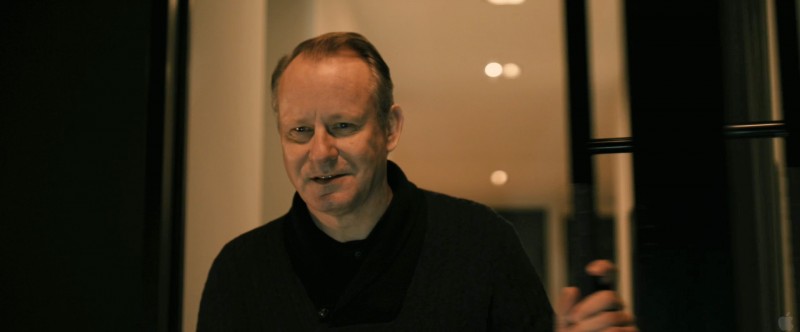
Stellan Skarsgard in THE GIRL WITH THE DRAGON TATTOO
Again – this post contains spoilers.
I liked both versions of The Girl with the Dragon Tattoo – the 2010 Swedish and the 2011 American. Both made my top ten lists at the end of the year. Still, they are distinctly different movies.
The best thing about the Swedish movie was Noomi Rapace’s full throttle performance as Lisbeth. Rooney Mara’s Lisbeth is different, but just as good. Rapace modulated her performance between sheer rage and full-out fury, and her signature was the always whirring motor. Mara’s Lisbeth has a more stone-faced affect until the moments that she explodes into a cyclone of wrath.
The rest of the performances are far superior in the American version. Daniel Craig is a much better Blomkvist; Craig has already played James Bond, so he is liberated here to play Blomkvist as a weary and defeated hang-dog whose confidence has been completely deflated. The other key characters are brilliantly played by Stellan Skarsgard, Stephen Berkoff, Robin Wright and Christopher Plummer.
In both versions, Lisbeth goes to her guardian’s house, puts down her bag and is victimized. In the Swedish version, he see her stumble home completely traumatized, wash herself and then watch the video of her own rape – OMG! She taped it! And she has it all on digital! This discovery is a huge moment in the film (for those of us who hadn’t read the book). But in the American version, when she puts down the bag, anyone who has seen a spy movie can tell that she’s got a camera in the bag, which takes the surprise effect away when she later plays the tape of her rape.
In the American version, some characters in the Vanger family are compressed. That’s fine with me. There are really only so many nasty blondes you can tell apart.
In the book (I understand) and the Swedish movie, Lisbeth ties Gottfried and Martin to the murders by plowing through the travel receipts in company’s archived expense accounts. In the American version, Lisbeth is looking through archived records when she (and we) see news photos of Gottfried and Martin near the scenes of the crimes. I prefer the non-dumbed down Swedish version.
The Swedish movie contains flashbacks that we learn depict 12-year-old Lisbeth burning her own father for his abuse of her mother. This device worked very well to explain Lisbeth’s constant state of fury. In the American film, this fact is described in dialogue and not shown. It’s usually better to show and not tell, and it is here, too. I prefer the approach of the Swedish film.
The American version’s opening credits depict a nightmarish montage of oiled human forms, all to a ripping version of Led Zeppelin’s Immigrant Song. I didn’t like the montage, which does not kickstart the story and just looks the opening sequence to a TV drama series. I do like the version of Immigrant Song, which I wrote about here. In fact, I liked all the music in the American version, by Nine Inch Nails founder Trent Reznor.
Apparently, Scandinavian audiences don’t need filmmakers to tell them that they live in a cold clime. But Fincher makes the unrelenting cold into a character itself, a touch that I liked very much.
On the whole, both movies are very good. After the first Dragon Tattoo, there was a change in directors for the Swedish trilogy, so I expect that Fincher’s take on the second and third movies to be far superior to the plodding Swedish versions.