
Cinequest – Four Lovers: those French sure are open-minded

Today and tomorrow, I’m catching up by commenting on two films from last week’s Cinequest 22.

In the thoughtful French film Four Lovers, two happily married couples hit it off socially.  They quickly decide that it’s okay to have sex with each others’ spouses.  It’s not “spouse swapping”.  It’s an arrangement whereby both couples continue to live as couples, but each adds a permitted fling with one of the other couple.

Plenty of explicit sex follows, but this is not primarily an erotic film.  Instead it explores what follows from this arrangement.  What rules need to be agreed upon? Is there jealousy and/or insecurity?  Will anyone go past the fling to fall in love with the new partner? Can one be in love with more than one lover?  Can they keep this from their kids?  How deeply do they need their new lovers?  How will this affect the original marriages?

It’s all complicated.  In fact, I think that watching this movie would be far superior than trying this out in real life.

Spoiler Alert:  After the arrangement ends, the couples return to their original married lives.  Something is missing in their lives, but it’s not the sexual thrill of the affairs.  Instead each grieves the loss of a lover.  Given this loss, all four are unhappy for the first time in the film and perhaps wishing that it had never happened.

Cinequest – Detachment: nightmare for teachers

Detachment is a gripping drama about the failure of American public schools from the teachers’ point of view.   Adrien Brody plays a long-term sub on a 60-day assignment at a high school that has burned out virtually every other teacher.  I can’t use the words  “grim” or “bleak” to describe this school environment – it’s downright hellish.    It’s making their very souls decay.

The students are rebellious and disrespectful, and somehow manage to be zealously apathetic.  No parents support the teachers, but some enthusiastically abuse and undermine them.  Administrators demand better test results but offer little support beyond “flavor of the month” educational fads.   The ills of the high school in Detachment are exaggerated – this is not a documentary – but there isn’t an urban public high school in American that hasn’t endured some elements of Detachment.

Brody won an Oscar for 2002’s The Pianist, and, in Detachment, he makes the most of his best role since.  Brody plays a haunted and damaged man with strong core beliefs, who, faced with a menu of almost hopeless choices, picks his battles.

Detachment’s cast is unusually deep, and the performances are outstanding.   James Caan is particularly outstanding as the veteran educator whose wicked sense of humor can still disarm the most obnoxiously insolent teen.  Christina Hendricks (Mad Men) is excellent as the young teacher hanging on to some idealism.  Blythe Danner and William Petersen (CSI) are the veterans who have seen it all.  Lucy Liu plays the educator who is clinging by her fingerprints, trying not to flame out like the basket case played by Tim Blake Nelson.  Marcia Gay Harden and Isiah Whitlock Jr. (Cedar Rapids) are dueling administrators.  Sami Gayle and Betty Kaye are superb as two troubled kids.  Louis Zorich delivers a fine performance as Brody’s failing grandfather.  There’s just not an ordinary performance in the movie.

For all its despair, Detachment doesn’t let the audience sink into a malaise.  Director Tony Kaye (American History X) keeps thing moving, and his choices in structure and pacing work well.  This is an intense film with a dark viewpoint.  It is also a very ambitious, thoughtful and originally crafted movie – one well worth seeing.

DVD of the Week: Waking Ned Devine

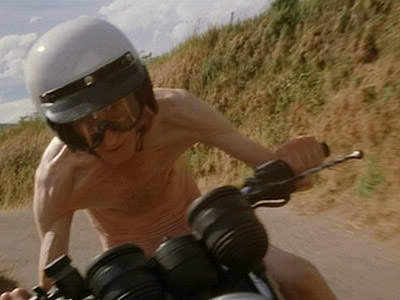
David Kelly's unforgettable naked motor scooter ride in WAKING NED DEVINE

For St. Patrick’s week, I recommend the 1998 comedy Waking Ned Devine in memory of one of it stars, David Kelly, who died last month.  Kelly and the late Ian Bannen play two mischievous geezers who learn that someone in their tiny Irish village has won the national lottery, and they connive to share the wealth.  It’s very Irish and very funny.

Coming up on TV: She Freak

She's lookin' for trouble and she's gonna find it

Turner Classic Movies is airing a real guilty pleasure of mine on March 16:  She Freak from 1967.  A nasty and manipulative skank mistreats all the slimeballs in a carnival until they disfigure her and she becomes the unwilling monster star of the sideshow.  It’s fun to mock the lame-o acting, the dim dialogue and the low, low, low budget.

It’s also a time capsule – with real 1967 carnival crowds in Bakersfield, Sacramento and Los Angeles.   You may recognize the diner-in-the-middle-of-nowhere because it was filmed at Piru, California (look it up on a map), where at least 50 movies have been filmed.

Look for Bill McKinney  (famed for the infamous “Squeal like a pig” scene in Deliverance) as Steve St. John.

Cinequest – Let the Bullets Fly: can 1.3 billion Chinese be wrong?

Ever seen a movie where the outlaw rides into town and sticks up for the little guys against the local bully of a crime boss?  Well, maybe so, but you probably haven’t seen a movie like Let the Bullets Fly (Rang Zidan Fei), which is set in southeastern China in the Chinese warlord period around 1919.

For one thing, it’s an unusually exuberant film that’s extremely funny for an action western.

For another, it’s a deeply cynical assessment of government corruption.  It quickly becomes apparent that the professional bandit is more honest and reliable than any of the local institutions.  (That subtext is not lost on the Chinese public.)

And the Chinese movie fans have embraced Let the Bullets Fly.  It’s the highest-grossing Chinese language movie ever, and is the all-time #2 most popular movie in China (behind Avatar).

Writer-director Wen Jiang plays the stalwart bandit hero who substitutes himself for the newly arriving appointed Governor (played by You Ge as a hilariously unabashed sleazeball).  Jiang’s bandit comes up against the local baddie (Chow Yun Fat), who doesn’t want to relinquish any of his power or ill-gotten gains.  As the two match wits, a fast, funny and utterly rambunctious ride ensues.

In this case, 1.3 billion Chinese are correct – this is one fun movie.

Coming up on TV: The Stunt Man

On March 11, Turner Classic Movies is showing The Stunt Man (1980).  It’s on a list of Overlooked Masterworks that I’m working on.

Steve Railsback plays a fugitive chased on to a movie location shoot.  The director (Peter O’Toole) hides him out on the set as long as he works as a stunt double in increasingly hazardous stunts.  The man on the run is attracted to the leading lady (Barbara Hershey).  It doesn’t take long for him to doubt the director’s good will and to learn that not everything is as it seems.  Shot on location at San Diego’s famed Hotel Del Coronado. Listen to Director Robert Rush describe his movie in this clip.

Cinequest – Percival’s Big Night: screwball comedy for hipsters

Imagine if Howard Hawks were making a screwball comedy today –  a guy and a girl spar with snappy patter, survive the crazed antics of their goofy friends and fall in love.   If he set the movie in the shambles of a hipster pot dealer’s NYC apartment, you’d have Percival’s Big Night, one of the gems of Cinequest 22.

You’ll recognize the set-up:  Two 24-year-old underachievers have so far made the least of their BFAs.  Percy is infatuated with Chloe, and needs his roommate Sal to introduce her to him.  Chloe arrives with her friend Riku, who is appropriately crazy enough to match up with Sal.   The guys and girls bicker and banter, eavesdrop on each other and pair into couples.

What’s so refreshingly welcome about Percival’s Big Night is how well all of this is executed, due to the frantically paced dialogue from writer-director Jarret Kerr, who also stars as Sal.  It’s briskly paced by director Will Sullivan and very, very funny.

The cast has performed Percival’s Big Night as an off-Broadway play.  They were able to shoot the movie in six 15-minute captures that are blended together to look like one shot.  Because of the madcap pace, the audience isn’t distracted by the single shot; instead, the technique intensifies the story compressed into the small apartment.

Percival’s Big Night is enough of crowd-pleaser to deserve theatrical release; in any case, hopefully, it will be available soon on cable TV, DVD, streaming or some other outlet.

The Forgiveness of Blood: modern teens trapped by ancient idiocy

The new film by Joshua Marston, writer-director of the brilliant Maria, Full of Grace, is about a bizarre custom that has survived in modern Albania.  When a person is killed, a blood feud begins, and the relatives of the killer cannot leave their homes until released by the family of the victim.  Families can and do spend years – even a decade – in self-imposed house arrest enforced by the wronged family upon pain of death.  This is the way of the ancient Albanian oral tradition, the Kanun.  The most bizarre aspect of the house arrest is that it still exists in an otherwise modern world, among people using cell phones and text messaging.

But it is a mistake to look on The Forgiveness of Blood as “the Albanian blood feud movie” because Marston focuses on the teenagers in the family.  What can it be like for a teen to be isolated in his house indefinitely?  Teens have no greater craving than to be with their peers.  American kids can get bored while surrounded by games, Internet access and 400 TV channels.  You can imagine sitting in rural Albania with four walls and Albanian TV.  Teens are also so dramatic and impulsive, the mere threat of death isn’t always enough to prevent a rash act.  And then there are the hormones…

This is the omnipresent tension in The Forgiveness of Blood – what happens when the kids just can’t stand it any longer?   The adults all accept a cultural logic, but the kids can see that this custom doesn’t make any sense.

The movie, as befits rural Albania, has a leisurely pace, but there is a throbbing tension underneath.  That ever present tension, and the look into a strange aspect of another culture, make me recommend The Forgiveness of Blood.

Here’s the teaser (which I like more) and then the trailer.


Cinequest – Salt: the best spaghetti western this year

I love spaghetti westerns and so does the protagonist of Salt (Sal), a would-be screenwriter who must have the only cat in Spain named Clint.  He has written a movie set in Chile’s Atacama Desert, the driest place on earth, but nobody else thinks it’s any good.  When he decides to visit the Atacama to improve his script, he is mistaken by all the locals for someone else – the guy who had cuckolded the local crime boss.  That first night in Chile, he is plunged into a real life shoot em up and is soon experiencing a story that Sergio Leone himself would have loved to film.

Much of the fun is in the fact that our hero has never shot a gun or been shot at, and he doesn’t take easily to either – he’s no Clint, for sure.   Salt is filmed in the style of a modern-day spaghetti western and comes with its own spaghetti western score with jangly guitar and jarring harmonica.  If you love A Fistful of Dollars, this is the movie for you.  Even if you don’t love the spaghetti western, you’ll find this a satisfyingly funny movie.

I attended the North American premiere of Salt at Cinequest 22.

Cinequest – Faust: a strikingly original slog

Mephistopheles and Faust in FAUST

Faust is Russian director Aleksander Sokurov‘s take on the famous story of a man who bargains with the devil for knowledge of the profound, with a young hottie thrown in the deal for good measure.

I saw this film primarily because I had admired Sokurov‘s Russian Ark, a 19th century period drama in which an aristocrat wanders through St. Petersburg’s Hermitage and encounters figures from earlier in Russian history.  Sokurov filmed the entire 99-minute movie in a single shot.  That’s a gimmick, but even beyond the singular achievement of the one shot, Russian Ark is a complete and effective film.

The German language Faust is also strikingly original.  Filmed in the Czech Republic, Sokurov vividly creates a grimy and economically depressed German town of the early 1800s.  The alleys, doorways and staircases are all so narrow that people are constantly jammed together. Sokurov’s Faust is not an old man, but a 40-year-old beaten down by poverty and malaise.  Similarly, his Mephistopheles is not a slick charmer, but physically gross and repellent character who is a canny manipulator.

Unfortunately, the originality is for naught, because the film fails to engage the viewer.  You watch Faust with the indifference one feels while observing someone park a car awkwardly.

Faust’s Aspect Ratio is a TV-like 1.37 : 1 (but goes wider for the final scene),  which is odd for a literary epic.  And some of the scenes are filmed through a distorted lens for some reason.  The 140 minute length just contributes to the sense of self-indulgence by Sokurov.   It’s not a pleasant way to spend 140 minutes of your life.